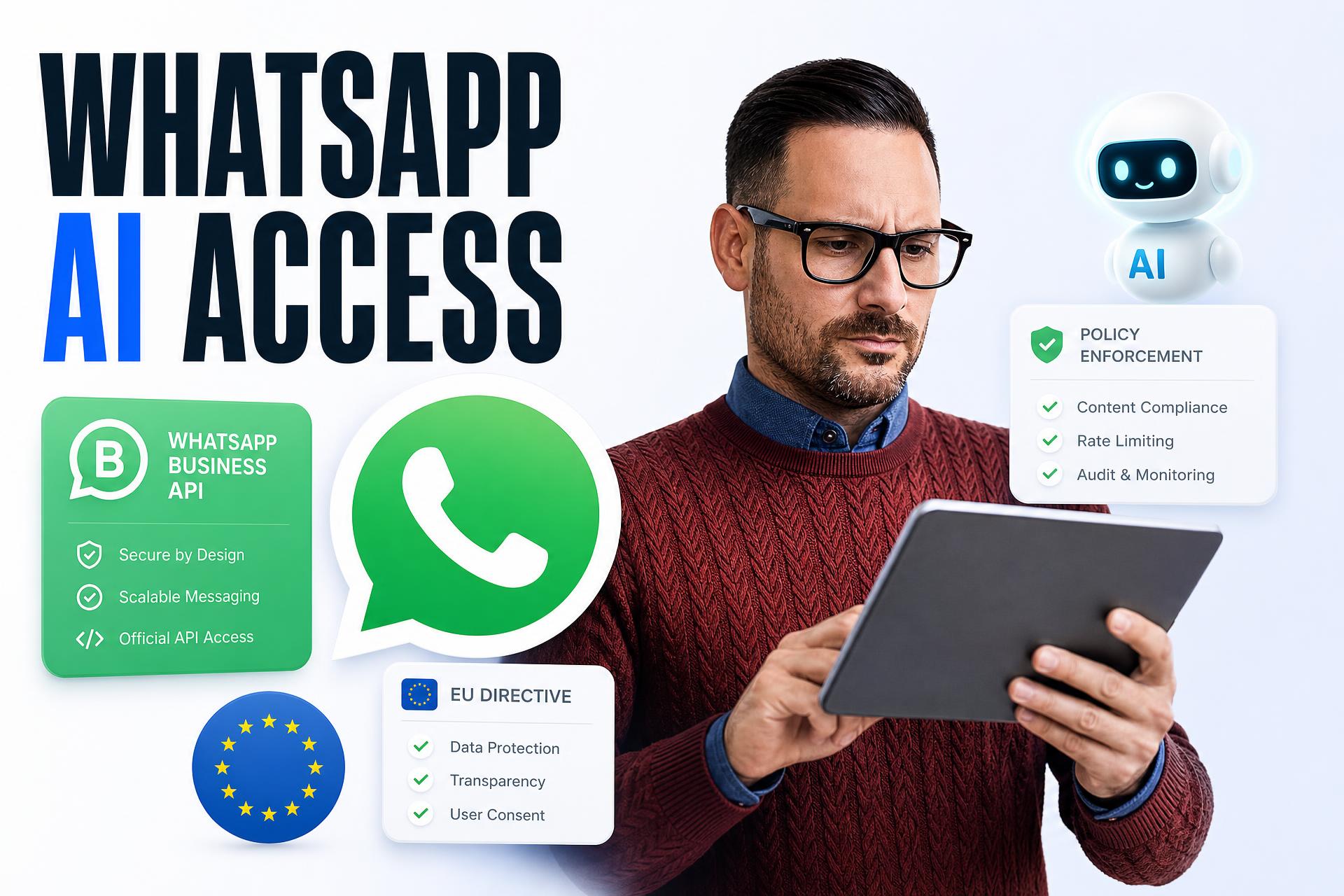
What did the EU order require Meta to change? → Meta must reverse the policy that blocks rival AI chatbots from using WhatsApp Business tools.
When will the order take effect? → The interim measures stay in place for the duration of the competition investigation.
Does the order affect pricing? → The Commission treats the earlier fee offer as equivalent to a ban, so free‑month offers do not satisfy the demand.
Will my AI assistant be able to message users on WhatsApp now? → Access is technically possible, but you must comply with the regulatory conditions that the EU enforces.
Why should a CTO care right now? → The decision reshapes the risk model for messaging‑channel strategy, turning a technical blocker into a compliance decision.
Why the EU Order Changes WhatsApp Integration Strategy
The European Commission’s antitrust decision forces Meta to expose its WhatsApp Business API to competing AI assistants, overturning a de‑facto monopoly that previously required a paid gateway or outright denial. This shift is not merely a policy tweak; it redefines the boundary between platform control and regulatory oversight, meaning that any enterprise planning a WhatsApp‑enabled chatbot must now embed compliance checks into the core architecture rather than treating the API as a static, optional component. The change arrives at a moment when conversational AI adoption is accelerating, and the messaging channel remains one of the highest‑engagement touchpoints for B2B and B2C interactions.
- Regulatory exposure — The EU order makes platform access a legal risk that must be monitored continuously.
- Vendor lock‑in reduction — Competitors can now negotiate terms directly with Meta, lowering the cost of entry.
- Compliance overhead — Enterprises must implement audit trails to prove adherence to the interim measures.
- Strategic agility — Product roadmaps can now include WhatsApp as a first‑class channel without fearing sudden bans.
- Market perception — Demonstrating openness to rival AI solutions can improve brand trust in regulated markets.
The Core Claim: Regulatory Access Trumps Technical Choice
In the wake of the EU antitrust intervention, the decisive factor for integrating AI chatbots with WhatsApp is no longer the technical feasibility of the API but the regulatory posture of Meta’s business terms. Historically, engineers evaluated the WhatsApp Business API on criteria such as latency, message templates, and webhook reliability. The Commission’s order flips that calculus: the primary gatekeeper becomes the legal framework governing access, and the technical stack must be designed to accommodate rapid policy shifts. Consequently, the right response for CTOs is to adopt a compliance‑first integration layer that can toggle between free, fee‑based, or restricted access without rebuilding core bot logic.
The practical implication is that architecture decisions—such as whether to embed the WhatsApp connector directly into the bot’s core or to abstract it behind a service mesh—must prioritize configurability and auditability. Teams that treat the connector as a replaceable microservice will find it easier to respond to future regulatory adjustments, while monolithic designs will incur costly refactoring. Moreover, the compliance layer should expose feature flags that respect the interim measures, ensuring that any prohibited interaction is automatically blocked while still allowing permissible messaging flows.
- Abstract the connector — Use a thin service layer to isolate WhatsApp calls.
- Implement policy enforcement — Embed rule engines that reference the latest EU directives.
- Maintain audit logs — Record every outbound message for regulatory review.
- Design for toggling — Feature flags enable instant switch between free and paid access.
- Plan for rollback — Ensure the system can revert to a no‑WhatsApp state if enforcement tightens.
Quick Answer: Can You Connect Your AI Bot to WhatsApp Today?
Yes, you can technically connect an AI chatbot to WhatsApp under the current EU interim measures, but you must do so through a compliance‑aware integration that respects the Commission’s requirement to reverse the restrictive policy. The API itself is available; the barrier now lies in ensuring that your usage complies with the antitrust conditions, such as avoiding fee structures that the EU deems equivalent to a ban. In practice, this means adopting a flexible integration pattern, documenting every message exchange, and preparing to adjust pricing or access models if the investigation’s final ruling changes the landscape.
- Validate compliance — Check that your usage aligns with the interim measures.
- Use the free‑month trial cautiously — Treat it as a temporary window, not a permanent solution.
- Monitor policy updates — Subscribe to Meta’s developer announcements and EU Commission releases.
- Engage legal counsel — Ensure your contract language reflects the regulatory expectations.
- Leverage platform SDKs — Adopt the latest WhatsApp Business SDKs that incorporate the new terms.
Regulatory Landscape vs. Platform Policy
The EU’s antitrust framework operates independently of Meta’s internal product roadmaps, meaning that even if Meta later revises its business terms, the Commission can enforce interim measures that supersede those changes. This separation creates a dual‑layered governance model: the platform’s own policy dictates technical access, while the regulator defines the permissible scope of that access. For engineers, this translates into a need for dual compliance checks—one against Meta’s API documentation and another against the evolving EU directives. The latter often carries heavier penalties, so it should dominate the risk assessment matrix.
Technical Architecture of WhatsApp Business API
The WhatsApp Business API is a RESTful service that requires a hosted server, TLS encryption, and webhook endpoints for inbound messages. It supports message templates, session messages, and media attachments, all of which must be approved by Meta before use. From an engineering standpoint, the API’s rate limits, message template approval workflow, and webhook reliability are the primary technical constraints. However, under the EU order, the API’s availability is now contingent on compliance with antitrust conditions, so the architecture must also incorporate a policy enforcement layer that can dynamically enable or disable specific message types based on regulatory guidance.
Key principle: Treat regulatory compliance as a first‑class service, not an after‑thought, to keep your WhatsApp integration resilient.
Compliance‑First Design for Messaging Channels
A compliance‑first design embeds policy checks at the edge of the messaging pipeline. Instead of sending every outbound message directly to WhatsApp, the system routes messages through a rule engine that evaluates each payload against the latest EU directives. This engine can be powered by a lightweight policy service, such as Open Policy Agent, which reads a declarative policy file updated whenever the Commission releases new guidance. By centralizing compliance, you avoid scattering legal checks throughout the bot codebase, reducing both technical debt and the risk of inadvertent violations.
Cost and Pricing Dynamics After the EU Intervention
Meta’s earlier offer to charge a fee for rival AI assistants was deemed by the Commission to be functionally identical to a ban, prompting the regulator to demand free access. While the fee‑free month was a temporary concession, the underlying pricing model remains uncertain. Enterprises should therefore prepare for three possible cost scenarios: (1) a fully free tier mandated by the EU, (2) a modest fee structure that complies with the antitrust ruling, or (3) a tiered pricing model that differentiates between high‑volume and low‑volume usage. Each scenario carries distinct budgeting implications, and the architecture must be able to switch cost models without disrupting service.
Rule of thumb: Design your billing integration to accept both free and paid usage paths from day one.
Risk of Future Policy Reversals
Even though the EU has imposed interim measures, the final decision of the competition probe could swing either way. Meta might be required to keep the API open permanently, or the Commission could impose stricter conditions, such as mandated data‑localisation or caps on message volume. Consequently, any long‑term product roadmap that assumes stable, unrestricted access is vulnerable. Mitigation strategies include maintaining a fallback channel (e.g., email or SMS) and modularizing the WhatsApp connector so it can be replaced or upgraded with minimal impact on the core bot logic.
Strategic insight: Build a multi‑channel messaging core that can gracefully degrade if WhatsApp access is curtailed.
How Plavno Helps Enterprises Navigate the New WhatsApp Rules
At Plavno, we specialize in turning regulatory uncertainty into a competitive advantage. Our AI‑agents development practice creates a compliance‑aware integration layer that abstracts the WhatsApp Business API behind a policy‑driven service mesh. This approach lets you launch AI chatbots on WhatsApp today while retaining the ability to toggle pricing models, enforce EU‑mandated restrictions, and generate audit‑ready logs for any future investigation. By partnering with us, you gain access to a pre‑built compliance framework, rapid onboarding of WhatsApp templates, and ongoing monitoring of regulatory updates, all of which accelerate time‑to‑market without exposing your engineering team to legal risk.
Our consulting services also include a bespoke risk‑assessment workshop that maps your existing messaging architecture against the EU antitrust criteria. We help you identify choke points, design fallback channels, and implement feature‑flag governance that aligns with both Meta’s technical specifications and the Commission’s legal expectations. The result is a resilient, future‑proof chatbot platform that can evolve as the regulatory environment does, while preserving the user experience that your customers expect. AI agents development, AI automation, cloud software development, AI voice assistant development, and software development consulting are all part of the ecosystem we leverage to keep you ahead of change.
- Compliance scaffolding — We embed policy engines that read EU directives in real time.
- Modular connectors — Our architecture isolates WhatsApp calls, making swaps painless.
- Audit‑ready logging — Every message is recorded with metadata for regulator review.
- Pricing flexibility — We provision both free and fee‑based usage paths from launch.
- Regulatory monitoring — Continuous updates ensure your integration stays within the law.
Business Impact on Revenue and Customer Experience
Opening WhatsApp to rival AI chatbots unlocks a high‑value engagement channel that can increase conversion rates, shorten sales cycles, and improve support satisfaction. For B2B SaaS firms, the ability to push personalized, AI‑driven notifications directly to a user’s preferred messaging app translates into higher upsell potential and lower churn. However, the financial upside is tempered by the need to allocate resources toward compliance engineering and ongoing legal oversight. Companies that underestimate the compliance burden risk costly retrofits, regulatory fines, or reputational damage, while those that embed compliance early can capture market share faster than competitors still navigating the policy maze.
Assess revenue uplift: Model the incremental revenue from WhatsApp‑enabled AI interactions versus current channels.
Budget compliance costs: Include engineering time for policy enforcement, audit logging, and legal review.
Plan rollout phases: Start with a pilot, measure engagement, then scale while monitoring regulatory updates.
Evaluating Integration Options in Practice
When deciding whether to build a custom WhatsApp connector or to adopt a third‑party integration platform, the primary differentiator is how each option handles regulatory change. A custom solution gives you full control over policy enforcement, but it requires dedicated resources to keep the compliance layer up to date. Third‑party platforms often provide out‑of‑the‑box compliance modules, yet they may lock you into proprietary APIs that limit flexibility if the EU mandates new constraints. The prudent approach is to prototype both paths, benchmark the effort required to update policy rules, and choose the architecture that minimizes both technical debt and compliance exposure.
In our experience, a hybrid model—where core messaging logic resides in a proprietary service and the WhatsApp gateway is delegated to a vetted integration partner—delivers the best of both worlds. The proprietary service can enforce fine‑grained policy checks, while the partner handles the heavy lifting of template approval and webhook reliability. This arrangement also simplifies the audit process, as the compliance logs are generated centrally, and the partner’s SLA guarantees adherence to Meta’s technical requirements.
- Prototype speed — Use sandbox environments to test policy enforcement quickly.
- Vendor lock‑in analysis — Evaluate the partner’s ability to adapt to EU directives.
- Operational overhead — Measure the ongoing effort to maintain compliance rules.
- Scalability — Ensure the solution can handle peak message volumes without throttling.
- Data governance — Verify that user data flows comply with GDPR and EU antitrust expectations.
Real‑World Deployment Scenarios
Consider a fintech firm that wants to deliver account alerts via WhatsApp. By implementing a compliance‑first layer, the firm can route alerts through a policy engine that blocks any message containing prohibited promotional content, thereby satisfying both Meta’s template rules and the EU’s antitrust conditions. Another scenario involves a healthcare provider using a medical‑voice‑assistant to schedule appointments; the same architecture can enforce patient‑consent checks before sending any WhatsApp message, ensuring GDPR compliance while leveraging the newly opened API.
These examples illustrate that the regulatory shift does not merely open a channel—it forces a redesign of how messaging logic, consent management, and policy enforcement interact. Organizations that treat the WhatsApp integration as a monolithic feature risk costly re‑architectures, whereas those that embed compliance as a service can iterate rapidly, launch new use cases, and stay ahead of regulatory changes.
| Integration Approach | Control Level | Compliance Risk |
|---|---|---|
| Custom In‑house API | High – full code ownership | Medium – requires dedicated compliance updates |
| Third‑party Platform | Medium – limited to provider features | Low – provider handles many regulatory updates |
| Hybrid (Plavno‑managed) | High – policy engine plus managed gateway | Low – centralized audit logs and rapid rule changes |
Limitations and Risks to Monitor
While the EU order removes the explicit fee barrier, it does not eliminate all sources of friction. First, the WhatsApp Business API still imposes strict message‑template approval processes that can delay time‑to‑market for new notification types. Second, the regulatory environment remains fluid; a future decision could reinstate pricing constraints or introduce additional data‑localisation requirements that affect where you can host the integration service. Third, reliance on a single messaging channel concentrates risk—any outage or policy change could disrupt a critical customer‑engagement pathway.
| Risk Category | Mitigation Strategy |
|---|---|
| Template approval delays | Pre‑approve templates and maintain a library of reusable messages |
| Regulatory shifts | Deploy policy‑engine updates via CI/CD pipelines |
| Single‑channel dependency | Add SMS and email fallbacks with unified messaging abstraction |
Final Takeaway for CTOs
The EU antitrust order transforms WhatsApp from a technically gated service into a regulatory‑driven channel, meaning that the decisive factor for integration is compliance architecture rather than raw API capability. CTOs must therefore prioritize a policy‑centric design, embed audit‑ready logging, and adopt a modular connector that can react instantly to future legal changes. By treating compliance as a core service, you protect your investment, accelerate time‑to‑market, and position your organization to capture the high‑engagement value that WhatsApp uniquely offers.
- Adopt a compliance‑first integration layer — make policy enforcement a service.
- Modularize the WhatsApp connector — keep it replaceable and feature‑flagged.
- Diversify communication channels — avoid single‑point‑of‑failure risks.
 Chat GPT
 Perplexity
 Claude
 Gemini