What makes a voice AI platform suitable for specialty care? → It must remember every patient interaction across channels, not just automate isolated tasks.
Why is a "patient journey memory" more important than raw speech accuracy? → Memory links context to decisions, turning a call into a continuous care experience.
How does Assort’s proprietary data give it a defensible edge? → Its 190 million patient interactions and 1.6 million decision pathways create patterns that generic LLMs lack.
What should a CTO prioritize when evaluating voice AI vendors this quarter? → Integrated memory architecture over point‑solution feature sets.
Can a platform that only automates scheduling scale to complex specialty workflows? → No – without memory the system collapses on multi‑step processes.
Quick Answer: How to Choose a Voice AI Platform for Healthcare Providers
A voice AI platform that embeds a patient‑journey memory—linking every call, triage, document, and payment to a unified patient profile—delivers the scalability and outcome improvements that specialty practices demand. In contrast, point‑solution agents that handle only one task at a time generate fragmented experiences, higher hand‑off rates, and limited ROI. Therefore, the decisive evaluation criterion is whether the vendor’s architecture natively supports continuous, cross‑channel memory, not merely speech recognition or isolated workflow automation.
Explore our AI voice assistant development services here, learn about digital transformation here.
- Memory‑first design – The platform must store interaction context (tone, language preference, pending tasks) and retrieve it for future calls.
- Specialty‑specific data – Proprietary datasets that capture clinical protocols and decision pathways are essential for nuanced triage.
- Scalable orchestration – Architecture should allow new workflows (e.g., lab requests) to plug into the existing memory without re‑engineering.
- Multi‑language support – Real‑world clinics serve diverse populations; the system must handle language switching seamlessly.
- Outcome tracking – Built‑in analytics that tie memory usage to appointment volume and staff capacity gains.
Memory‑First Architecture Beats Isolated Task Automation
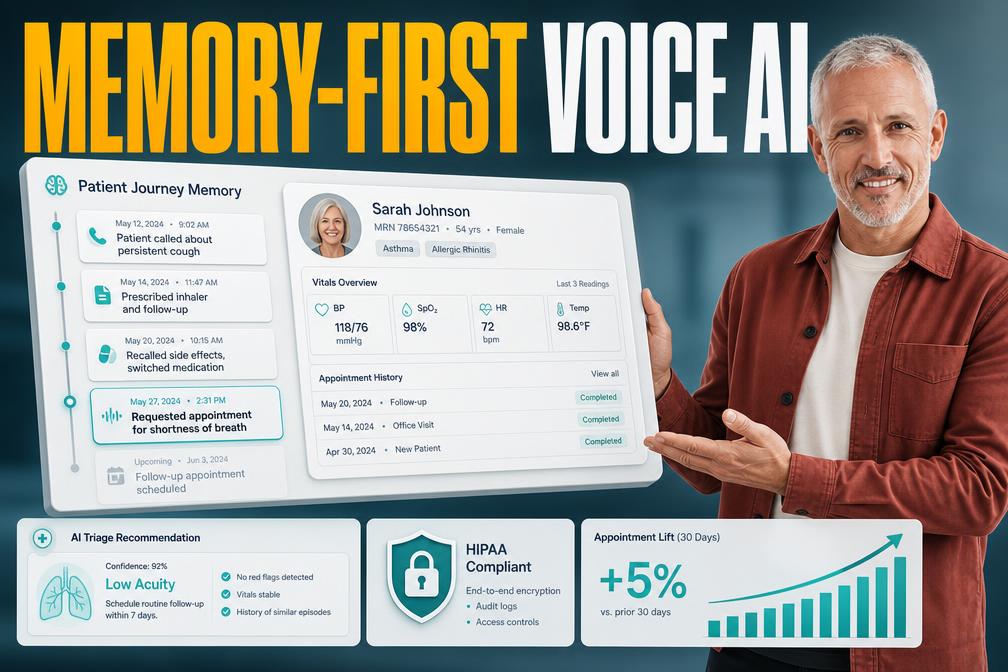
In practice, the first point of contact between a patient and a provider sets the tone for the entire care journey. Assort’s platform demonstrates that when a voice AI agent can recall prior interactions—such as a missed appointment or a pending lab request—it can proactively guide the patient, close care gaps, and reduce administrative friction. By contrast, a point‑solution that merely schedules appointments forgets the patient once the call ends, forcing staff to re‑collect information and duplicate effort. The memory‑first approach therefore unlocks higher automation rates, as evidenced by Assort’s reported 5 percent lift in appointment volume and a 115 percent increase in staff capacity.
A platform that forgets the patient after each interaction is fundamentally a broken system; memory is the glue that turns a voice assistant into a true care partner.
Why Proprietary Specialty Data Is a Competitive Moat
Assort’s claim of a 190 million‑interaction dataset, 62 000 care protocols, and 1.6 million decision pathways is not marketing fluff—it is the engine that powers its Synapse model to anticipate complex clinical scenarios. When a voice AI agent can simulate rare referral pathways or insurance eligibility edge cases, it reduces the time needed to train the model from months to weeks. This data advantage translates directly into faster rollout across specialties, a critical factor for health systems that cannot afford prolonged pilot phases.
- Depth of clinical protocols – Detailed care pathways enable the agent to triage with specialty‑level nuance.
- Volume of interactions – Hundreds of millions of calls provide statistical confidence for rare event handling.
- Decision pathway mapping – Structured pathways guide the AI in generating appropriate follow‑up actions.
- Simulation capability – Synthetic scenarios stress‑test the agent before deployment, shortening go‑live timelines.
- Continuous learning – Ongoing interactions refine the model, ensuring relevance as protocols evolve.
The Hidden Cost of Point‑Solution Sprawl
Healthcare operators that cobble together multiple single‑purpose AI tools quickly encounter integration overhead, data silos, and inconsistent patient experiences. MDCS Dermatology’s chief executive highlighted that “everyone else automates one piece and forgets the rest,” a pain point that forces staff to juggle disparate systems. The hidden cost is not just the license fee but the engineering effort required to stitch together APIs, maintain data consistency, and train staff on each new interface. By contrast, a unified platform that centralizes memory eliminates these hidden expenses and accelerates ROI.
Integration overhead – Each additional vendor adds API mapping, authentication, and monitoring layers.
Data fragmentation – Patient information is split across tools, leading to duplicate entry and errors.
Training fatigue – Front‑office staff must learn distinct workflows for each point solution.
Vendor lock‑in risk – Switching costs rise as more tools become entrenched.
Delayed insights – Aggregating metrics from multiple sources slows performance reporting.
How Memory‑First Design Impacts System Architecture
From an engineering perspective, a memory‑first voice AI platform requires a central state store that persists interaction metadata, coupled with a real‑time inference engine that can query that state during each turn. This contrasts with a stateless microservice that processes a single request and discards context. The former demands robust data pipelines, low‑latency retrieval, and strong consistency guarantees—especially when handling sensitive health data under HIPAA. However, the payoff is a seamless, personalized experience that scales across specialties without re‑architecting each new workflow.
Evaluating Platforms: Decision Logic for the CTO
When a CTO evaluates voice AI vendors this quarter, the decision matrix should prioritize architectural memory capabilities over surface‑level feature checklists. First, assess whether the platform offers a persistent patient‑journey store that can be queried in sub‑second latency. Second, verify that the vendor’s data model aligns with your existing EHR and billing systems, reducing integration friction. Third, examine the depth of specialty data—does the provider have a proprietary dataset comparable to Assort’s 190 million interactions? Finally, consider the vendor’s roadmap for expanding memory‑driven functionalities, ensuring long‑term alignment with your growth plans.
Our AI consulting services here and cloud software development expertise here can help you evaluate these criteria.
State persistence – Does the solution retain context across calls, channels, and devices?
EHR compatibility – Are standard HL7/FHIR adapters provided for seamless data exchange?
Specialty depth – Is there evidence of domain‑specific protocols and decision pathways?
Scalability guarantees – What SLA does the vendor offer for latency and throughput under peak loads?
Roadmap transparency – Does the vendor publish a timeline for new memory‑centric features?
Real‑World Impact: From Pilot to Full‑Scale Deployment
Assort’s two‑year partnership with MDCS Dermatology illustrates how a memory‑first platform can evolve from a simple appointment scheduler to a comprehensive patient‑journey orchestrator. The practice saw a 20 percent increase in bookings while maintaining a 4.9‑star rating across 30 000 reviews—a testament to the patient‑centric continuity that memory provides. Moreover, the platform’s ability to handle outbound communications, such as reminders for vaccinations and missed appointments, demonstrates how a single system can close care gaps without adding staff.
Scaling Across Multiple Specialties
When expanding from orthopaedics to cardiology, the memory layer allowed Assort to reuse the same patient profile while injecting specialty‑specific decision pathways. This avoided the need to rebuild a separate knowledge base for each department, cutting implementation time dramatically.
- Unified patient profile – One record serves all specialties, eliminating duplicate records.
- Specialty plug‑ins – New clinical protocols are added as modular extensions to the memory engine.
- Consistent UX – Patients experience the same conversational tone regardless of the department.
- Operational efficiency – Staff train once on a single system, reducing onboarding costs.
- Data analytics – Consolidated metrics enable cross‑specialty performance monitoring.
Engineering Trade‑offs of Persistent State
Persisting interaction state introduces challenges: data privacy, latency, and consistency. Engineers must design encrypted storage, enforce strict access controls, and implement caching strategies to keep response times within conversational thresholds. However, these trade‑offs are justified because the alternative—stateless point solutions—forces repeated data entry and erodes patient trust.
| Aspect | Memory‑First Platform | Point‑Solution Stack |
|---|---|---|
| Context Retention | Persistent across calls, channels, and visits | Lost after each interaction |
| Integration Effort | Single API surface, unified data model | Multiple adapters, data silos |
| Scalability | Centralized state with horizontal scaling | Fragmented services, inconsistent performance |
| Compliance | Centralized audit trail, easier HIPAA compliance | Disparate logs, higher audit burden |
Business Implications: ROI and Competitive Advantage
From a business standpoint, the memory‑first approach translates into measurable gains: Assort reports a five‑percent rise in appointment volume and a 115‑percent boost in staff capacity. These figures stem directly from the platform’s ability to automate complex workflows—referrals, insurance eligibility checks, and payment collection—without manual intervention. For health systems, the competitive advantage lies in delivering a “concierge‑style” experience that remembers each patient, thereby reducing churn and increasing referral rates.
Risks and Limitations of Memory‑Centric Voice AI
While the benefits are compelling, memory‑centric platforms carry risks that must be mitigated. Persistent state can become a target for cyber‑attacks, demanding robust encryption and continuous monitoring. Additionally, the quality of the stored context depends on the fidelity of the initial data capture; noisy or incomplete interactions can propagate errors. Finally, regulatory compliance requires that any stored patient conversation be auditable and deletable upon request, adding operational overhead.
Mitigating Security and Compliance Risks
To safeguard the memory layer, organizations should adopt end‑to‑end encryption, role‑based access controls, and regular penetration testing. Auditing tools must be integrated to track who accessed which patient context and when, ensuring traceability for HIPAA and GDPR compliance.
- Encryption at rest and in transit – Protects stored conversation data from unauthorized reads.
- Fine‑grained IAM – Limits access to only those roles that need patient context.
- Audit logging – Records every retrieval and modification of patient memory.
- Data retention policies – Automatically purge old interactions per regulatory timelines.
- Regular security assessments – Identify and remediate vulnerabilities before exploitation.
When a Point Solution May Still Be Appropriate
In low‑complexity settings—such as a small primary‑care clinic with a single language and minimal workflow depth—a lightweight point solution can be sufficient and more cost‑effective. However, as soon as the practice expands to multi‑specialty services, multilingual support, or complex insurance verification, the memory‑first architecture becomes indispensable.
| Scenario | Recommended Approach |
|---|---|
| Single‑language, simple scheduling | Point‑solution voice bot |
| Multi‑specialty, multilingual, complex workflows | Memory‑first voice AI platform |
| High‑volume outpatient center | Integrated platform with persistent state |
| Small pilot with limited budget | Scoped point solution with future migration path |
 Chat GPT
 Perplexity
 Claude
 Gemini