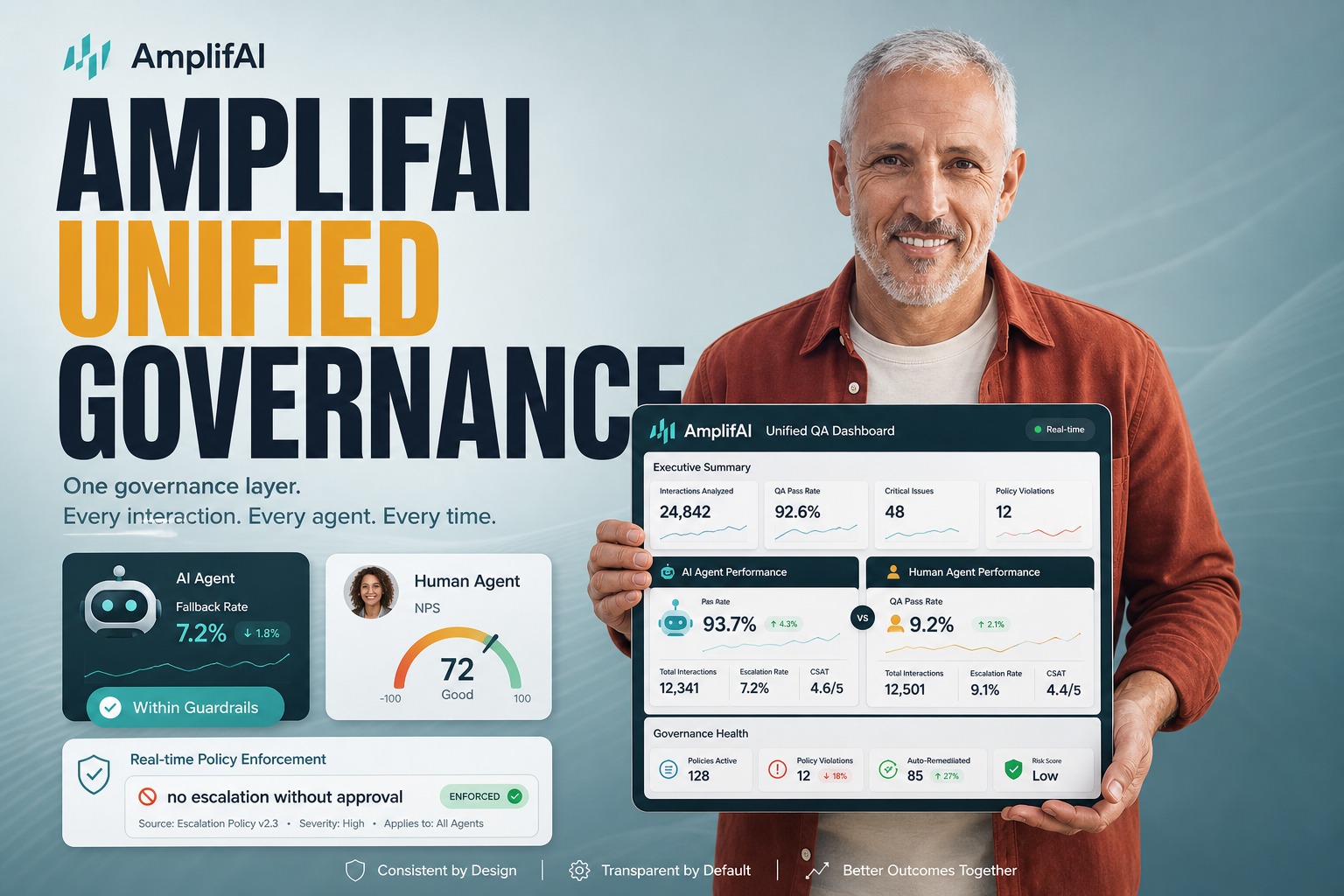
Can AI agents be held to the same quality metrics as human agents? → Yes, when a platform unifies data and applies identical performance rules to both.
What does a unified performance standard buy a contact center today? → It lets leaders scale automation without sacrificing coaching, accountability, or brand experience.
How does AmplifAI achieve a single view of blended‑workforce performance? → By centralizing QA, analytics, and coaching data across live and AI interactions.
Is it risky to treat AI agents like people in performance reviews? → The risk lies in ignoring it; without governance, automation can drift and erode CX.
What should a CTO evaluate when choosing a unified performance platform? → The depth of data integration, real‑time scoring, and the ability to extend coaching to both bots and humans.
The Core Question: How Do You Govern a Blended Workforce Without Losing Quality?
Contact‑center leaders are racing to replace repetitive tasks with AI agents, yet many still rely on separate dashboards for bots and humans. That split creates a hidden performance gap: automation can surge throughput while slipping on the very metrics that define brand experience. The decisive question for any CTO or VP of Customer Experience this quarter is not whether to adopt AI agents, but how to embed them in the same performance‑management loop that governs human representatives. The answer determines whether automation scales profitably or simply adds invisible risk.
Why Separate Governance Is a Liability, Not a Shortcut
When AI agents are evaluated on a different set of KPIs, the organization loses the ability to compare outcomes side‑by‑side. In practice, this means a bot could achieve a 95 % first‑contact resolution rate while simultaneously delivering a tone that drives churn, and the discrepancy would never surface because the bot’s metrics live in a silo. Moreover, without a unified quality‑assurance (QA) engine, supervisors cannot apply the same coaching insights that have proven effective for humans to the bots that are increasingly handling the same conversations. The liability compounds as the blended workforce grows: each unchecked bot adds an opaque layer that can amplify brand‑damage incidents.
The AmplifAI Model: One System, One Bar
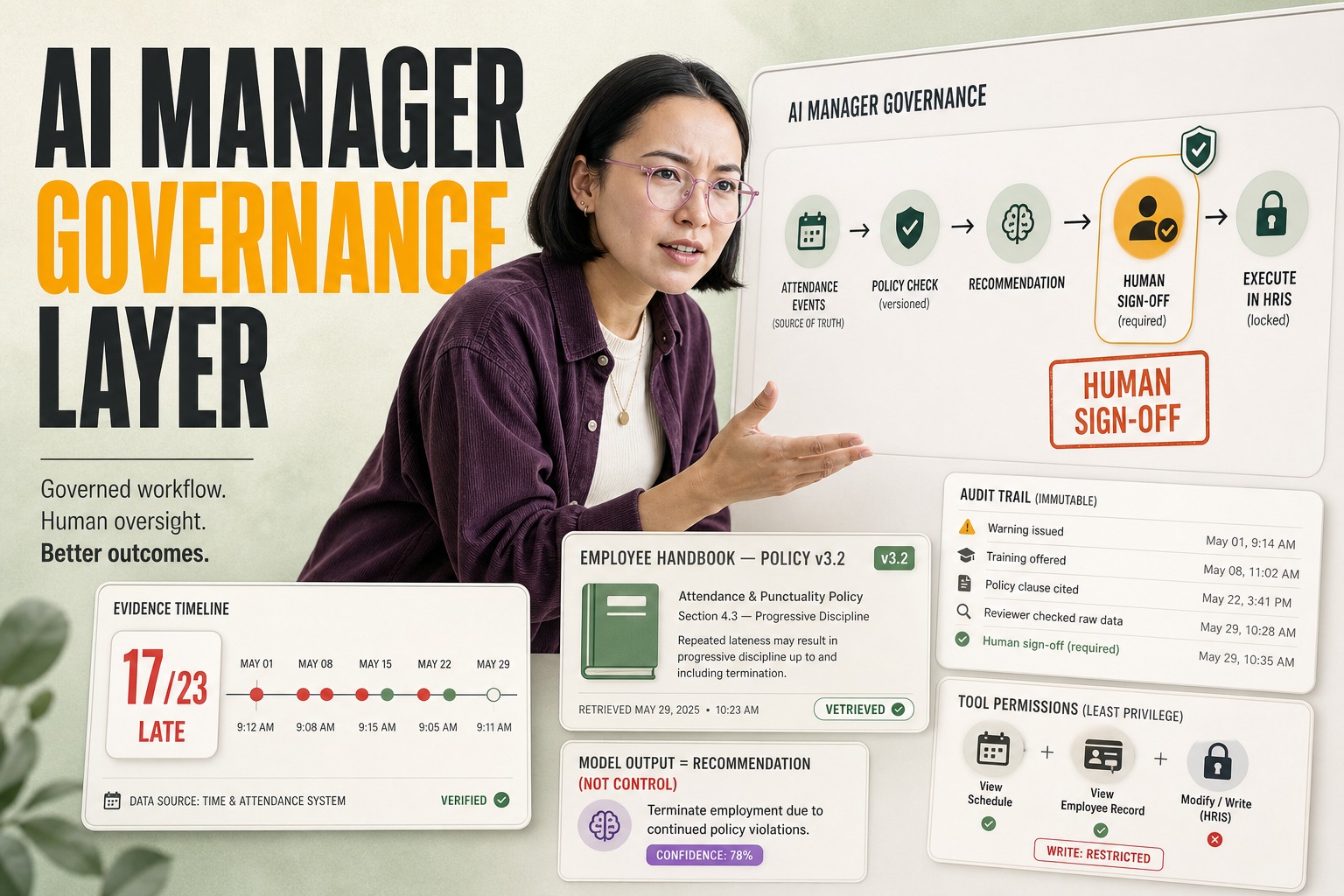
AmplifAI’s platform demonstrates a concrete way to collapse the silo. By feeding every interaction—whether handled by a live agent or an AI agent—into a single auto‑QA engine, the system generates a consistent score that reflects both efficiency and experience. Conversational intelligence then annotates each call with sentiment, compliance flags, and escalation triggers, regardless of the speaker. The result is a unified data lake that powers AI‑enabled coaching for humans and performance governance for bots in parallel. In this model, the same performance dashboard surfaces the top‑line metrics (average handle time, net promoter score) alongside granular bot‑specific indicators (fallback rate, intent accuracy), all under one performance bar.
Architectural Blueprint of Unified Performance Management
At the heart of a unified platform is a data‑centric architecture that treats every interaction as an event stream. Ingest pipelines pull voice recordings, chat logs, and metadata from telephony, web‑chat, and messaging channels into a central event hub such as Apache Kafka. From there, a real‑time processing layer—often built on Apache Flink or Spark Structured Streaming—applies the same auto‑QA algorithms to both bot‑generated and human‑generated transcripts. The scoring service writes normalized performance scores to a time‑series store like InfluxDB, which feeds a BI layer powered by Looker or Power BI. Crucially, the governance layer sits atop this stack, exposing policy rules (e.g., “no escalation without human approval”) that are enforced by both the bot orchestration engine (such as Rasa or Dialogflow) and the supervisor console. This shared pipeline eliminates data duplication, reduces latency, and ensures that any improvement to the QA model instantly benefits the entire blended workforce.
Operational Impact: From Hours Saved to Better Coaching
When QA runs automatically on every interaction, supervisors no longer spend days listening to recordings. Instead, they receive a concise performance card that highlights deviations from the unified standard. AI‑driven coaching then suggests micro‑learning modules tailored to the specific gaps—whether a human rep needs to improve empathy or a bot needs to adjust its fallback phrasing. Because the same coaching engine serves both, the organization can roll out a single training curriculum that lifts overall CX quality. Teams report reclaimed hours each week, which can be redirected to higher‑value activities like proactive outreach or product feedback loops.
Plavno’s Perspective: Building the Foundations for Unified Governance
At Plavno we have seen first‑hand how fragmented performance data hampers automation initiatives. Our experience developing AI‑agents for finance, healthcare, and retail shows that the moment you align bot metrics with human KPIs, you unlock measurable ROI. The key is to start with a robust data‑integration layer that normalizes interaction formats, then layer on a policy engine that can enforce the same quality thresholds across the board. By leveraging our expertise in cloud‑software development and AI‑consulting, we help clients design platforms that ingest telephony streams via Twilio, apply conversational intelligence with Azure Speech Services, and surface unified dashboards through custom React front‑ends. The result is a scalable architecture that lets you add new bot capabilities without re‑architecting the performance backbone.
Business Impact: Scaling Automation Without Diluting Brand Trust
When a contact center can measure bot performance against the same bar as humans, the risk of brand erosion drops dramatically. Leaders gain confidence to push automation deeper—into complex routing, cross‑sell recommendations, and regulatory compliance checks—knowing that any deviation will be flagged instantly. The financial upside is twofold: operational costs shrink as bots handle routine queries, and revenue lifts as human agents spend more time on high‑margin interactions. Moreover, a unified performance narrative simplifies reporting to executives, who can see a single set of KPIs that reflect the true health of the blended workforce.
How to Evaluate a Unified Performance Platform This Quarter
Decision‑makers should start by mapping the end‑to‑end interaction flow in their contact center and identifying where data silos exist. Next, assess whether a vendor’s auto‑QA engine can ingest the formats you use—voice recordings, chat logs, and API‑based bot transcripts. Verify that the scoring model is configurable, allowing you to apply the same thresholds to both human and AI agents. Finally, test the real‑time policy enforcement: can the platform prevent a bot from violating compliance rules without human intervention? A pilot that runs a single queue through the unified system for two weeks will reveal latency, scoring accuracy, and coaching relevance, providing the evidence needed to green‑light a broader rollout.
Real‑World Applications: From Finance to Healthcare
Financial institutions have deployed blended workforces to handle balance inquiries and fraud alerts. By unifying performance metrics, they discovered that a bot’s 98 % intent‑recognition rate masked a 12 % escalation rate due to tone‑misinterpretation, which was corrected after the unified QA flagged the pattern. In healthcare, a tele‑triage bot was held to the same compliance standards as nurses; when the bot inadvertently omitted a required disclaimer, the governance layer automatically routed the call to a live clinician, preserving regulatory compliance. These examples illustrate how a single performance bar protects both the customer experience and the organization’s risk profile.
Risks and Limitations: Guardrails You Must Build
Even a unified platform cannot magically eliminate all pitfalls. Data quality remains a prerequisite; noisy transcripts will produce misleading scores. Bias in the QA model can propagate to both humans and bots, so continuous model monitoring is essential. Additionally, over‑reliance on automation for coaching may reduce the human touch that some agents need for growth. Finally, integrating legacy telephony systems into a modern event‑stream architecture can be technically challenging and may require middleware adapters.
Closing Insight: Governance Is the New Automation Lever
The industry narrative that “AI agents will replace humans” is a distraction. The real lever for scaling contact‑center automation is governance—ensuring that every interaction, whether bot‑driven or human‑driven, meets the same performance expectations. Platforms like AmplifAI prove that unified performance management is not a futuristic concept but a present‑day necessity. For any organization looking to expand its AI footprint this quarter, the decisive move is to adopt a single performance standard that holds both sides of the workforce accountable.
Explore our services: AI agents development, cloud software development, AI consulting, AI voice assistant development, and digital transformation.
 Chat GPT
 Perplexity
 Claude
 Gemini