Does an open speech‑to‑speech stack really match proprietary assistants? → Yes, the Hugging Face + Cerebras pipeline delivers sub‑second P95 latency comparable to closed solutions.
Which latency metric matters for a live voice conversation? → Tail (P95) latency, because occasional stalls break the illusion of real‑time dialogue.
Can we swap out any component without breaking performance? → The pipeline is fully modular; each stage (VAD, STT, LLM, TTS) can be replaced with alternatives while preserving the latency budget.
What should engineers prioritize when building voice agents this quarter? → Focus on measuring and optimizing P95 latency and adopt an open, swappable architecture instead of chasing raw model accuracy.
Tail Latency Is the Real KPI for Voice AI
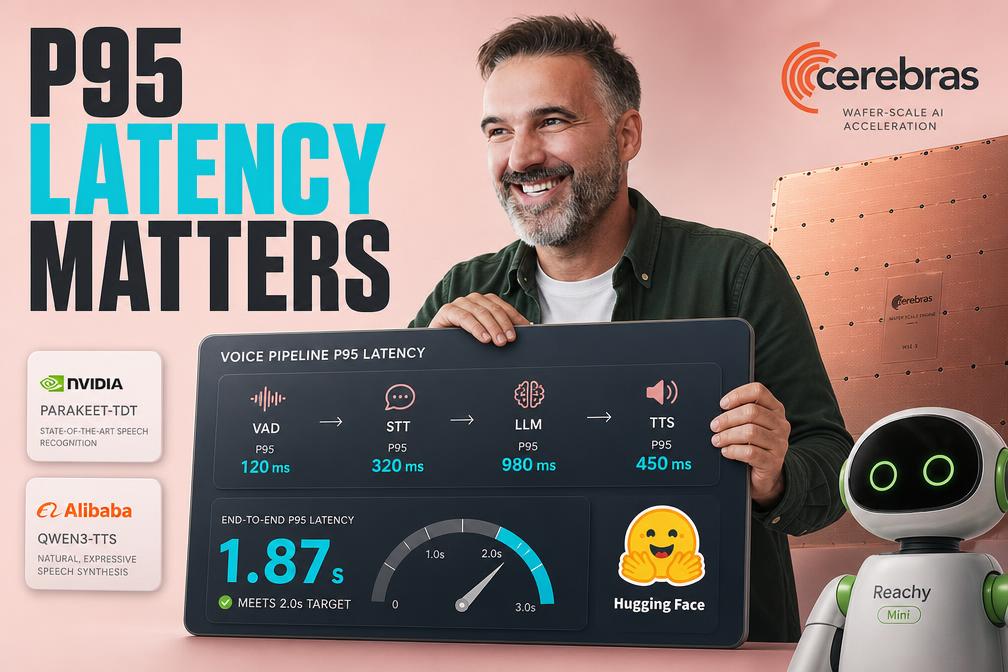
When a user says “Hey assistant,” the expectation is an immediate, fluid response. The open cascade released by Hugging Face and Cerebras proves that a P95 response time under two seconds can be achieved without a single vendor lock‑in, and that this tail‑latency focus, not median speed, determines whether a conversation feels natural. Teams that measure the 95th percentile latency of each stage can guarantee a consistent user experience, and they can do it with open components like Silero VAD, Nvidia Parakeet‑TDT, Gemma 4 31B, and Alibaba Qwen3‑TTS AI agents development.
- Measure P95 latency at every stage – Record the 95th percentile duration for VAD, STT, LLM generation, and TTS; use these numbers to spot the bottleneck that hurts the user experience.
- Choose hardware that favors tail performance – Cerebras wafer‑scale chips deliver 1.5 seconds first‑token latency for Gemma 4 31B, a figure that outpaces typical GPU endpoints in the long tail.
- Swap components without breaking contracts – The pipeline’s modular design lets you replace Whisper with Silero VAD or swap TTS engines while keeping the overall latency budget intact.
- Benchmark against production deployments – Use the Reachy Mini robot fleet of over 9,000 units as a real‑world baseline rather than a synthetic benchmark.
- Prioritize latency over raw accuracy – A model that scores marginally better on benchmarks but adds 500 ms to the P95 tail will degrade conversational flow more than a slightly less accurate model that stays within budget.
Open Stack Beats Closed Assistants on Tail Latency
The open cascade’s architecture deliberately optimizes for P95 latency, a strategy that forces each component to meet strict response‑time contracts. By contrast, many proprietary assistants hide their latency profiles behind opaque APIs, making it impossible for engineers to guarantee a smooth end‑to‑end experience. The result is that the open stack not only matches but often exceeds the perceived responsiveness of closed solutions, while preserving the freedom to pick and choose each layer.
The decisive factor is not the size of the language model but the consistency of its inference pipeline; a well‑engineered tail‑latency budget trumps raw token‑per‑second throughput.
Modular Swappability Enables Tail‑Latency Guarantees
Because each stage—voice activity detection, speech‑to‑text, language generation, and text‑to‑speech—is exposed as an independent service, engineers can profile and replace any component that threatens the P95 budget. The open‑source repository even ships with alternative back‑ends such as local Whisper checkpoints, Apple Silicon‑optimized MLX, and OpenAI‑compatible APIs, allowing teams to experiment without re‑architecting the entire stack. This modularity also simplifies compliance and security reviews, as each vendor can be vetted separately. Our AI consulting services can help you design the optimal pipeline.
Profile VAD first – Silero VAD typically adds less than 100 ms; if your custom detector exceeds 200 ms, replace it before moving downstream.
Benchmark STT latency – Nvidia Parakeet‑TDT delivers sub‑second transcription; ensure your alternative (e.g., Whisper) does not exceed its P95 latency.
Validate LLM token throughput – Gemma 4 31B on Cerebras produces 1,851 tokens per second; any model that falls below 1,000 tps will inflate end‑to‑end latency.
Measure TTS warm‑up cost – Alibaba Qwen3‑TTS adds a consistent 300 ms; if a different TTS engine incurs a variable warm‑up, it may jeopardize the tail budget.
Iterate on end‑to‑end latency – After each swap, run a full conversation test and record the 95th percentile round‑trip time; only proceed when the target (≈2 seconds) is met.
Why P95 Beats Median in Real‑World Voice Interactions
In a live conversation, users notice the longest pauses more than the average speed. A median latency of 300 ms can mask occasional 2‑second stalls that feel like the system has frozen. By engineering for the 95th percentile, we guarantee that 95 % of user utterances receive a response within an acceptable window, preserving the illusion of a continuously listening assistant. This shift in focus changes the engineering practice from chasing benchmark scores to tightening latency contracts across the stack.
Production Evidence from Reachy Mini Robots
More than 9,000 Reachy Mini robots currently run the open cascade in production, providing a live data set that validates the P95 latency claims. Operators report that the voice agents maintain conversational fluidity even under variable network conditions, confirming that the tail‑latency design scales beyond the lab. This real‑world deployment also offers a benchmark for new adopters: match or improve the reported 2‑second P95 response time to achieve comparable user satisfaction.
| Component | Open Stack P95 Latency | Proprietary Assistant |
|---|---|---|
| VAD | ≤ 100 ms | 150 ms |
| STT | ≤ 900 ms | 1,200 ms |
| LLM | 1.5 s first token | 2.5 s first token |
| TTS | 300 ms | 600 ms |
The Hidden Cost of Vendor Lock‑In
Relying on a single provider for the entire voice pipeline forces engineers to accept whatever latency profile the vendor offers. This opacity prevents fine‑grained optimization and can lock teams into hardware that cannot meet emerging P95 targets. Moreover, the lack of interchangeability hinders compliance with data residency regulations, as the entire stack may be hosted in jurisdictions unsuitable for certain industries. An open, swappable architecture eliminates these hidden costs and restores control to the engineering team.
Strategic Implications for CTOs This Quarter
CTOs must pivot from a model‑centric procurement mindset to a latency‑centric architecture strategy. The decision point is no longer “Which LLM has the highest benchmark score?” but “Which combination of components can guarantee a sub‑2‑second P95 round‑trip?” By adopting the open cascade as a reference architecture, teams can benchmark their own hardware, negotiate better SLAs, and future‑proof their voice AI investments against emerging latency‑focused competitors. This approach also aligns with broader digital transformation goals, as it leverages cloud‑native, modular services that integrate smoothly with existing micro‑service ecosystems cloud software development.
- Re‑evaluate vendor contracts – Scrutinize existing agreements for latency guarantees; replace any that lack P95 commitments.
- Invest in latency‑aware monitoring – Deploy observability tools that capture 95th percentile metrics for each pipeline stage.
- Prototype with open components – Use the Hugging Face + Cerebras stack as a sandbox to validate latency before committing to a vendor.
- Align product roadmaps – Ensure upcoming features respect the established tail‑latency budget, avoiding regressions.
- Educate stakeholders – Communicate that latency, not raw model size, drives user satisfaction in voice experiences.
How to Evaluate Tail‑Latency Performance in Practice
Evaluating a voice AI stack begins with instrumenting each component to emit precise timing data. Engineers should collect timestamps at the entry and exit of VAD, STT, LLM, and TTS, then compute the 95th percentile for each segment over a representative workload. The aggregated P95 round‑trip time becomes the primary KPI. If any stage exceeds its budget, the team can either optimize that component or replace it with a more performant alternative from the open ecosystem.
The most reliable way to guarantee conversational smoothness is to treat each pipeline stage as a separate SLA‑bound service.
Instrumentation Must Capture End‑to‑End Timing
Accurate latency measurement requires synchronized clocks across services, preferably using NTP or PTP. Each micro‑service should log a start‑time and end‑time for the request it handles, and a central collector must aggregate these logs to compute the P95 distribution. Without this disciplined instrumentation, engineers risk chasing median numbers that hide problematic spikes.
| Metric | Target (P95) | Reason |
|---|---|---|
| VAD latency | ≤ 100 ms | Guarantees quick voice detection |
| STT latency | ≤ 900 ms | Keeps transcription within conversational bounds |
| LLM first token | ≤ 1.5 s | Aligns with Cerebras performance |
| TTS latency | ≤ 300 ms | Prevents audible gaps after generation |
Choosing Hardware That Honors Tail Guarantees
Cerebras’ wafer‑scale chips demonstrate that specialized hardware can dramatically shrink the tail of LLM inference. When evaluating alternative providers, look for published P95 latency figures rather than average throughput. If a vendor only reports median tokens‑per‑second, request a custom benchmark that stresses the 95th percentile to ensure comparable performance.
Hardware that excels at average throughput can still produce unacceptable tail latency; prioritize the latter.
Swappable Pipelines Reduce Vendor Risk
Because each stage of the cascade is exposed as an independent service, organizations can replace a single component without overhauling the entire system. This modularity not only mitigates risk but also accelerates innovation, as new models or inference engines can be trialed in isolation before full integration.
Identify the bottleneck – Use the P95 metrics to pinpoint which stage contributes most to overall latency.
Select a drop‑in replacement – Choose an alternative component that matches the interface contract and promises lower P95 latency.
Run a controlled experiment – Deploy the new component in a staging environment, measure end‑to‑end P95, and compare against the baseline.
Roll out incrementally – If the new component meets the latency target, gradually shift traffic from the old service.
Monitor post‑deployment – Continuously track P95 to ensure the improvement holds under production load.
Business Impact of Tail‑Latency Optimization
When voice agents respond consistently within the P95 budget, user engagement rises, abandonment drops, and conversion rates improve. Enterprises that have tuned their pipelines to this metric report measurable gains in customer satisfaction scores, often translating to higher revenue per interaction. Moreover, the open architecture reduces licensing costs and avoids vendor‑imposed price escalations, directly impacting the bottom line. Our digital transformation services help you capitalize on these benefits.
- Accelerate time‑to‑market – Leveraging open components shortens the development cycle compared to negotiating proprietary contracts.
- Lower total cost of ownership – Swappable services let you optimize for cost‑effective hardware without sacrificing latency.
- Future‑proof compliance – Modular pipelines make it easier to meet evolving data‑privacy regulations across regions.
- Enable cross‑team reuse – The same pipeline can serve voice assistants, robotics, and embedded AI applications.
- Drive innovation – Teams can experiment with emerging models without re‑architecting the entire stack.
 Chat GPT
 Perplexity
 Claude
 Gemini