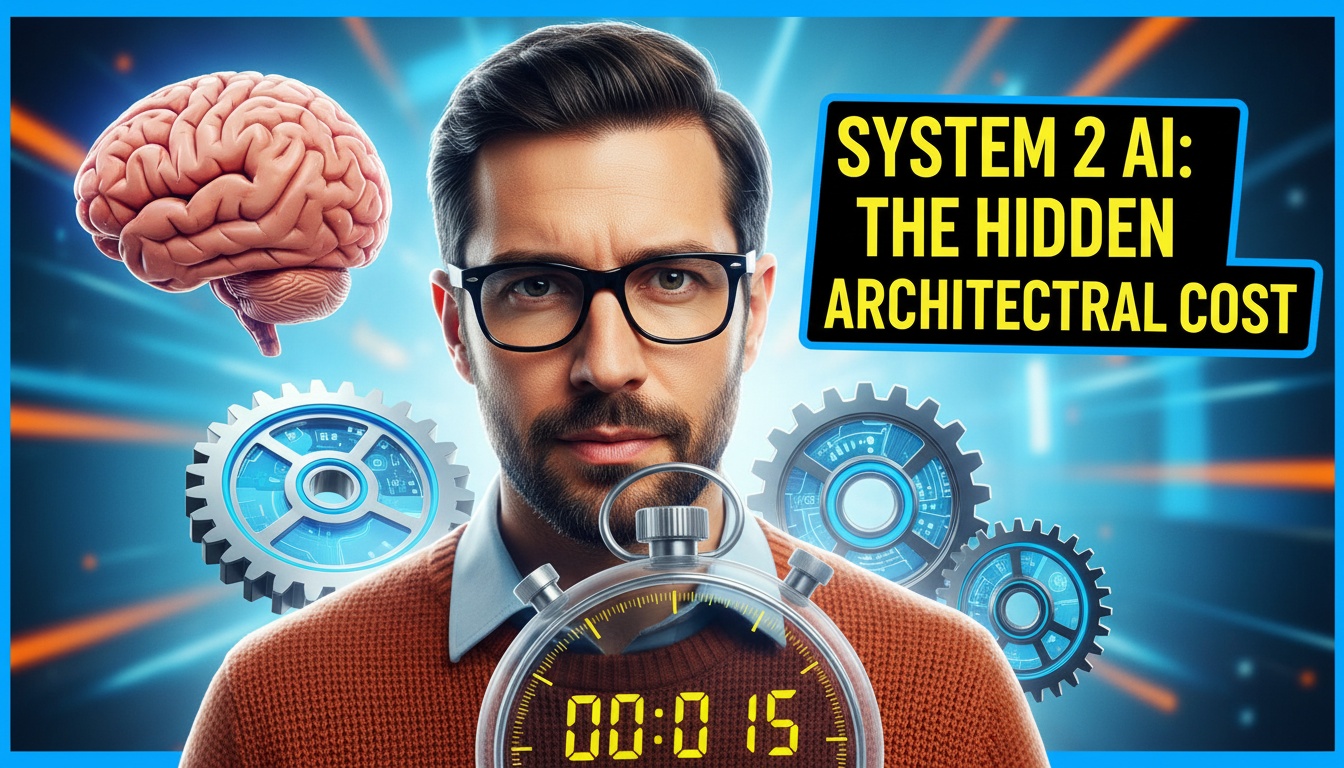
The release of "reasoning" models—specifically the class of System 2 architectures popularized recently by OpenAI's o1 series and similar research releases—marks the most significant shift in inference infrastructure since the introduction of the transformer. Unlike traditional LLMs that generate tokens reflexively based on immediate probability, these models engage in a hidden, multi-step "thinking" process before producing a final output. This isn't just a marketing label; it represents a fundamental change in the compute graph, where the model spends significant resources generating and refining a Chain of Thought (CoT) that the user often never sees. For engineering leaders, the news is clear: the era of deterministic, low-latency text generation is splitting into a two-tiered landscape. The risk? Treating these reasoning models as drop-in replacements for standard GPT-4 class models, a mistake that leads to exploded cloud bills, unpredictable latency spikes, and a new class of security vulnerabilities where the model's internal logic becomes a black box.
Plavno's Take: What Most Teams Miss
At Plavno, we believe the industry is drastically underestimating the operational friction introduced by "thinking" models. Most teams see the benchmark scores on coding or math and assume they have found a smarter general-purpose engine. They miss the critical architectural implication: the inference latency is no longer linearly correlated with output length. A reasoning model might take 20 seconds to generate a "Yes" or "No" answer because it is processing thousands of hidden tokens to verify the logic.
The biggest pitfall we see is the loss of observability. In standard architectures, you can log the prompt and the response to debug hallucinations. With reasoning models, the intermediate steps—the actual "thought" process—are often redacted or hidden by the provider to prevent distillation. This creates a "trust gap" in production. If a model denies a loan application or flags a transaction as fraudulent, you cannot simply inspect the log to see why. You are flying blind unless you build a secondary layer of interpretability or strict prompt engineering that forces the model to externalize its reasoning, which ironically negates some of the efficiency gains of the hidden CoT. Furthermore, teams often fail to account for the "thinking token" billing model. You are paying for the computation required to think, not just the text you read. If your prompt triggers a deep exploration of a dead-end logic path, you pay for that failure just as much as you would for a success.
What This Means in Real Systems
Integrating reasoning models into a production stack requires a move away from synchronous request-response patterns. In a typical REST API setup using a standard model, you might set a timeout of 10 seconds. With a reasoning model, a complex query could easily exceed 30 seconds. If you enforce a strict timeout, you truncate the thinking process, often resulting in a degraded or nonsensical answer, effectively wasting the compute spent up to that point.
Architecturally, this necessitates an asynchronous orchestration layer. We recommend a pattern where the client submits a request, receives a 202 Accepted with a task ID, and the system processes the reasoning in the background. This requires a message broker (like RabbitMQ or Kafka) and a webhook or polling mechanism to deliver the final result. You also need to implement a "circuit breaker" for cost. Because the duration is variable, a runaway process—where a model gets stuck in a logical loop—can drain your API budget in minutes. We implement strict "max thinking tokens" limits at the application level, forcing the model to converge or fail fast.
From a data flow perspective, the context window management changes. Reasoning models consume context not just for retrieval, but for "working memory" during their thought process. A RAG (Retrieval-Augmented Generation) pipeline that feeds 50 documents into a reasoning model might cause the model to spend its entire thinking budget just comparing documents rather than answering the question. This requires a much more aggressive pre-filtering or ranking step (often using a cheaper, faster model) before the reasoning model ever sees the data. We often use a cascading architecture: a fast model (like GPT-4o-mini) handles the retrieval and summarization, passing only the critical 1-2 data points to the reasoning model for the final deduction.
Why the Market Is Moving This Way
The shift toward System 2 reasoning is driven by the plateau of "scaling laws" for pre-training. Simply adding more parameters and data to reflexive models is yielding diminishing returns on complex logic tasks. The market has realized that "test-time compute"—spending more processing power at the moment of inference—allows smaller models to outperform massive ones on specific, difficult tasks like theorem proving, advanced coding, and strategic planning.
Technically, this is enabled by the discovery that Reinforcement Learning (RL) can be used to train models to recognize and correct their own errors during the generation process. Instead of predicting the next token based on training data, the model is trained to output a sequence of thoughts that maximizes a reward signal for correctness. This changes the business model for AI providers: they are no longer selling just "text generation"; they are selling "cognition as a service." This is why we are seeing distinct pricing tiers for "reasoning" versus standard generation. The market is moving toward a hybrid stack where fast, cheap models handle 90% of queries (reflexive), and expensive, slow reasoning models handle the 10% that require deep logic (reflective).
Business Value
The business case for reasoning models is not about replacing all AI; it is about solving the "high-stakes" problems that standard LLMs consistently fail at. For example, in custom software development, a standard model might write code that looks correct but fails on edge cases. A reasoning model can simulate the execution of that code, identify the edge case, and rewrite it before the developer ever sees it. This reduces the review burden significantly.
Consider a financial services client automating trade reconciliation. A standard model might look at two numbers and say "they don't match." A reasoning model can iterate through the transaction history, apply accounting rules step-by-step, and identify that a specific fee was accrued on a different date, resolving the discrepancy automatically. In our estimates, while reasoning models can cost 20–40x more per input/output token than standard models, they can reduce the "human-in-the-loop" intervention rate for complex tasks from 30% to under 5%. For a process costing $100 per human review, the ROI is immediate despite the higher inference cost. However, this value only materializes if the workflow is designed to tolerate the latency. You cannot use a reasoning model for a live chat interface where the user expects a reply in 2 seconds. The value is unlocked in asynchronous workflows: report generation, code auditing, and complex data analysis.
Real-World Application
Legal Contract Analysis
A law firm uses reasoning models to review M&A agreements. Instead of simply extracting clauses, the model is asked to identify conflicts between the "Indemnification" clause and the "Limitation of Liability" clause. A standard model might miss the subtlety if the conflict requires referencing a definition three sections back. The reasoning model effectively "reads" the document like a human lawyer, cross-referencing and deducing the conflict. The outcome is a 50% reduction in senior attorney time spent on initial reviews, though the processing time per document increases from 10 seconds to 2 minutes.
Medical Diagnosis Support
In a telehealth setting, a reasoning model analyzes patient history, lab results, and current symptoms. It must rule out rare diseases (zebras) rather than defaulting to common explanations. By engaging in a differential diagnosis process, the model suggests tests that a standard model would likely omit. The trade-off is strict compliance; the system must run in a HIPAA-compliant environment where the "thought process" logs are retained for audit, requiring a specific architectural setup to capture the hidden CoT without violating the provider's terms of service.
Logistics Optimization
A supply chain manager needs to re-route shipments due to a port closure. A reasoning model evaluates thousands of route combinations, factoring in fuel costs, transit times, and warehouse capacity. It treats this as a constraint satisfaction problem, iterating on solutions until it finds the optimal one. This replaces a manual Operations Research team that would take hours to run the same numbers. The latency (60 seconds) is acceptable because the alternative is a decision made hours later.
How We Approach This at Plavno
At Plavno, we don't just swap API keys; we redesign the orchestration layer. When we implement AI solutions involving reasoning models, we start by defining the "latency budget" for the specific business process. If the budget is low (under 3 seconds), we rule out reasoning models immediately. If the budget allows for asynchronous processing, we design a "Supervisor Agent" pattern. This supervisor uses a fast, cheap model to triage the incoming request. If the request is simple (e.g., "summarize this email"), the supervisor handles it. If the request is complex (e.g., "debug this Python script"), the supervisor delegates it to the reasoning model.
We also focus heavily on "Thought Engineering." Since we often cannot see the raw CoT, we use prompt strategies to force the model to output a structured reasoning trace in the final response (e.g., "<reasoning>...</reasoning> <answer>...</answer>"). This allows us to log the logic for debugging and compliance, even if the model's internal hidden thoughts remain opaque. We also implement strict cost guards. We set a maximum "thinking time" or token limit at the application level. If the reasoning model hits the limit, we fail gracefully with a fallback to a standard model or a human request, rather than letting the API call run indefinitely. This approach ensures that we leverage the intelligence of System 2 models without letting the operational costs spiral out of control.
What to Do If You're Evaluating This Now
If you are looking to pilot reasoning models, do not start with your customer-facing chatbot. Start with an internal, high-value, asynchronous workflow.
- Audit your failures: Look at the logs of your existing AI systems. Where are the hallucinations or logic errors most expensive? These are your pilot candidates.
- Design for Async: Ensure your infrastructure can handle long-running tasks. If you are using serverless functions (like AWS Lambda), be aware of the timeout limits (usually 15 minutes) and cold starts.
- Benchmark Cost vs. Accuracy: Run a shadow test where you send production traffic to a reasoning model but don't act on it. Compare the output quality and the cost against your current model. Look for the "break-even point" where the value of the correct answer exceeds the extra inference cost.
- Beware of the Black Box: If you are in a regulated industry, check with your compliance team about the implications of using a model where the decision-making process is not fully auditable. You may need to implement a "human-in-the-loop" for the reasoning model's outputs.
Conclusion
The arrival of reasoning models is not just an upgrade; it is a specialization of the AI stack. It forces us to distinguish between "fast thinking" (intuition) and "slow thinking" (deliberation). For businesses, the opportunity lies in offloading complex, high-stakes cognitive labor to these systems. But the operational reality is that they require a different architectural backbone—one built for patience, asynchrony, and strict cost controls. If you try to force a System 2 model into a System 1 workflow, you will get the worst of both worlds: slow, expensive, and unreliable results. The winners will be those who redesign their processes to let these models think, without letting the thinking time break the business.
 Chat GPT
 Perplexity
 Claude
 Gemini