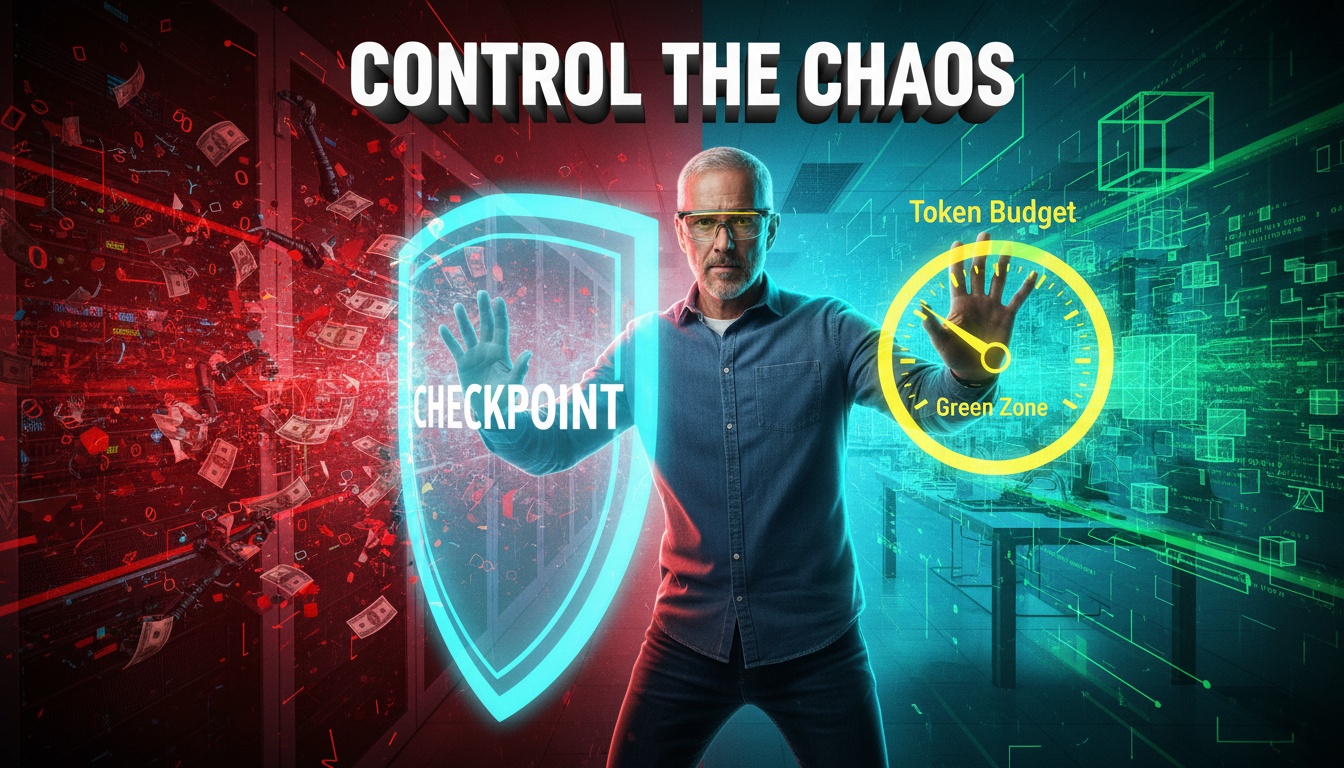
When IBM unveiled its AI‑powered development platform Bob this week, the announcement did more than add another tool to the market. It signaled a decisive shift: enterprises are no longer content with ad‑hoc AI assistants that write snippets of code; they want a structured, auditable workflow that blends the speed of large language models with human governance at every critical juncture. The core signal is clear—the next generation of AI‑driven development tools must embed checkpoints, role‑based stages, and explicit cost controls, otherwise the promise of productivity collapses under the weight of security incidents and runaway token bills.
At Plavno we have been watching this transition closely because it directly answers the most common search query from CTOs and engineering leaders today: "How can we safely integrate AI agents into our software development lifecycle?" The answer is not a single product recommendation; it is a set of architectural decisions, governance practices, and operational patterns that together form a reliable, production‑grade AI agent pipeline.
Quick Answer: How to Build a Controlled AI‑Agent‑Driven Development Pipeline
The safest way to embed AI agents in your development process is to layer a role‑based orchestration framework on top of a vetted model pool, enforce human‑in‑the‑loop checkpoints at each stage, and apply token‑budget guardrails backed by real‑time cost monitoring. In practice this means defining distinct agent roles (e.g., architect, front‑end generator, test engineer), wiring each role to a specific model (Granite, Claude, or a distilled Mistral variant), and using a central coordination service that pauses execution for human approval before any code is merged. The coordination service should also enforce a per‑action token limit—typically 200 k tokens per day per developer seat—to prevent runaway expenses. When these three pillars—role separation, human checkpoints, and token budgeting—are combined, enterprises can achieve the 70 % time‑saving reported by IBM while keeping security, auditability, and cost under control.
The Core Architectural Pattern Behind IBM’s Bob
Bob’s architecture can be distilled into four interacting components:
- Model Registry – a curated catalog of supported models (IBM Granite, Anthropic Claude, Mistral distilled). Each model entry records its latency, token cost, and compliance certifications.
- Agent Engine – a lightweight runtime that spawns role‑specific agents. The engine injects a Model Context Protocol (MCP) payload that contains the current repository state, recent commit diffs, and any policy constraints.
- Checkpoint Service – a microservice that surfaces a UI widget in the developer’s IDE (VS Code, JetBrains, or the IBM Bob Shell). It presents a concise diff and asks for Approve / Reject / Iterate. The service logs the decision with a cryptographic signature tied to the user’s corporate identity.
- Cost Ledger – an immutable ledger (often built on a blockchain‑style append‑only store) that records token consumption per action. The ledger is queried by a throttling proxy that rejects any request exceeding the daily budget.
The flow is simple: a developer triggers an agent‑run via the CLI; the Agent Engine selects the appropriate model, forwards the request to the Model Provider, receives a generated code artifact, and hands it to the Checkpoint Service. Only after a human signs off does the code get merged into the main branch, and the Cost Ledger updates the token balance.
Designing Role‑Based Agent Stages with Human Checkpoints
The most common mistake in early AI‑agent pilots is to treat the model as a single monolithic coder. This leads to brittle pipelines where a hallucinated function can cascade into downstream failures. By contrast, a role‑based pipeline mirrors a real development team:
- Architect Agent drafts high‑level design documents and creates a feature‑spec JSON file. It never writes code directly but defines the contract for downstream agents.
- Back‑End Agent consumes the spec, generates service stubs, and runs unit‑test scaffolding. It pauses after each generated file for a review checkpoint.
- Front‑End Agent builds UI components based on the same spec, again awaiting human approval before committing.
- Test Engineer Agent runs integration tests, reports flaky results, and triggers a re‑run loop that only terminates when the human authorizes a retry.
Each checkpoint is a single point of audit: the system records who approved which artifact, the model version used, and the token cost incurred. This design eliminates the “black‑box” problem that plagued earlier autonomous agents and satisfies compliance teams that demand traceability.
Choosing Models and Orchestrators: From Granite to Claude
Model selection is not a trivial “pick the biggest” decision. Enterprises must weigh latency, cost, licensing, and data residency. For instance, IBM Granite offers on‑premise deployment with a predictable $0.0004 per 1 k token price, making it ideal for regulated industries. Claude, accessed via the Anthropic API, provides higher reasoning depth but incurs a $0.0012 per 1 k token charge and may store data in the US region only. Mistral’s distilled models strike a balance, delivering ~85 % of Granite’s accuracy at half the token price.
Orchestration frameworks such as LangGraph, Cursor, or OpenClaw provide the plumbing to chain model calls, but they differ in how they handle state persistence. Bob’s approach—using an external persistent storage (e.g., an S3‑backed JSON store) to hold the spec and intermediate results—avoids the fragility of in‑process chat histories. When you design your own pipeline, adopt a similar out‑of‑process state store so that agents can resume after a crash without losing context.
Managing Costs and Token Consumption at Scale
Token consumption can explode when agents are left to iterate unchecked. A practical cost‑control strategy consists of three steps:
- Per‑Action Token Caps – set a hard limit (e.g., 2 k tokens) for any single generation request. If the model exceeds the cap, it returns a partial result that the Checkpoint Service can flag for human review.
- Daily Budget Quotas – allocate a token budget per developer seat (e.g., 200 k tokens) and enforce it via the Cost Ledger throttling proxy.
- Model‑Switch Fallback – configure the Agent Engine to automatically downgrade to a cheaper model (e.g., from Claude to Mistral) when the budget approaches exhaustion.
By instrumenting these controls, enterprises have reported up to 70 % time savings without surprising cost overruns—a figure that aligns with IBM’s internal pilot data.
Embedding Guardrails: From Context Protocols to Policy Enforcement
Guardrails are the non‑negotiable constraints that keep an AI agent from doing something it shouldn’t. In production, guardrails live in two layers:
- Static Policy Layer – a set of immutable rules encoded in the Checkpoint Service (e.g., Never commit code that modifies files outside the /src directory). These rules are enforced before any merge.
- Dynamic Runtime Layer – a monitoring daemon that watches for anomalous behavior such as rapid token spikes, repeated failed test runs, or attempts to access prohibited cloud resources. When an anomaly is detected, the daemon automatically suspends the offending agent and raises a ticket.
Both layers are essential. Static policies prevent obvious policy violations, while dynamic monitoring catches subtle drift that emerges as models are fine‑tuned or new prompts are introduced.
Plavno’s Playbook for Enterprise‑Ready AI Agent Integration
At Plavno we have distilled the lessons from IBM, OpenClaw, and Squad into a repeatable playbook that we offer as part of our AI agents development service:
- Phase 1 – Baseline Assessment – map existing development workflows, identify pain points, and catalog current toolchain integrations.
- Phase 2 – Role Definition – work with product owners to define agent roles and the corresponding model contracts.
- Phase 3 – Orchestration Blueprint – design a microservice‑based coordinator that implements the checkpoint and cost‑ledger patterns described above.
- Phase 4 – Guardrail Implementation – codify compliance policies, integrate with your IAM system, and deploy runtime anomaly detectors.
- Phase 5 – Pilot & Iterate – run a controlled pilot on a non‑critical feature branch, collect telemetry, and refine token budgets.
Clients that have followed this playbook report a 30‑50 % reduction in cycle time for feature delivery while maintaining full audit trails required by SOC 2 and ISO 27001.
Our AI automation services, custom software development, cloud software development, and AI consulting capabilities complement this approach, ensuring end‑to‑end coverage of your digital transformation journey.
Business Impact: Productivity Gains vs. Governance Overheads
The primary business driver for AI‑agent pipelines is developer velocity. By offloading repetitive boilerplate generation to agents, senior engineers can focus on architecture and risk mitigation. However, the governance layer introduces a modest overhead: each checkpoint adds an average of 2 minutes of human review per pull request. When multiplied across a team of 20 developers, this overhead is offset by the 10‑hour weekly time savings reported in the IBM case study. The net effect is a ~15 % increase in delivered features per sprint, with the added benefit of a tamper‑evident audit log that satisfies compliance auditors.
Evaluating the Approach in Your Organization
Decision makers should weigh three dimensions when evaluating a structured AI‑agent pipeline:
- Technical Fit – does your current CI/CD stack support microservice orchestration? Can you expose a Model Context Protocol endpoint?
- Risk Appetite – are you comfortable granting agents limited, just‑in‑time permissions, or do you need a fully sandboxed environment?
- Cost Sensitivity – does your token budget align with the projected usage patterns? Remember that token costs are linear; a 10 % increase in generated code size translates directly to a 10 % cost rise.
A practical evaluation method is to run a dual‑track experiment: run a traditional manual code‑review process on one feature branch while enabling the AI‑agent pipeline on another. Measure cycle time, defect density, and token spend over a two‑week period. The side‑by‑side data will surface the true ROI for your specific context.
Real‑World Scenarios: From Feature Generation to Automated Testing
Consider a fintech startup that needs to roll out a new KYC verification API within three weeks. Using a structured AI‑agent pipeline, the team can:
- Feed the product spec to the Architect Agent, which emits a JSON contract describing the API endpoints and required data fields.
- Spawn a Back‑End Agent that generates a Spring Boot controller, unit tests, and OpenAPI documentation. After each file is generated, the Checkpoint Service surfaces a diff for the senior engineer to approve.
- Deploy a Test Engineer Agent that runs the generated tests against a staging environment, automatically reporting flaky results and suggesting code tweaks.
- Finally, a Front‑End Agent builds a React component that consumes the new API, again pausing for human sign‑off before committing.
The entire pipeline reduces the manual effort from an estimated 120 hours to 45 hours, while preserving a full audit trail for regulator review.
Risks, Failure Modes, and Mitigation Strategies
Even with guardrails, enterprises can encounter failure modes that mirror the five patterns identified by industry analysts:
- Over‑Scope Agents – agents that attempt to perform end‑to‑end development without explicit role boundaries. Mitigation: enforce strict role contracts and reject any agent request that exceeds its defined scope.
- Edge‑Case Blindness – agents that fail on unexpected inputs (e.g., legacy codebases). Mitigation: maintain a curated edge‑case test suite and run agents against it during the pilot phase.
- Cost Escalation – token loops that generate endless code. Mitigation: implement the per‑action token caps and daily budget quotas described earlier.
- Security Drift – agents retaining credentials after decommissioning. Mitigation: integrate the Cost Ledger with your secret‑management platform (e.g., HashiCorp Vault) to automatically revoke tokens.
- Human‑In‑The‑Loop Fatigue – reviewers overwhelmed by too many checkpoints. Mitigation: batch approvals by grouping related diffs and using a review confidence score to prioritize high‑impact changes.
By proactively addressing these risks, organizations can keep AI agents from becoming a liability.
Closing Thought: The Future of AI‑Assisted Development
The emergence of platforms like IBM’s Bob demonstrates that the future of software engineering will be a hybrid of human expertise and AI‑driven automation, not a replacement of one by the other. The decisive factor will be how quickly enterprises can adopt structured pipelines that embed checkpoints, enforce cost controls, and maintain auditable provenance. Those that master this balance will unlock the promised 70 % productivity boost while preserving the security and compliance posture demanded by modern enterprises.
 Chat GPT
  Perplexity
  Claude
  Gemini
