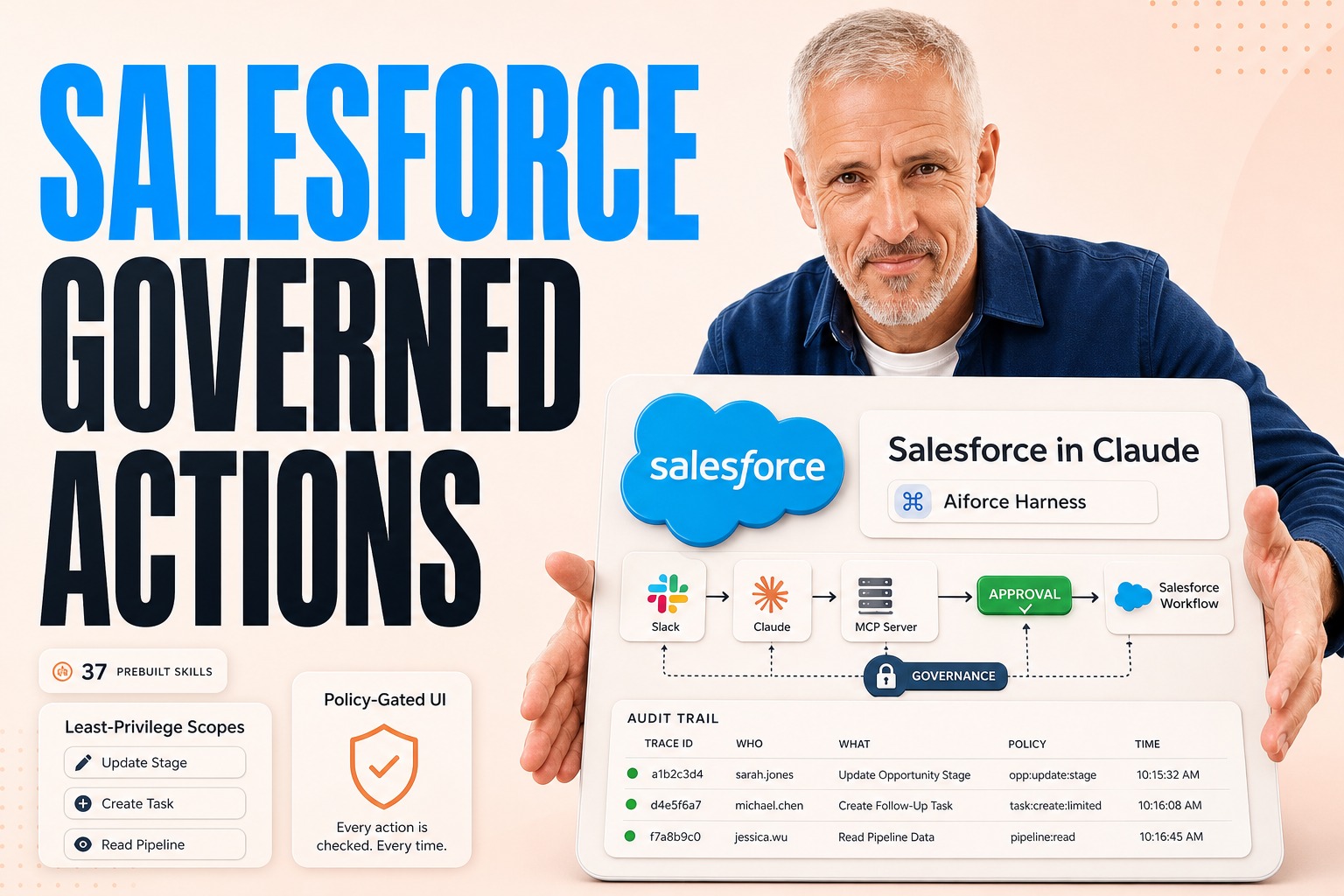
What’s the dominant signal this week? → Salesforce and Anthropic are expanding their partnership so Claude can reason over Salesforce data and execute governed actions through Salesforce workflows, delivered first as ‘Salesforce in Claude.’
What’s the search question engineers are actually asking? → How do we integrate Claude with Salesforce in a way that lets it take real actions (not just answer questions) while staying inside enterprise governance?
Why does it matter now if open beta is later? → ‘Salesforce in Claude’ is already in pilot, and it signals a platform direction: tool-access through MCP servers, APIs, and CLI tools becomes a first-class product surface.
What will break if we treat this like a normal chatbot integration? → The failures won’t be in the model’s prose; they’ll show up at orchestration boundaries—permissions, workflow triggering, auditability, and action scope.
What’s the angle we’ll defend? → Claudeforce is less about Claude being smarter and more about Salesforce packaging an enterprise harness (AIforce) that changes how teams should design ‘agentic’ access to deterministic systems.
Quick Answer: should we adopt Salesforce in Claude for agentic Salesforce workflows?
If your goal is to let Claude take governed action in Salesforce—not just draft emails or summarize notes—then Salesforce in Claude is the direction to plan around, because it is explicitly built on an enterprise harness (AIforce) that exposes Salesforce data, workflows, and business logic through MCP servers, APIs, and CLI tools. The engineering work shifts from prompt-tuning to defining safe action contracts, permissioning, and audit-ready execution paths that survive real revenue operations.
The practical rule we use at Plavno: when an LLM starts touching Salesforce workflows, treat the integration as production automation with a reasoning layer—not as conversational UX with a CRM plug-in.
The real shift: Salesforce is productizing ‘tool access’ as the enterprise control plane
Salesforce and Anthropic aren’t merely connecting a model to a data source; they’re aligning Claude’s reasoning with Salesforce’s ‘trusted enterprise harness’ so business data, workflows, logic, actions, and governance are securely accessible for agentic experiences. The technical implication is that your architecture no longer revolves around a single chatbot endpoint; it revolves around a governed tool surface that Claude can call into, and that your org can audit.
Salesforce frames ‘Salesforce in Claude’ as being made possible by AIforce, which brings business data and workflows to any agent through MCP servers, APIs, and CLI tools ‘without complicated and costly integrations.’ We read that as a shift away from bespoke, point-to-point glue and toward a standardized action interface where governance lives alongside the tools—not bolted on after the fact. In practice, this is the difference between ‘Claude can talk about pipeline’ and ‘Claude can update pipeline, within the same guardrails your CRM already enforces.’
- Integration gravity moves to MCP and tool gateways. Your most important design decisions become how tool calls are exposed, scoped, and observed—not which prompt template you like.
- Salesforce becomes the deterministic backplane. Claude provides reasoning and judgment, but Salesforce provides the rules and workflows that make actions enterprise-ready.
- The user interface becomes a generated surface. The partnership positions ‘generative UI’ as a way to surface live revenue context, which forces engineers to treat UI generation as an operational concern.
- Slack becomes a primary execution context. With Claude as the default model for Slack and an ‘intelligent backbone’ across Slack experiences, the boundary between chat and system-of-record becomes thin.
MCP servers are the integration boundary you should design around
Because AIforce explicitly mentions MCP servers alongside APIs and CLI tools, it signals a future where the stable contract is not ‘Claude calls Salesforce directly,’ but ‘Claude calls a tool surface that is versioned, governed, and observable.’ If you’ve been building internal agents with ad-hoc HTTP endpoints, this is the moment to think like a platform team: define a tool catalog, enforce least privilege at the tool level, and assume multiple agent runtimes will eventually consume the same actions.
- Tool catalog as product surface. Treat each exposed action as a product with an owner, documentation, and deprecation policy, because agents will depend on it.
- Scope-first permissions. Design scopes around business intent (‘update pipeline stage’) rather than object-level raw power (‘write Opportunity fields’).
- Observability by default. Insist that every tool execution emits structured events that can be traced back to a user, a conversation, and a governance policy.
- Versioned workflows. If Salesforce workflows evolve, the tool contract must remain stable or explicitly versioned, otherwise agent behavior becomes unpredictable.
‘37 prebuilt skills’ matter less than the action contract they imply
Salesforce in Claude launches with 37 prebuilt sales skills aimed at pipeline visibility, deal execution, and productivity in existing workflows. The important engineering takeaway isn’t the number; it’s the implied pattern: skills are packaged, governed actions over live revenue context. If your team tries to replicate this with generic CRM prompts wrapped around an API, you’ll recreate the hardest parts—permission drift, audit gaps, and brittle workflow triggering—without inheriting the guardrails.
- Inputs must be constrained. Skills that act on ‘live revenue context’ need explicit input boundaries so the agent cannot smuggle unintended fields or objects into execution.
- Outputs must be deterministic. The effect in Salesforce must be verifiable (records updated, workflow executed) even if the reasoning is probabilistic.
- Every action needs governance hooks. Approvals, policy checks, and logging cannot be optional add-ons once the agent can write.
- Fallback paths must exist. When a skill cannot execute safely, the system should degrade to drafting, summarizing, or asking for clarification—not improvising writes.
Why ‘Salesforce in Claude’ targets seller workflow, not the admin console
The product is framed around sellers and agents working ‘where sellers work,’ with skills that automate pipeline updates and improve deal execution. That’s a deliberate architectural bet: the agent interface sits in the flow of work (Claude, and increasingly Slack), but the system-of-record and governance stay in Salesforce. For engineering teams, that means your integration success will be measured by whether the agent can act inside existing CRM workflows without forcing users into a new app.
Governance is the feature, not the compliance tax
Salesforce and Anthropic position the partnership as combining Claude’s judgment with Salesforce’s ‘trusted workflows’ and governance so actions are enterprise-ready. That framing matters because it rejects the common pattern where governance is added after the agent is ‘working.’ In real deployments, the first incident is rarely a hilarious hallucination; it is an action that was technically allowed but operationally unacceptable—an update without approval, an untracked workflow trigger, or a change that can’t be explained in a forecast meeting.
Salesforce’s language about making data, workflows, business logic, actions, and governance ‘securely accessible’ implies a control plane mindset: the same system that stores the data also mediates and records how agents touch it. If your organization is already investing in enterprise security, the most realistic path is to align agent actions with existing governance mechanisms and then validate them through security review. When we help teams build agentic systems, we often start with threat modeling and audit requirements, because the architecture you choose will either make those requirements cheap—or make them impossible. For teams that need help hardening these systems end-to-end, our cybersecurity and penetration testing practice is usually involved early, before the first production workflow is exposed.
- Permission drift across contexts. Claude may be used in one context (Slack or Claude UI) while Salesforce permissions are defined elsewhere, creating mismatches in least privilege.
- Workflow triggering without intent. A ‘small’ field update can trigger large downstream Salesforce workflow behavior; governance must understand blast radius.
- Audit logs that don’t answer business questions. Logging that captures only API calls won’t satisfy leadership when they ask ‘why did the agent do this?’
- Data exposure through connectors. If onboarding reads enterprise context across Salesforce, Slack, and connectors, your data classification policy must be enforceable at ingestion.
Slack as the front door changes your threat model and your user expectations
The partnership states that Claude is the default model for Slack and powers Slackbot, augments team decision-making via Claude Tag, and accelerates multiplayer coding through Slack Code. Even if your Salesforce actions remain governed, the user’s mental model shifts: they will expect ‘chat’ to be able to execute. That turns Slack channels into potential initiation points for CRM actions, which means your authentication, authorization, and approval experience must survive a messy, real team conversation.
If Slack becomes the place where actions are initiated, identity and intent must be reconstructed from conversation context—so your governance design can’t assume a clean, single-user UI.
How to evaluate Claudeforce this quarter even if open beta is September 2026
Salesforce in Claude is available to select pilot customers now and is expected to launch in open beta in September 2026, with additional prebuilt skills beginning in late 2026. For a CTO, that timing creates a trap: teams either ignore it until it arrives, or they overbuild a parallel internal platform that they later rip out. The better approach is to treat Claudeforce as a signal about interface contracts: MCP servers, APIs, and CLI tools as the harness for agent access.
In practice, we recommend evaluating your readiness independent of any single vendor UI. Start by inventorying the Salesforce actions you would ever allow an agent to do, then map which of those actions are already mediated by Salesforce workflows and governance. The goal is to define a narrow ‘agent write surface’ that is safe enough to pilot, even if the eventual execution environment is Claude, Slack, or a custom interface.
From there, validate that your organization can answer three questions for every action: who initiated it, what policy allowed it, and what data it touched. If you cannot answer those reliably today, adopting ‘Salesforce in Claude’ later won’t fix it; it will amplify the gap. This is where our teams typically engage through AI consulting to translate agent ambition into a governed operating model that security and revenue operations can actually sign off on.
| Evaluation focus | What you should produce now | Why it matters for Salesforce in Claude |
|---|---|---|
| Action inventory | A documented set of allowed Salesforce actions and their business owners | Prebuilt skills are only useful if they fit your allowed write surface |
| Governance mapping | A mapping from each action to Salesforce workflows and approval logic | The partnership emphasizes governed action, not free-form automation |
| Tool contract design | A stable interface for actions exposed via MCP servers, APIs, or CLI tools | AIforce frames the harness as the portability layer for any agent |
| Observability plan | Audit-ready traces from initiation context to Salesforce record changes | Agentic systems fail operationally when you cannot explain outcomes |
Where ROI shows up first: pipeline hygiene and deal execution, not ‘AI magic’
The launch focuses on sales teams improving pipeline visibility, automating pipeline updates, and supporting deal execution ‘within existing workflows.’ In engineering terms, that’s an ROI profile you can defend: fewer manual updates, fewer context switches, and more consistent data freshness—assuming the agent’s write actions are gated and observable. The value is not that Claude can talk about pipeline, but that it can move work forward under governance.
Real-world patterns: pipeline updates, onboarding dashboards, and Tableau-era expectations
Salesforce in Claude is described as having an onboarding experience that reads a seller’s enterprise context across Salesforce, Slack, and connectors in Claude, then stands up a tailored dashboard with accounts, pipeline, and live data surfaced in interactive views that Claude generates. The engineering implication is that the ‘first experience’ is not a static UI build; it is a generated artifact derived from live systems. Teams adopting this pattern must think carefully about what data is eligible to be surfaced, and what ‘live’ means under your governance rules.
The partnership also references Salesforce running on top of AIforce UI harness with Headless 360, Data 360, Tableau, and Slack. Even without adding assumptions about those products beyond what is stated, the direction is clear: executives want a dynamic interface where the UI is effectively driven by the AI layer. For engineering, that raises the bar on integration correctness. A generated dashboard that reads from live revenue context must still respect the same data access rules as a hand-built Salesforce page, and it must fail gracefully when context is missing or permissions deny access.
Context ingestion happens first. The system reads enterprise context from Salesforce, Slack, and connectors available in Claude to determine what to surface.
Reasoning produces an action plan. Claude reasons over live revenue context to decide what needs attention in pipeline visibility or deal execution.
Generative UI presents interactive views. Instead of a fixed dashboard, the interface is generated to show accounts, pipeline, and live data in interactive views.
Governed actions execute in Salesforce. Pipeline updates and workflow actions occur through Salesforce’s trusted workflows and governance rather than ad-hoc writes.
When a generative UI is safer than a static one
It sounds counterintuitive, but a generated interface can be safer if it forces every displayed element to be justified by current context and permissions. A static dashboard often becomes a ‘God view’ over time, accumulating fields and widgets that no longer match least-privilege intent. A generative UI, if tied to the same governance checks used for actions, can reduce accidental exposure by only rendering what the user and policy can currently justify—provided you treat UI generation as part of the control plane, not as a design flourish.
- Policy-gated rendering. The same governance rules that allow actions should gate what can be surfaced in interactive views.
- Context expiration. If the dashboard was generated from ‘live’ context, it should not persist beyond the session if permissions or context could change.
- Explainable elements. Each surfaced account, pipeline view, or KPI should be explainable as derived from known Salesforce data and allowed connectors.
- Fail-closed behavior. When data access is denied, the UI should degrade to summaries or prompts for access, not partial leakage.
Risks you should assume: orchestration boundaries, permission mismatches, and audit gaps
Claudeforce is explicitly about ‘agentic experiences’ that can take action. In production, the highest-risk failures happen at boundaries: a Slack-initiated request that maps to a Salesforce write, a connector that widens context unexpectedly, or a workflow trigger that creates downstream effects the requester didn’t intend. The partnership’s promise of governed action is exactly what you should stress test, because the moment users trust the agent with pipeline updates, incidents become business events, not technical tickets.
Plavno’s position: treat AIforce as a platform layer, not a plugin you ‘turn on’
The temptation with something like Salesforce in Claude is to think of it as a productivity feature you enable for sales. We think that’s the wrong mental model. The partnership is signaling a platform approach where AIforce exposes governed access to business data and workflows for any agent runtime through MCP servers, APIs, and CLI tools. That’s a platform surface, and platform surfaces require ownership, lifecycle management, and clear contracts.
In our delivery work, we’ve seen teams succeed when they separate ‘reasoning’ from ‘execution.’ Claude (or any model) can propose changes, but the execution path must be deterministic, policy-checked, and observable in Salesforce. That often means building or adopting an internal tool gateway, defining action scopes, and integrating approval workflows that match your revenue operations reality. When the goal is to move from chat to automation, our AI automation engagements typically focus less on UI polish and more on the operating model: who can authorize what, where logs live, and how failures are handled without corrupting pipeline data.
| Approach | What you gain | What you risk |
|---|---|---|
| Wait for Salesforce in Claude open beta | Vendor-aligned harness centered on governed Salesforce action | Delayed learning on governance gaps and action contracts until late adoption |
| Build a custom Claude-to-Salesforce agent now | Immediate iteration on action inventory and workflows | You may duplicate harness work that AIforce later standardizes |
| Hybrid: design tool contracts now, plug into vendor UI later | Early governance maturity without committing to a single front end | Requires discipline to keep the tool surface stable while UIs evolve |
| Pilot narrowly with select users | Real usage feedback while limiting blast radius | Risk of shadow workflows if policies and ownership aren’t explicit |
Decision checkpoint: what to commit to before more skills arrive in late 2026
Salesforce in Claude will add more integrations across Claude, Salesforce, and Slack, and additional prebuilt skills begin launching in late 2026. The commitment to make now isn’t a UI choice; it’s whether you will invest in a governed action layer that can support agentic execution across contexts. Author: Plavno team. Last updated: September 2026. If you want a scoped architecture assessment focused on Salesforce agent actions and governance readiness, request a technical estimate through our project estimate flow and we’ll respond with a concrete integration plan and risk register.
- Boldly reduce scope before you pilot. Pick a small set of pipeline-update actions that are already well-governed in Salesforce workflows, and treat everything else as read-only.
- Boldly define ownership. Every action the agent can take needs a business owner and an engineering owner, because ‘who approved this?’ is inevitable.
- Boldly instrument end-to-end. Trace from Slack or Claude context to Salesforce record change, and make those traces usable by revenue operations.
- Boldly plan for multiple front doors. Assume sellers will initiate work in Claude, Slack, and whatever comes next; your tool layer must remain consistent across them.
 Chat GPT
  Perplexity
  Claude
  Gemini
