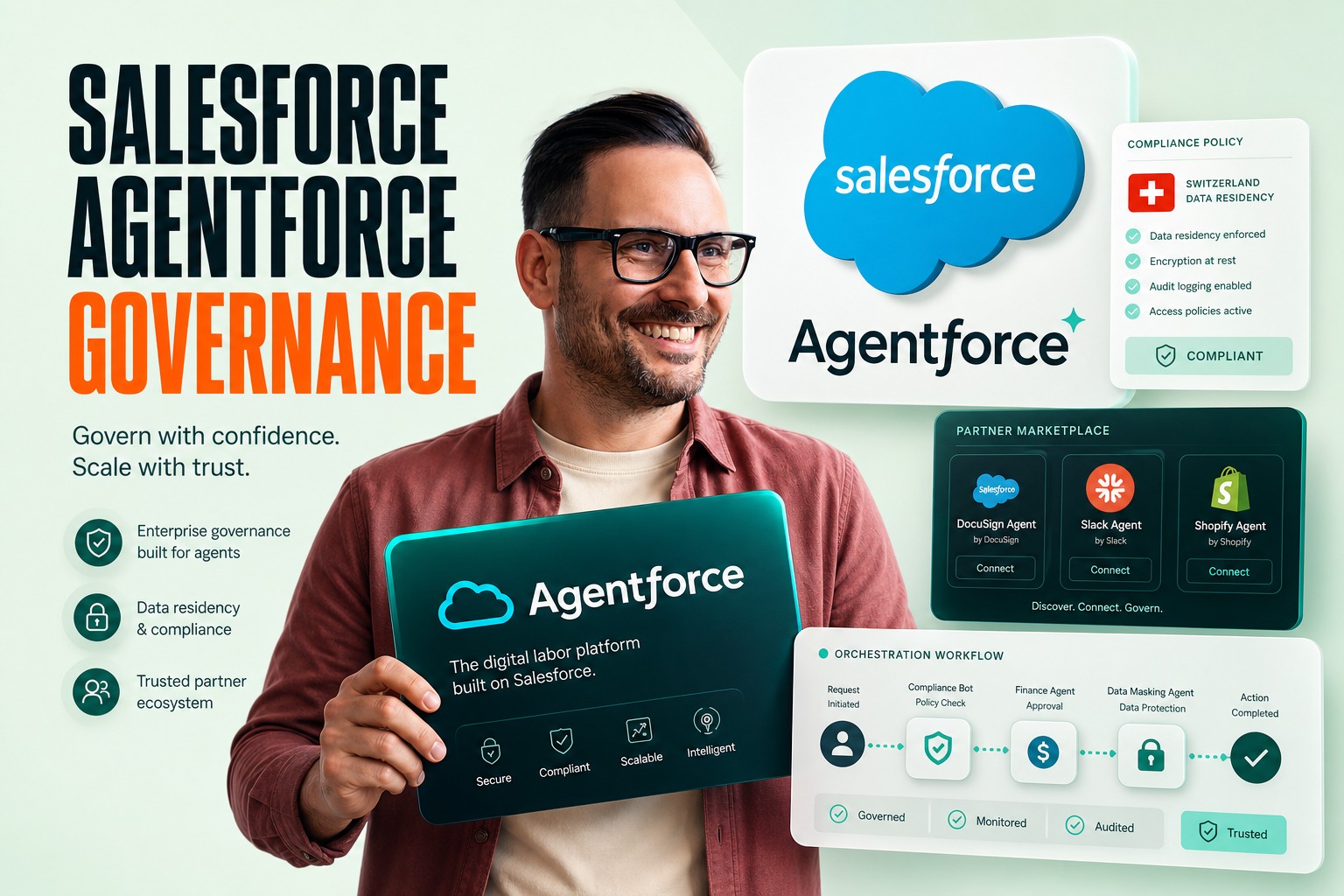
Will Salesforce’s $1 billion Swiss AI spend change how we pick AI platforms? → It forces a shift from pure model selection to platform‑level orchestration.
Is the Agentforce platform the only option for Swiss enterprises? → No, but it becomes a compelling baseline because of the investment’s ecosystem pull.
Do Swiss data‑sovereignty rules affect AI agent design? → Absolutely; compliance will dictate where data lives and how agents are wired.
Should CTOs re‑evaluate their AI roadmaps this quarter? → Yes, the investment creates a strategic inflection point for any AI‑centric product line.
Quick Answer: How to Assess Salesforce’s Agentforce After the Swiss $1 B Commitment
Enterprise leaders should treat the announcement as a market‑signal that the real competitive advantage will lie in how well their architecture can plug into Agentforce’s orchestration layer, not merely in the raw capabilities of the underlying language model. Prioritize integration points, data‑governance compliance, and partner‑ecosystem readiness over chasing the newest model, because the $1 billion spend will accelerate tooling, training, and consultancy around the Agentforce stack.
The decisive factor is not the AI model’s size but the platform’s ability to enforce Swiss data‑sovereignty while scaling multi‑agent workflows.
Why Platform‑Centric Orchestration Beats Model‑Centric Choices in 2024
In the wake of Salesforce’s commitment, the industry is witnessing a pivot from isolated model deployments toward unified orchestration frameworks. Architects who continue to design pipelines around a single LLM will soon hit integration walls as partner ecosystems demand standardized interfaces. Agentforce’s promise of a single pane for people, AI agents, and data aligns with the emerging need for cross‑domain coordination, especially in regulated sectors like banking and life sciences.
Standardized APIs – Salesforce is investing in open‑source connectors that reduce custom glue code.
Unified Governance – Central policies will enforce encryption and residency for all agent data.
Partner Marketplace – A curated ecosystem of pre‑built agents accelerates time‑to‑value.
Skill‑Building Programs – Grants and training lower the barrier for in‑house AI talent.
Scalable Infrastructure – Cloud‑native scaling baked into Agentforce reduces operational overhead.
The Hidden Integration Bottleneck: Swiss Regulatory Compliance
Switzerland’s strict data‑sovereignty rules mean that any AI deployment must keep personal and financial data within national borders. While most LLM providers focus on model performance, Agentforce’s architecture embeds compliance hooks at the orchestration layer, allowing enterprises to route data through certified Swiss data centers. This design choice shifts the engineering effort from model tuning to policy‑driven routing, a trade‑off that can save months of legal review.
How the $1 B Investment Reshapes the Swiss AI Talent Landscape
Salesforce’s funding will fuel university collaborations, apprenticeship programs, and the Bring Women Back to Work initiative. For CTOs, this translates into a deeper talent pool familiar with Agentforce’s tooling. Companies that tap into these programs can staff integration projects faster, reducing reliance on external consultants. Moreover, the Davos Codes program will produce a pipeline of students already versed in the platform’s SDK, lowering onboarding costs for new AI teams.
From Model‑Centric to Orchestration‑Centric Design
The shift forces engineers to reconsider where they place their optimization effort. Instead of squeezing marginal gains from a 175‑billion‑parameter model, they should focus on designing robust orchestration graphs that can dynamically route requests among multiple specialized agents. This approach improves latency, fault tolerance, and compliance, especially when dealing with heterogeneous data sources across banking, life sciences, and energy.
- Modular Agent Registry – Central catalog replaces ad‑hoc model endpoints.
- Policy‑Driven Routing – Data‑location rules dictate agent selection.
- Event‑Based Coordination – Asynchronous pipelines reduce blocking calls.
- Observability Layer – Unified metrics simplify monitoring across agents.
- Versioned Contracts – Backward‑compatible APIs protect downstream services.
The Role of Partner Ecosystems in Accelerating Adoption
Agentforce’s partner program, bolstered by the new investment, will deliver pre‑built agents for banking compliance, medical diagnostics, and energy forecasting. Enterprises can thus shortcut development by integrating these vetted components rather than building from scratch. The trade‑off is a modest licensing fee, but the speed‑to‑market gain often outweighs the cost, especially when regulatory deadlines loom.
| Aspect | Traditional Model‑Centric Approach | Agentforce‑Centric Approach |
|---|---|---|
| Compliance | Post‑hoc audits, costly retrofits | Built‑in policy hooks, automated checks |
| Integration Speed | Weeks of custom connector work | Minutes using standard APIs |
| Ecosystem Leverage | Limited, vendor‑specific | Rich partner marketplace, shared agents |
Plavno’s Take: Aligning Architecture with the New Swiss AI Reality
At Plavno we see the investment as a catalyst for re‑architecting AI services around platform orchestration. Our experience delivering AI‑agent solutions shows that the most resilient deployments are those that treat the orchestration layer as the primary integration point. By partnering with Salesforce’s Agentforce, we can offer clients a faster path to compliant, multi‑agent workflows, leveraging our expertise in cloud software development and AI consulting.
The strategic win comes from embedding compliance into the orchestration fabric, not tacking it on later.
Business Impact: What the Investment Means for ROI
The $1 billion infusion will lower the total cost of ownership for Swiss firms adopting AI agents. Faster integration reduces project timelines by an estimated 30 %, while the talent pipeline cuts hiring expenses by up to 20 %. Moreover, the partner marketplace introduces revenue‑sharing opportunities for firms that develop niche agents, turning compliance costs into new profit centers.
- Map existing data flows against Agentforce’s compliance hooks.
- Pilot a partner agent in a low‑risk domain to gauge integration effort.
- Engage with Salesforce’s training programs to upskill internal teams.
- Re‑evaluate vendor contracts to prioritize platform‑centric solutions.
- Set governance KPIs that track policy enforcement alongside latency.
How to Evaluate This in Practice: Decision Logic Over Checklists
Rather than ticking boxes, executives should construct a decision matrix that weighs integration complexity, regulatory risk, and ecosystem access. Start by scoring each candidate on three dimensions: (1) native support for Swiss data residency, (2) availability of pre‑built agents in the target industry, and (3) flexibility of the orchestration API. The option with the highest composite score will typically be the one that maximizes both speed and compliance.
Define compliance requirements – Identify data categories subject to residency rules.
Score platform capabilities – Use a 1‑5 scale for orchestration, partner access, and governance.
Weight factors – Assign higher weight to compliance for regulated sectors.
Calculate composite score – Multiply scores by weights and sum.
Select the platform – Choose the solution with the highest total, validating against a pilot.
Real‑World Applications: From Banking to Energy
Swiss banks can deploy Agentforce‑driven compliance bots that automatically verify transaction data against national AML registers, leveraging the platform’s built‑in policy routing. Life‑science firms can orchestrate multi‑agent pipelines that combine patient data, genomic analysis, and regulatory reporting, all while keeping data within Swiss borders. Energy providers can use pre‑built forecasting agents to balance grid loads, integrating directly with existing SCADA systems through standard APIs. These capabilities also open opportunities for AI voice assistant development.
Closing Insight: The Real Competitive Edge Is Architectural Alignment
The $1 billion Swiss AI investment does not guarantee market dominance for Salesforce; it guarantees that any firm willing to align its architecture with Agentforce’s orchestration will gain a decisive advantage. Engineers who treat the platform as a compliance‑aware, partner‑enabled hub will outpace those who cling to isolated model deployments. The choice is clear: redesign for orchestration, embed governance early, and tap the emerging Swiss AI ecosystem.
 Chat GPT
 Perplexity
 Claude
 Gemini