What does Salesforce’s acquisition of m3ter mean for AI pricing? → It signals a strategic shift toward usage‑based billing for AI services, indicating that revenue models will increasingly align with actual consumption rather than static seat counts.
Will usage‑based pricing change how we design AI products? → Yes, because billing becomes part of the data pipeline, requiring engineers to embed metering logic directly into model serving layers.
Is real‑time metering required for AI workloads? → Real‑time metering is essential to capture per‑call, per‑token, or per‑GPU‑hour consumption accurately and to synchronize revenue with delivered value.
Can legacy subscription systems handle AI consumption? → They struggle, as traditional subscription platforms lack the granularity and latency needed for fine‑grained AI usage tracking.
Should my engineering team prioritize metering over model improvements? → Prioritizing metering ensures revenue alignment; model improvements remain important but become secondary when pricing depends on consumption.
Quick Answer: Build Real‑Time Metering into the AI Service Stack
Embedding a dedicated metering layer that captures usage events as they happen is the most reliable way to support consumption‑based pricing for AI products. Real‑time data streams feed billing engines, enabling instant invoicing, accurate forecasting, and alignment of revenue with the actual value customers receive from each API call or inference.
The Core Claim: Billing Is a Data‑Pipeline Problem, Not a Licensing Problem
When an AI service moves from seat‑based licensing to usage‑based pricing, the billing challenge morphs into a data‑pipeline challenge. The engineering practice that matters most shifts from choosing the right licensing model to designing a resilient, low‑latency pipeline that records, aggregates, and validates consumption data before it reaches the revenue system. Ignoring this shift leads to revenue leakage and mis‑aligned incentives.
- Granular Consumption Data – Without per‑request metrics, you cannot price at the level of individual inference, which defeats the purpose of usage‑based models.
- Latency Sensitivity – Billing must keep pace with API responses; delays of even a few hundred milliseconds can break SLAs and erode trust.
- Data Integrity Guarantees – Inaccurate or incomplete usage logs create disputes, increase churn, and complicate audit trails.
- Scalable Aggregation – As AI workloads scale, aggregation mechanisms must handle billions of events without becoming a bottleneck.
- Regulatory Compliance – Real‑time metering helps satisfy data‑privacy and financial reporting requirements that static licenses cannot address.
From Seat Licenses to Consumption: How Salesforce’s m3ter Signals a Market Shift
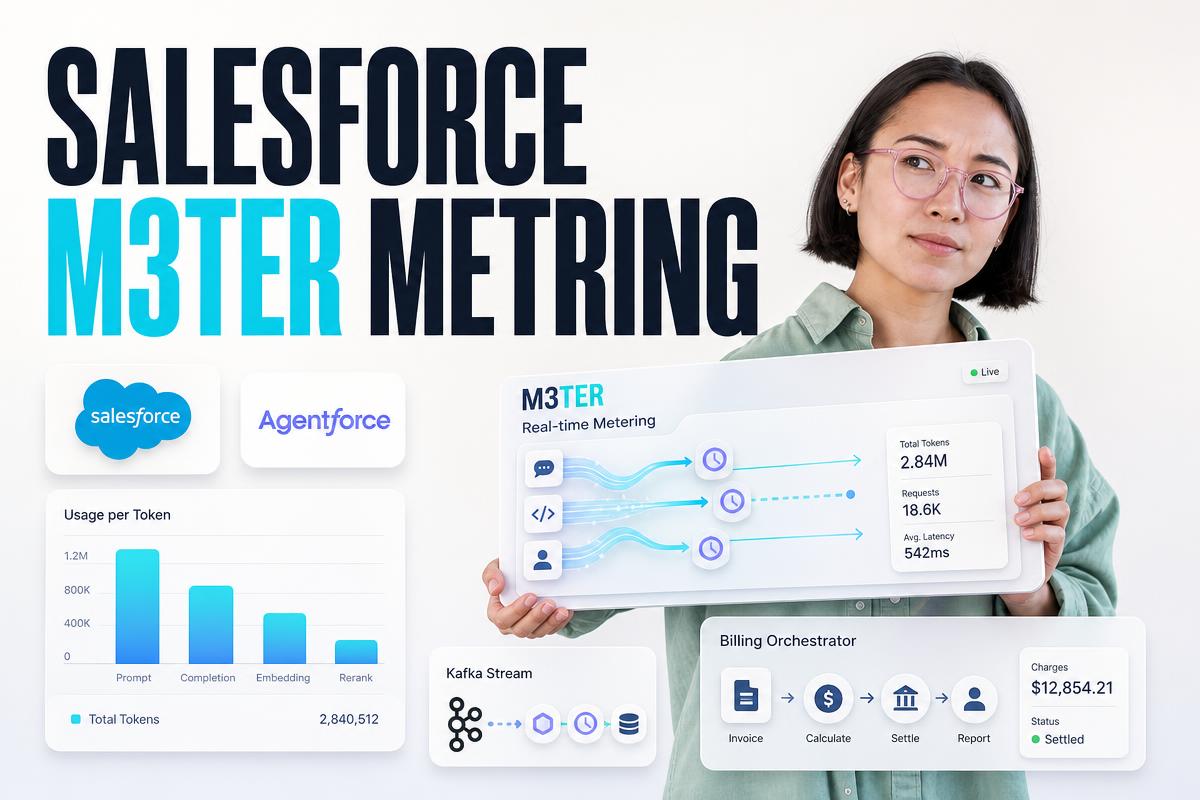
Salesforce’s integration of m3ter into Agentforce Revenue Management demonstrates that even the largest enterprise SaaS vendors recognize the need for consumption‑driven billing. The acquisition highlights a broader industry trend: AI‑intensive products, from large language models to computer‑vision APIs, are increasingly priced by the compute unit, token, or data processed. This shift forces product teams to reconsider architecture, data flow, and customer contracts.
- AI‑Heavy Workloads Demand Flexibility – Customers want to scale usage up or down without renegotiating contracts, which static seat models cannot accommodate.
- Revenue Predictability Improves – Usage‑based pricing aligns cash flow with actual consumption, reducing the risk of over‑provisioning.
- Competitive Differentiation – Vendors that offer transparent metering gain an edge in markets where cost per inference is a key decision factor.
- Customer Trust – Real‑time usage dashboards build confidence, as buyers can see exactly what they are paying for.
- Operational Efficiency – Automated metering reduces manual invoicing effort and accelerates the order‑to‑cash cycle.
Why Real‑Time Metering Beats Post‑Hoc Invoicing
Post‑hoc invoicing relies on batch‑processed logs that may be days old, introducing latency that hampers cash flow and creates reconciliation headaches. Real‑time metering, by contrast, streams usage events directly into billing engines, enabling instant chargeback, dynamic throttling, and immediate usage alerts. This approach also supports tiered pricing rules that react to spikes, ensuring customers never exceed budgetary limits.
Key Rule: Treat every API request as a billable event and route it through a low‑latency, fault‑tolerant pipeline before the response reaches the client.
Embedding Metering Into the AI Stack
Embedding metering means instrumenting the inference layer, the data preprocessing stage, and any downstream analytics components. Each component emits a usage record that includes timestamps, resource identifiers, and cost factors. These records flow into a centralized event hub—often built on Kafka or Pub/Sub—where they are enriched, de‑duplicated, and persisted for downstream billing.
Designing an End‑to‑End Usage‑Based Revenue Engine
A robust revenue engine starts with a metering collector that captures raw usage events at the edge of the AI service. The collector forwards events to a streaming processor that applies business rules, such as tiered discounts or free‑tier caps. The processed events are then stored in a time‑series ledger that feeds a billing orchestrator. Finally, the orchestrator generates invoices, updates customer balances, and triggers notifications. This architecture ensures that every consumption point is accounted for, from the first token generated to the final GPU hour consumed, and that revenue recognition aligns with GAAP standards.
The engine must also support reconciliation for audit purposes, providing immutable logs that can be queried by finance teams. Integration with existing ERP systems, such as SAP or Oracle, is achieved via RESTful adapters that translate usage records into financial entries. By treating billing as a first‑class citizen of the AI stack, organizations avoid the pitfalls of retrofitting legacy subscription modules onto modern, high‑throughput workloads.
Instrument the Inference API – Add lightweight hooks that emit a usage record for each request, capturing model ID, token count, and compute time.
Stream Events to a Central Hub – Use a durable message broker (e.g., Kafka) to ensure no data loss and to enable real‑time analytics.
Apply Business Rules in Flight – Deploy a stream processor (e.g., Flink) to calculate discounts, caps, and tiered rates as events flow.
Persist to an Immutable Ledger – Store enriched events in a time‑series database that supports audit queries and compliance reporting.
Choosing the Right Metering Service
Selecting a metering platform involves evaluating API latency, scalability, and integration depth. Services that expose native SDKs for popular AI frameworks (TensorFlow, PyTorch) reduce implementation effort. Additionally, platforms that provide out‑of‑the‑box connectors to billing systems accelerate time‑to‑value. The right choice balances performance with the ability to customize pricing rules for complex AI workloads. For enterprises embarking on digital transformation, seamless integration is critical.
Operational Implications for Cloud and Edge Deployments
When AI workloads run across hybrid environments—cloud, on‑prem, and edge—the metering layer must remain consistent. Edge devices generate usage events that may be intermittent due to connectivity constraints. To handle this, engineers should employ store‑and‑forward mechanisms that buffer events locally and sync them when the network stabilizes. Cloud‑native deployments benefit from auto‑scaling stream processors that can absorb traffic spikes without manual intervention.
Moreover, latency budgets differ between real‑time inference (sub‑100 ms) and batch processing (seconds to minutes). Metering logic must be lightweight enough not to add perceptible overhead to latency‑sensitive paths, while still capturing sufficient detail for accurate billing. This often means offloading heavy aggregation to downstream consumers, keeping the edge collector minimal.
| Aspect | Legacy Seat Licensing | Real‑Time Usage Metering |
|---|---|---|
| Granularity | Coarse (per‑seat) | Fine (per‑call, per‑token) |
| Billing Latency | Days to weeks | Seconds to minutes |
| Scalability | Limited by contract terms | Scales with event volume |
| Revenue Alignment | Fixed revenue, variable usage | Revenue matches actual consumption |
Plavno’s Approach to Building AI‑Ready Billing
At Plavno, we embed metering directly into the AI service layer using our AI‑agents development expertise. Our architects design a unified pipeline that captures usage from model serving, enriches it with cost metadata, and feeds it into a flexible billing engine. By leveraging cloud‑native streaming services and our proprietary analytics framework, we ensure that clients can launch usage‑based AI products without re‑architecting their entire stack.
Principle: Treat metering as a non‑functional requirement—just like security or observability—so it is baked into the design from day one.
Business Impact: Cash Flow, Margins, and Go‑to‑Market Speed
Usage‑based pricing reshapes cash flow dynamics. Instead of receiving large upfront payments, companies collect smaller, recurring charges that mirror actual consumption. This improves cash‑flow predictability when usage patterns are stable, but it also introduces volatility if demand fluctuates. Margins can increase because customers only pay for value delivered, reducing churn and enabling upsell opportunities through tiered pricing.
From a go‑to‑market perspective, offering consumption models shortens sales cycles. Prospects can trial AI APIs with a free tier, then scale seamlessly as their workloads grow. This reduces the friction of negotiating multi‑year contracts and accelerates revenue recognition. However, finance teams must adapt to more frequent invoicing and invest in analytics to forecast revenue under variable usage. For organizations seeking strategic guidance, our AI consulting services can help align product strategy with billing architecture.
- Revenue Volatility – Monitor usage trends closely to anticipate cash‑flow swings.
- Margin Compression Risks – Ensure cost‑to‑serve is captured accurately to avoid underpricing.
- Customer Adoption – Offer transparent dashboards to build trust in consumption billing.
- Operational Overhead – Automate reconciliation to keep finance overhead manageable.
- Regulatory Scrutiny – Prepare audit trails that demonstrate compliance with financial reporting standards.
Evaluating This Shift in Your Product Roadmap
When deciding whether to adopt usage‑based pricing this quarter, weigh the engineering effort against the strategic upside. Map the required metering hooks against your current API surface, estimate the latency impact, and calculate the incremental cost of streaming infrastructure. If the effort fits within your sprint capacity and aligns with market demand, prioritize a pilot that targets a high‑value AI endpoint.
Real‑World Scenarios Where Usage Billing Wins
Consider a fintech firm that offers a credit‑risk scoring API. Charging per‑score request aligns revenue with the value each transaction delivers, and the firm can dynamically adjust pricing based on risk tiers. Another example is a media company that streams AI‑generated subtitles; billing per‑minute of generated text ensures cost proportionality and encourages efficient model usage. For voice‑enabled products, our AI voice assistant development services illustrate how per‑call metering can monetize conversational interactions.
High‑Variability Workloads – When demand spikes unpredictably, consumption pricing prevents over‑provisioning.
Developer‑Facing APIs – Exposing clear per‑call costs encourages responsible usage and reduces abuse.
Regulated Industries – Transparent metering satisfies compliance requirements for auditability.
Limitations and Edge Cases of Usage‑Based Pricing
While usage‑based models offer flexibility, they are not a silver bullet. In scenarios where workloads are predictable and low‑volume, the administrative overhead of metering may outweigh benefits. Additionally, latency‑sensitive applications cannot afford heavy instrumentation that adds processing time. For legacy customers accustomed to flat‑fee contracts, shifting to consumption can cause resistance and require renegotiation.
Furthermore, accurate cost modeling is challenging when multiple resource dimensions—CPU, GPU, memory, storage—contribute to pricing. Over‑simplified pricing can lead to under‑charging for expensive GPU time, eroding margins. Finally, regulatory environments that mandate fixed‑price contracts may limit the applicability of pure usage‑based approaches.
- Low‑Volume Predictable Use Cases – Stick with flat fees to avoid unnecessary complexity.
- Latency‑Critical Paths – Keep instrumentation lightweight; defer heavy aggregation to downstream processes.
- Multi‑Resource Cost Modeling – Develop granular cost tables to reflect true resource consumption.
- Contractual Constraints – Offer hybrid models that combine a base fee with usage add‑ons.
- Compliance Boundaries – Ensure that any consumption model complies with industry‑specific financial regulations.
Future Outlook: AI Consumption as a Service
The trajectory points toward AI platforms being sold as consumable services, much like cloud compute or storage. As models become more modular and API‑first, the ability to bill per inference, per token, or per data point will become a competitive differentiator. Companies that embed metering early will enjoy smoother scaling, better customer insights, and a clearer path to monetizing AI innovations.
Key Takeaways for CTOs This Quarter
CTOs must recognize that usage‑based pricing transforms billing into a data‑pipeline challenge. The immediate action is to audit existing AI endpoints, identify where metering hooks can be added, and prototype a streaming pipeline that feeds a billing orchestrator. Prioritize low‑latency collectors, choose a scalable event broker, and align finance processes to handle frequent invoicing. This proactive stance positions the organization to capture value from AI consumption before competitors catch up.
- Audit API Surface – List all AI endpoints and map potential usage metrics.
- Prototype Metering – Implement a lightweight collector on a high‑traffic endpoint.
- Select Streaming Backbone – Choose Kafka, Pub/Sub, or a managed service that meets latency SLAs.
- Align Finance – Prepare the billing team for more granular invoicing cycles.
- Monitor Early Metrics – Track usage volume, latency impact, and revenue correlation.
Closing Insight: Architecture Wins Over Model Choice
When the pricing model hinges on consumption, the robustness of the metering architecture determines success more than the superiority of the underlying AI model. A sophisticated model cannot compensate for a brittle billing pipeline; conversely, a solid pipeline can monetize even modest AI capabilities effectively. Need talent to build it? Our hire developer service can staff your team with experts in metering and AI infrastructure.
| Decision Factor | Focus on Model Excellence | Focus on Metering Architecture |
|---|---|---|
| Revenue Capture | May miss usage nuances | Captures every billable event |
| Scalability | Limited by model performance | Scales with event throughput |
| Customer Trust | Relies on perceived value | Built on transparent usage data |
Final Thought: Prioritize Data Pipelines for Sustainable AI Monetization
Investing in a resilient, real‑time metering pipeline is the most strategic move for enterprises that want to monetize AI services through usage‑based pricing. By treating metering as a core infrastructure concern, organizations can unlock flexible pricing, improve cash flow, and accelerate market adoption without sacrificing performance.
Bottom Line: Design billing as a first‑class data pipeline; the rest of the stack will follow.
Call to Action
If your product team is ready to transition to usage‑based AI pricing, let’s discuss how Plavno can help you architect a production‑grade metering pipeline that integrates seamlessly with your existing services. Our expertise spans AI‑agent development, cloud software engineering, and end‑to‑end revenue automation.
- Schedule a Discovery Session – Align business goals with technical feasibility.
- Co‑Design the Metering Architecture – Leverage our AI‑agents development practice.
- Pilot the Implementation – Validate performance and revenue impact before full rollout.
 Chat GPT
 Perplexity
 Claude
 Gemini