What did AHIP 2026 reveal about data interoperability? → Insurers highlighted that sharing claims, pharmacy and clinical data in real time could eliminate many manual handoffs.
How does CVS’s conversational AI differ from a standard chatbot? → It tries to anticipate member intent, surfacing coverage, cost and prior‑auth details before the member even asks.
Why does real‑time data matter more than AI model size? → Because the bottleneck is the flow of information, not the sophistication of the language model.
What problem will a persistent personal AI assistant solve for members? → It will reduce the “homework” of tracking benefits, refills and appointments by proactively flagging gaps.
When will the Health100 platform be generally available? → CVS and Google Cloud plan to launch it later this year.
Quick Answer: Real‑time interoperable data pipelines, paired with a purpose‑driven conversational assistant, are the fastest way for health insurers to slash administrative costs and improve member experience.
The answer is not to chase the newest large‑language model but to invest in AI agents development, claim‑exchange standards (e.g., FHIR, X12) and a thin orchestration layer that can surface the right data at the moment a member asks a question. When the data‑flow is instantaneous, the conversational AI can pull the exact coverage rule, out‑of‑pocket estimate and prior‑auth requirement without human mediation, delivering a measurable reduction in call volume.
Why Interoperability Beats Model Size in the First Three Years of Adoption
In practice, insurers spend months integrating claim‑status feeds, pharmacy benefit managers and electronic health records. Those integrations are the true cost drivers. A large‑language model can generate fluent text, but without the underlying data it can only guess. By contrast, a modest model that can query a real‑time data lake will answer with concrete numbers, reducing the need for follow‑up clarification. The industry’s focus on prior‑authorization automation is a symptom of this deeper data‑exchange problem.
Key principle: The moment a member’s request touches a live data source, the conversation becomes a transaction, not a chat.
Core Architecture: From Data Lake to Persistent Assistant
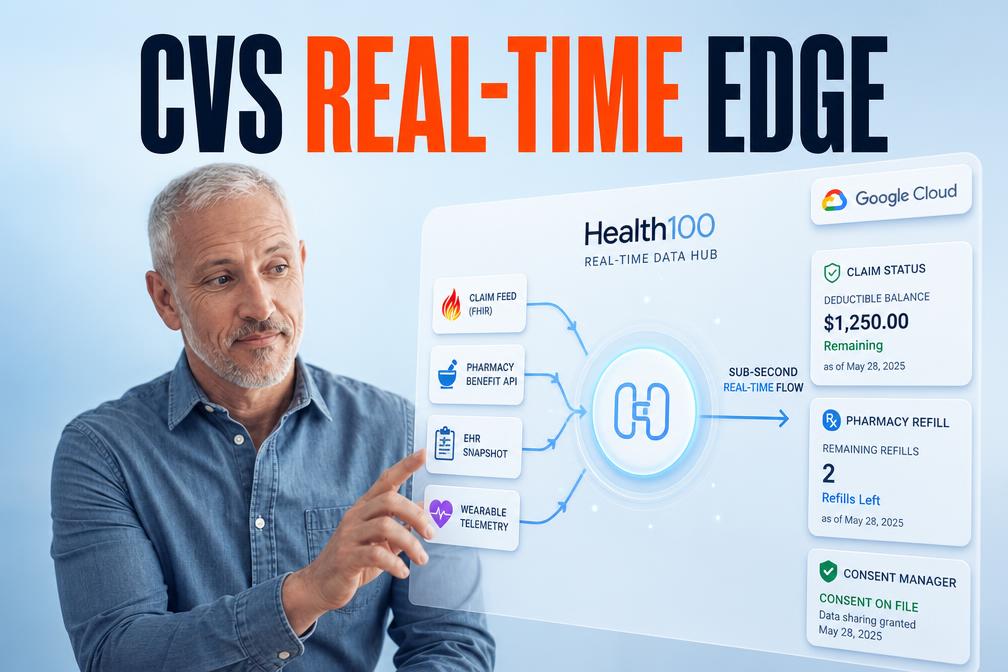
At the heart of CVS’s Health100 vision is a consent‑based data hub that aggregates claims, pharmacy records, EHR snapshots and, where permitted, wearable telemetry. This hub sits behind a secure API gateway that enforces OAuth scopes per member. A lightweight orchestration service receives the member’s natural‑language query, maps intent to a predefined workflow, and then pulls the exact fields needed – for example, the current deductible balance, the formulary tier of a prescribed drug, and any pending prior‑auth flags. The response is then templated into a conversational UI, giving the member a single, actionable answer.
- Unified claim feed: All payer‑to‑payer claim updates flow through a single FHIR‑based endpoint, eliminating duplicate processing.
- Pharmacy benefit integration: Real‑time prescription status is exposed via a RESTful API that returns fill history, remaining refills and cost share.
- EHR snapshot service: A nightly extract of key clinical data (diagnoses, allergies) is cached for fast lookup.
- Consent manager: Members opt‑in once; the system records consent granularity for each data source.
- Orchestration engine: A rule‑based router matches intents (e.g., “Is surgery covered?”) to the exact data calls needed.
Operational Insight: Reducing Call Volume with a Proactive Assistant
CVS reported that its pharmacy call center handled over 500 million inquiries annually. After deploying the conversational AI, roughly 75 % of those interactions were resolved without human involvement. The remaining 25 % now consist of complex clinical questions that truly require a pharmacist’s expertise. This shift illustrates how a well‑engineered data pipeline can offload routine tasks, allowing staff to focus on high‑value care coordination.
The Hidden Cost of Intermediary Layers
Every additional system that translates or enriches data adds latency and a point of failure. When a member asks about coverage, a naïve chatbot might first query a legacy claims database, then a separate pharmacy system, and finally a pricing engine. Each hop introduces delay and potential data mismatch. By collapsing these hops into a single, real‑time orchestrator, insurers can guarantee sub‑second response times and avoid the “information silo” trap that has plagued prior‑authorization workflows.
Technical Trade‑offs: Choosing the Right Integration Stack
When architects select a stack, they must balance latency, security, and extensibility. A pure‑REST approach offers simplicity but can become brittle as new data sources are added. Event‑driven architectures using Kafka or Pub/Sub provide scalability but require careful schema management to avoid “event storm” fatigue. Moreover, regulatory compliance (HIPAA, GDPR) forces encryption at rest and in transit, demanding robust key‑management services. The right choice often depends on the insurer’s existing technology debt and the speed at which they need to launch the assistant.
| Integration Style | Latency (typical) | Extensibility |
|---|---|---|
| Synchronous REST | 200‑400 ms | Moderate – new endpoints require versioning |
| Event‑Driven (Kafka) | 50‑150 ms (after warm‑up) | High – topics can be added without breaking consumers |
| Hybrid (REST + Events) | 100‑250 ms | High – critical paths stay sync, bulk feeds async |
Plavno’s Perspective on Building Scalable Health AI
At Plavno we have helped insurers modernize their data pipelines by deploying cloud‑native API gateways and managed event streams. Our experience shows that a phased rollout—starting with a high‑impact claim‑status API, then layering pharmacy and EHR feeds—delivers quick wins while preserving architectural flexibility. We also advise clients to embed observability (metrics, tracing) from day one, because the moment the assistant goes live, any latency spike is immediately visible to members.
Map member intents to data calls: Identify the top‑10 queries (e.g., coverage, cost, prior‑auth) and define the exact data fields each needs.
Build a unified API contract: Use OpenAPI to describe the request/response schema, ensuring all downstream systems adhere to the same contract.
Implement a consent layer: Leverage a consent‑management service that records member permissions per data source.
Deploy an orchestration engine: Choose a rule‑engine (e.g., Drools) that can route intents to the appropriate API calls.
Instrument end‑to‑end latency: Use distributed tracing (OpenTelemetry) to monitor each hop and set SLAs for sub‑second responses.
Business Impact: From Cost Savings to Member Loyalty
By cutting 75 % of routine pharmacy calls, insurers can reallocate staff to value‑added services such as chronic‑disease management. The reduction in call‑center operating expense translates directly into lower overhead, while the proactive assistant improves Net Promoter Score (NPS) by delivering answers before members even pick up the phone. Moreover, real‑time data sharing reduces claim‑processing errors, which in turn lowers re‑work costs and speeds reimbursement cycles.
Bottom line:Data integration delivers ROI faster than any AI model upgrade.
How to Evaluate This Strategy This Quarter
When deciding whether to invest in a real‑time data hub versus a fancier LLM, executives should compare the total cost of ownership (TCO) of API development against the projected reduction in call‑center volume. A pilot that connects the pharmacy‑status API to the conversational front‑end can be measured in weeks, whereas training a new model may take months. The key metric is “calls avoided per dollar spent on integration.” If that ratio exceeds the industry benchmark of 0.5, the integration wins.
The Path Forward for CTOs and Product Leaders
CTOs should champion a data‑first roadmap, allocating budget to API standardization, secure consent management and real‑time orchestration before committing to large‑scale model training. Product leaders must align roadmaps with the top member intents, ensuring that each new data source directly supports a measurable reduction in manual contact.
Quick‑Start Checklist for the First 90 Days
1. Identify the five most common member queries.
2. Map each query to the exact data fields required.
3. Build a secure, versioned API for those fields.
4. Deploy a lightweight orchestration service that can merge responses.
5. Launch a beta conversational UI and measure call avoidance.
| Phase | Goal | Success Metric |
|---|---|---|
| 0‑30 days | Data mapping | Intent‑to‑field map completed |
| 31‑60 days | API rollout | Sub‑second latency for 90 % of calls |
| 61‑90 days | UI launch | ≥ 70 % call avoidance on pilot cohort |
Final Thought
When insurers finally let data flow without the traditional bureaucratic intermediaries, the entire care experience accelerates. The conversational AI becomes a delivery mechanism, not the engine. By investing first in the data fabric, insurers unlock the true potential of AI‑driven member assistance.
Takeaway: Real‑time data sharing is the lever that moves the needle; chatbots are merely the handle.
Author
Plavno team
Last updated: June 2026
 Chat GPT
 Perplexity
 Claude
 Gemini