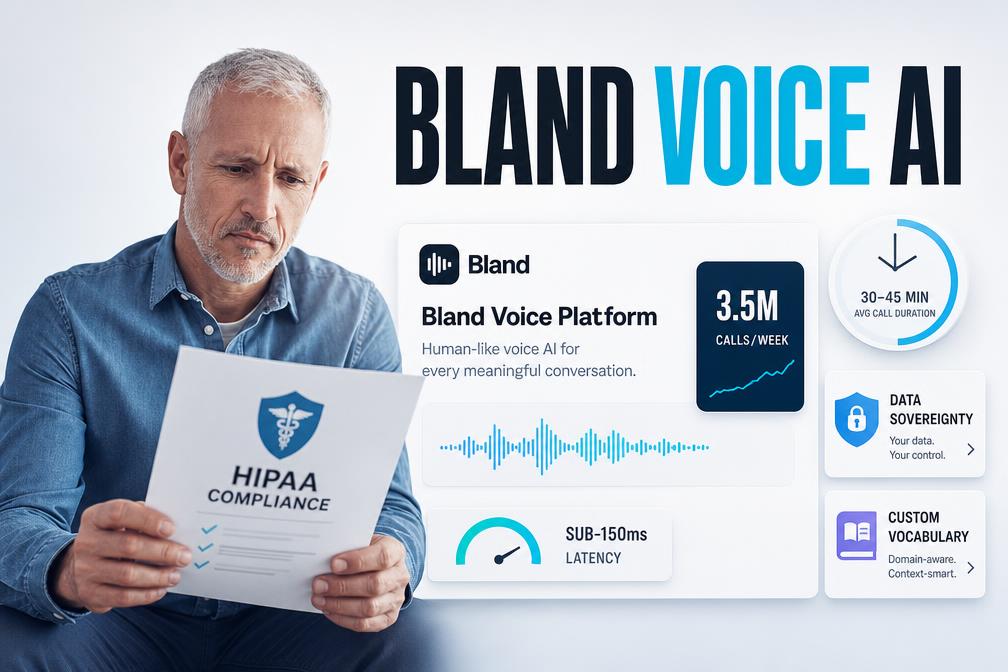
Will proprietary voice AI survive the shift to generative models? → Yes, because control over latency and data privacy is essential for regulated calls.
Can a self‑hosted voice platform handle millions of calls weekly? → Bland’s numbers prove it can, with over 3.5 million calls a week.
Do investors still back long‑form voice agents? → Dell Technologies Capital led a $50 M Series C, showing confidence.
Is model ownership really a competitive advantage? → It eliminates reliance on third‑party APIs and secures data sovereignty.
Enterprise Voice AI Needs Model Ownership, Not API Plug‑Ins
The short answer to the core question—Should enterprises adopt proprietary voice AI platforms for multi‑minute, regulated calls?—is a firm yes. When a call stretches beyond a few seconds, the latency, compliance, and feature‑control demands outpace what a generic, plug‑in model can guarantee. Owning the model lets you dictate the entire stack, from acoustic front‑end to decision logic, ensuring that every 30‑ to 45‑minute interaction meets both performance and regulatory standards.
- Latency guarantees: Third‑party APIs introduce variable network delay that can break multi‑minute dialogs, while an in‑house model runs on dedicated hardware with predictable response times.
- Data sovereignty: Proprietary models keep protected health information and financial data on‑premises, satisfying HIPAA, PCI‑DSS, and other compliance regimes without relying on external providers.
- Feature control: Owning the model lets you iterate on domain‑specific vocabularies, custom intents, and escalation rules without waiting for upstream releases.
How Bland’s Self‑Hosted Voice Platform Redefines Call‑Center Economics
Bland’s architecture is built around a single, in‑house voice model that never allows customers to plug in OpenAI or Anthropic. This design choice forces the entire inference pipeline to run on the customer’s own infrastructure, whether in a private cloud or on‑premises, delivering consistent performance for calls that last up to 45 minutes. Investors such as Dell Technologies Capital and Twilio founder Jeff Lawson have praised this approach, calling voice “one of the hardest problems in AI” and highlighting model ownership as the differentiator.
The platform’s scale speaks for itself: over 3.5 million calls a week, more than 175 million AI‑driven interactions last year, and a roster of 250‑plus enterprise customers including Samsara, Kin Insurance, and CNO Financial Group. These numbers demonstrate that a proprietary voice stack can handle the volume and regulatory constraints of large‑scale enterprises, something plug‑in solutions have yet to prove at comparable depth.
The Long‑Form Call as a Competitive Moat
A typical voice‑AI vendor focuses on short, scripted interactions—appointment reminders, password resets, or simple routing. Bland, by contrast, targets calls that run 30 to 45 minutes, a duration that enables complex tasks such as walking an elderly patient through a blood‑pressure reading and making real‑time escalation decisions. This longer engagement creates a moat: competitors must invest heavily in both model fidelity and compliance tooling to match the depth of service Bland already provides.
Why 30‑45 Minute Calls Matter in Healthcare
In regulated sectors like healthcare, the ability to stay on the line for a full diagnostic conversation can be the difference between a successful outcome and a missed opportunity. Bland’s agents can ask follow‑up questions, interpret vitals, and trigger emergency protocols—all within a single, continuous session. This capability reduces hand‑offs, lowers error rates, and aligns with the stringent documentation requirements of HIPAA‑covered entities.
Regulatory Pressures Force Self‑Hosted Deployments
Healthcare and financial services are bound by strict data‑handling rules. A third‑party API that processes PHI or financial records off‑site introduces legal risk and often fails compliance audits. By offering self‑hosted deployments, Bland gives enterprises the sovereignty needed to meet regulatory mandates while still leveraging cutting‑edge voice AI.
- Compliance auditability: On‑prem models provide full traceability of data flows, satisfying auditors.
- Custom encryption: Enterprises can enforce their own encryption standards at every stage of processing.
- Geofencing: Data never leaves the designated jurisdiction, avoiding cross‑border legal complications.
- Version control: Organizations retain control over model updates, preventing unexpected behavior changes.
Evaluating Model Ownership vs. Plug‑In Strategies
When deciding whether to build a proprietary voice stack or rely on a plug‑in API, CTOs should weigh three dimensions: latency, data control, and feature flexibility. Latency is non‑negotiable for long‑form calls; even a 200 ms jitter can disrupt conversational flow. Data control determines whether you can meet HIPAA, GDPR, or other regulatory obligations. Feature flexibility dictates how quickly you can adapt the model to new domains or compliance updates.
Choosing a plug‑in model may reduce upfront engineering effort, but it hands over critical performance and compliance levers to an external party. In contrast, a proprietary model demands higher initial investment but returns predictability, security, and the ability to differentiate through custom intent handling and domain‑specific tuning.
What the Market Is Funding: A $100M Bet
Bland’s $50 million Series C, led by Dell Technologies Capital, sits alongside a broader $3 billion market estimate that could swell to $13.5 billion by 2034. The capital influx signals confidence that voice AI’s next frontier lies in deep, regulated engagements rather than shallow, transactional calls. Investors are betting that the companies that master model ownership will capture the lion’s share of this expanding market.
Investor Signals from Dell and Voice‑AI Veterans
Dell’s partner Elana Lian highlighted voice as “one of the hardest problems in AI,” emphasizing that owning the model is the differentiator. Backers such as Max Levchin (Affirm) and Jeff Lawson (Twilio) further reinforce the notion that the future of voice lies in bespoke, enterprise‑grade solutions rather than generic APIs.
- Strategic alignment: Investors see proprietary voice as a lever for vertical differentiation.
- Risk mitigation: Owning the stack reduces reliance on external roadmaps.
- Long‑term value: Proprietary models can be monetized across multiple regulated industries.
- Barrier to entry: High engineering effort creates a defensible moat.
Architectural Implications of In‑House Voice Models
Building a self‑hosted voice platform requires rethinking the classic micro‑service stack. Instead of a thin API gateway that forwards audio to a cloud LLM, you need a dedicated inference cluster, a real‑time audio pre‑processor, and a domain‑specific intent engine that can operate under strict latency budgets. This architecture often leverages GPUs or specialized ASICs for acoustic modeling, while the downstream decision logic runs on low‑latency CPUs.
The result is a tightly coupled system where each component is tuned for the 30‑ to 45‑minute call window. Engineers must monitor end‑to‑end latency, manage model versioning, and enforce data residency policies—all within a unified deployment pipeline. We also offer AI agents development, digital transformation, and cloud software development expertise to support your journey.
Scaling to 3.5 Million Calls per Week
Bland’s reported volume—over 175 million AI calls last year—demonstrates that a proprietary voice stack can scale to enterprise‑grade traffic. The key to this scalability is a combination of horizontal inference scaling, efficient audio chunking, and robust orchestration that can handle thousands of concurrent sessions without degrading quality.
Operational teams rely on telemetry that tracks per‑call latency, error rates, and compliance flags. By keeping the model in‑house, they can adjust resource allocation in real time, ensuring that peak‑hour spikes never compromise the user experience.
Choosing Between Cloud‑Native and On‑Prem Deployments
Enterprises must decide whether to host their proprietary voice model in a public cloud or on‑premises infrastructure. Cloud‑native deployments offer elasticity and managed services, but they may conflict with data‑sovereignty requirements. On‑prem solutions provide absolute control over data flow and enable tighter integration with existing security tooling, at the cost of higher operational overhead.
A hybrid approach—running the core acoustic model in a private cloud while keeping sensitive decision logic on‑prem—can deliver the best of both worlds. This pattern aligns with the growing trend of “edge‑first” AI, where latency‑critical components reside close to the data source.
Key rule: For any regulated, multi‑minute voice interaction, model ownership trumps convenience; the architecture you choose determines compliance, latency, and long‑term differentiation.
Practical Steps for CTOs This Quarter
The immediate action for technology leaders is to audit existing voice‑AI pipelines for hidden dependencies on third‑party models. Identify any call flows that exceed 15 seconds, as these are the first candidates where latency and compliance become critical. Then map out a migration path that replaces external inference endpoints with an in‑house model, leveraging existing GPU resources where possible.
Parallel to the technical migration, engage legal and compliance teams to define data‑handling policies that match the new deployment model. This dual focus—engineering and governance—will ensure a smooth transition without service disruption.
Assessing Latency Budgets
Latency budgets should be measured from audio capture to intent resolution. For long‑form calls, a target of sub‑150 ms round‑trip per inference step is a practical threshold. Engineers can instrument the pipeline with end‑to‑end tracing, isolate bottlenecks, and allocate additional compute to the acoustic front‑end if needed.
| Dimension | Proprietary Model | Third‑Party API |
|---|---|---|
| Latency | Predictable, on‑prem hardware, sub‑150 ms avg | Variable network latency, often >200 ms avg |
| Data Control | Full sovereignty, on‑site encryption | Data leaves enterprise, limited control |
Cost Considerations Beyond License Fees
While third‑party APIs charge per‑token or per‑call, proprietary models incur upfront compute and engineering costs. However, the total cost of ownership often favors the in‑house route when you factor in compliance audit expenses, data egress fees, and the hidden cost of latency‑induced call failures. Enterprises that process millions of calls can realize significant savings by avoiding per‑call fees and by reducing call‑abandonment rates.
Initial investment: GPU clusters, model training pipelines, and data labeling.
Operational overhead: Monitoring, model versioning, and compliance reporting.
Long‑term savings: Elimination of per‑call API fees and reduced error‑related costs.
Strategic value: Ability to create differentiated, domain‑specific voice experiences.
Real‑World Use Cases That Validate the Approach
In healthcare, Bland’s agents guide patients through vital‑sign collection, dynamically adjusting questions based on real‑time readings. Financial services firms use the same platform to verify identity, collect sensitive documents, and flag suspicious activity—all within a single call, complying with AML and KYC regulations. These deployments prove that long‑form, regulated voice interactions are feasible at scale when the model is owned and tightly integrated.
The success stories also highlight a secondary benefit: the data generated from these calls can be fed back into the model for continuous improvement, creating a virtuous cycle of accuracy and compliance that plug‑in solutions cannot match.
Risks of Ignoring Model Ownership
Choosing an off‑the‑shelf API may appear low‑effort, but it exposes enterprises to hidden latency spikes, unpredictable model updates, and compliance gaps. A sudden change in the provider’s pricing or terms can cripple a call‑center that relies on consistent per‑call costs. Moreover, regulatory audits may flag the use of external processing for PHI, leading to costly remediation.
These risks compound as call duration grows. The longer the interaction, the higher the probability that a latency hiccup or policy change will disrupt the user experience, eroding trust and potentially exposing the organization to legal liability.
| Risk | Ignoring Ownership | Mitigation with Proprietary Model |
|---|---|---|
| Latency spikes | High | Predictable on‑prem inference |
| Compliance breaches | Moderate | Full data sovereignty |
| Vendor lock‑in | High | Independent upgrade path |
| Cost volatility | High | Fixed infrastructure investment |
Future Outlook for Voice‑AI in Regulated Sectors
As regulations tighten and the demand for empathetic, long‑form digital interactions rises, the market will increasingly favor solutions that can guarantee both performance and compliance. Voice‑AI providers that continue to rely on external LLMs will find themselves at a strategic disadvantage, while those that invest in proprietary stacks will capture the premium segment of healthcare, finance, and insurance.
The next wave of innovation will likely involve tighter integration of voice with other modalities—video, IoT sensors, and real‑time analytics—further amplifying the need for an end‑to‑end, owned AI pipeline.
- Multi‑modal expansion: Voice combined with video triage.
- Edge inference: Deploying models on devices for ultra‑low latency.
- Regulatory AI audits: Automated compliance checks built into the pipeline.
- Domain‑specific fine‑tuning: Continuous learning from sector‑specific data.
Key Takeaway for Decision Makers
If your organization processes calls longer than a few seconds and operates under strict compliance regimes, the strategic choice is clear: invest in a proprietary voice model and the supporting architecture. The alternative—relying on third‑party APIs—leaves you vulnerable to latency, compliance, and cost volatility that can erode both user trust and bottom‑line performance.
By aligning engineering resources with a model‑ownership strategy, you position your company to dominate the emerging $100 billion voice‑AI market, rather than becoming a footnote in a vendor‑driven ecosystem.
Bottom line: Model ownership is the decisive factor for long‑form, regulated voice AI; treat it as a core infrastructure decision, not an optional add‑on.
How Plavno Helps Build Proprietary Voice Solutions
At Plavno, we specialize in end‑to‑end development of custom voice AI platforms, from acoustic model training to secure, self‑hosted deployment. Our expertise spans the full stack—GPU‑accelerated inference, real‑time orchestration, and compliance‑first architecture—so you can focus on domain logic while we handle the heavy lifting of model ownership. Learn more about our AI voice assistant development services.
Our teams integrate directly with your existing security and data pipelines, ensuring that every byte of audio remains under your control.
Next Steps for Your Organization
Begin with a pilot that replaces a high‑value, long‑duration call flow with an in‑house model. Measure latency, compliance metrics, and cost impact over a 30‑day window. Use those results to build a business case for broader rollout, aligning engineering, legal, and finance stakeholders around a unified voice‑AI strategy.
A disciplined pilot provides the data you need to justify the upfront investment and to demonstrate ROI to the board.
Contact Us to Accelerate Your Voice AI Journey
Ready to own your voice AI stack and capture the emerging market? Reach out to the Plavno team to discuss a tailored roadmap, architecture review, and implementation plan that aligns with your regulatory and performance goals.
We’ll help you turn the promise of long‑form voice AI into a reliable, compliant, and profitable reality.
 Chat GPT
 Perplexity
 Claude
 Gemini