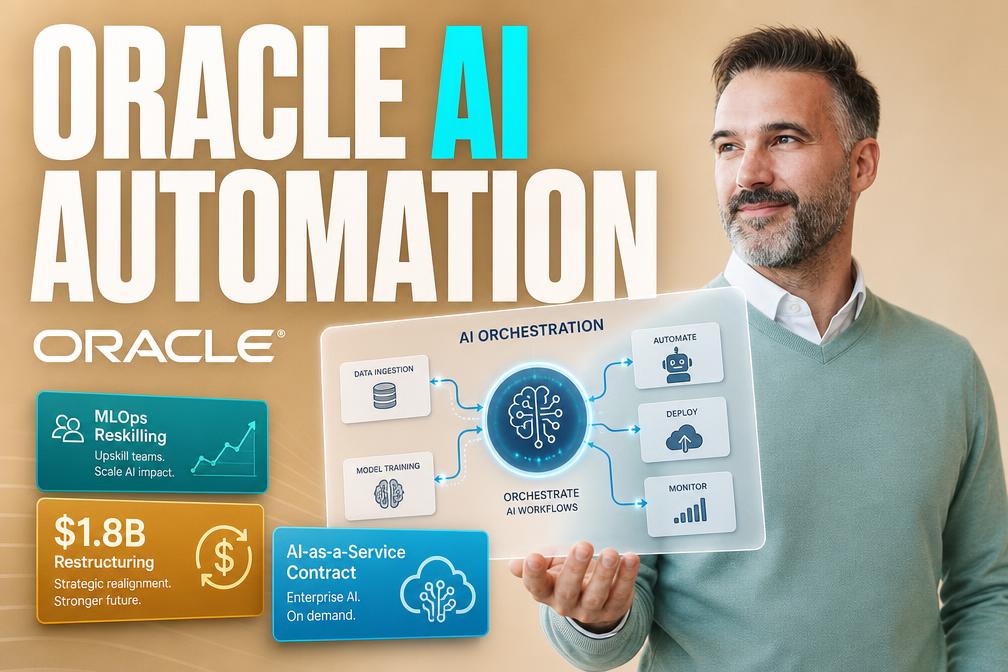
Is Oracle’s AI‑driven workforce reduction a warning for my cloud team? → Yes – it shows that AI can replace many support and middle‑management roles faster than core engineering.
Will cutting 21,000 jobs affect Oracle’s ability to deliver AI services? → Not immediately; the cuts are aimed at reducing costs while keeping AI‑focused infrastructure.
What does the headline number of 49,000 US employees tell me? → It signals a shift from a large, diversified staff to a leaner, AI‑centric operation.
How should a CTO respond to this trend this quarter? → Prioritize reskilling, modular AI contracts, and a tighter automation governance model.
Is the cost of $1.8 billion restructuring a one‑off expense? → It reflects the financial pressure of funding AI infrastructure while shedding legacy labor.
Quick Answer
Oracle’s recent layoff of 21,000 workers—driven by AI‑enabled automation—demonstrates that the most immediate cost‑savings come from replacing routine operational roles, not from cutting core engineers. For a CTO, the actionable takeaway is to shift hiring focus toward AI orchestration talent, invest in upskilling existing staff, and negotiate flexible AI‑as‑a‑service contracts rather than expanding the traditional cloud engineering headcount.
Explore our AI solutions such as AI agents development, cloud software development, AI consulting, digital enterprise consulting, AI recommendation system, and AI automation.
- Automation replaces routine tasks faster than core development – AI can handle ticket triage, data migration, and routine monitoring without extensive human oversight.
- Cost pressure drives a shift to AI‑centric contracts – Large upfront capex on data‑center capacity is being offset by variable‑rate AI service agreements.
- Reskilling beats hiring for many mid‑level roles – Employees who can manage AI pipelines add more value than new cloud engineers.
- Geographic distribution matters – The bulk of the cuts occurred outside the U.S., hinting at a global reallocation of talent.
- Strategic focus moves to AI governance – Controlling model drift and compliance becomes a higher priority than raw compute.
Why Oracle’s AI‑First Cost Model Undermines Traditional Cloud Hiring
Oracle’s filing shows a 13 % drop in global headcount, paired with a $1.8 billion restructuring bill. The company is simultaneously expanding data‑center capacity to serve AI customers like OpenAI. This paradox reveals a strategic pivot: Oracle is willing to invest heavily in hardware while shedding labor that does not directly contribute to AI service delivery. The implication for CTOs is clear—spending on raw compute does not guarantee a proportional increase in engineering talent; instead, the organization must reallocate budget toward AI platform orchestration, model monitoring, and rapid integration pipelines.
How Automation Targets Non‑Engineering Roles First
Automation tools—such as intelligent ticket routing, predictive maintenance, and automated compliance checks—are most effective in functions that generate high‑volume, low‑complexity work. Oracle’s reduction of 21,000 positions reflects this pattern: many of the eliminated roles were in support, finance, and HR, where AI can deliver immediate efficiency gains. By contrast, core engineering teams that design and maintain the AI infrastructure remain largely untouched, underscoring a deliberate staffing shift.
Why Core Engineers Remain Critical Despite the Cuts
Even as AI replaces many support functions, the underlying infrastructure still requires deep expertise. Oracle’s continued investment in data‑center expansion signals that the company still needs architects, security specialists, and performance engineers to keep the AI platform reliable and compliant. This creates a paradoxical hiring need: a smaller, more specialized engineering cohort that can manage AI‑centric workloads at scale.
The real staffing bottleneck now lies in AI orchestration, not in raw compute provisioning.
The Strategic Shift From Hiring Cloud Engineers to Securing AI Service Contracts
For enterprises watching Oracle’s moves, the pragmatic response is to treat AI capabilities as a consumable service rather than a build‑from‑scratch effort. By negotiating usage‑based contracts with AI providers, CTOs can align cost with demand, avoid over‑staffing, and retain flexibility. This also frees internal engineers to focus on integration, data governance, and custom model fine‑tuning—areas where proprietary knowledge adds competitive advantage.
- Predictable OPEX – Pay‑as‑you‑go pricing matches workload spikes without long‑term salary commitments.
- Rapid access to cutting‑edge models – Providers update models continuously, keeping your stack current.
- Reduced hiring latency – No need to source senior cloud architects for every new AI project.
- Focused internal talent – Engineers can specialize in data pipelines, security, and compliance.
- Scalable governance – Contractual SLAs enforce performance and auditability.
Reskilling as a Competitive Lever in an AI‑Automated Workforce
Oracle’s layoffs underscore the urgency of upskilling existing staff. Employees who understand both cloud operations and AI model lifecycle management become valuable assets. Reskilling programs that blend DevOps practices with MLOps concepts enable teams to automate model deployment, monitoring, and rollback without expanding headcount. This approach also mitigates the risk of talent shortages in a market where AI expertise is in high demand.
How Oracle’s $1.8 B Restructuring Cost Shapes Future Investment Priorities
The restructuring expense signals that Oracle is willing to absorb short‑term financial pain to achieve a leaner, AI‑centric operating model. For CTOs, this means that capital allocation should prioritize AI platform tooling, model governance frameworks, and talent development over traditional data‑center expansion. The trade‑off is clear: investing in AI automation yields higher ROI than adding more servers when the workforce is shrinking.
| Category | Oracle’s 2023 Focus | Typical Enterprise Response |
|---|---|---|
| Infrastructure | Heavy data‑center spend for AI workloads | Shift to hybrid or multi‑cloud to avoid capex |
| Workforce | 21,000 cuts, especially in support roles | Upskill existing staff, reduce hiring |
| AI Services | Expand contracts with OpenAI‑type providers | Adopt modular AI‑as‑a‑service models |
The Hidden Cost of Maintaining Legacy Systems During AI Transition
Even as AI replaces many functions, legacy applications still consume compute and staff time. Oracle’s rapid AI rollout forces a parallel effort to decommission or modernize older workloads. CTOs must allocate resources to refactor legacy codebases, otherwise the promised efficiency gains are eroded by ongoing maintenance overhead.
Audit current roles – Identify positions with high‑volume, low‑complexity tasks suitable for automation.
Map AI service gaps – Determine which AI capabilities can be sourced externally versus built in‑house.
Design a reskilling roadmap – Prioritize MLOps, data‑engineering, and security training for existing staff.
Negotiate flexible AI contracts – Secure usage‑based agreements that include governance SLAs.
Monitor workforce metrics – Track headcount, productivity, and cost per AI transaction to adjust strategy.
Why Governance Becomes the New Bottleneck
As AI replaces more human processes, ensuring model compliance, bias mitigation, and auditability becomes a critical function. Oracle’s focus on AI infrastructure without proportional growth in governance staff suggests a potential risk area. Enterprises must therefore embed governance roles early, even if overall headcount shrinks, to avoid regulatory pitfalls.
- Regulatory penalties – Non‑compliant models can trigger fines.
- Reputational damage – Bias incidents erode customer trust.
- Operational downtime – Model drift may cause service failures.
- Hidden costs – Remediation after incidents is far more expensive than proactive governance.
- Strategic misalignment – Poor governance can derail AI initiatives.
Business Impact: From Cost Savings to Market Positioning
Oracle’s layoffs translate into immediate cost reductions, but the longer‑term business impact hinges on how quickly the remaining workforce can deliver AI‑powered products. Companies that emulate Oracle’s automation while preserving a skilled AI‑orchestration team can accelerate time‑to‑market for AI features, gaining a competitive edge in sectors like finance, healthcare, and retail.
How to Evaluate AI‑Automation Benefits in Your Organization
When assessing whether to follow Oracle’s model, measure the ratio of automated tasks to total operational volume. If automation can handle more than 30 % of routine tickets, the ROI of cutting support staff becomes compelling. Combine this metric with a talent heat map to identify which roles can be reskilled versus which require external AI services.
- Automation coverage percentage – Share of processes handled by AI.
- Cost per AI transaction – Operational expense after automation.
- Employee productivity index – Output per remaining staff member.
- Time‑to‑model‑deployment – Speed of bringing new AI capabilities live.
- Compliance incident rate – Frequency of governance breaches.
Real‑World Applications Where Oracle’s Model Is Already Paying Off
Financial institutions leveraging AI for fraud detection have reduced manual review staff by up to 40 %. Healthcare providers using AI‑driven imaging analysis report similar reductions in radiology support roles. These examples confirm that AI can safely replace many middle‑tier positions, provided governance and data quality are maintained.
Risks and Limitations of an Aggressive AI‑First Workforce Strategy
While automation yields cost benefits, over‑reliance on AI can expose organizations to model drift, data bias, and vendor lock‑in. Oracle’s rapid expansion of AI infrastructure without proportional governance staffing highlights this tension. Enterprises must balance speed with robust monitoring, and retain enough human expertise to intervene when models misbehave.
| Risk Category | Potential Impact | Mitigation Approach |
|---|---|---|
| Model Drift | Degraded service quality | Continuous monitoring and retraining pipelines |
| Vendor Lock‑In | Loss of bargaining power | Multi‑cloud AI strategy with interchangeable providers |
| Skill Gap | Inability to manage AI lifecycle | Structured reskilling and hiring of MLOps talent |
| Compliance | Regulatory fines | Embedded governance frameworks |
Closing Insight: The Real Decision for CTOs
Oracle’s AI‑driven layoffs prove that automation reshapes staffing more quickly than hardware investments. The decisive move for a CTO this quarter is not to double down on hiring cloud engineers, but to reallocate budget toward AI orchestration talent, robust governance, and strategic reskilling. By doing so, you turn cost‑saving layoffs into a catalyst for a more agile, AI‑ready organization.
The takeaway is simple: let AI replace routine work, but keep humans in the loop for orchestration and governance.
Next Steps for Your Organization
Begin by mapping all support‑level processes that generate high ticket volume. Identify which of those can be handed off to AI, then draft a reskilling plan for the affected staff. Simultaneously, negotiate flexible AI‑as‑a‑service contracts that include clear governance SLAs. This three‑pronged approach aligns cost reduction with sustainable AI growth.
Process audit (Weeks 1‑4) – Catalog support tasks, estimate automation potential, and prioritize high‑impact candidates.
Pilot automation (Weeks 5‑8) – Deploy AI bots for selected tasks, measure coverage, and refine models.
Scale and reskill (Weeks 9‑12) – Expand automation, formalize reskilling pathways, and lock in AI service contracts with governance clauses.
 Chat GPT
 Perplexity
 Claude
 Gemini