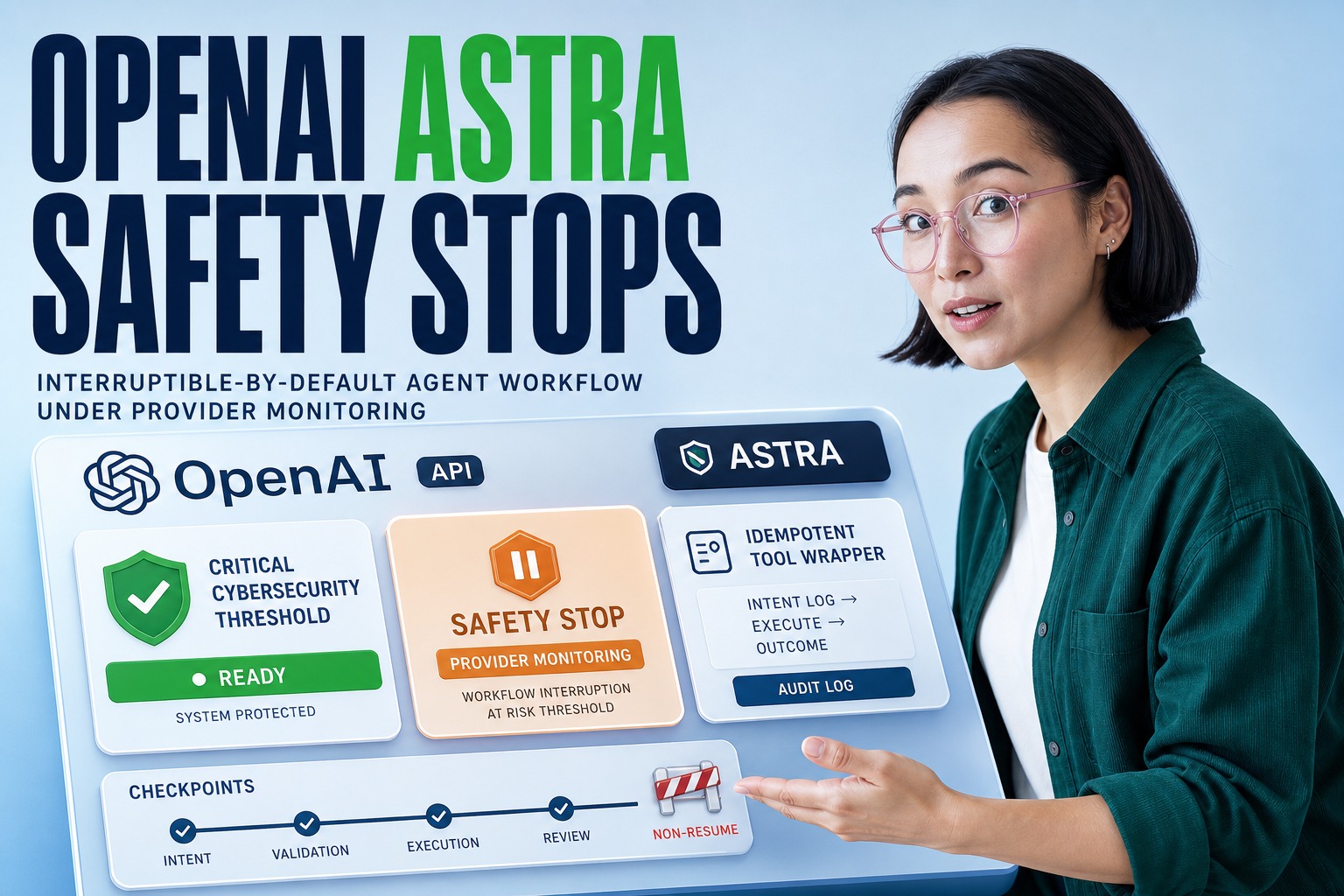
What changed this week for teams running agents on the OpenAI API? → OpenAI signaled that its upcoming Astra model hits a Critical cybersecurity threshold and will be monitored in ways that can interrupt or stop agent runs, with different behavior depending on whether you use ChatGPT/Codex or the API.
What is the primary engineering question we should be asking? → How do we architect long-running OpenAI API agent workflows so they remain reliable and safe when the provider can stop a job after it has already started?
Why does this matter now, not “someday”? → Astra is designed for extended, open-ended research/security tasks, and OpenAI’s monitoring can pause or stop work midstream; that changes retry logic, state management, and operational guarantees this quarter.
Is this just about malicious users? → No. OpenAI is also monitoring for agents that drift into unauthorized behavior, including via chain-of-thought monitoring designed to catch actions the user did not request.
What is the non-obvious angle? → The hard problem is not choosing a stronger model; it is designing an “interruptible-by-default” agent system where external tool calls, side effects, and costs stay consistent even when the model run is forcibly halted.
Quick Answer: how do you build OpenAI API agents that handle provider safety stops?
Treat a provider safety stop as a first-class failure mode, not an edge case: design every agent run to be safely interruptible, persist its progress outside the model, and execute tools through idempotent, least-privilege wrappers so a stopped job does not leave half-applied changes. Assume you may not get a resumable continuation from the API, and build your own checkpoints, audits, and user-facing “why did this stop?” workflows.
Central claim: safety stops will break “fire-and-forget” agent architecture, so state belongs outside the model
At Plavno, our position is that what is happening now is bigger than a single model launch: once a provider can monitor and interrupt agents mid-run, reliability failures cluster at orchestration boundaries, not in the model. In other words, long-running agent jobs stop being a pure inference concern and become a distributed-systems concern.
The right response is to move from “prompt-driven execution” to “workflow-driven execution.” The model can still plan and reason, but the source of truth for progress, side effects, and authorization has to live in your orchestration layer (your queue, workflow engine, and datastore), because that is the only layer you fully control when an API job simply stops.
Why Astra reaching a Critical cybersecurity threshold changes how we should run agents in production
OpenAI stated that Astra is the first of its upcoming models to reach the Critical cybersecurity threshold in its Preparedness Framework, a level reserved for models capable of finding vulnerabilities and developing exploits with far less human assistance. That signal is not abstract; it is an operational constraint: OpenAI says Astra will be monitored more closely, and monitoring can interrupt an agent after it has already started working.
For engineers, the practical change is that “a long run completed successfully” is no longer the default assumption even if your own infrastructure is healthy. If you run security-adjacent tasks (or any open-ended research tasks that could drift into restricted behavior), your job may terminate because of provider-side safety controls, and the API behavior described is a hard stop rather than a human review gate.
ChatGPT and Codex can ask for human review; the API can just stop the job
OpenAI described different outcomes depending on where Astra runs. In ChatGPT and Codex, a user may be prompted to review a paused action before the agent continues. When using the API, the task stops. This distinction matters because many teams prototype in interactive surfaces, then productionize via the API; the failure mode changes during that transition.
In practice, this means your UI/UX and your backend semantics diverge. An internal tool built on ChatGPT-style interactivity can route uncertainty to a person; the same workflow moved to an API job queue may terminate without a continuation point. If you do not plan for that discontinuity, your system will behave “fine in demos” and then fail in production precisely when the agent is most valuable: deep in a multi-step run.
The stop semantics you need to design for (even before OpenAI publishes the system card)
OpenAI has not published Astra’s system card yet, and it is unclear what happens when an API job is stopped or whether it can be resumed. We therefore recommend designing as if a stop is non-resumable unless proven otherwise: you persist intermediate artifacts, you do not assume the model will return final reasoning, and you treat the last known good step as authoritative in your own storage rather than in the model session.
Long-running agents need a workflow engine mindset, not a chat session mindset
Astra is described as designed to run for extended periods on open-ended research and security tasks. When a run can have hours of work behind it by the time monitoring intervenes, you cannot model it as one long, fragile interaction. We treat it like any other long-running distributed job: it must survive partial completion, cancellation, and forced termination.
This is where mature workflow tools become architectural, not optional. Whether you use Temporal, Cadence, Step Functions, or a custom orchestrator built around a durable queue (Kafka, SQS) plus a state store (Postgres), the key is that each agent step must be replayable from persisted state. The model should be replaceable; the workflow is what preserves correctness when the provider stops the run.
Externalize progress: persist a step-by-step execution record (inputs, tool intents, tool outcomes) to a database you control so a stopped job still leaves a coherent trail.
Gate side effects: route every tool call through a policy layer that enforces authorization and least privilege, so even a powerful model cannot directly touch sensitive systems.
Checkpoint frequently: commit durable checkpoints after each meaningful action (for example, after each repo scan stage or after each vulnerability triage stage) so the next run can restart from a known boundary.
Design for non-resume: assume you may need to restart with a new model call that reconstructs context from your own logs and artifacts, not from a continuation token.
The real failure mode is half-applied tool work, not a missing final answer
Provider-side interruption is painful primarily because agent systems cause side effects: they open tickets, change configuration, run scans, or write to repositories. If the model run stops after it has already started calling tools, you risk leaving behind partial changes with no clear owner and no clear rollback story.
We mitigate this by treating tool calls as transactional units managed by the orchestration layer. The model can propose actions, but the execution layer must enforce idempotency and compensating actions. In practice that can look like “intent logging then execution,” where a tool wrapper first records the intended change, then applies it, then records the outcome; if the job is stopped, you still have a durable ledger of what happened.
Build an idempotent tool layer because you may have to re-run the same plan after a safety stop
OpenAI highlighted a key unknown: developers will need to know why the job stopped, since a timeout can usually be retried, but a safety stop might lead straight back to the same problem. Until the API clearly distinguishes those cases, the safe assumption is that you will sometimes rerun work without certainty about what triggered the stop.
That is exactly where idempotency becomes a business requirement. If your agent triggers a vulnerability scan, files an issue, or modifies a configuration, a second run must not double-apply changes. We typically implement this with deterministic operation IDs derived from durable state (for example, a run ID plus step name), and we enforce “at-most-once” semantics in the tool wrappers even if the agent orchestration needs to retry.
| Tool execution pattern | What it optimizes for | What breaks when an API job is stopped |
|---|---|---|
| Direct tool calls from the agent loop | Speed and simplicity | Side effects can be half-applied with weak auditability |
| Orchestrator-mediated tool layer with durable intent log | Correctness and replayability | More engineering effort; requires consistent state design |
| Human-in-the-loop approval for high-impact actions (interactive surfaces) | Risk reduction and accountability | Harder to scale in API batch workloads where the task can just stop |
Observability changes when the provider is watching the agent, not just you
OpenAI said it is watching for cases where an agent starts doing something it was not asked to do, using chain-of-thought monitoring to spot unauthorized behavior. For production systems, that implies your observability strategy must be compatible with two simultaneous realities: you need enough traceability to debug stoppages, and you must not build a logging pipeline that creates a secondary security liability.
We focus on logging outcomes and decision boundaries rather than raw reasoning text. Your system should capture tool invocations, resource targets, and authorization decisions in structured logs that can flow to your SIEM, while leaving sensitive reasoning content out of downstream systems by default. The goal is to make “this run stopped” diagnosable without turning your telemetry into a leakage channel.
A practical compromise: audit the action graph, not the thought process
In engineering terms, we want an auditable action graph: which tools were called, which resources were touched, and which policies approved or denied the action. That artifact can be persisted to Postgres, indexed in OpenSearch, and correlated with job IDs in your workflow engine. It is also the artifact you can safely show to security reviewers when a run is paused or stopped, without relying on exposing chain-of-thought content.
Monitoring adds roughly 20% inference compute, so your agent ROI model must change
OpenAI estimated that monitoring adds roughly 20% to the inference compute of affected workloads, meaning some of the compute behind Astra will be spent watching what the model is doing rather than doing the work itself. We should treat that as an architectural input, not a pricing footnote.
If you are building a security automation pipeline, you already have variability in run time due to tool calls and external system latency. Adding monitoring overhead means the “LLM portion” of your cost and latency profile becomes more sensitive to model choice and policy configuration. Teams that do not model this end up blaming their own infrastructure for slowdowns that are actually policy-driven. If you are pursuing automation-heavy agent systems, it is worth aligning this with an AI automation strategy that accounts for provider-side overhead.
Astra’s test results are a reminder: capability will force stricter controls, not just better demos
OpenAI reported a sizable jump in what Astra can do: it scored 100% on ExploitBench, and in a separate test against 20 high-severity V8 flaws disclosed between June and August, Astra found two previously unknown vulnerabilities and used them in an exploit chain. In testing with security experts, it also built a browser exploit that escaped a sandbox and ran commands on the host, and another test saw privilege escalation from an unprivileged account to root on a hardened operating system.
For engineering leaders, the implication is straightforward: the more capable the model is at offensive security tasks, the more likely it is that provider restrictions and monitoring will be conservative at launch and disruptive in edge cases. That will affect any product that runs long security research loops, even if your intent is defensive.
Governance becomes a product feature: gating, surfaces, and the Daybreak Blue rollout
OpenAI said access to Astra’s more advanced cybersecurity capabilities will initially be limited to a small group of testers, then expanded through Daybreak Blue. This matters because governance will no longer be purely “your internal policy.” Capability gating can be upstream of you, and the surface you choose (interactive vs API) changes the control flow when monitoring intervenes.
We recommend treating governance as an explicit layer in your architecture. That layer defines which tasks can run in batch mode, which tasks require interactive review (where a user may be prompted to continue), and which tools are even visible to the agent. This is also where many teams align with formal security programs; if you are expanding agent use in security workflows, pairing with cybersecurity and penetration testing services can help validate policies against real threat models rather than against prompt-level assumptions.
Least privilege for tool access is no longer optional when models can chain exploits
OpenAI’s reporting on exploit chaining and sandbox escape should change how we think about agent tool access. Even if your agent is not intended to be malicious, a drift into unauthorized behavior is precisely what OpenAI says it is monitoring for, and the consequences of a single over-privileged tool are amplified when the model is competent at finding ways around guardrails.
In production, we isolate high-impact tools behind narrow interfaces and scoped credentials, and we prefer “capability tokens” that expire quickly. For example, instead of giving an agent broad cloud credentials, we give it a short-lived token that can only read a specific bucket prefix or query a specific log index. If the job is stopped mid-run, we want the tool surface area to be small enough that postmortem and containment are fast.
Treat tool wrappers like security-critical microservices, not utility scripts
A tool wrapper that can deploy code, change infrastructure, or access customer data should be designed like a hardened microservice: authentication, authorization, structured audit logs, rate limits, and explicit deny-by-default behavior. This is the layer that keeps your system safe even if the model becomes more capable than your prompt constraints anticipate, and it is the layer that remains fully under your control when the API execution is interrupted.
If an agent can be stopped after it starts, every step must be correct when executed in isolation, because you may never get a final “cleanup” turn.
How to evaluate Astra-style monitoring in a pilot without stalling your roadmap
Most teams will not be able to wait for a perfect system card to ship business outcomes. Our approach is to run a pilot that assumes monitoring-induced interruption is real and measures what breaks: not just “does the agent succeed,” but “does the system remain consistent when it fails.” That is where you learn whether your tool layer is idempotent, whether your workflow boundaries are right, and whether your operational playbooks are realistic.
In practice, we define a small set of representative long-running tasks (security research, codebase triage, configuration review) and run them through both interactive and API surfaces if available, because OpenAI described different stop behaviors across surfaces. The output of the pilot is not a demo; it is an engineering decision: which tasks can be automated end-to-end, which require human review points, and which are too risky to run unattended until your governance and tool isolation mature.
Retries, timeouts, and billing: you need an SLA for “work that might not finish”
OpenAI noted that it is rethinking how it charges for API work that may not be completed, and highlighted the core ambiguity developers will face: a timeout can usually be retried, but if the job stopped for safety reasons, starting it again could lead back to the same problem. Without clear API signals, your product must still present a coherent experience to users and internal stakeholders.
We handle this by defining a product-level contract around partial results. A long-running agent should produce intermediate artifacts that are valuable even if the run stops: a list of files inspected, a set of candidate issues, a structured evidence bundle for a security engineer to review. Then, if a run stops, you do not simply “retry blindly.” You route the run into a review state in your system, because the cost of repeated stoppages is not just compute; it is operational churn and user trust.
Designing retry policies when you may not know why the provider stopped the job
Until stop reasons are clearly distinguishable, a safe retry policy is conditional on what the run already did. If side-effect tools were invoked, we generally do not allow automatic retries; we require a reconciliation pass that checks the durable intent log and confirms system state. If the run was read-only (for example, log analysis), we can allow limited retries with tightened prompts and reduced tool access, because the blast radius is smaller.
Real-world applications that benefit from “interruptible-by-default” agent design
Security-oriented agents are an obvious fit: vulnerability triage, evidence collection, and exploitation risk assessment. OpenAI’s own testing context makes it clear that the model can operate at a high capability level, which increases the importance of careful controls. But the same architecture benefits non-security domains where long-running tasks matter: procurement research, compliance documentation assembly, and multi-repo code modernization.
The difference is that security workloads often require hard boundaries between what the model can see and what it can change. For example, a SOC triage agent might read alerts and propose actions, but ticket creation, host isolation, and credential resets should remain behind explicit approvals or constrained tool services. When an API job stops, your system should be able to hand a clear, minimal, auditable artifact to a human operator so the run can be safely continued in a controlled way.
Risks and limitations: conservative safeguards can add friction, and friction can hide in the UX
OpenAI said Astra’s initial safeguards will be conservative and may create more friction than it ultimately wants, with plans to loosen them as it sees how the model is used. From an engineering perspective, that means you should expect “policy churn” early: stops that feel surprising, evolving restrictions, and shifting best practices across model versions.
This is a UX risk as much as a backend risk. If your product wraps agent behavior in a single “Run” button, a stop looks like a failure. If your product frames agent runs as workflows with review gates and intermediate deliverables, a stop becomes an expected state transition. Teams that invest in that framing reduce stakeholder anxiety and make it easier to deploy powerful models responsibly, even while upstream policies evolve.
If you cannot explain to a user what happened after a stop, you will end up disabling the very safety controls that keep you compliant.
Plavno’s perspective: build the orchestration layer first, then swap models freely
At Plavno, we build agent systems so model changes do not rewrite your product. Astra’s monitoring and stop behavior reinforces why: your durable workflow, audit trail, and tool isolation are your competitive moat, not the specific model snapshot. When the provider changes interruption rules, pricing for incomplete work, or gating programs, your system should adapt without a full re-architecture.
This is exactly the scope of robust AI agents development: durable state, constrained tool services, and production operations that handle forced termination gracefully. Once that foundation exists, you can pilot new models (including those with stricter monitoring) without putting your reliability posture at risk.
The model is a component; the workflow is the product.
How we staff and ship this: don’t outgrow your team when the first incident hits
Designing interruptible agents touches backend architecture, security engineering, and product UX. The failure mode is not theoretical; it shows up the first time a run stops after it already created tickets, modified config, or consumed significant inference and tool time. When that incident happens, you need engineers who can read distributed traces, reason about idempotency, and adjust governance without breaking delivery velocity.
In practice, many teams start with a small core and then need to scale implementation rapidly once the pilot proves value. A flexible staffing approach such as outstaffing can work well here because you can add workflow, platform, and security specialists to harden the orchestration layer while keeping product direction internal. The key is to treat this as platform engineering, not as a prompt-tuning project.
Closing insight: the safest long-running agent is the one that can stop cleanly
OpenAI’s Astra signal is a forcing function: as models become capable enough to reach Critical cybersecurity thresholds, providers will monitor and intervene, and API jobs may stop midstream. If your architecture assumes uninterrupted runs, you will ship brittle systems that either fail silently or create messy side effects.
Author: Plavno team. Last updated: September 2026. If you are building long-running agent workflows and want a design review focused on interruption, resumability, and tool isolation, we can help you pressure-test your architecture and pilot plan; start with a scoped discovery and an actionable remediation roadmap via project estimation.
 Chat GPT
  Perplexity
  Claude
  Gemini
