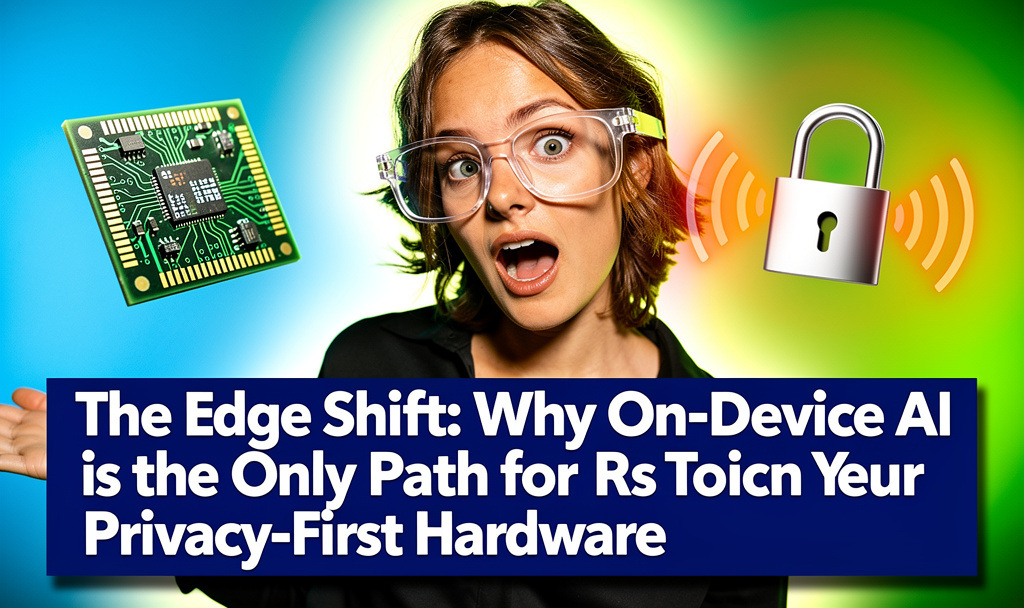
This week, the smart glasses market signaled a decisive pivot away from cloud dependency. Brilliant Labs, in collaboration with Neuphonic and TheStage AI, announced the rollout of the Halo frame, featuring on-device vision inference and conversational AI models that run locally on a dedicated inference engine. This isn’t just a hardware update; it is a rejection of the "cloud-first" latency model that has plagued wearable tech for a decade. By moving both vision and voice processing onto the device, they are addressing the two primary failure modes of consumer AI hardware: unacceptable latency and the inability to guarantee privacy. For enterprise architects and product leads, this move validates a critical thesis: for ambient computing to work, the inference must happen at the edge, not in the data center.
Plavno’s Take: What Most Teams Miss
Most engineering teams underestimate the sheer difficulty of squeezing a multimodal AI pipeline into a power-constrained wearable. The common mistake is assuming that "on-device" simply means swapping an API call for a local model file. In reality, it requires a complete re-architecture of the data pipeline. When we evaluate edge AI strategies, we see teams getting stuck on the thermal envelope. A smart glass frame has a negligible thermal budget; if your vision inference engine runs the CPU at 100% for more than a few seconds, the device becomes physically uncomfortable to wear, and the battery drains in minutes.
The critical oversight is the integration of the inference engine with the sensor hardware. You cannot simply run a standard Python script; you need highly optimized runtimes—likely C++ or Rust-based—that interface directly with the Neural Processing Unit (NPU). If you treat the edge device like a mini-server, you will fail. The architecture must be event-driven and interrupt-based, waking the NPU only when specific sensor thresholds are met. Furthermore, teams often neglect the "update friction." In the cloud, you can patch a hallucination or a bias issue instantly. On the edge, you need a robust Over-the-Air (OTA) mechanism to push new model weights to thousands of devices without bricking them. If your update strategy isn’t as sophisticated as your model architecture, your fleet will fragment into incompatible versions overnight.
What This Means in Real Systems
Implementing this architecture requires a shift from RESTful API calls to local inter-process communication (IPC) and shared memory buffers. In a system like Halo, the audio pipeline from Neuphonic and the vision pipeline from TheStage AI likely share a common orchestration layer. We are looking at a stack where raw sensor data (audio streams or camera frames) is processed by a Digital Signal Processor (DSP) before being passed to the NPU.
From a systems perspective, this introduces new failure modes. A cloud-based system fails when the network goes down; an edge system fails when the memory allocator fragments or when the specific silicon revision has a driver bug. You must implement rigorous "watchdog" services that monitor not just application health, but hardware metrics like temperature and voltage. The inference engine must support dynamic quantization—switching between INT8 for speed and FP16 for accuracy based on the remaining battery level.
Data flow changes fundamentally. Instead of uploading a video stream for analysis, the device performs feature extraction locally. It might only transmit a compressed vector embedding or a simple text string to the cloud for secondary processing. This reduces bandwidth requirements by orders of magnitude—often moving from megabytes per second to kilobytes per session. However, this requires local storage management. If the device needs to retain context for a conversation, it must use a local, lightweight vector database (like SQLite-based extensions) rather than querying a remote instance. This introduces complexity in state synchronization: if the user switches devices, the conversation state must be merged, which is a non-trivial distributed systems problem when the primary generation happens offline.
Why the Market Is Moving This Way
The shift to on-device inference is driven by the collision of privacy regulations and physics. Regulatory bodies in the EU and US are increasingly scrutinizing the transmission of biometric data. Streaming video and audio from a camera-equipped glasses frame to a third-party server is a compliance nightmare under GDPR and CCPA. By processing data locally, the device can claim "zero data retention" for the raw biometric inputs, drastically reducing legal liability.
Technologically, the commoditization of NPUs in System-on-Chips (SoCs) has made this feasible. We are no longer reliant on power-hungry GPUs; modern mobile chips can perform trillions of operations per second (TOPS) on milliwatts of power. The market is realizing that the "cloud tax"—the cost in latency and dollars of round-tripping every interaction—is too high for real-time applications. A conversational interface that takes 500ms to respond feels broken; a sub-100ms local response feels magical. This competitive pressure is forcing hardware vendors to adopt local inference engines like TheStage AI to differentiate on user experience rather than just form factor.
Business Value
The primary business value here is the unlocking of use cases that were previously impossible due to latency or privacy constraints. Consider an industrial setting: a warehouse worker using smart glasses for inventory scanning. With cloud-based vision, every scan requires a Wi‑Fi connection and incurs a 200–400ms delay. In a high-throughput environment, that latency kills productivity. With on-device inference, the recognition happens in under 50ms, allowing for real-time overlay guidance without network dependency.
From a cost perspective, the economics shift from OpEx to CapEx. Cloud inference costs scale linearly with usage. If you have 10,000 users interacting with an AI assistant 50 times a day, your token costs and server bills can skyrocket. On-device inference has a fixed R&D cost but near-zero marginal cost per interaction. Based on typical public pricing for vision APIs versus the amortized cost of local silicon, we estimate that high-volume deployments can reduce inference costs by 60–80% after the initial development investment is recouped.
However, there is a trade-off: the initial R&D investment is significantly higher. Optimizing models for edge hardware requires specialized talent in AI consulting and embedded systems. You cannot simply hire a standard web developer to build this. The Total Cost of Ownership (TCO) analysis must account for the longer development cycle (often 4–6 months additional for optimization) against the long-term savings in cloud bills and compliance risk mitigation.
Real-World Application
Healthcare Assistants: Surgeons or nurses using smart glasses can access patient records or receive procedural guidance without sending video of the patient to the cloud. This satisfies HIPAA requirements much more easily than cloud-based solutions. The glasses can transcribe doctor‑patient conversations locally, storing only the text note on the secure hospital server, never the raw audio.
Industrial Maintenance: Technicians repairing complex machinery can point their glasses at a component, and the local vision model identifies the part and overlays torque specifications or wiring diagrams. Because this runs on the edge, it functions perfectly in the basements of factories or remote field sites where cellular connectivity is non‑existent.
Retail and Loss Prevention: Store associates wearing glasses can identify inventory levels on shelves in real-time. The vision model counts items and triggers restocking alerts locally. This eliminates the privacy risk of facial recognition systems that upload customer footage to central servers, a practice that is increasingly banned in jurisdictions like Illinois and San Francisco.
How We Approach This at Plavno
At Plavno, we do not treat edge AI as a mere porting exercise. When we build custom software for edge deployment, we start with the constraints of the hardware. We select models not just for their accuracy on benchmarks, but for their "quantizability"—how well they maintain performance when compressed to INT8. We often utilize techniques like knowledge distillation, training a large "teacher" model to train a tiny "student" model that fits on the target device.
We prioritize a hybrid architecture. We recognize that the edge is powerful, but the cloud is still smarter for certain tasks. Our designs typically feature a "local-first" approach where the device handles low-latency, sensor‑heavy tasks (like wake‑word detection or object detection), while complex reasoning (like summarizing a week’s worth of logs) is offloaded to the cloud only when connectivity and battery permit. This requires a sophisticated synchronization layer that we build using robust queuing protocols to ensure no data is lost during the hand‑off.
Security is paramount. Since the device processes sensitive data locally, the model weights themselves become a high‑value target. We implement hardware‑backed encryption (like ARM TrustZone) to ensure that even if a device is physically compromised, the AI model cannot be extracted or reverse‑engineered. This is a step that many in‑house teams skip, leaving their intellectual property vulnerable.
What to Do If You’re Evaluating This Now
- Benchmark on Target Hardware: Do not rely on cloud benchmarks. Run your inference tests on the actual chipset or a close development board. Measure p99 latency under sustained load, not just average latency.
- Plan for the Update Cycle: Define how you will handle model drift. If you discover a bias in your computer vision model three months after launch, how do you patch 5,000 devices in the field?
- Audit Your Data Flow: Map exactly what data leaves the device and what stays. If your selling point is privacy, ensure your architecture enforces this by design (e.g., physically disabling the radio when processing sensitive biometrics).
- Consider Hybrid Early: Don't boil the ocean. Start with a feature that benefits most from low latency (like voice commands) and keep the heavy lifting in the cloud. Gradually migrate features to the edge as you optimize the models.
Conclusion
The release of Halo and the integration of TheStage AI’s inference engine mark the end of the "dumb terminal" era for wearables. The future of AI hardware is not just about capturing the world; it is about understanding it instantly and privately. For businesses, this means the competitive landscape is shifting. The winners will be those who can master the complex engineering required to run sophisticated AI on the edge, balancing the triad of performance, power, and privacy.
If you are building systems that rely on the cloud for every interaction, you are building for a past that is rapidly disappearing. The edge is where the intelligence lives now.