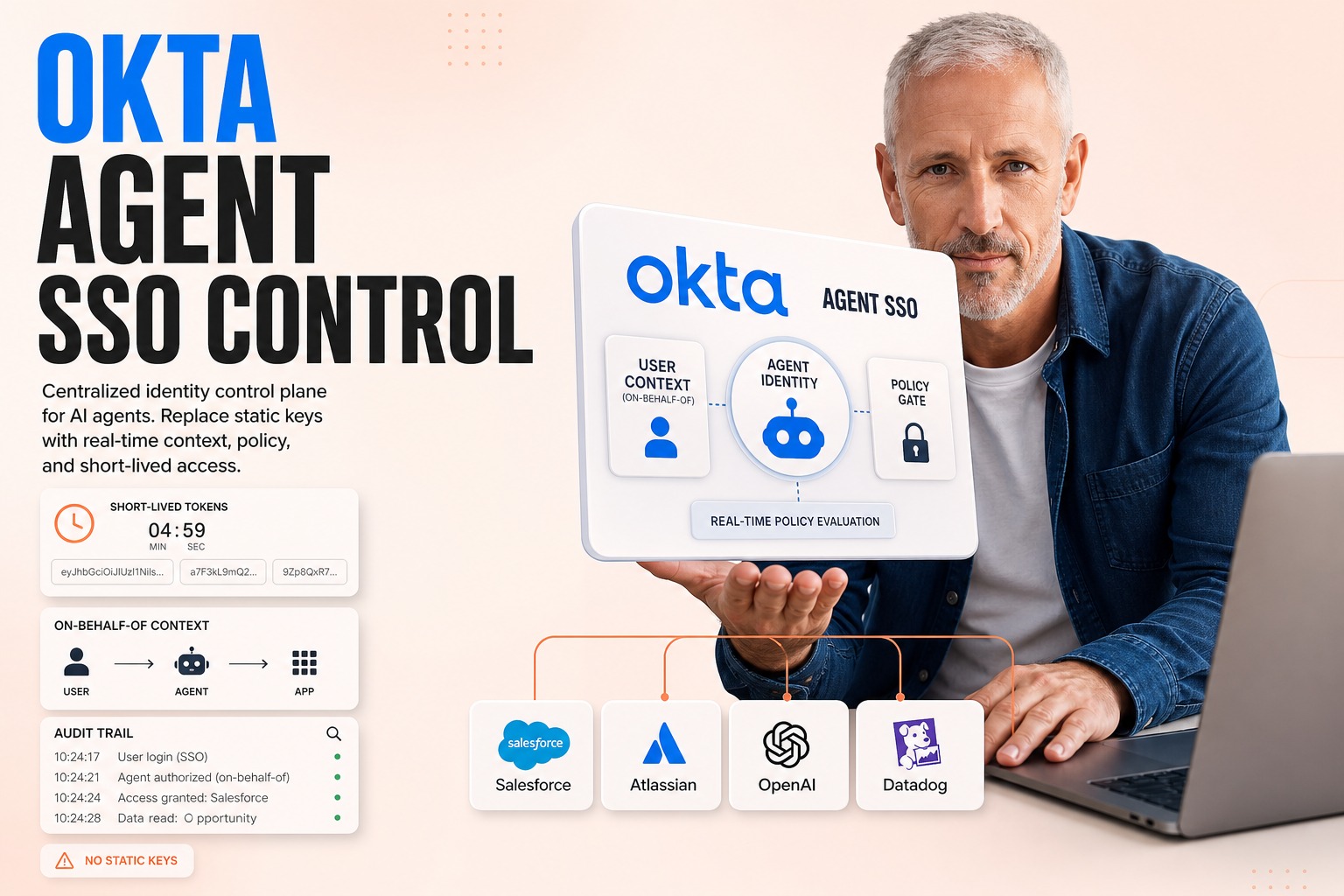
What changed this week that forces an engineering decision now? → Okta made Agent SSO generally available, letting enterprises register AI agents as identities in Okta and govern their access through the same SSO control plane.
What is the real search question behind the headline? → How do we secure AI agents that touch multiple SaaS and internal apps without scattering static API keys or broadly scoped OAuth tokens?
Why does this matter to a CTO shipping agents this quarter? → As agents start acting across systems, your biggest risk shifts from model behavior to credential sprawl and untraceable access paths.
What is the non-obvious angle we’re taking? → The hard part is not creating an agent identity; it’s making every destination application correctly understand on-behalf-of context and enforcing policy at that boundary.
What should we decide before we pilot Agent SSO? → Whether your critical apps support the required identity and authorization signals, and whether your logging can tie each agent action back to both the agent and the user.
Quick answer: should we use Okta Agent SSO to secure AI agents?
If your AI agents are moving beyond a single application and need to act on a user’s behalf across systems, we’d treat Agent SSO as the default starting point over static API keys or broadly scoped OAuth tokens. Okta’s approach registers an agent in Okta Universal Directory, applies centralized access policies, and issues short-lived tokens when the agent needs to call another app as part of a task. The immediate win is governance and traceability using familiar SSO infrastructure, but only where connected services actually support the required signals.
Central claim: agent failures are identity failures first, so the fix is centralized agent identity, not better prompts
Okta’s Agent SSO becoming generally available is a signal that the enterprise market is converging on a new baseline: AI agents must be treated as managed identities, not as scripts with secrets. Our central claim is that what’s happening now breaks a common engineering practice—embedding long-lived credentials in automations—because agents don’t live inside one workflow; they traverse apps, inherit user context, and produce audit requirements that static secrets cannot satisfy.
The right response this quarter is to redesign the access layer so each agent call is mediated by identity policy and logged as an agent acting for a user, using short-lived access. Okta is positioning Agent SSO specifically as an alternative to static API keys or broadly scoped OAuth tokens, and anchoring it in its existing SSO service. You can disagree and keep keys for speed, but then you’re choosing to scale agent capability faster than governance.
- If an agent touches more than one business system, treat it like a first-class identity. The moment an agent moves between a collaboration tool and a customer system, the security story becomes about how you authorize and trace cross-app actions, not about the agent’s prompt.
- If you cannot name the user behind an action, you do not have defensible audit. In practice, embedded secrets in workflows produce activity that looks like anonymous automation, which is exactly what regulated teams get asked to explain after an incident.
- If token scope is broad because it’s easier, you’ve built a latent breach accelerator. Broad OAuth tokens can be operationally convenient, but they create a gap between what the business thinks an agent can do and what the token actually allows.
- If your destination apps don’t understand on-behalf-of context, central governance is aspirational. Okta’s model depends on connected services recognizing the identity and authorization signals; coverage and depth of integrations are what make or break the rollout.
Why static API keys collapse under cross-app agent workflows
Enterprises didn’t start with agents; they started with integrations. That’s why so many teams reach first for API keys or a single OAuth client and call it done. The problem is that an autonomous or semi-autonomous agent rarely stays put. It may read documents in a collaboration platform, create tasks in a work management tool, open a ticket, and then push an update into a customer-facing system. Once you accept that an agent’s unit of work spans multiple applications, credentialing stops being a minor implementation detail and becomes the control plane.
Okta is explicitly positioning Agent SSO as an alternative to giving agents static API keys or broadly scoped OAuth tokens, and that’s the right framing. When developers embed long-lived secrets in workflows, it becomes difficult to trace activity to a specific agent, user, and action. Even when teams try to compensate with extra logging, the identity substrate remains weak: the destination system only sees a token, not the enterprise intent that the agent is acting for a particular user under a particular policy.
The audit gap is structural, not a logging problem
In real environments, the moment you investigate an incident you end up asking the same question in three systems: which software identity called this API, which human authorized it, and what policy allowed it. With static secrets or a shared OAuth token, the destination application often can’t differentiate between two agents, or between an agent and a background integration, without custom plumbing that you have to maintain forever.
If your agent platform can’t produce a record that ties access to both the agent identity and the user context, you don’t have ‘AI governance,’ you have automation with plausible deniability.
Short-lived access changes the blast radius you’re willing to accept
Okta highlights short-lived tokens as a way to narrow credential risk, because a stolen credential stays useful for a smaller window and revocation becomes more responsive. In practice, this shifts how we design operational controls: instead of building a perfect secret distribution system, we build policy-backed issuance and assume compromise is possible. The engineering trade-off is clear: more moving parts at runtime, but less long-term exposure when something leaks.
What Okta Agent SSO changes in production architecture (and what it doesn’t)
Agent SSO lets an organization register an AI agent in Okta Universal Directory, apply access policies, and issue short-lived tokens when the agent needs to act in another application on a user’s behalf. The key is not simply token issuance; it’s that the destination application can understand that the agent is acting for a user while the enterprise maintains central control over authorization. Okta says Agent SSO is based on Cross App Access and an enterprise-managed authorization extension to the Model Context Protocol.
The Model Context Protocol boundary is where integration truth lives
Okta’s design ties Agent SSO to an enterprise-managed authorization extension to the Model Context Protocol, which is a strong signal about where standardization pressure is landing. For engineers, the takeaway is that agent governance won’t be solved by a single platform knob; it will be solved where your apps accept and correctly interpret identity context. That boundary is also where mismatches appear: an enterprise thinks it set policy centrally, while an app only partially honors the signal.
Agent SSO is only as strong as the destination application’s willingness to enforce the on-behalf-of identity context you’re sending.
Integration coverage is the real dependency you must validate early
Okta explicitly notes that support across vendors will determine how useful the model becomes in practice, and we agree. Okta names Anthropic, Asana, Atlassian, Canva, Datadog, Figma, Glean, Miro, Monday.com, OpenAI and Salesforce as working with its agent identity approach. Those categories matter because they hold documents, code, telemetry, and customer data that agents are expected to use. The engineering decision is to confirm availability and scope per integration, not assume uniform support.
Identity is a control point, not a safety guarantee: it can authorize an agent action, but it cannot determine whether every authorized action is appropriate.
How we’d layer Agent SSO into an enterprise security stack without breaking velocity
Okta includes Agent SSO in its existing single sign-on service and says it’s available at no additional cost to customers on core SSO plans, which lowers the friction for a serious pilot. The architectural move we recommend is to treat Okta as the issuance and policy authority for agent-to-app calls, while keeping your existing privileged-access and data-governance tooling in place for non-agent access paths. You are not replacing your security stack; you’re re-centering it around non-human identities that act across apps.
Where teams get stuck is trying to force agents into either employee identity patterns or purely service-account patterns. Agent SSO’s core value is the ability to enforce policies based on the user, agent, and target application, and to keep a record of agent access through the same identity infrastructure used for employees and conventional applications. That record becomes far more actionable if you test it like a security system, which is why we often pair pilots with focused cybersecurity and penetration testing to pressure the weakest integration points.
- Directory modeling must distinguish agent identity from user identity. Registering agents in Universal Directory is only useful if you can consistently name, tag, and lifecycle-manage them as separate principals, otherwise your policy layer becomes a pile of exceptions.
- Policy must be evaluated on three axes: user, agent, target app. Okta explicitly calls out that policies can be enforced based on these dimensions, and in practice this is where you encode business intent like ‘this agent may act for a user in collaboration tools but not in customer systems.’
- Token issuance must be observable, not just functional. Short-lived tokens reduce exposure, but the operational win is the ability to see when tokens were issued, for which user-agent combination, and for which destination application.
- Logging must be treated as a product requirement for agents. Okta positions Agent SSO as providing a record of agent access through existing identity infrastructure, but engineers still need to verify that the log detail answers security questions, not just that a log exists.
- Revocation workflows must be rehearsed under change. Agents change frequently; integrations get disabled; users move roles. The point of short-lived access is to make policy changes responsive, but you only get that benefit if your teams practice the lifecycle events that trigger revocation.
How to evaluate Agent SSO in practice: decide based on cross-app risk, not excitement about agents
Okta cites its own research suggesting organizations are adopting agents faster than they are establishing governance, and we see the same directional pattern when teams start rolling out workplace agents. The evaluation question isn’t whether agents are useful; it’s whether your current credential approach can survive agent multiplication without creating an unbounded set of long-lived secrets. Agent SSO is most compelling when your agent needs to hop between systems that contain high-value business data, where you need evidence that an automated action can be traced to both the agent and the person or process that authorized it.
The most practical way to run this evaluation is to pick one high-frequency agent workflow and map it to the destination apps it must touch. If those apps participate in Okta’s agent identity approach and can recognize the relevant identity and authorization signals, Agent SSO can centralize control. If they don’t, you can still experiment, but you should treat the pilot as an integration program, not just an AI rollout. At Plavno, this is typically where AI consulting pays for itself: you need architecture-level decision support more than you need another prompt iteration.
Start from the workflow graph, not from the agent framework. Write down which applications the agent must call during a task, including collaboration, development, monitoring, and customer systems, because cross-app calls are where credential risk accumulates.
Define the on-behalf-of requirement in business terms. Decide where the agent must act as a specific user and where it should act as a bounded service identity, because this determines whether on-behalf-of context is mandatory for audit.
Validate destination support for the identity and authorization signals. Okta warns that integration support will determine usefulness; confirm availability and scope for each connected service rather than assuming uniform coverage.
Test policy enforcement against real privilege boundaries. Use the user-agent-target app policy axes to verify that the same agent can be permitted in one app and blocked in another, and that the behavior matches what your security team expects.
Treat logs and traceability as go/no-go criteria. An agent identity that can’t be investigated is worse than a key you at least know exists; make sure each agent access can be tied back to both the agent and the user context within your identity infrastructure.
Comparing agent credential patterns: what breaks first under real pressure
Most enterprises are choosing between three patterns: static API keys embedded in automations, broadly scoped OAuth tokens for an agent client, or managed agent identity through an SSO control plane like Okta’s Agent SSO. The hidden trade-off is that keys and broad tokens optimize for initial delivery, while managed identity optimizes for sustainable change. Once agents start calling multiple systems per task, the operational cost of chasing secrets and interpreting ambiguous logs tends to surface faster than teams expect.
| Approach | What it optimizes for | What typically breaks first |
|---|---|---|
| Static API keys in workflows | Fast integration with minimal dependencies | Traceability to a specific agent and user, plus long-lived secret exposure |
| Broad OAuth token for an agent client | Simplified token handling across apps | Over-permissioning and unclear mapping between action, agent, and user intent |
| Okta Agent SSO managed identity | Central policy, short-lived tokens, on-behalf-of context | Practical usefulness depends on destination app support and integration scope |
| Hybrid patterns during migration | Incremental rollout across apps | Inconsistent governance where some apps are centrally controlled and others still use secrets |
Where Agent SSO shows immediate ROI: collaboration and developer systems
Okta’s named participants include collaboration and development-adjacent platforms such as Asana, Atlassian, Canva, Datadog, Figma, Glean, Miro, Monday.com, and Salesforce, alongside AI vendors like Anthropic and OpenAI. Those are exactly the systems where enterprises store the documents, code, telemetry, and customer data that workplace agents are expected to use. In production, these tools become the first blast radius because agents are naturally drawn to where knowledge is easiest to access.
If you’re building or buying workplace agents, we’d start by ensuring your agent identity strategy is aligned with how these platforms will be accessed and audited. Agent SSO’s promise is that administrators can apply access policies and get a record of agent access through identity infrastructure. Turning that into a real deployment is equal parts IAM and product engineering, which is why we treat it as part of AI agents development, not as an afterthought to model selection.
- Workplace research agent that reads docs and creates tasks. The agent may search internal knowledge and then create or update items in a work management tool; Agent SSO is attractive because it can represent the agent as a managed identity and still convey that it is acting for a specific user.
- Engineering assistant that spans tickets, code discussions, and monitoring. When an agent touches developer collaboration and an observability platform, the risk is not only data access but also the inability to distinguish which agent initiated an action during an incident review.
- Sales enablement agent that pulls customer context into a CRM workflow. Customer systems amplify audit requirements, and Okta’s emphasis on records of agent access and policy based on user-agent-target app is specifically aligned with that pressure.
- Cross-team agent for distributed, regulated deployments. The input notes relevance for regulated sectors where evidence of traceability is required; in these environments, having agent actions tied to both the software agent and the authorizing person or process becomes a deployment prerequisite.
What Agent SSO does not solve: the agent can be authorized and still be dangerous
Okta is explicit that agent identity does not address every security issue associated with AI systems. Even with centrally governed short-lived access, you still need controls for data classification, prompt injection, model behavior, tool permissions, and human approval of sensitive actions. Identity provides a control point, but it cannot determine whether every action an authorized agent attempts is safe or appropriate. This matters because teams often confuse authenticated with acceptable.
In practice, the best posture is to treat Agent SSO as your foundation for who can call what, and then design your agent workflows so sensitive actions are gated and reviewable. This is where operational design matters more than vendor selection: you want the identity layer to make revocation and policy changes responsive, while the agent runtime ensures that high-impact actions are mediated by process. For teams standardizing that execution layer, we often implement approvals and action boundaries as part of AI automation rather than leaving them to ad-hoc tool permissions.
- Prompt injection remains a tool-use problem, not an identity problem. An agent can be properly authenticated and still be tricked into calling a tool in an unsafe way; identity won’t detect that the request was coerced.
- Data classification still needs enforcement where data is accessed. Even with on-behalf-of context, you must ensure the destination application’s data controls align with what the agent is allowed to see for that user.
- Model behavior must be constrained by workflow design. Identity can authorize a call, but it doesn’t guarantee the agent’s interpretation of the task is correct or safe; guardrails belong in the orchestration and approval design.
- Human approval is still required for sensitive actions. Okta notes the need for human approval of sensitive actions; engineering teams must decide which actions are sensitive and how approvals are captured and audited.
- Tool permissions need least privilege at the destination. Central policy is valuable, but the destination app must still enforce granular permissions; otherwise you’re handing an agent a master key with a short expiration.
The operational trap: non-human identities will sprawl faster than your SDLC can document them
Okta frames the market problem directly: organizations are adopting agents faster than they are establishing governance. Whether or not you rely on survey percentages, the direction is consistent with what most identity teams are already dealing with—non-human identities multiplying across pipelines, SaaS, and internal systems. Agent SSO lowers the friction to register agents as identities, which is good, but it can also accelerate sprawl if you don’t define ownership, lifecycle, and integration rules.
Teams often underestimate the organizational component: someone must own the agent directory model, policy conventions, and integration validation across vendors. When internal capacity is tight, the fastest path is frequently a dedicated extension team that can work inside your standards and security process; that’s exactly the scenario where an outstaffing model can keep delivery moving without turning governance into a part-time job.
- Define an agent lifecycle that matches how agents actually change. Agents get modified, integrated, and disabled; if those events don’t trigger predictable access changes, your short-lived tokens won’t save you from long-term privilege drift.
- Require integration validation before production access. Okta warns not to assume uniform support across vendors; operationally, that means no agent gets access to a destination app until support and scope are confirmed.
- Standardize naming and ownership in the directory. Registering agents in Universal Directory is powerful only if you can answer who owns the agent, what it is allowed to do, and what systems it touches.
- Make auditability a release gate for agent workflows. If you can’t trace an action to the agent and the user context, you should treat the workflow as incomplete, even if the demo looks great.
- Align security reviews to the user-agent-target app policy model. Okta’s policy dimensions provide a natural structure for reviews; without it, teams revert to one-off exceptions that erode central control.
The stance we take at Plavno: identity first, then autonomy
Agent SSO going generally available is a market signal we’d act on: enterprise agents are becoming normal, and identity is becoming the control plane for them. Our position is simple—start by making every agent a managed identity with policy and traceability, and only then expand autonomy across applications.
Author: Plavno team. Last updated: August 2026. If you’re piloting workplace agents across tools like collaboration platforms, monitoring, or CRM, we can help you validate integration coverage and design an access model that survives scale before you ship it to the whole company.
 Chat GPT
  Perplexity
  Claude
  Gemini
