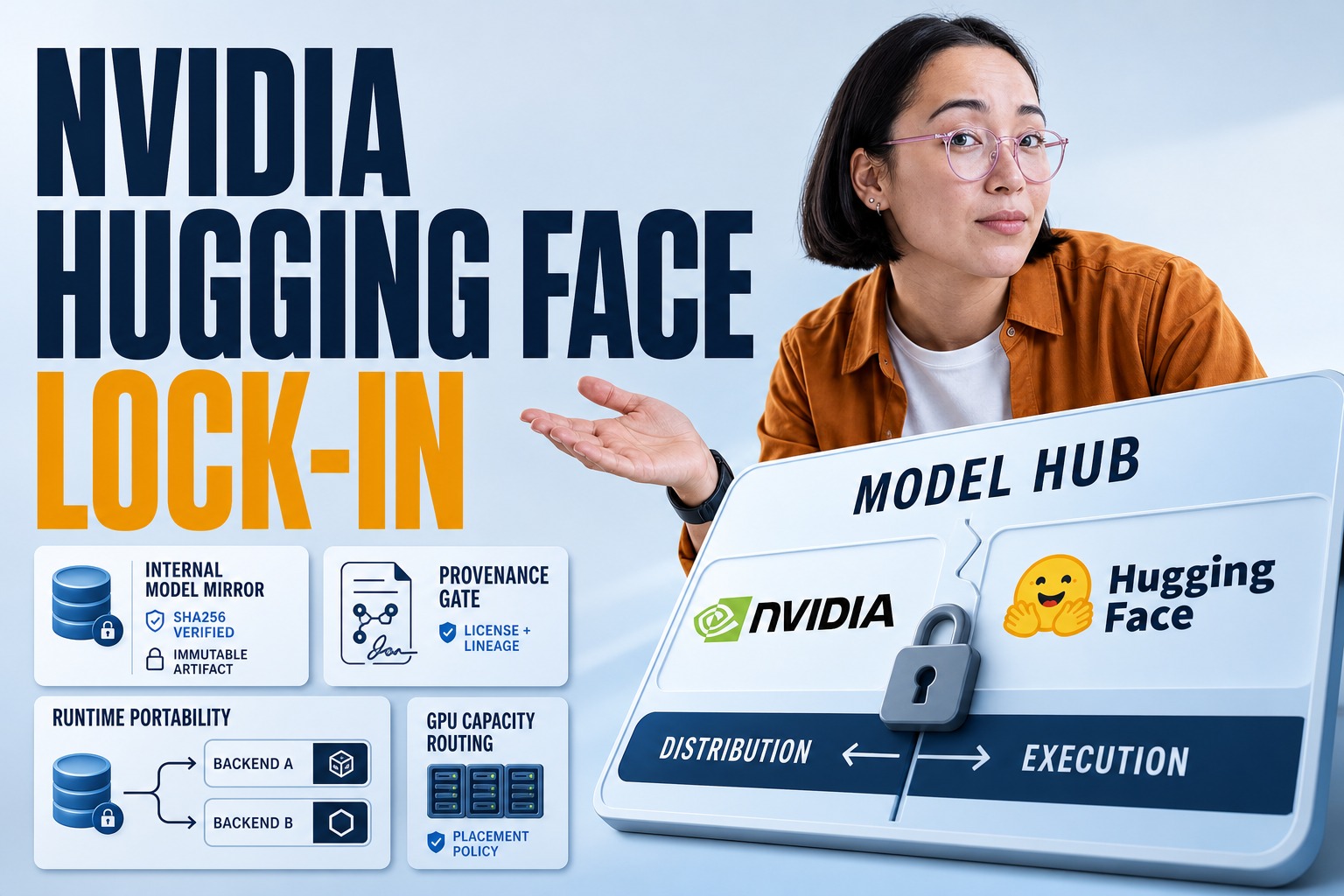
Is Nvidia really buying Hugging Face, and why is everyone treating it like an infrastructure event? → The report is a $12.9 billion acquisition discussion, and the reason it matters is that Hugging Face sits on the model distribution path for open-source AI.
What is the primary engineering question we should answer this quarter? → How do we design an enterprise model supply chain that still works if the “neutral” model hub becomes an extension of a hardware and cloud strategy?
What changes first in production systems if this deal closes? → Your default assumptions about model provenance, pricing leverage, and compute routing shift, because the same company can influence both the model marketplace and the GPU capacity behind it.
What is the fastest way to reduce risk without freezing progress? → Treat model download and model execution as separate trust domains, and build a portability layer that keeps your runtime and governance independent of any single hub.
What’s the non-obvious angle we see at Plavno? → The biggest failures won’t come from model quality; they’ll come from orchestration boundaries where your registry, rented compute, and security posture collide under a new owner.
Quick Answer: should we change our enterprise AI stack if Nvidia buys Hugging Face?
We should not rebuild our stack around the acquisition rumor, but we should immediately harden for the outcome it implies: Hugging Face could shift from a broadly neutral distribution hub into a GPU-aligned platform. The right move is to keep using Hugging Face where it accelerates teams, while isolating it behind a model supply-chain layer that enforces provenance, repeatable deployments, and exit options.
If your production pipeline cannot run the same approved model from a second source of compute and storage, you do not have an “open-source” strategy; you have a single-platform dependency that just became strategic.
Nvidia buying the model hub changes procurement more than model quality
The dominant signal this week is not that another AI company might get acquired; it is that Nvidia is reported to be negotiating to buy Hugging Face for $12.9 billion. Hugging Face is one of the most popular hubs where developers share and download open-source AI models, and the report explicitly frames the deal as a way for Nvidia to deepen its foothold in open-source AI while protecting its chip dominance.
From an engineering-lead perspective, that matters because a ‘hub’ is not just a website. In production, the hub becomes part of your supply chain: where artifacts come from, how you verify them, how quickly you can patch them, and how you attach policy. When ownership of that hub aligns with a hardware strategy, our day-to-day engineering decisions about model onboarding and runtime placement become procurement decisions—whether we intended them to or not.
- Model provenance becomes a board-level question: model origin and integrity stop being a developer convenience and start being an audit surface tied to enterprise risk.
- Compute routing becomes political: if a hub also ‘helps developers run their AI models using rented computing power,’ your default path may drift toward the owner’s preferred capacity.
- Negotiation leverage shifts: the report highlights closed labs building their own AI chips; this kind of acquisition is a counter-move that can reshape pricing and dependency in your stack.
- Security stories get weaponized: when a CEO cites using an Nvidia-modified version of a Chinese open-source model after a cyberattack, it signals that incident response will be used as justification for platform alignment.
Our central claim: neutrality breaks at the distribution layer, so engineers must decouple registry trust from runtime trust
Nvidia’s reported move to buy Hugging Face implies the model hub is being repositioned as infrastructure, not community. That breaks the common engineering practice of treating a popular hub as a neutral upstream, and the right response is to design a model supply chain where model intake, verification, and approval stay stable even if execution and rented compute become strategically steered.
Your model supply chain is about to become a GPU go-to-market channel
The input report is explicit about Nvidia’s motivation: it wants to protect dominance in AI chips as major closed-source labs—OpenAI, Google, Amazon, and Anthropic—build their own chips to reduce reliance on Nvidia. A thriving open-source ecosystem gives customers alternatives to closed labs, which in turn keeps more of the market dependent on Nvidia hardware. That tells us what to expect from a combined Nvidia–Hugging Face entity: aggressive investment in open models and aggressive coupling between ‘where models live’ and ‘where they run.’
In production, we see model supply chains already behaving like package management: teams ‘install’ models by pulling weights and metadata, then operationalize them as internal services. If the default pull source becomes part of a GPU strategy, the subtle risk is not that models vanish; it’s that your enterprise’s operational habits drift toward the owner’s preferred compute pathways, billing constructs, and support surfaces—especially when speed matters and teams default to the most frictionless path.
The new architecture boundary: separate registry trust from runtime trust
The primary search question we see emerging is: what does the Nvidia Hugging Face acquisition mean for enterprise AI architecture? Our answer is that it forces a cleaner separation between two trust domains most teams currently blur. Registry trust is about what you allow into your environment: provenance, integrity, licensing posture, and whether you can reproduce a build. Runtime trust is about where and how you execute: rented compute, isolation, tenancy boundaries, and cost control.
Hugging Face already sits on both sides in the report’s framing, because it is a distribution hub and it ‘helps developers run their AI models using rented computing power.’ If Nvidia owns that surface while also managing chip strategy and cloud capacity commitments, engineers should assume incentives will favor tighter end-to-end pathways. The right architecture response is to make the registry domain enterprise-controlled: internal mirroring, internal approval gates, and a stable metadata schema you own, so you can change runtimes without re-approving everything from scratch.
| Enterprise decision you’re really making | What changes if the hub owner is also the hardware strategist | What to design for |
|---|---|---|
| Where models are sourced | Hub can become a default upstream tied to GPU ecosystem incentives | Internal mirror and explicit provenance gates |
| Where models are run | ‘Rented computing power’ can become a preferred execution lane | Runtime portability across at least two execution backends |
| How you manage vendor risk | Hub neutrality is no longer a safe assumption | Contractual exit paths plus technical exit paths |
| How you respond to incidents | Security narratives can justify platform coupling | Independent incident playbooks and artifact verification |
Treat every model you pull like a production dependency: if you cannot explain where it came from, how you verified it, and how you would replace its source tomorrow, you are building operational debt you cannot refinance later.
Where cloud capacity commitments distort platform incentives
One of the most operationally relevant details in the report is Nvidia’s promise to help cover the cost of ‘tens of billions of dollars’ in cloud computing deals for customers. The report also notes a risk: if customers do not use all the computing power they signed up for, Nvidia could get stuck with it, and owning Hugging Face would give Nvidia a way to sell unused capacity to Hugging Face’s customers.
For engineers, this matters because it explains a potential future where the platform’s ‘default’ or ‘recommended’ path is economically motivated. Even if your team thinks it is just selecting a convenient execution environment, your architecture can get pulled toward a capacity-balancing engine. The response is not paranoia; it is instrumentation and controls: you need to see when and why workloads move, what it does to latency and cost, and which organizational incentives are embedded in the platform choices you are making.
Map your dependency chain: document where models are discovered, downloaded, approved, stored, and executed, and who controls each step.
Define a second-path runtime: design an alternate execution route that can run approved models without relying on the same hub-to-compute integration.
Establish artifact immutability: ensure what you approve is what you run, even if upstream metadata changes later.
Make cost routing observable: track when workload placement changes and whether it correlates with a platform’s ‘rented compute’ offerings.
Put exit into the contract and the design: assume you may need to switch supply sources quickly, and avoid building one-off glue that only works in one ecosystem.
DGX Cloud scaling back is the tell: distribution plus execution is the comeback plan
The report says Nvidia scaled back its own cloud business, DGX Cloud, about a year ago, and that owning Hugging Face could provide a way back into cloud computing ‘without starting from scratch.’ That is the strategic context engineers should design for: a combined entity can use distribution to drive execution, and execution to fund distribution.
What this means for open-weight governance and US compliance postures
The input describes a debate that has been building for months as Washington officials reportedly weighed restrictions on open-weight models, and it frames competitive and national-security concerns around Chinese labs releasing systems that match leading U.S. models on benchmarks while costing less to run. It also notes a letter signed by Nvidia CEO Jensen Huang and 24 other companies, including Hugging Face, urging the U.S. government to support open models rather than restrict them.
We should read this as a governance forcing function. If your company is deploying open-weight models, you are not just managing model risk; you are managing policy volatility risk. A Hugging Face acquisition by Nvidia could accelerate open model adoption while simultaneously increasing scrutiny on your sourcing and controls. The right engineering response is to build a governance layer that can absorb policy change without rewriting your stack: approval workflows that are auditable, clearly versioned model lineages, and an internal ‘allowed model set’ that can be tightened or expanded without breaking production.
How to run Hugging Face in production without inheriting vendor lock-in
Teams will keep using Hugging Face because it is where developers share and download models, and because it can help with running models on rented computing power. We do not advise fighting that gravity; we advise containing it. The goal is to make Hugging Face a source and a convenience surface, not the definition of your internal standard.
Architecturally, that means designing an enterprise-controlled intake pipeline that pulls models into your managed storage, attaches your metadata and security attestations, and then deploys them into your execution environment through your own release process. Even if you continue to discover models in Hugging Face, your production truth should be your internal mirror and your internal approval record. If you need help designing that kind of production-grade pipeline, this is exactly the kind of platform architecture we build in AI agents development.
- Model intake boundary: treat external hubs as untrusted sources until your pipeline verifies and records what was pulled.
- Internal artifact store: run production from your own controlled copy, so upstream changes do not silently alter what you deploy.
- Policy attachment point: attach usage policy, ownership, and deprecation rules to the model artifact inside your environment.
- Runtime abstraction: keep inference execution swappable so ‘where it runs’ is a decision you can revisit.
Evaluation logic: decide between staying, mirroring, or exiting the hub
If this acquisition closes, many CTOs will ask whether they should leave Hugging Face. In practice, the decision is rarely binary; it is about how much of your lifecycle depends on the hub. Staying can be rational when your main goal is speed and your risk is limited by strong internal controls. Mirroring becomes essential when you need repeatability, auditability, and independence from platform incentive shifts. Exiting makes sense only when your organization’s risk model cannot tolerate a hub that is potentially tied to a hardware and cloud strategy.
The key is to evaluate the deal’s likely effect on your specific bottleneck. If your bottleneck is model discovery and experimentation, Hugging Face remains valuable. If your bottleneck is production reliability and governance, the hub should not be your system of record. If your bottleneck is cost predictability, you should be skeptical of any platform that can nudge you toward using particular rented capacity—especially in a world where Nvidia is explicitly managing exposure to unused cloud commitments.
The acquisition doesn’t force a single decision; it forces you to become explicit about which parts of your stack are ‘market-driven’ and which parts must remain enterprise-owned.
The failure modes we expect at orchestration boundaries, not in the model
This is where we take a strong position: the biggest production failures after a platform consolidation like this won’t be that a model suddenly becomes worse. They will show up where orchestration meets policy and cost. When one company influences distribution, execution, and ecosystem incentives, small integration assumptions become brittle: how you pin versions, how you track provenance, how you route workloads to compute, how you respond to security incidents, and how you deprecate models without breaking downstream services.
We see this most clearly in agentic systems, where failures cascade: a retrieval step pulls the wrong artifact, an execution step runs on an unexpected environment, and a governance step cannot explain what happened. The model itself may be fine; the system is not. That is why we emphasize infrastructure-level design. If your production rollout depends on rented compute sourced through the same channel as your model distribution, you need stronger observability and stronger separation of concerns than the average ‘download and deploy’ workflow provides. This is a core part of how we approach cloud software development for AI-heavy platforms.
| Boundary where things break | What engineers usually assume | What we recommend under a consolidated hub + compute model |
|---|---|---|
| Version pinning | ‘The hub link is stable’ | Treat external sources as mutable; run from internal pinned artifacts |
| Workload placement | ‘Compute choice is an internal decision’ | Instrument and enforce placement policies explicitly |
| Incident response | ‘We can reconstruct what ran’ | Record model lineage and execution context as first-class metadata |
| Decommissioning | ‘We can swap models later’ | Design deprecation paths and rollback plans before scale |
Business impact: negotiating leverage shifts from API vendors to infrastructure vendors
The report frames Nvidia’s goal as protecting chip dominance as closed labs build their own chips. That is not an abstract market storyline; it is a concrete negotiation context for enterprises. If closed labs reduce reliance on Nvidia, Nvidia has an incentive to make open-source ecosystems stronger and easier to run on Nvidia-aligned paths. If your AI strategy includes both open and closed models, you should expect pricing and leverage to move in response.
For CTOs, the practical business impact is that ‘model choice’ becomes entangled with ‘compute choice.’ If Hugging Face becomes a bridge between open-source models and Nvidia-backed execution capacity, enterprise buyers need to negotiate for portability and operational transparency, not just for access. This is also why recent consolidation signals matter: the report notes Stripe’s deal to acquire OpenRouter, a startup that helps customers select different AI models depending on needs and budget, for more than $7 billion after it was valued at $1.3 billion in May. Routing and selection are becoming strategic; your contracts should reflect that.
Ask what becomes harder after year one: if the hub-to-runtime path is optimized, what will it cost you to run the same models elsewhere later?
Negotiate for operational data access: ensure you can export the metadata you need for audits, incidents, and lifecycle management.
Demand clear termination mechanics: avoid contract language that makes your approved model set effectively non-portable.
Align internal budgets to reality: if platform incentives can steer compute usage, finance and engineering need shared placement policies.
Treat routing as a strategic capability: as seen in the OpenRouter acquisition story, selection layers become assets; do not outsource the entire brain of your platform.
How we at Plavno design for portability when the platform owner is also the hardware vendor
At Plavno, we treat the Nvidia–Hugging Face signal as a reminder that ‘open-source’ is not the same as ‘operationally independent.’ Even if the weights are open, your production posture can still be captive to distribution and execution pathways. So we design for portability at the seams: internal artifact control, explicit execution policies, and clear governance logs that are decoupled from any single external hub.
This is also a resourcing reality. Building a real model supply chain is a systems engineering project that crosses platform, security, and application teams. Many organizations do not need to hire a large permanent group for the first iteration; they need experienced engineers who can set the architecture and build the first production-grade version quickly, then transfer ownership. That is where an outstaffing model can be a pragmatic fit: you get senior platform execution without committing to a long-term org change before the market settles.
Portability is not a future rewrite; it is a present architecture choice. If you do not pay for it while the system is small, you will pay for it during an incident.
The hard limits: when neutrality matters more than convenience
There are cases where the right answer is to reduce dependency on any single hub, regardless of how popular it is. If your risk posture is shaped by policy volatility around open-weight models, or by security constraints where you must demonstrate provenance end-to-end, convenience can be a trap. The report highlights public discussion of restrictions and competitive concerns; even without predicting the policy outcome, we can say the scrutiny itself is enough to require stronger controls.
Neutrality matters most when you cannot afford implied incentives. If a hub is owned by a company that also benefits from steering execution toward particular compute, you should assume subtle nudges will exist. That does not make the platform ‘bad,’ but it does mean you cannot outsource your governance or your placement logic. In practice, we advise building security verification and incident drills around model artifacts the same way you would around any critical production dependency. When organizations want this done rigorously, we typically pair platform architecture work with independent review from cybersecurity and penetration testing.
- Regulated data environments: if you must prove what ran, where it ran, and why it was allowed, you need enterprise-owned records.
- High-impact incident response: if you may need to defend decisions after a cyberattack, you cannot rely on informal hub history.
- Multi-stakeholder platforms: if multiple business units ship models, you need uniform lifecycle governance independent of external incentives.
- Long-lived products: if product lifetimes exceed platform strategy cycles, your architecture must survive ownership changes.
Closing insight: treat model distribution like critical infrastructure, not a website
The input story is fundamentally about vertical integration pressure. Nvidia is reported to be considering paying $12.9 billion for Hugging Face, a company that raised $235 million in 2023 at a $4.5 billion valuation and was reportedly generating about $150 million a year in revenue recently, up from roughly $100 million two months earlier. Those numbers only make sense if the buyer believes the distribution position is strategically valuable, not just financially interesting.
For engineering leaders, the actionable takeaway is simple but not easy: design so that your production environment can keep operating if the upstream hub changes incentives, access patterns, or default execution routes. Use Hugging Face for speed, but own your supply chain. Be explicit about your second path. If you do that, the acquisition becomes a manageable market event rather than an architectural crisis.
Need a second-path architecture before your next model goes live?
If your team is currently pulling models directly into production or relying on a single integrated path for both sourcing and rented compute, we can help you design and implement the internal mirror, governance records, and runtime portability layer that keeps you in control regardless of how the Nvidia–Hugging Face story resolves. Request a scoped architecture review and delivery plan through a project estimate, and we will map the minimum changes needed to make your stack resilient.
Author: Plavno team. Last updated: August 2026.
 Chat GPT
  Perplexity
  Claude
  Gemini
