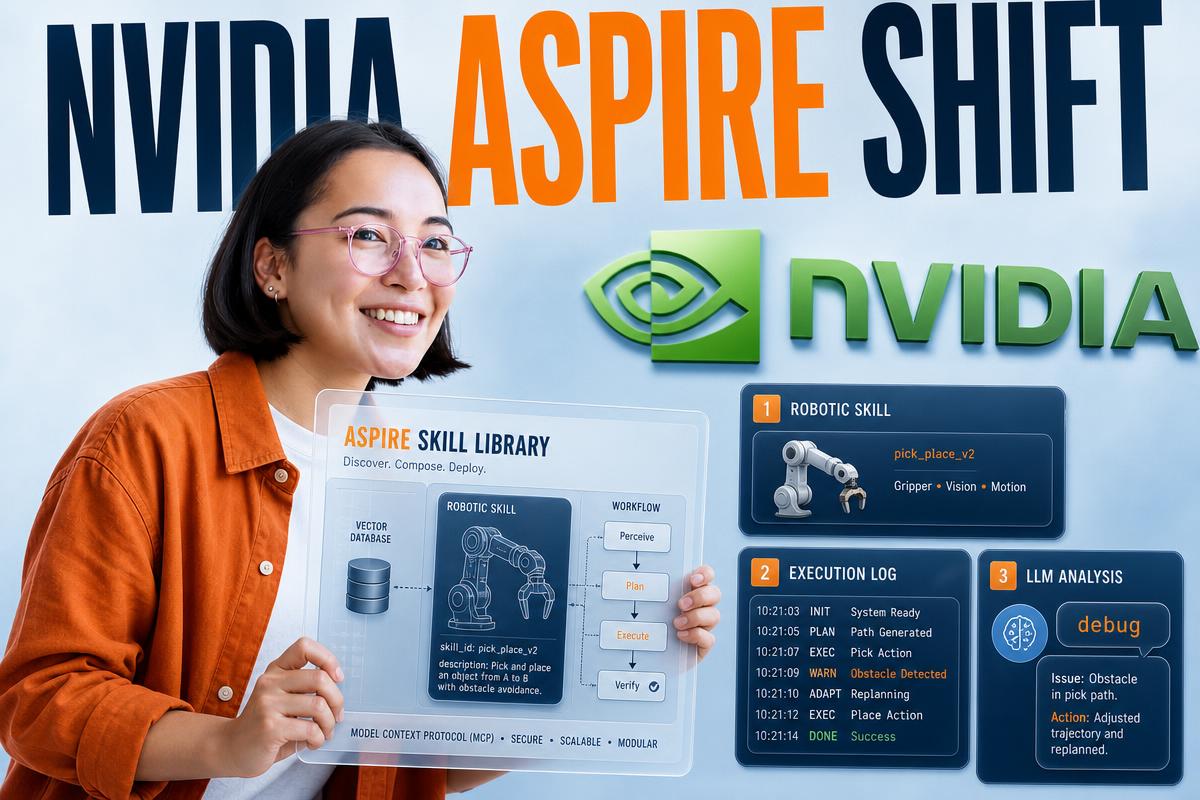
What is Nvidia’s ASPIRE and why does it matter now? → ASPIRE is an open‑source robot skill library that captures debugging experience as reusable "Skills," letting robots skip repetitive trial‑and‑error.
How does ASPIRE differ from traditional gradient‑descent training? → Instead of updating floating‑point weights, ASPIRE aggregates concrete repair procedures, turning each successful fix into a callable module.
Which engineering decision does ASPIRE challenge? → It forces CTOs to prioritize skill‑library governance over raw model size when building reliable embodied AI.
Can existing Code‑as‑Policy pipelines adopt ASPIRE without a rewrite? → They can augment their pipelines by adding execution logging and skill distillation, but must restructure around a shared library.
What is the immediate action for a robotics team this quarter? → Begin instrumenting robot runs to capture failure traces and prototype a minimal skill‑library service.
Quick Answer: ASPIRE replaces model‑centric updates with a continuously growing skill library, so reliable robot deployments now depend on how you curate, version, and invoke those skills rather than on scaling larger LLMs.
- Capture every failure trace – record perception, planning, and control calls.
- Diagnose root cause automatically – let LLM agents label the failure type.
- Distill a reusable Skill – encode the repair as a parameterized program.
The Core Claim That Engineers Must Test
We argue that continuous skill libraries like Nvidia’s ASPIRE replace gradient‑descent model updates with reusable debugging knowledge, meaning that robot system architects must prioritize skill‑library management over raw model scaling to achieve production reliability.
Skill‑library hygiene is the new performance bottleneck, not model size.
How ASPIRE Rewrites the Training Loop
ASPIRE restructures the classic training pipeline into three stages. First, the Robot Execution Engine logs every API call, sensor reading, and error code during a task. Second, the Skill Library receives a distilled description of the fix—often a short script that reroutes a planner or adds a multi‑angle grasp strategy. Third, Evolutionary Search generates candidate programs, runs them, and feeds successful candidates back into the library. This loop mirrors a human engineer’s debugging workflow, turning each iteration into a reusable artifact.
Why Gradient Descent Is No Longer Sufficient
Traditional approaches push larger LLMs to learn better policies, assuming more parameters will capture edge cases. ASPIRE shows that without a mechanism to remember concrete fixes, even massive models revert to the same trial‑and‑error pattern. The library acts as a memory that bypasses the need for the model to relearn the same failure, dramatically improving success rates on benchmarks like Robosuite’s dual‑arm handover, where success rose from 20 % to 92 %.
Reusing a repaired program cuts the learning curve for new tasks by orders of magnitude.
The Hidden Architecture Shift
To support a skill library, engineers must introduce a persistent store that can version, query, and compose Skills. This store sits alongside the usual model‑serving endpoints but requires transactional guarantees, schema evolution, and efficient retrieval. In practice, teams often repurpose a vector database for similarity search, but the real challenge is ensuring that a Skill’s dependencies—perception modules, planner APIs, and hardware drivers—remain compatible across robot generations.
Real‑World Trade‑offs When Adding a Skill Library
Deploying ASPIRE‑style pipelines introduces latency during the distillation phase, because the LLM must analyze logs and generate a Skill description. However, that cost is amortized: once a Skill exists, subsequent tasks retrieve it instantly. Teams must balance the upfront compute budget against long‑term gains in task success. Moreover, the library grows linearly with the number of distinct failure modes, so storage planning and pruning policies become essential.
Plavno’s Perspective on Skill‑Centric Robotics
At Plavno we view ASPIRE as a catalyst for a new class of AI‑driven automation services. Our experience building large‑scale AI agents for enterprise workflows teaches us that reusable knowledge artifacts—whether prompts, policies, or repair scripts—are the primary lever for scaling reliability. By integrating a skill‑library layer into our AI agents development offering, we help clients capture operational intelligence and reuse it across heterogeneous robot fleets. Our AI automation services and AI voice assistant development further extend capabilities. We also serve healthcare and med‑tech sectors (AI healthcare). Contact us for collaboration.
| Aspect | Traditional Gradient‑Descent | ASPIRE Skill Library |
|---|---|---|
| Update Frequency | Continuous weight updates | Periodic skill distillation |
| Memory Scope | Implicit in model parameters | Explicit, queryable artifacts |
| Failure Recovery | Re‑learn from scratch | Reuse repaired program |
Business Impact of a Growing Skill Library
When a robot can instantly apply a previously distilled Skill, the time‑to‑value for new automation projects shrinks dramatically. Enterprises that previously allocated weeks to tune motion planners can now launch pilot deployments in days, because the library supplies proven work‑arounds for common collision or grasping issues. This accelerates ROI and reduces the need for costly specialist robotics engineers.
- Faster onboarding – new robot models inherit existing Skills.
- Lower maintenance cost – fixes are centralized, not scattered across code bases.
- Improved SLA compliance – success rates rise, reducing downtime.
How to Evaluate ASPIRE‑Style Skill Management This Quarter
First, instrument a representative robot to emit detailed execution logs. Second, run a pilot where an LLM agent parses those logs and proposes a Skill for a known failure, such as a planner buffer collision. Third, measure the reduction in repeat failures after the Skill is added to the library. If the success rate improves by at least 30 % on a benchmark task, the approach justifies broader rollout.
| Evaluation Metric | Target Threshold |
|---|---|
| Skill adoption latency | <5 seconds per distillation |
| Success rate lift on repeat task | ≥ 30 % |
| Library storage growth per month | ≤ 2 GB |
Real‑World Applications Across Industries
Manufacturing lines can embed Skills that handle misaligned parts, while warehouse robots can share Skills for navigating narrow aisles with dynamic obstacles. In healthcare, a surgical assistant could reuse a Skill that safely repositions a tool when force feedback exceeds a threshold. Each domain benefits from a centralized repository of proven fixes, turning isolated debugging effort into enterprise‑wide knowledge.
Scenario: Warehouse Picking with Edge‑Case Objects
A robot repeatedly fails to grasp a thin‑walled bottle placed near a shelf edge. ASPIRE logs the failure, the LLM identifies the planner’s target point as colliding with the shelf, and creates a Skill that attempts approaches from 45°, 90°, and 180° angles. Once stored, any robot encountering a similar geometry instantly applies the Skill, lifting the success rate from 15 % to over 80 %.
Scenario: Service Robots in Hospitality
A service robot bumps into a decorative plant while delivering towels. The execution engine records the collision, the LLM classifies it as a navigation error, and a Skill is generated to dynamically re‑plan around obstacles using a higher‑resolution map. Future deployments of the same robot model no longer need manual path tweaking.
Scenario: Assembly Line Re‑tooling
When a new component is introduced, the robot’s grasp planner fails because the gripper’s force profile is mismatched. ASPIRE captures the failed force parameters, the LLM suggests a calibrated grip sequence, and the resulting Skill is added to the library. Subsequent runs with the new component succeed without additional human intervention.
Risks and Limitations of the Skill‑Library Approach
The primary risk is skill bloat: as the library expands, retrieval latency can increase, and outdated Skills may cause regressions if underlying hardware changes. Moreover, the quality of distilled Skills depends on the LLM’s ability to correctly diagnose failures; mis‑labelled Skills propagate errors. Finally, regulatory environments may demand auditability of each Skill, adding compliance overhead.
- Skill decay – outdated entries must be retired.
- LLM hallucination – incorrect diagnoses can poison the library.
- Compliance burden – each Skill may need documentation for audit.
How to Mitigate Those Risks in Practice
Implement a versioned Skill store with automated tests that replay each Skill against a simulated environment before promotion. Use a lightweight validator that checks API compatibility and safety constraints. Schedule periodic pruning cycles that archive low‑usage Skills, and maintain a changelog that satisfies compliance auditors.
A disciplined Skill lifecycle—test, version, retire—keeps the library an asset rather than a liability.
Decision Logic for Quarterly Planning
When deciding whether to invest in an ASPIRE‑style pipeline, weigh the expected reduction in repeat‑failure cost against the upfront engineering effort to build the execution engine and Skill store. If your robot fleet experiences more than three distinct failure patterns per week, the ROI typically exceeds the development cost within a single fiscal quarter.
Identify high‑frequency failure modes – prioritize those that cause the most downtime.
Prototype logging and LLM analysis – use an existing LLM API to generate candidate Skills.
Integrate a versioned Skill store – start with a simple key‑value service.
Run a controlled A/B test – compare tasks with and without Skill reuse.
Scale based on measured lift – expand to the full fleet if success improves by >25 %.
The Path Forward for Robot‑Centric Enterprises
By treating debugging knowledge as a first‑class artifact, organizations can shift from a model‑centric mindset to a skill‑centric one. This transition aligns with modern software engineering practices that favor reusable libraries, automated testing, and continuous delivery. In the coming year, the firms that embed a robust skill‑library infrastructure will outpace competitors that continue to chase larger LLMs without systematic knowledge capture.
| Quarter | Investment Focus | Expected Outcome |
|---|---|---|
| Q1 | Execution logging & LLM integration | Baseline Skill catalog (≈10 Skills) |
| Q2 | Skill store versioning & testing | Success rate lift ≥ 30 % |
| Q3 | Pruning & compliance automation | Stable library growth ≤ 2 GB/month |
- Continuous learning – each new task enriches the library.
- Scalable reliability – reuse eliminates redundant trial‑and‑error.
- Strategic advantage – faster time‑to‑market for robot solutions.
Why the Shift Is Inevitable
As robot deployments scale across factories, warehouses, and service venues, the cumulative cost of repeated debugging becomes untenable. ASPIRE demonstrates that a systematic approach to capturing and reusing fixes can slash that cost dramatically. Ignoring this shift means persisting with brittle pipelines that will falter under real‑world variability.
The future of embodied AI is a living library of repaired programs, not a monolithic model.
Final Takeaway for CTOs
If you are planning a robot rollout this quarter, prioritize building the execution‑engine and skill‑library scaffolding before scaling LLM size. The measurable gains in success rate and deployment speed will outweigh the allure of larger models, and the skill‑library will become a strategic asset that compounds value over time.
Take the Next Step with Plavno
Ready to embed a skill‑library into your robotics stack? Our AI‑agents development team can help you design the execution engine, integrate LLM‑driven debugging, and deploy a versioned skill store that scales with your fleet. Reach out to discuss a proof‑of‑concept tailored to your industry challenges.
 Chat GPT
 Perplexity
 Claude
 Gemini