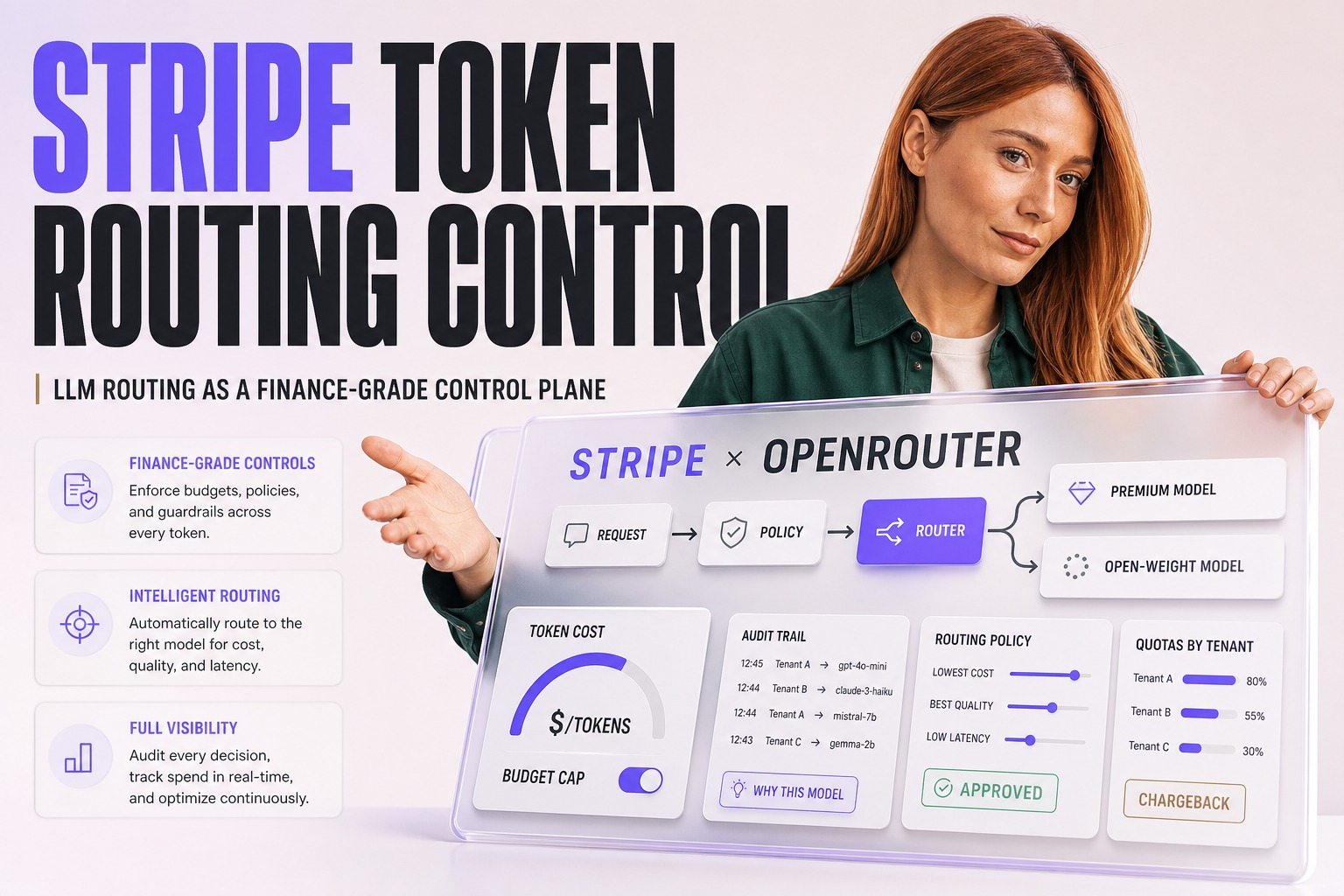
Is Stripe acquiring OpenRouter just an AI product bet? → No. It signals that model access and token spend are becoming an “economic infrastructure” layer, closer to payments routing than to ML experimentation.
What’s the real engineering question this creates? → Whether we should adopt an AI model router (or build an equivalent gateway) to control token costs and performance as models are constantly released and repriced.
Why does this matter this quarter, not “someday”? → Stripe itself called out the pace at which models are released and repriced, which turns “pick a model” into an ongoing operational decision, not a one-time architecture choice.
What changes most for CTOs and platform teams? → The critical work shifts from model evaluation to routing policy, observability, and governance at the orchestration boundary where requests enter and exit your system.
What’s the non-obvious angle we’ll argue? → The biggest failures won’t come from a model’s raw quality; they’ll come from treating routing as an app feature instead of a spend-control plane with auditability.
Stripe’s OpenRouter move turns “model choice” into a routing layer you have to own
Stripe said it plans to acquire OpenRouter as it expands into the AI model market, explicitly framing the goal as optimizing token costs and routing tokens efficiently amid rapid model releases and repricing. The engineering implication is uncomfortable but actionable: if token spend is now volatile like pricing in any fast market, then “which LLM do we use?” stops being a product-team preference and becomes a platform responsibility, like payments routing or cloud cost governance.
Treat LLM calls as a metered commodity: if usage is measured in tokens and pricing shifts quickly, we should assume finance-level scrutiny, not “dev tool” informality.
Put a gateway in front of models: whether you use a third party or an internal abstraction, the business needs one control point for routing, policy, and logging.
Decouple app logic from provider churn: app teams should request capabilities (task, latency target, policy constraints), while the gateway selects the model path.
Make routing decisions explainable: when cost and performance trade off, you need a reason you can audit later, not a black-box heuristic.
Operationalize change as the default: models will be released and repriced; your architecture should assume frequent policy updates without redeploying every client.
Quick Answer: Should we use an LLM router to manage token costs across models?
Yes, if you expect to use more than one model over the next quarter and you care about predictable spend. Stripe’s decision to acquire OpenRouter and talk publicly about routing tokens efficiently is a market signal that model usage is being treated like metered infrastructure. The right response is to design a single routing layer—commercial or internal—that enforces policy, captures usage and outcomes, and lets you switch models without rewriting application integrations.
| Approach | What it optimizes for | What breaks first in production |
|---|---|---|
| Single-model direct integration | Fastest initial ship, simplest surface area | Vendor lock-in and painful migration when pricing or behavior changes |
| Multi-model via a router/gateway | Cost-performance flexibility and faster model switching | Policy complexity and missing observability if routing is not instrumented |
| Build your own abstraction layer | Maximum control over governance and data boundaries | Ongoing operational burden as models are released and repriced |
| “Wait and see” | Avoids near-term work | Spend surprises and reactive rewrites when leadership asks for cost control |
Token costs got operational because models are released and repriced too fast
Stripe’s own rationale is the tell: it’s difficult to manage AI costs relative to performance because of the pace at which models are released and repriced, and Stripe has been working with companies to optimize token costs and route tokens efficiently. In practice, that means engineering teams are being pulled into an ongoing market-making task: continuously choosing among proprietary models and open-weight alternatives that developers increasingly adopt for cost efficiency, including models from Chinese labs cited in the coverage.
If model pricing and availability can change faster than your product release cycle, you need a routing control plane that can change without waiting for every application team to refactor.
The routing layer is where production reliability is won—or quietly lost
In most organizations we see, LLM adoption starts as “call a model API from a service.” The minute you add a second model—often for cost reasons—you’ve created a distributed systems problem: every caller now contains policy, fallback logic, and inconsistent telemetry. Stripe’s framing of “routing requests intelligently” is effectively an argument for centralizing that complexity.
Architecturally, the router belongs alongside your API gateway and service mesh concerns: authentication, quotas, request shaping, and observability. Whether you buy it (as Stripe is doing through OpenRouter) or build it, the decisive factor is not model quality—it is whether you can enforce consistent policy and measurement across every token-producing path.
- Policy drift across microservices: when each service hardcodes its preferred model, spend-control becomes a game of whack-a-mole and budget owners lose the ability to answer “why did costs spike?”
- Inconsistent telemetry: without one routing choke point, token usage and outcomes get logged differently by different teams, which makes optimization claims unprovable.
- Fallback chaos: multi-model strategies usually rely on fallback, but when fallback is implemented per-client, failure modes multiply and become hard to reproduce.
- Data boundary confusion: routing is where you decide what context is sent to which model; if that logic is scattered, governance becomes accidental.
Open-weight model adoption shifts procurement logic more than it shifts ML logic
OpenRouter became popular with developers seeking to use AI models, particularly non-proprietary open-weight options that can be free, including models from Chinese labs named in the report. Even if your company is not planning to standardize on those specific models, the broader signal is that procurement will no longer be “choose one vendor.” You will be asked to justify why a given class of requests uses a proprietary model when open-weight alternatives are perceived as more cost-efficient.
Treat every model like a provider behind one contract, not a library your app “imports”
The most practical move we recommend is to design one stable internal contract for “model work,” and let a router decide which model fulfills it. That contract should feel more like an internal API product than an SDK convenience: versioned request/response expectations, explicit metadata, and enforcement points for safety and cost policy. This is where AI consulting becomes less about picking a model and more about designing a system that keeps working when the market shifts.
- A single request envelope: keep a consistent structure for prompts, context, and output requirements so callers don’t couple to model quirks.
- A routing decision record: capture which model was selected and why, so cost and outcome debates become data-driven.
- A policy surface, not ad-hoc flags: define how teams request priorities like “lowest spend” versus “highest quality,” then map that to routing rules.
- A consistent identity model: propagate user, tenant, and purpose metadata so governance and quotas can be enforced at the router.
Routing policy becomes a product requirement the same way payments policy is
When Stripe says it is building economic infrastructure for AI and wants to help businesses maximize profitability by routing requests intelligently, it’s implicitly stating that routing policy is part of the business model. Engineering teams should expect questions like “which workloads are allowed to use the premium model?” or “when do we switch to the more cost-efficient open-weight option?” These are policy questions first and technical questions second, and they belong in a controlled system boundary.
- Workload classification: separate customer-facing, revenue-critical requests from internal tooling so routing can prioritize appropriately.
- Context minimization rules: decide what data is permitted to leave your boundary for each class of request, then enforce it consistently.
- Change management: create an approval path for routing rule updates so “silent switches” don’t become incident root causes.
- Exception handling: define when a request is allowed to break glass and use a different model, and how that is audited.
Stripe is betting that model “neurodiversity” wins—so your architecture must survive it
OpenRouter’s stated vision is “a healthy AI ecosystem where many models thrive,” where “no single model becomes the default by inertia,” and where a breakthrough provider can reach millions of developers. Stripe’s statement aligns with that: it wants to route requests intelligently and spend tokens efficiently. The combined message for a CTO is that multi-model isn’t an edge case anymore; it’s the expected market shape.
If you accept that, the architectural goal changes. We are no longer building “an AI feature.” We are building a stable mediation layer between fast-changing model supply and slower-moving enterprise systems: CRMs, ticketing systems, data warehouses, and internal services. The hard part is not wiring an API call; it’s ensuring every change in model routing is observable, explainable, and reversible.
Multi-model strategy fails when switching costs live inside applications; it succeeds when switching costs live inside one gateway with strong telemetry.
How we’d evaluate an OpenRouter-style layer for production adoption this quarter
We would evaluate a router the way we evaluate any critical platform component: by its ability to centralize control without becoming a single point of organizational failure. Stripe’s language about token optimization and efficient routing suggests the router is expected to handle constant repricing and model churn; your evaluation should therefore stress operational ergonomics and governance, not just whether it can reach many models.
- Integration surface with existing infrastructure: the router must fit with your API gateway, identity, and service-to-service patterns rather than forcing bespoke client changes.
- Policy and auditability: you should be able to answer, after the fact, why a request went to a specific model and who approved the rule.
- Observability by default: routing decisions, token usage, and outcome signals must be captured consistently enough to support cost-performance trade-offs.
- Vendor and geopolitical considerations: if developers want open-weight models from specific labs, the system must support governance decisions without ad-hoc blocks.
- Operational change speed: because models are released and repriced rapidly, updating routing policy should be safer than redeploying dozens of services.
The minimum viable observability that makes “token efficiency” a real claim
“Optimize token costs” is meaningless unless you can connect spend to workloads and decisions. In practice, we want one place where every request produces a durable record: what the system attempted, what it chose, and what happened. That record must be compatible with the observability stack you already run—traces, logs, and dashboards—so platform teams can debug cost anomalies the same way they debug latency regressions.
- Per-request lineage: track how a user action in a product maps to one or many model calls, so token spend can be attributed to features.
- Decision visibility: record the routing rule or policy that triggered the choice so changes can be correlated with cost shifts.
- Outcome feedback hooks: define how you capture success signals (human rating, task completion, escalation) so cost cutting doesn’t silently degrade product quality.
- Tenant-aware accounting: ensure requests carry customer or business-unit identity so chargeback and budgeting are possible.
Where multi-model routing shows up first: support, internal ops, and developer tooling
The earliest profitable place for routing is usually not a moonshot product; it’s the workflows already producing high-volume text: customer support responses, internal knowledge queries, and automation that touches CRMs and ticketing systems. These are the domains where teams will feel token costs quickly and where leadership will ask for “the same output, cheaper,” which is exactly the problem Stripe highlighted. This is also where we typically implement AI automation to connect model outputs to real business systems.
The production risks that demos don’t surface: governance, inertia, and misaligned incentives
OpenRouter argues against a single default model “by inertia,” but inertia is exactly what happens inside enterprises when app teams pick what’s easiest and move on. Without a routing layer, the first model integrated becomes the default forever because changing it requires product work, QA cycles, and stakeholder alignment. The result is a slow drift into lock-in and unaccountable spend, even if cheaper or better options emerge.
- Unowned policy decisions: when no platform team owns routing, product teams make cost choices implicitly and finance only sees the bill.
- Shadow adoption: developers attracted to “free” open-weight models may route around governance, creating unmanaged data flows.
- Inability to respond to repricing: if models are repriced quickly, organizations without centralized routing can’t react without widespread refactoring.
- Audit gaps: when routing decisions are not logged consistently, post-incident analysis becomes opinion-based and political.
Build vs buy is really about whether routing is a platform capability you can staff
Stripe can acquire OpenRouter; most companies can’t. The practical choice for everyone else is whether to buy a router, adopt an existing layer, or build an internal gateway. We think the decision should be framed around staffing and operational maturity: if you cannot continuously maintain policy, telemetry, and integrations as models change, buying can be safer; if your data governance needs are strict and your platform team is strong, building can reduce long-term dependency.
At Plavno, we often see teams underestimate the “last mile” work: integrating routing with identity, audit, and deployment processes across environments. That work looks like platform engineering, not prototyping, and it tends to pull in cloud networking, security review, and SRE practices. When companies want to accelerate without sacrificing correctness, they frequently use cloud software development support to harden the gateway layer and its operational workflow.
Plavno’s position: route tokens like money, because the organization will
Stripe’s statement that it is building economic infrastructure for AI, combined with OpenRouter’s push for a multi-model ecosystem, is the clearest sign yet that “token routing” is becoming a first-class business system. Our central claim is simple and arguable: model selection is becoming a spend-routing problem more than an ML problem, which breaks the common engineering practice of embedding model choice in application code; the right response is to implement a governed routing boundary with auditable policy and consistent measurement.
If you want multi-model flexibility, you must make routing a platform product with owners, telemetry, and change control—not a convenience wrapper.
Closing insight: the default model is now a financial decision you’ll have to defend
OpenRouter’s popularity with developers and Stripe’s focus on token efficiency point to the same future: more models, faster repricing, and constant pressure to justify spend. If we architect for that reality now—one routing boundary, one contract, one measurement system—we can switch models as strategy, not as emergency.
If you’re building a multi-model gateway or agent-driven workflows, consider engaging AI agents development expertise early, or submit scope for a fast project estimate. Author: Plavno team. Last updated: August 2026.
 Chat GPT
  Perplexity
  Claude
  Gemini
