What did JPMorgan’s decision to block Anthropic AI access mean for global enterprises? → It showed that compliance and data‑sovereignty concerns can outweigh the allure of the latest large language model.
Is this an isolated incident or a trend? → The move aligns with a growing pattern of financial institutions tightening AI vendor controls.
How should CTOs react when a major vendor is suddenly restricted? → They must build flexible access‑control layers that can swap providers without rewiring core business logic.
What practical steps can teams take today to prepare for similar restrictions? → Start by abstracting LLM calls behind a policy‑driven gateway and audit data flows for regulatory exposure.
Will limiting LLM access hurt innovation? → Not if the architecture separates model selection from business logic, allowing rapid experimentation on approved providers.
The Core Question: How Do Enterprises Safely Navigate LLM Access Restrictions?
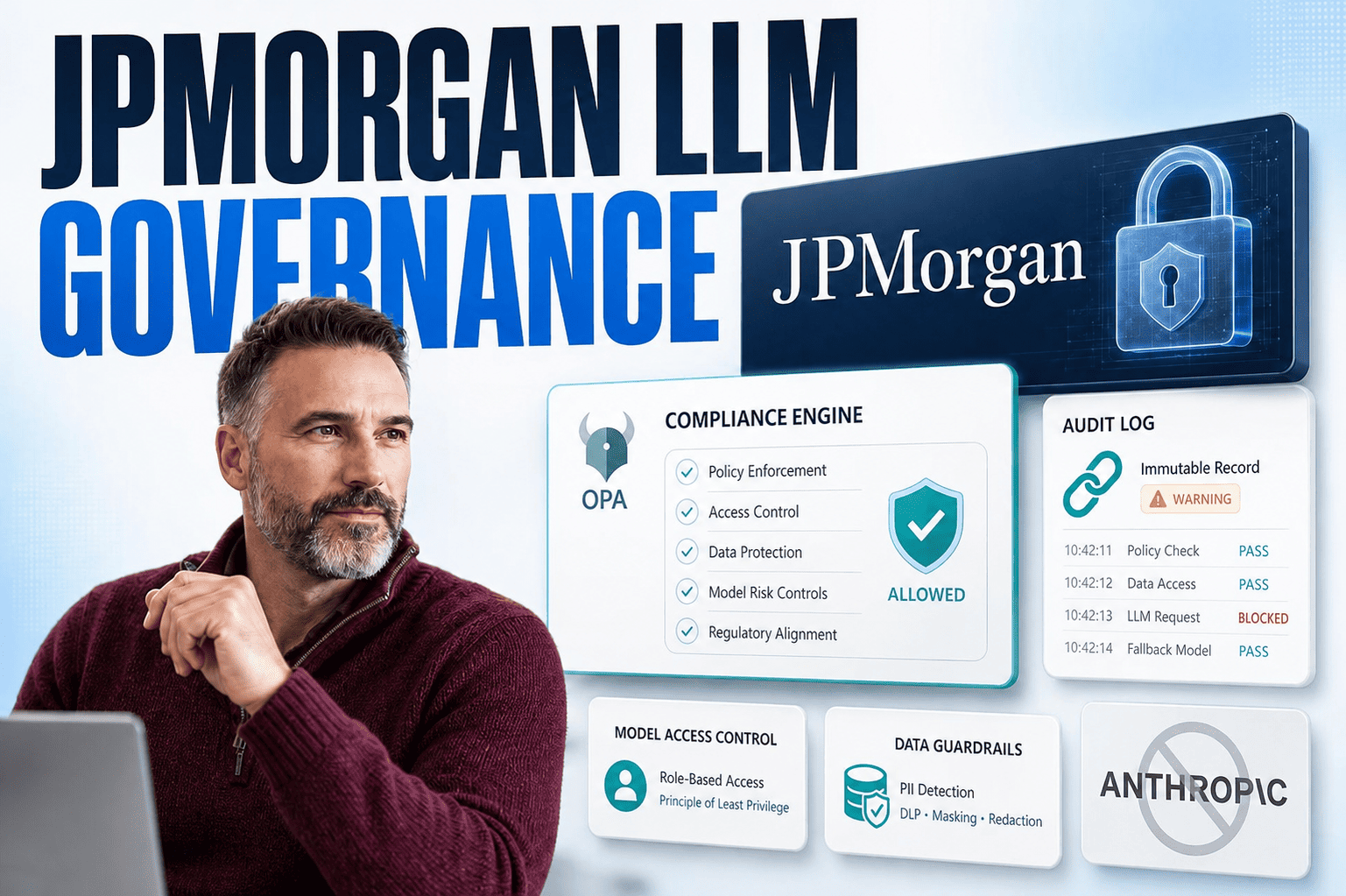
When JPMorgan blocked Anthropic’s AI for its Hong Kong staff, the headline grabbed attention, but the deeper implication for every CTO is whether their AI stack can survive sudden vendor bans. The answer hinges on treating LLMs as interchangeable services behind a governance layer, rather than hard‑wired dependencies that crumble when a provider is pulled.
A robust LLM governance layer is the single most effective safeguard against unexpected provider restrictions.
Why Compliance Trumps Model Performance in Regulated Industries
In sectors like finance, the cost of a data‑leak or regulatory breach dwarfs the marginal gains from using the newest model. JPMorgan’s decision reflects a risk‑averse posture: the bank prefers to keep data within jurisdictions it can audit, even if that means foregoing Anthropic’s cutting‑edge capabilities. This shift forces enterprises to prioritize contractual clarity, audit trails, and data residency over raw model benchmarks.
- Policy‑first architecture – Design the AI integration point as a policy engine that can enforce regional data rules.
- Vendor‑agnostic adapters – Wrap each LLM behind a thin adapter that translates a common request schema.
- Audit‑ready logging – Capture every prompt, response, and metadata in immutable logs for compliance checks.
- Dynamic routing – Route requests to alternative providers based on real‑time compliance status.
- Governance dashboards – Provide visibility into which models are active, their jurisdictions, and associated risk scores.
Building a Provider‑Neutral LLM Gateway (M)
The first practical step is to introduce a gateway service that abstracts the LLM API. This gateway should expose a stable internal contract—typically a JSON payload with `prompt`, `temperature`, and `max_tokens`—while internally mapping those fields to the specific parameters of each vendor. By decoupling the business logic from the provider, you gain the ability to switch models without code changes, merely by updating routing rules.
A second layer of the gateway enforces compliance policies. For example, before forwarding a request, the service checks the user’s location, the data classification tag, and the regulatory regime. If the request originates from a jurisdiction with strict data‑residency rules, the gateway can route the call to a provider that guarantees on‑shore processing, or reject it outright. This approach transforms a potential outage into a manageable policy decision.
| Layer | Responsibility | Example Technology |
|---|---|---|
| Gateway API | Stable request schema | OpenAPI spec, FastAPI |
| Compliance Engine | Jurisdictional routing | OPA policies, custom rule engine |
| Provider Adapter | Vendor‑specific translation | Anthropic SDK, OpenAI client |
The Hidden Cost of Hard‑Coding LLM Calls (M)
When teams embed provider‑specific SDK calls directly into business services, they create a tight coupling that makes any future restriction a costly rewrite. The hidden cost is not just developer time; it also includes the risk of non‑compliance during the window between a ban and a code fix. Moreover, hard‑coded endpoints often bypass centralized logging, leaving audit trails incomplete.
Conversely, a gateway‑centric design centralizes logging, security checks, and policy enforcement. It also enables you to leverage existing cloud‑native observability tools—such as AWS CloudWatch or Azure Monitor—to track usage, latency, and error rates across all providers. This unified view is essential for meeting regulatory reporting obligations and for making data‑driven decisions about model performance versus compliance risk.
Map business intents to generic LLM operations – Identify the core capabilities your app needs (e.g., summarization, classification) and define them abstractly.
Implement a thin provider adapter – Write a small module that translates the generic operation into the vendor’s API call.
Integrate compliance checks – Use a policy engine to evaluate data residency, user location, and classification before invoking the adapter.
Centralize observability – Funnel all request/response pairs through the gateway’s logging pipeline for audit and performance monitoring.
Plan for provider rotation – Maintain a catalog of alternative vendors and their compliance attributes to enable rapid swaps.
Real‑World Scenario: A Global FinTech Platform’s Response (L)
A multinational fintech company that offered AI‑driven credit scoring across Asia faced a sudden restriction when its primary LLM provider was barred in Singapore due to data‑locality rules. The engineering team, having previously implemented a provider‑neutral gateway, simply updated the routing configuration to point to a compliant on‑shore model. Within hours, the service resumed without any code changes, and the compliance team could produce the required audit logs for regulators.
In contrast, a competitor that had hard‑coded the LLM SDK into its risk‑assessment microservice experienced a week‑long outage. Their engineers scrambled to refactor the codebase, while the compliance team struggled to prove that no data had crossed borders during the downtime. The incident not only delayed product releases but also resulted in a regulatory fine for inadequate data‑handling procedures.
How Existing LLM Integrations Can Be Refactored Quickly
Refactoring legacy integrations begins with extracting the LLM call into a dedicated service module. By exposing this module via a REST or gRPC endpoint, you create a single point of change. The next step is to replace the direct SDK usage with calls to the newly created gateway, ensuring that all downstream services interact only with the abstracted interface. This pattern reduces the blast radius of any future provider restriction.
- Identify all hard‑coded SDK imports – Use static analysis tools to locate every direct LLM client usage.
- Create a thin wrapper service – Encapsulate the SDK call behind a simple HTTP endpoint.
- Redirect calls to the gateway – Update the wrapper to forward requests to the governance layer.
- Validate compliance policies – Ensure the gateway enforces jurisdiction and data‑classification checks.
- Monitor and iterate – Use observability dashboards to confirm that the new flow meets performance and compliance goals.
The Role of Vendor Contracts in LLM Governance
Beyond technical safeguards, the legal terms of LLM contracts dictate data‑ownership, residency, and termination clauses. Enterprises must negotiate clauses that guarantee data retrieval rights and define clear exit strategies. Without such provisions, a provider’s unilateral ban can leave the organization without access to critical model outputs, compounding operational risk.
Plavno’s Approach to Future‑Proof LLM Integration (M)
At Plavno we embed governance layers into every AI solution we deliver. Our AI‑agents development service starts with a policy‑driven gateway that abstracts provider details, allowing us to swap models on demand while preserving compliance footprints. By leveraging our cloud‑software development expertise, we integrate OPA‑based policy checks and centralized logging that satisfy even the most stringent financial regulators.
Clients benefit from a modular architecture that decouples business logic from LLM choice, meaning that when a provider is restricted, the impact is limited to a configuration update. This approach reduces downtime, protects audit integrity, and keeps innovation pipelines flowing.
| Feature | Plavno Implementation | Customer Benefit |
|---|---|---|
| Policy Engine | OPA with custom jurisdiction rules | Automatic compliance enforcement |
| Provider Adapter | Plug‑in architecture for Anthropic, OpenAI, etc. | Seamless model swaps |
| Audit Logging | Immutable CloudTrail‑style logs | Ready‑for‑regulator evidence |
Business Impact: Cost Savings and Risk Reduction (M)
By adopting a provider‑neutral gateway, enterprises can avoid the hidden costs of emergency rewrites and regulatory penalties. The upfront investment in a governance layer pays off through reduced incident response time—often cutting outage durations from days to hours. Moreover, the ability to rotate models without code changes preserves competitive advantage, as firms can quickly adopt newer, more efficient LLMs when they become compliant.
Financial institutions that have implemented such architectures report up to a 40 % reduction in compliance‑related engineering effort, while maintaining or improving AI‑driven service performance. The strategic advantage lies not just in avoiding disruption, but in turning compliance into a lever for faster innovation cycles.
- Reduced engineering overhead – One gateway handles all provider integrations.
- Accelerated compliance reporting – Centralized logs simplify audit preparation.
- Flexibility to adopt emerging models – No code changes needed for new vendors.
- Lower risk of regulatory fines – Proactive policy enforcement mitigates breaches.
- Improved service resilience – Quick provider swaps minimize downtime.
How to Evaluate This Strategy in Your Organization (M)
Start by auditing your current LLM usage: catalog every direct SDK call, note the data classification of inputs, and map the regulatory regimes involved. Next, prototype a lightweight gateway that forwards a subset of requests to a sandbox provider, adding a simple compliance check based on user location. Measure latency, error rates, and audit log completeness. If the prototype meets performance SLAs, expand the gateway to cover all LLM traffic and formalize policy rules.
Finally, engage legal and compliance stakeholders to embed contract clauses that guarantee data retrieval and define termination notice periods. Align the technical roadmap with these contractual safeguards, ensuring that any future provider restriction can be handled through configuration rather than code rewrites.
- Map current LLM dependencies – Identify all touchpoints and data flows.
- Prototype a governance gateway – Use a minimal viable product to validate feasibility.
- Benchmark performance – Compare latency and cost against existing direct calls.
- Integrate compliance checks – Enforce jurisdiction and data‑classification policies.
- Formalize contracts – Secure data‑ownership and exit terms with providers.
Real‑World Applications Across Industries (S)
Financial services, healthcare, and legal tech are already adopting provider‑neutral LLM gateways to satisfy stringent data‑privacy regulations while still delivering AI‑enhanced user experiences. In banking, for example, AI‑voice assistants powered by compliant LLMs can answer customer queries without exposing data to offshore servers. In med‑tech, on‑premise models ensure patient data never leaves the hospital network, yet developers retain the flexibility to upgrade models as they become certified.
These deployments demonstrate that a governance‑first approach scales across domains, providing both regulatory assurance and the agility to leverage the latest AI breakthroughs.
The decisive factor is not the LLM’s size, but the robustness of the governance layer that shields your business from policy shocks.
Risks and Limitations of a Purely Technical Solution (S)
Even the most sophisticated gateway cannot compensate for poorly drafted vendor contracts or insufficient organizational processes. If the legal team does not secure data‑retrieval rights, a provider’s shutdown can still leave you without essential model outputs. Additionally, over‑centralizing LLM calls can create a single point of failure if the gateway itself is not highly available.
Contractual gaps – Ensure contracts include data‑access and exit clauses.
Gateway reliability – Deploy the gateway in a multi‑region, high‑availability setup.
Performance trade‑offs – Adding policy checks may increase latency; monitor and optimize.
Operational overhead – Governance layers require ongoing policy updates as regulations evolve.
Vendor lock‑in of the gateway – Keep the gateway codebase modular to avoid its own lock‑in.
Future Outlook: Anticipating More Provider Restrictions (S)
Regulators worldwide are tightening AI oversight, and we can expect more institutions to impose provider bans similar to JPMorgan’s. Organizations that have already built flexible, policy‑driven architectures will find it easier to adapt, turning compliance into a competitive advantage rather than a barrier.
Quick Answer: How Should Enterprises Respond to LLM Provider Bans?
Enterprises should decouple business logic from specific LLM providers by implementing a policy‑driven gateway that abstracts model calls, enforces jurisdictional compliance, and centralizes audit logging. This architecture enables rapid provider swaps, satisfies regulatory requirements, and preserves innovation velocity, turning a potential disruption into a manageable configuration change.
Take the Next Step with Plavno
If you need to future‑proof your AI investments, let Plavno design and implement a provider‑neutral LLM gateway tailored to your regulatory landscape. Our expertise spans cloud software development, digital transformation, and AI security solutions, ensuring you can innovate without fear of sudden vendor bans.
 Chat GPT
 Perplexity
 Claude
 Gemini