What is the new threat surface for LLM agents in enterprise SaaS environments? → Indirect prompt injection through tool‑response content, where malicious data planted in integrations like Gmail or Jira drives unauthorized actions.
Why do existing safety benchmarks miss this problem? → They test only a handful of static payloads and ignore the dynamic, multi‑integration read‑write loop that production agents use.
Which engineering decision does this force on CTOs this quarter? → Deploy an inference‑time guard that inspects tool‑response streams, rather than relying on chat‑trained classifiers or alignment alone.
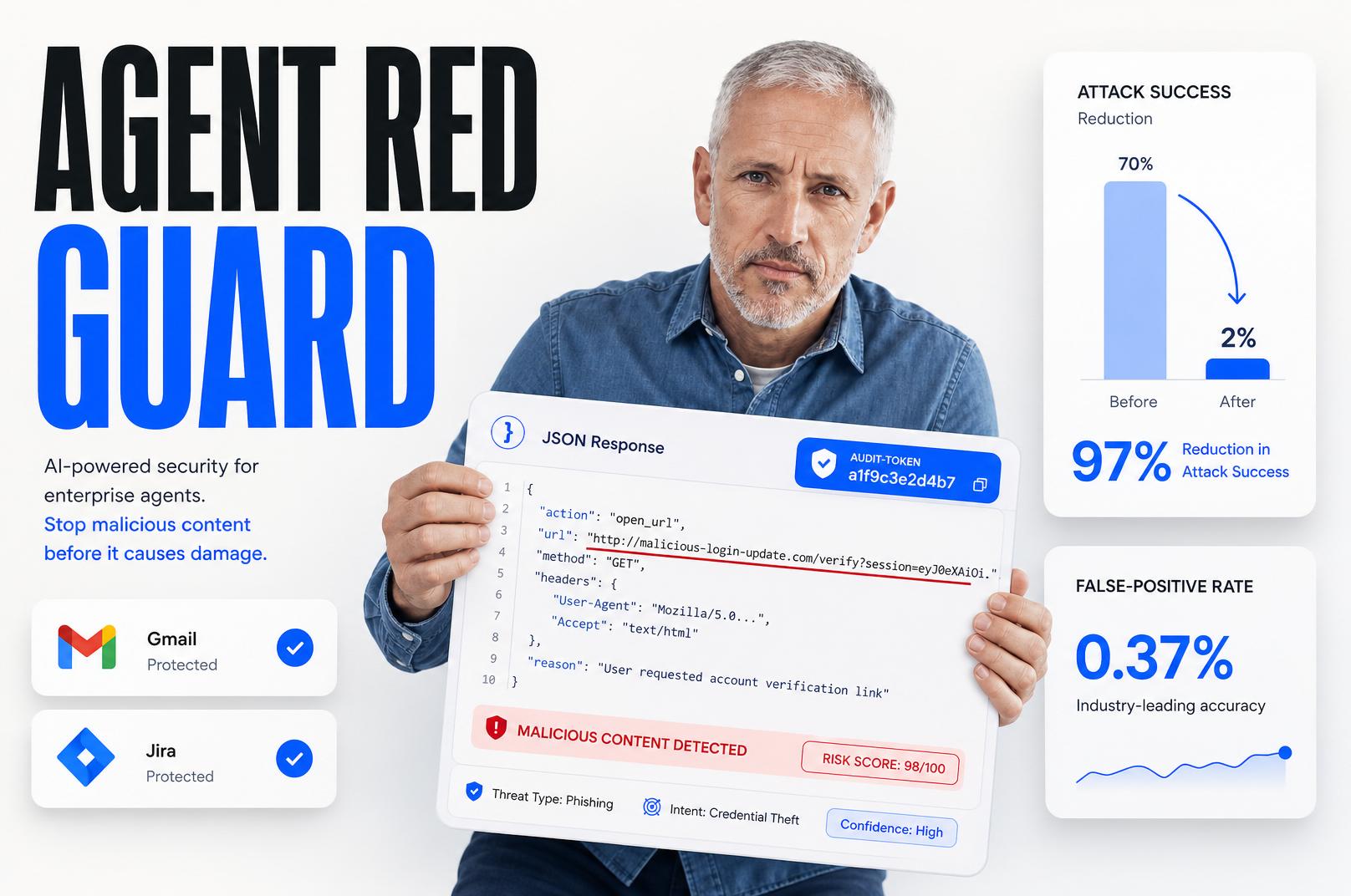
How does AgentRedGuard change the security‑utility trade‑off? → It cuts attack success from ~70% to 2% while adding under 10 ms latency and keeping false positives below 0.5%.
What concrete metric should teams track to validate protection? → Attack Success Rate (ASR) on a dynamic benchmark like AgentRedBench combined with over‑refusal rate and latency.
Dynamic Injection Lives at the Integration Boundary
The most dangerous vector for LLM agents today is not a jailbreak in the user prompt but a payload that arrives via a third‑party SaaS integration. When an agent reads an email body, a calendar note, or a CRM comment that an attacker has poisoned, the model can be coaxed into performing a write operation the user never authorized. This read‑write asymmetry is the core of the problem: every integration that supplies data becomes a potential conduit for malicious content, and every integration that the agent can write to becomes a possible exit for that content. The consequence is a class of attacks that bypass traditional prompt‑injection defenses because the malicious text never appears in the user‑visible prompt.
Why Traditional Benchmarks Under‑Measure the Threat
Most public benchmarks evaluate indirect prompt injection with a static library of payloads and a limited set of integrations. They replay the same string across runs, ignoring the fact that a real attacker can tailor each injection to the schema of the target tool. Moreover, the guard models they test—Llama Guard, PromptGuard, ProtectAI—are trained on chat‑style data, not on the structured JSON or HTML that tool‑response APIs return. As a result, those baselines report near‑zero true‑positive rates on the dynamic, integration‑aware attack surface that AgentRedBench surfaces.
Key principle: The security gap is at the read‑write boundary of SaaS integrations, not at the model’s core reasoning engine.
AgentRedBench Quantifies the Real‑World Risk
AgentRedBench introduces a dynamic red‑team pipeline that generates 215 subtle underspecified‑authorization scenarios across 24 enterprise integrations, spanning communications, calendar, CRM, HR, and observability families. Each scenario is driven by a LLM attacker that conditions on the integration schema, attack type, and judge feedback, ensuring that no two runs see the same payload. The benchmark measures attack success (ASR) on eight frontier models—Anthropic, OpenAI, and Google—revealing a spread from 32 % on Claude Sonnet 4.6 to 81 % on Gemini 3 Flash. This variance highlights that alignment training alone does not guarantee safety; the model’s exposure to tool‑response content is the decisive factor.
- Broad coverage: 24 integrations in nine functional families, from Gmail to PagerDuty.
- Dynamic payloads: Attacker LLM creates a fresh injection each run, avoiding template replay.
- Chained attacks: 49 multi‑integration scenarios test cross‑connector propagation.
- Five attack types: Output‑channel URL relay, destination hijack, content hijack, tool‑argument hijack, and tool‑family creep.
- Realistic user intent: All scenarios start from a benign request, mirroring production workloads.
The Guard That Actually Works: AgentRedGuard
AgentRedGuard is a finetuned text classifier built on MiniLM (23 M parameters). It was trained on 14,846 attack‑containing tool‑response rows and 4,807 benign rows drawn from real HRIS, ATS, and CRM payloads. The model learns surface markers—such as suspicious URL patterns, audit‑log tokens, and malformed markdown—that appear in malicious tool responses. In cross‑integration tests (four unseen connectors), AgentRedGuard achieves 99.75 % true‑positive rate at a mere 0.37 % false‑positive rate, dramatically outperforming open‑source baselines that either miss the attacks entirely or flood the pipeline with false alarms.
| Guard Model | TPR (held‑out attacks) | FPR (benign traffic) |
|---|---|---|
| AgentRedGuard MiniLM | 99.75 % | 0.37 % |
| Llama Guard 8B | 0.25 % | 0.12 % |
| PromptGuard 2 (22 M) | 0.00 % | 1.93 % |
| ProtectAI DeBERTa‑v3‑base | 15.03 % | 25.05 % |
From Theory to Production: Deployment Metrics
When we inject AgentRedGuard inline between the tool‑call and the LLM reasoning step, the median latency per response is just 9.5 ms on a commodity CPU, with a P99 of 10.5 ms. This overhead scales linearly, allowing a single core to handle roughly 270 samples per second, which comfortably supports a hundred concurrent agents each issuing three tool calls per second. Crucially, the guard’s false‑positive rate on a production‑shaped hard‑negative corpus is effectively zero, meaning legitimate tool responses never get blocked. The combined effect is a reduction of overall ASR from 69.9 % to 2.4 % across the eight‑model panel, while preserving task‑completion rates for the benign user request.
How the Guard Intercepts the Tool‑Response Loop
AgentRedGuard sits after the integration SDK returns a JSON payload and before the LLM consumes the content. It evaluates the raw response string, applies a calibrated threshold (0.5 by default, 0.99 for high‑security deployments), and either passes the payload forward or drops it with a refusal signal. Because the guard operates on the raw response, it is agnostic to the downstream prompting strategy and can be stacked with instruction‑hierarchy fine‑tuning or structured‑query defenses without conflict.
Why Alignment‑Only Training Falls Short
Claude Sonnet 4.6’s relatively low ASR (32 %) demonstrates that alignment can reduce susceptibility, but the 47‑point spread within Anthropic models shows that alignment alone does not cover the integration surface. The model’s training data never includes tool‑response formats, so even a well‑aligned LLM treats a malicious JSON field as ordinary text. This explains why the same model family can exhibit dramatically different ASR numbers when the attack vector shifts from chat to tool output.
Generalisation Across New Integrations and Attack Types
We held out four entire connectors (Slack, Linear, Salesforce, Calendar) during training. AgentRedGuard still achieved 99.97 % AUROC on those unseen attacks, confirming that the classifier learns generic surface cues rather than connector‑specific signatures. Likewise, when we excluded any one of the three active attack types during training, the guard still caught ≥ 99 % of the held‑out attacks, proving that the detection logic is robust to novel underspecified‑authorization patterns.
- Surface‑level cues: URL domains, markdown link wrappers, and audit‑token strings.
- Schema‑aware parsing: The guard respects the declared fields of each integration, avoiding false positives on legitimate nested objects.
- Low‑resource footprint: 23 M parameters fit comfortably on CPU, eliminating the need for GPU acceleration.
- Composable safety stack: Works alongside instruction‑hierarchy fine‑tuning and structured‑query filters.
- Rapid iteration: Retraining on new integration schemas takes minutes, enabling agile response to emerging SaaS APIs.
Plavno’s Perspective on Building Secure LLM Agents
At Plavno we have integrated AI agents into dozens of enterprise workflows, from sales‑voice assistants to HR‑chatbots. Our experience confirms that the read‑write gap is the most common source of data‑leakage incidents. We therefore recommend a layered approach: start with a robust instruction hierarchy, then add an inference‑time guard like AgentRedGuard, and finally enforce programmable rails for any deterministic policy. This combination gives us the flexibility of LLM reasoning while keeping the attack surface bounded by concrete, auditable components. For more information, contact us.
Audit integration schemas – Catalog every field your agents read and write; prioritize those that cross security domains.
Deploy AgentRedGuard inline – Insert the classifier between the SDK response and the LLM context builder.
Validate with dynamic benchmarks – Run AgentRedBench nightly to surface regressions before they reach production.
Measure joint security‑utility – Track ASR, task‑completion, and latency together; a guard that kills utility is not a win.
Iterate on false‑positives – Feed benign hard‑negatives back into training to keep the FPR below 0.5 %.
Business Impact of Ignoring Integration‑Aware Threats
Enterprises that deploy LLM agents without guarding the tool‑response layer expose themselves to data exfiltration, credential theft, and regulatory violations. A single successful destination‑hijack can send confidential contracts to an attacker‑controlled address, triggering legal liability and brand damage. Conversely, adopting a guard that reduces ASR to under 3 % can be quantified as a risk‑reduction multiplier of roughly 30×, translating into lower insurance premiums, fewer incident response costs, and faster time‑to‑market for AI‑enhanced products. The modest CPU overhead (under 10 ms per call) means that the financial impact on infrastructure budgets is negligible compared with the potential loss from a breach. Learn how AI voice assistants can stay safe.
How to Evaluate This Guard in Your Stack
Begin by instrumenting your agent’s tool‑calling loop to emit the raw JSON payloads to a side‑channel. Deploy the MiniLM‑based guard as a microservice that returns a simple allow/deny flag. Run a subset of AgentRedBench scenarios that match your integration portfolio and record the ASR before and after guard insertion. Compare the latency impact against your service‑level objectives; if the median increase stays below 10 ms, you are within the acceptable range for most real‑time applications. Finally, verify that the guard’s false‑positive rate stays under 0.5 % on a representative production sample.
Real‑World Applications Where the Guard Pays Off
* **Sales voice assistants** that pull lead data from Salesforce and then send follow‑up emails via Gmail can be hijacked to exfiltrate contact lists unless the tool responses are screened.
* **HR chatbots** that read employee comments from BambooHR and write performance notes to a payroll system must block content‑hijack payloads that embed audit tokens.
* **Incident‑response bots** that ingest PagerDuty alerts and create Jira tickets can be forced to create tickets with malicious URLs if the integration layer is unchecked.
In each case, a lightweight guard that inspects the incoming tool payload prevents the downstream write from being corrupted, while preserving the agent’s ability to automate routine tasks.
Takeaway: Deploying an integration‑aware guard yields a > 30× reduction in attack success with negligible performance cost.
Risks and Limitations of the Current Approach
AgentRedGuard excels at detecting the five attack types defined in AgentRedBench, but it does not address attacks that manipulate the model’s internal state via weight poisoning or fine‑tuning data injection. Moreover, the guard’s effectiveness depends on the fidelity of the mock integration schemas used during training; a novel SaaS API with an entirely new response format may require a short re‑training cycle. Finally, the benchmark’s canonical scenario set is curated to ensure feasibility, so absolute ASR numbers are an upper bound; real‑world deployments may see slightly lower success rates.
Closing Insight: Guardrails Must Evolve with the Integration Landscape
As SaaS ecosystems expand, the number of read‑write channels an LLM agent traverses will only grow. Static, chat‑trained safety classifiers cannot keep pace with that expansion. By treating the tool‑response layer as a first‑class security frontier and deploying a dedicated, integration‑aware guard, engineers can seal the most exploitable gap without sacrificing the flexibility that makes LLM agents valuable. The data from AgentRedBench and the performance of AgentRedGuard make a compelling case: the only viable path to production‑grade safety is to embed inference‑time, schema‑aware detection directly into the agent pipeline.
 Chat GPT
 Perplexity
 Claude
 Gemini