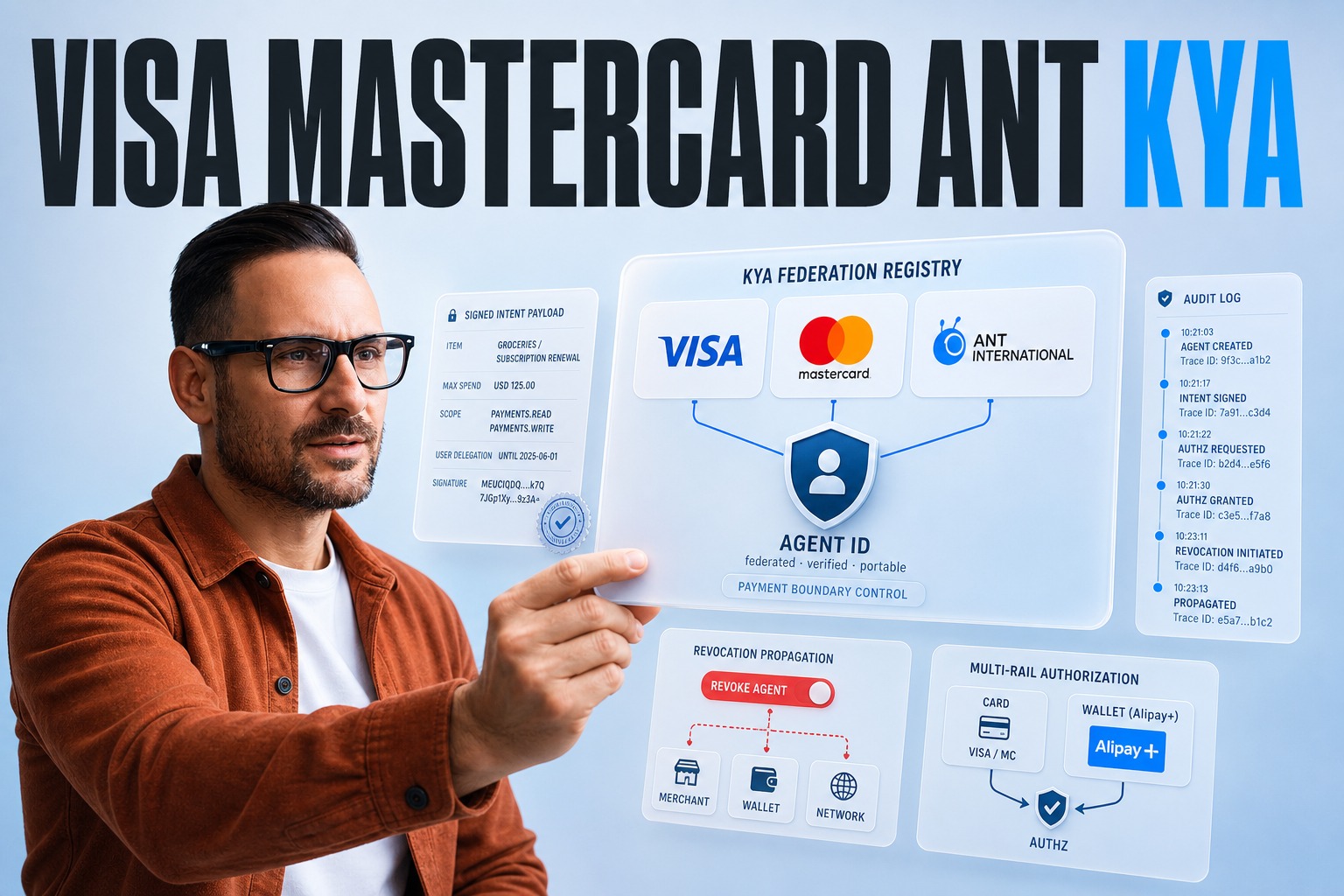
What changed this week that engineers should care about? → Visa, Mastercard, and Ant International said they will develop a shared Know Your Agent (KYA) framework so an AI shopping agent trusted on one network can be recognized across others.
What is the real search question behind the headlines? → How do we authenticate and authorize AI shopping agents to initiate payments safely, with auditability, across multiple payment and wallet networks.
Why does this matter now, not later? → The same week-level signal is that payments are preparing for agentic commerce, where software can place orders and renew subscriptions within user-defined rules, increasing transaction volume and risk at the same time.
What will break in our current payment architecture? → User-centric identity and checkout flows do not map cleanly to agent-driven intent, policy constraints, and delegated authority; the failure mode shifts to the boundary between agent decisions and payment authorization.
What is Plavno’s stance in one line? → Interoperable KYA will force teams to build an explicit agent identity and intent-verification layer at the payment boundary, and the right response is to treat agent authorization as a first-class security perimeter with consistent logging, revocation, and policy enforcement.
Visa, Mastercard, and Ant just made agent identity a payment-layer problem
Visa, Mastercard, and Ant International saying they will develop a shared KYA framework is not just payments news; it is an architecture signal. When an AI agent can check out on your behalf, identity cannot stop at the user login screen, and intent cannot be implied from a click. The practical question for CTOs is whether we design agentic commerce so that delegated authority is verifiable at the payment edge, or we let agents operate as opaque app automation that fraud teams must clean up later.
If you do not make agent identity and intent verifiable at the point of authorization, you will end up arguing about model quality while the real failures happen in delegation, policy, and audit trails.
Quick Answer: How do we implement Know Your Agent (KYA) for AI shopping agents?
A production KYA approach is an identity-and-authorization layer that treats the AI agent as a distinct actor from the end user and requires the payment request to carry proof of delegated authority, plus a verifiable statement of intent that can be audited after the fact. In practice, we design KYA as a combination of agent registration, cryptographic identification, policy-constrained scopes, and a revocation model that works across merchants, fintechs, and payment networks.
The key engineering move is to put KYA at the same trust boundary as payment authorization, not inside the conversational agent. Visa, Mastercard, and Ant are signaling that this boundary will be federated: each network keeps its own approval process, but trusted agents should be recognized across networks. For teams building agentic checkout this quarter, the right strategy is to align your integration around verifiable delegation and consistent logs, because network-level interoperability is coming even if timelines and merchant pilots are not yet named.
- Treat the agent as a principal: model it like a service identity with its own lifecycle, rather than a UI feature, so you can register, rotate credentials, and revoke authority without waiting for user password resets.
- Bind intent to authorization: require a structured, signed representation of what the agent is trying to purchase and under what constraints, because a generic payment token without intent is a fraud magnet.
- Make revocation instantaneous: plan for the user, merchant, wallet, or network to disable an agent quickly; otherwise subscription renewals and repeat purchases become an unbounded liability.
- Design for cross-network recognition: assume you will need to map your agent identity to multiple trust registries, because the whole point of a shared KYA framework is interoperability.
KYA is identity, delegated authority, and intent verification in one contract
KYA only works if we stop thinking of it as bot detection and start treating it as a contract between four parties: the user, the agent, the merchant, and the payment network. In typical production systems, identity proves who is acting, authorization proves what they are allowed to do, and intent provides the semantic reason for the transaction. If any one of these is implicit, you will see edge-case failures like agents buying the right item at the wrong price, renewing the wrong subscription tier, or creating transaction patterns that look like fraud.
Agent onboarding and registration: you need a process to register an agent identity and bind it to an operator, an application, and a set of permitted use cases, because anonymous agents cannot be meaningfully trusted.
Delegation from the user: the user must be able to grant scoped authority, typically separated from their primary login session, so agent access can be constrained and independently revoked.
Intent declaration at checkout: the payment initiation needs an intent payload that is stable enough to audit, so disputes can be resolved without guessing what the agent saw.
Network recognition and validation: the payment rails must be able to validate the agent and its authorization, which is exactly what a shared KYA framework implies across Visa, Mastercard, and Ant.
Interoperability changes the threat model more than it changes the UX
When Visa, Mastercard, and Ant aim to let an agent cleared on one network be recognized across others, they are moving from isolated trust silos to a federation model. That is great for adoption, but it also means compromise has a wider blast radius if revocation and monitoring are not consistent. In practice, our architecture must assume that one compromised agent identity will attempt to reuse its standing across multiple merchants and wallets, so federation requires stronger controls, not fewer.
- Federated trust, local policy: interoperability does not mean identical rules; it means a shared way to recognize an agent while each network keeps its own approval process.
- Revocation propagation: the hardest operational problem is making a revoked agent stop working everywhere quickly, not just in one app.
- Auditability across parties: disputes will cross boundaries, so logs must be correlatable between merchant, PSP, wallet, and network.
- Least-privilege delegation: users will demand granular constraints, because agentic spending without limits is indistinguishable from a compromised account.
Why agentic commerce breaks your current payment integration patterns
Most payment integrations are designed around a human-driven checkout flow where the user is present, the cart is visible, and intent is obvious. Agentic commerce removes that guarantee: software can browse, compare, and purchase within user-defined rules, including recurring actions like renewing subscriptions. That means your core integration assumption shifts from interactive confirmation to delegated execution, and the weak link becomes the translation of business policy into a payment authorization request.
- Session-based authentication stops being enough: a user login session does not prove the agent is currently acting within scope, especially for background purchases and renewals.
- Disputes become semantic: chargebacks and user complaints will hinge on whether the purchase matched the user’s rules, not whether the card number was valid.
- Fraud signals get noisier: agents can generate more transactions, and high-frequency legitimate behavior can look like fraud until you add agent identity and intent to the risk context.
- Merchant systems become policy engines: inventory, pricing, and subscription logic must be expressed in a way an agent can execute safely, or you will see unintended purchases and inconsistent fulfillment.
The new boundary is not the model, it is authorization under constraints
Teams often debate which model to use for agent reasoning, but the production failures happen when the agent crosses a boundary into a real-world side effect like a payment. That boundary needs deterministic enforcement: policy checks, limits, and verifiable authorization. If you cannot explain, after the fact, why a transaction was permitted, you have an incident-response problem no amount of prompt tuning will solve.
| Checkout design question | Human-first flow | Agent-first flow with KYA |
|---|---|---|
| Who is the actor? | The user identity is the actor | The agent is a distinct actor with delegated authority |
| What proves intent? | UI actions imply intent | A verifiable intent statement must travel with the payment |
| What is the main failure mode? | Stolen credentials, card fraud | Mis-scoped delegation, ambiguous intent, federation risk |
| What resolves disputes? | Receipts and user confirmations | Correlated logs of policy, intent, and authorization |
If software does the spending, you need machine-readable policy, not fine print
The input signal includes the simple but uncomfortable question: if software does your spending, who ensures it spends wisely. From a systems angle, the answer is not governance committees; it is enforceable constraints. In practice, that means translating subscription rules, product restrictions, and spending limits into machine-evaluable policy checks at the moment of authorization, with explicit allow and deny outcomes that can be audited.
- Policy must be evaluated at the edge: checks should happen where the payment is initiated, not deep inside the agent conversation where context can drift.
- Constraints must survive retries: agent workflows will retry on failures; without idempotency and stable intent identifiers, the same request can become multiple charges.
- Approval is not the same as trust: a user approving an agent once does not mean every future action is safe, especially for recurring renewals.
- Logs need cross-party correlation: you cannot investigate agentic disputes if merchant logs cannot be matched to wallet or network logs.
Designing a production KYA layer means choosing a control plane, not a chatbot feature
At Plavno, we see KYA as a control plane decision. You are deciding where agent identity lives, how authority is granted, and how intent is bound to a payment initiation across services. If you put KYA logic only in the agent application layer, you create a fragile system where the most safety-critical checks are coupled to fast-changing product logic. If you put it at the payment boundary, you can stabilize the contract and let product teams iterate safely on agent UX.
This is why KYA frameworks matter even before they ship as standardized products. Visa, Mastercard, and Ant have already named their own efforts, and now they are aligning on a shared approach so an agent recognized on one network can be recognized across others. If you are building agentic commerce capabilities, we recommend designing your system so the KYA layer is explicit, independently testable, and operationally owned like any other security-critical service. This is the mindset behind our AI agents development work: the agent is not the system, the boundaries are.
Interoperable KYA implies federation, and federation forces clearer ownership
The collaboration explicitly aims for interoperability: an agent cleared on one network should be recognized across others, while each network keeps its own approval process. For engineering leaders, that means your architecture must reflect that ownership is shared. When something goes wrong, everyone will have part of the evidence, and no single party will have the whole story unless you design for correlation from day one.
- Identity mapping becomes unavoidable: the same agent will need to be recognized in multiple ecosystems, so you should plan for identifiers that can be mapped rather than reinvented per partner.
- Trust is portable, liability is not: even if recognition is shared, each participant will still manage their own approval and risk posture, creating integration friction you must budget for.
- Wallet and card rails collide: Ant’s Alipay+ links many digital wallets, and a shared KYA framework signals that agentic commerce will not be card-only.
- No timeline means you must design for change: the press signal includes that no timeline and no merchant pilots were named, so treat this as a direction and avoid hard-coding assumptions.
Ant’s wallet footprint is the architectural reason this is not just a Visa-Mastercard story
The input includes a concrete distribution fact: across much of Asia, digital wallets are more popular, and Ant’s Alipay+ network links dozens of them. That matters because agentic payments will route through whatever rails are most native to the customer context. If your agentic checkout assumes a card token is always the endpoint, you will struggle in wallet-first markets where identity, consent, and risk signals are expressed differently.
Decide where the agent is anchored: in your merchant app, in a wallet ecosystem, or as a cross-merchant agent, because the anchor determines which party can enforce policy at authorization.
Define the revocation authority: the user, the merchant, the wallet, and the network will all need a way to disable an agent, and conflicting revocations must resolve deterministically.
Standardize the minimum audit log: choose the smallest set of fields you must log to reconstruct delegation and intent, so cross-party investigations are possible.
Plan for multi-rail payments: design your payment orchestration so the same agent identity can be evaluated consistently whether the route is card-based or wallet-based.
Stablecoins are the competitive pressure hiding inside the KYA narrative
The input explicitly notes that agents could bypass cards with stablecoins, and also that Visa and Mastercard pursue that area. For builders, the takeaway is not to bet on one rail; it is to design the authorization and trust layer so it can travel across rails. If you architect KYA as an abstraction that only works for one network, you will rebuild it when the payment route changes.
| KYA decision | If you get it right | If you get it wrong |
|---|---|---|
| Agent identity lifecycle | Fast onboarding with controlled scopes and clean revocation | Permanent, over-privileged agents that cannot be safely disabled |
| Intent binding at authorization | Disputes can be resolved with evidence | Disputes devolve into guesswork and customer support escalations |
| Federation readiness | One integration can scale across networks | Each partner requires a bespoke, brittle integration |
| Multi-rail compatibility | Same trust layer works across wallets and cards | Payments strategy is locked to one rail and hard to evolve |
Networks are betting that KYA will be a fraud-and-services revenue line, not a feature
The input makes it clear that Visa and Mastercard already monetize through network fees tied to volume, and that agents can increase the number of transactions by removing human time limits. It also ties the KYA direction to a security push: Visa agreed in August to buy fraud-detection firm BioCatch for $2.4 billion, and Mastercard reported value-added services revenue grew 20% year over year in the second quarter (18% on a currency-neutral basis). Those facts matter for engineers because they indicate where platform capabilities will land: not only in consumer UX, but in network-provided verification and risk services.
The practical implication is that KYA will likely show up as a set of network-facing requirements and APIs that merchants and fintechs must integrate with to keep authorization rates healthy and fraud losses contained. Whether you are a marketplace, a subscription business, or a fintech building an agent experience, your stack will need to pass richer context to the payment layer: agent identity, delegated scope, and intent. That is also why the companies referenced research suggesting AI agents could handle $3 trillion to $5 trillion of global consumer commerce by 2030; the scale is large enough that the supporting security and verification primitives become strategic infrastructure, not optional add-ons.
From Plavno’s point of view, this is where we advise clients to invest: build your agentic commerce architecture so you can plug into network-level KYA and fraud services without rewriting your core ordering logic. When we develop AI security solutions, we treat delegated authority and verification as production systems with owners, SLAs, and incident playbooks, because that is exactly how the networks are positioning this space.
What merchants and fintechs should decide this quarter, before KYA is standardized
The input includes that the companies set no timeline and named no merchant pilots, which means teams cannot wait for a finished standard to start building. The decision this quarter is whether you will keep agentic commerce as internal automation, or you will externalize it as a product that must survive partner integrations and audits. If you choose the latter, you should design the payment orchestration so agent identity, delegation, and intent are explicit artifacts that can be passed through your systems, not inferred from UI state.
This is also the moment to align engineering ownership. In many organizations, payments live under finance systems, while AI lives under product or data teams. Agentic commerce forces them together: the agent is the interface, but the payment boundary is the risk perimeter. At Plavno, we often start with a short architecture engagement to map those boundaries and ownership lines, which fits well into software development consulting when the goal is to ship safely without turning every purchase into an incident.
- Payments team: should own the authorization boundary and ensure agent context can be carried to the gateway or PSP without breaking existing reconciliation.
- Fraud and risk team: should define what signals are required to distinguish high-frequency legitimate agent behavior from abuse.
- Product team: should translate user rules into machine-enforceable constraints that are visible and editable, especially for subscriptions.
- Platform team: should build the audit and observability layer so cross-service traces can reconstruct who did what, when, and under which delegated scope.
Agent in your app vs agent in the wallet is a fork you must make explicit
An AI agent that orders groceries and renews subscriptions can be built as a feature inside a merchant app, or it can be anchored in a wallet ecosystem that spans merchants. Architecturally, these choices determine where KYA enforcement lives: merchant-first designs favor merchant policy controls, while wallet-first designs favor a central delegation and identity model. The Visa, Mastercard, and Ant signal is that both worlds will exist, and interoperability will be demanded when customers move between them.
Real deployments will start with groceries and subscriptions because intent is repeatable
The input uses two concrete examples that matter operationally: ordering groceries and renewing subscriptions. These are ideal early categories because user intent can be expressed as a recurring pattern with constraints, and fulfillment feedback loops exist to validate outcomes. In a grocery scenario, the agent is likely to act frequently, making transaction volume and fraud detection more sensitive to false positives; KYA must reduce risk without blocking legitimate automation.
Subscriptions create a different failure mode: drift. A user’s constraints can change, and subscription terms can change, while the agent keeps executing. In practice, that is why we recommend treating delegation as time-bounded and scope-bounded, and ensuring each renewal can be mapped to the rule set that was in effect at the time. The same design also supports expansion into wallet-first markets signaled by Ant’s Alipay+ ecosystem, where agentic experiences may be embedded in a super-app or wallet context rather than a single merchant.
Risks you cannot outsource to the model provider when agents initiate payments
Even if your agent reasoning is provided by a third party, your liability sits at the integration boundary where the agent triggers real-world effects. The input directly hints at the governance issue: if software does your spending, someone must ensure it spends wisely. In engineering terms, that means you must own policy enforcement, revocation, and post-incident forensics, because those are not model features; they are system properties that arise from architecture.
We also see a new category of security work: validating that your authorization and logging cannot be bypassed by workflow retries, race conditions, or partial failures across services. This is where organizations benefit from independent validation and adversarial testing of the payment boundary and agent delegation layer, which fits naturally into cybersecurity and penetration testing when you are turning agentic commerce into a real product.
If you build agentic checkout without a revocation model that works across partners, you are effectively granting permanent power of attorney to software.
Closing insight: KYA is the new identity perimeter for commerce
Visa, Mastercard, and Ant are pointing to the same future: agentic commerce is coming, and trust must be portable across networks even if approvals remain local. The central engineering shift is that identity and authorization can no longer stop at the user; the agent becomes a principal, and intent becomes a verifiable artifact. Author: Plavno team. Last updated: September 2026.
 Chat GPT
  Perplexity
  Claude
  Gemini
