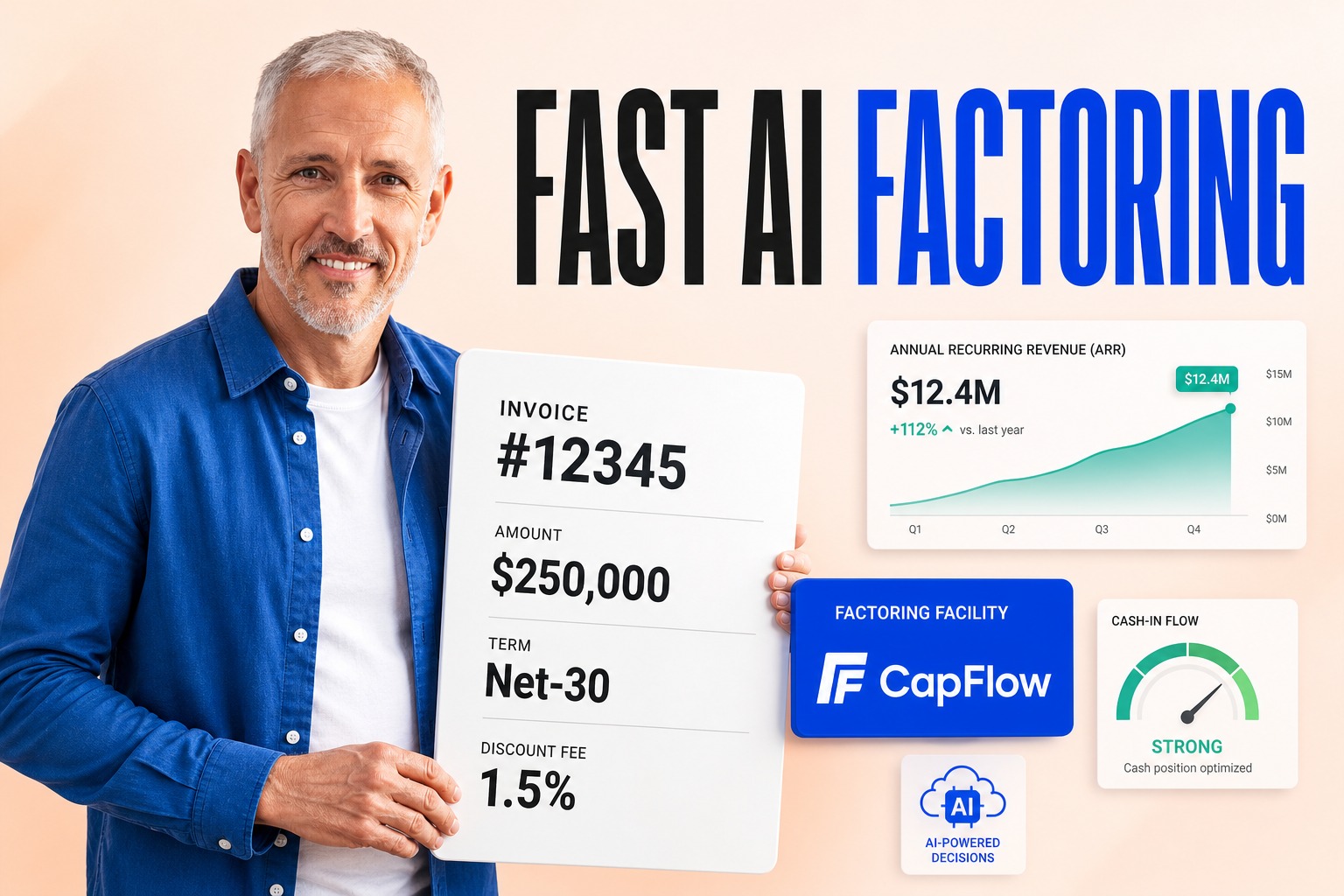
Is invoice factoring a viable alternative to equity rounds for AI SaaS startups? → Yes, when receivables are strong and cash‑flow timing is critical.
Can factoring preserve ownership while delivering fast cash? → It provides liquidity without issuing new shares.
Does factoring suit companies with multi‑industry SaaS customers? → It works best when contracts generate predictable invoices.
Will factoring affect a company’s runway calculations? → It can extend runway by converting receivables into immediate cash.
Quick Answer: Factoring Beats Dilutive Funding for Rapid AI SaaS Growth
For AI‑driven SaaS firms that are scaling quickly, invoice factoring provides the liquidity they need without giving up equity, and it aligns cash outflows with receivable cycles, making it the preferred financing tool when the company has strong accounts‑receivable discipline.
- Preserves ownership – No new shares are issued, so founders keep control of strategic direction.
- Matches cash‑in timing – Funding arrives as soon as invoices are generated, eliminating the gap between delivery and payment.
- Speed of funding – Factoring desks can approve and fund within days, far faster than a typical Series A round.
- Cost transparency – Fees are expressed as a clear discount on invoices, avoiding hidden interest that equity investors may embed.
Factoring Aligns Cash Flow Directly to Receivable Cycles
When a SaaS company bills on net‑30 or net‑60 terms, the cash needed to sustain product development, cloud spend, and talent acquisition sits locked in unpaid invoices. Factoring converts those pending payments into immediate working capital, allowing the business to fund headcount and infrastructure without waiting for the customer’s payment schedule. This alignment reduces the need for bridge loans and keeps the balance sheet lean, a crucial advantage in a market where speed to market defines competitive edge.
If your receivable turnover is under 60 days, factoring can fund growth faster than any round of equity.
Dilutive Financing Adds Hidden Runway Cost
Equity rounds inject cash, but they also introduce ownership dilution, governance overhead, and expectations for rapid scaling that may outpace operational readiness. The cost of equity is not merely the share price; it includes future profit sharing, board seats, and the pressure to meet investor‑driven milestones. For an AI SaaS firm that already has a predictable billing cadence, the incremental cash from a round often exceeds the cash‑flow gap, making the dilution an avoidable expense. Learn more about our AI solutions. Our AI consulting services complement the financing options.
How Factoring Works for SaaS Companies
The factoring process begins with the SaaS provider submitting approved invoices to the factor. The factor advances a percentage—typically 70‑90 %—of the invoice value within 24‑48 hours. Once the customer pays, the factor releases the remaining balance minus a discount fee. Because the SaaS product is subscription‑based, the recurring revenue stream provides the factor with a reliable cash‑flow forecast, reducing risk and enabling lower discount rates compared to one‑off sales contracts.
Risk Controls Built Into Factoring Contracts
Factoring agreements include covenants that protect the factor, such as minimum invoice sizes, credit limits on customers, and periodic reporting of churn metrics. These controls ensure that the factor’s exposure aligns with the SaaS company’s health. Moreover, most factors allow the seller to retain the customer relationship, preserving brand equity while the factor merely handles the financing leg of the transaction.
| Metric | Invoice Factoring | Equity Funding |
|---|---|---|
| Liquidity | Immediate cash on approved invoices | Cash arrives after closing, often weeks |
| Ownership Dilution | None – ownership remains unchanged | Shares issued, reducing founder stake |
| Covenant Flexibility | Limited to credit and invoice criteria | Broad covenants on burn rate, milestones |
| Funding Speed | Days to weeks (typically 2‑3 days) | 4‑12 weeks for term sheet and due diligence |
| Cost Structure | Transparent discount (1‑3 % of invoice value) | Implicit cost via equity dilution and expectations |
Scenarios Where Factoring Shines
Factoring is especially advantageous when a SaaS firm lands large enterprise contracts with lengthy payment terms, experiences rapid headcount growth that outpaces cash receipts, or needs to fund cloud infrastructure spikes without waiting for quarterly invoicing cycles. In these cases, the ability to convert receivables into working capital preserves the company’s strategic flexibility and avoids the pressure of meeting aggressive growth targets imposed by new investors.
Common Myths That Steer Founders Away From Factoring
Many founders view factoring as a last‑resort financing tool, assuming it is only for distressed businesses or that it erodes profit margins. These myths persist because the industry historically served manufacturing firms, and the terminology can sound “financial‑services‑heavy.” In reality, modern factoring desks specialize in SaaS and subscription models, offering competitive discount rates and preserving the seller’s brand. Understanding the true economics dispels the fear that factoring is a sign of weakness.
- Myth 1: Factoring is only for cash‑strapped companies – Modern factors evaluate recurring revenue stability, not just balance‑sheet health.
- Myth 2: Fees eat into margins – Discount rates are often lower than the effective cost of equity when you factor in dilution.
- Myth 3: It damages customer relationships – The seller retains all customer interactions; the factor merely advances cash.
- Myth 4: It’s a one‑time fix – Factoring can be a recurring financing mechanism that scales with revenue growth.
Roadmap to Embed Factoring Into a Growth Plan
Integrating factoring requires a disciplined approach that starts with assessing receivable quality and ends with aligning financial KPIs to the new cash‑flow profile. First, map out the invoice pipeline and identify contracts with the longest payment terms. Next, model the impact of a factoring discount on gross margin and runway, comparing it against the dilution cost of a hypothetical equity round. Finally, select a factor that offers transparent fees and a technology stack that integrates with your ERP or billing system, ensuring seamless fund flow. Integrating factoring with your cloud software development stack ensures seamless data flow.
Aligning Sales Operations With Factoring
Sales teams must understand how invoice terms affect financing eligibility. By standardizing contract language to include clear payment milestones, the company can accelerate approval with the factor. Additionally, sales compensation plans should reflect the cash‑flow reality, rewarding closed‑won deals that generate high‑quality invoices rather than merely focusing on headline ARR.
Operational Adjustments Required for AR Management
A shift to factoring forces the finance organization to tighten accounts‑receivable monitoring. Real‑time dashboards that track invoice aging, churn risk, and customer credit scores become essential. The finance team also needs to establish a routine audit process to ensure that only eligible invoices are submitted, preventing disputes that could delay funding. These operational upgrades not only support factoring but also improve overall cash‑flow visibility.
- Implement an invoice aging dashboard – Gives visibility into which invoices are fundable.
- Standardize contract clauses – Ensures invoices meet factor eligibility criteria.
- Integrate billing software with the factor’s portal – Automates submission and reduces manual errors.
- Establish a quarterly AR audit – Detects anomalies early and maintains factor confidence.
- Train sales ops on cash‑flow impact – Aligns revenue targets with financing strategy.
Financial Modeling Implications
When factoring replaces an equity infusion, the financial model must reflect a lower cash‑outflow timeline and a higher operating cash balance. The model should capture the discount fee as a line‑item expense, adjust the cash‑burn forecast, and recalculate runway based on the new cash‑on‑hand figure. Sensitivity analysis around invoice turnover rates helps quantify how changes in collection speed affect financing costs.
Accurate AR forecasting is the single most important factor in securing favorable factoring terms.
Effect on Runway and Valuation
Factoring can extend runway by converting months of receivables into immediate cash, often adding 3‑6 months of operating capital without altering the equity base. Because the company’s ownership structure remains intact, valuation calculations that depend on share count stay stable, which can be advantageous when preparing for a later, higher‑priced equity round. For a deeper dive on how financing choices affect digital transformation, see our digital transformation offering.
Real‑World Case: AI SaaS Scaling With Factoring
A California‑based AI SaaS provider secured a $3 million invoice factoring facility from CapFlow Funding Group. The company leveraged the cash to hire additional data‑science talent, expand its cloud infrastructure, and sign larger contracts with enterprise clients. By converting its growing accounts‑receivable into working capital, the firm avoided a dilutive Series A round, preserved founder equity, and accelerated its product roadmap, demonstrating the strategic advantage of factoring in a high‑growth environment.
Assessed receivable quality – Identified contracts with net‑45 terms and low churn risk.
Negotiated a $3 million facility – Structured a discount rate aligned with invoice risk profile.
Integrated factoring portal – Connected billing platform to automate invoice submission.
Reinvested cash – Allocated funds to talent acquisition and cloud scaling.
Monitored performance – Tracked cash‑flow improvements and adjusted strategy quarterly.
Key Lessons From the Case
The experience shows that factoring can be a catalyst for scaling when the company maintains disciplined AR practices and aligns its operational processes with the financing mechanism. It also highlights the importance of choosing a factor that understands SaaS revenue dynamics, as the right partner can negotiate lower discount fees and provide value‑added services like credit monitoring.
Risk Mitigation Tactics
To protect against potential downsides, the company instituted a credit‑risk review for new customers, capped exposure to any single client, and maintained a reserve fund to cover any factor‑related fees that exceeded budgeted levels. These safeguards ensured that the factoring arrangement remained a net positive contributor to cash flow.
Choosing a Factoring Partner
Selecting a factor involves more than comparing discount rates. Companies should evaluate the provider’s technology integration capabilities, the transparency of fee structures, and the depth of industry expertise. A partner that offers a robust API and real‑time reporting will reduce operational friction and enable the finance team to focus on strategic decisions rather than manual reconciliations.
Technology integration – API support for billing and ERP systems.
Industry expertise – Experience with subscription‑based SaaS models.
Fee transparency – Clear disclosure of discount rates and ancillary charges.
Credit risk support – Access to customer credit assessments.
Service level agreements – Guarantees on funding speed and dispute resolution.
Future Financing Landscape for AI SaaS
As AI applications become more mission‑critical, the demand for flexible, non‑dilutive capital will grow. Investors are increasingly comfortable with hybrid financing models that combine equity with receivable‑based funding, allowing companies to preserve ownership while still accessing the liquidity needed for rapid scaling. Factoring, especially when paired with advanced analytics platforms, will become a standard tool in the AI SaaS financing toolkit. Explore our FinTech solutions for integrated financing options.
Bottom Line for CTOs and CFOs
When the primary constraint is cash tied up in long payment cycles, invoice factoring delivers immediate liquidity without sacrificing equity or strategic control. For CTOs, this means the ability to provision cloud resources and hire specialized talent on schedule, keeping product development velocity high. For CFOs, factoring simplifies cash‑flow forecasting, reduces reliance on bridge loans, and preserves a clean cap table for future fundraising rounds.
Validate receivable quality – Ensure contracts have low churn and clear payment terms.
Compare cost of capital – Model factoring discount versus dilution impact on valuation.
Assess operational impact – Confirm finance and sales ops can support the factoring workflow.
Select a specialist factor – Prioritize partners with SaaS expertise and API integration.
Monitor and iterate – Track cash‑flow improvements and adjust the financing mix as the business evolves.
Takeaway
Invoice factoring offers fast‑growing AI SaaS companies a pragmatic, non‑dilutive way to turn outstanding invoices into working capital, preserving ownership and accelerating product delivery. By treating factoring as a strategic financing layer rather than a stop‑gap, CTOs and CFOs can align cash flow with growth ambitions, maintain a clean cap table, and position the business for a higher‑valued equity round when the market is favorable.
 Chat GPT
 Perplexity
 Claude
 Gemini