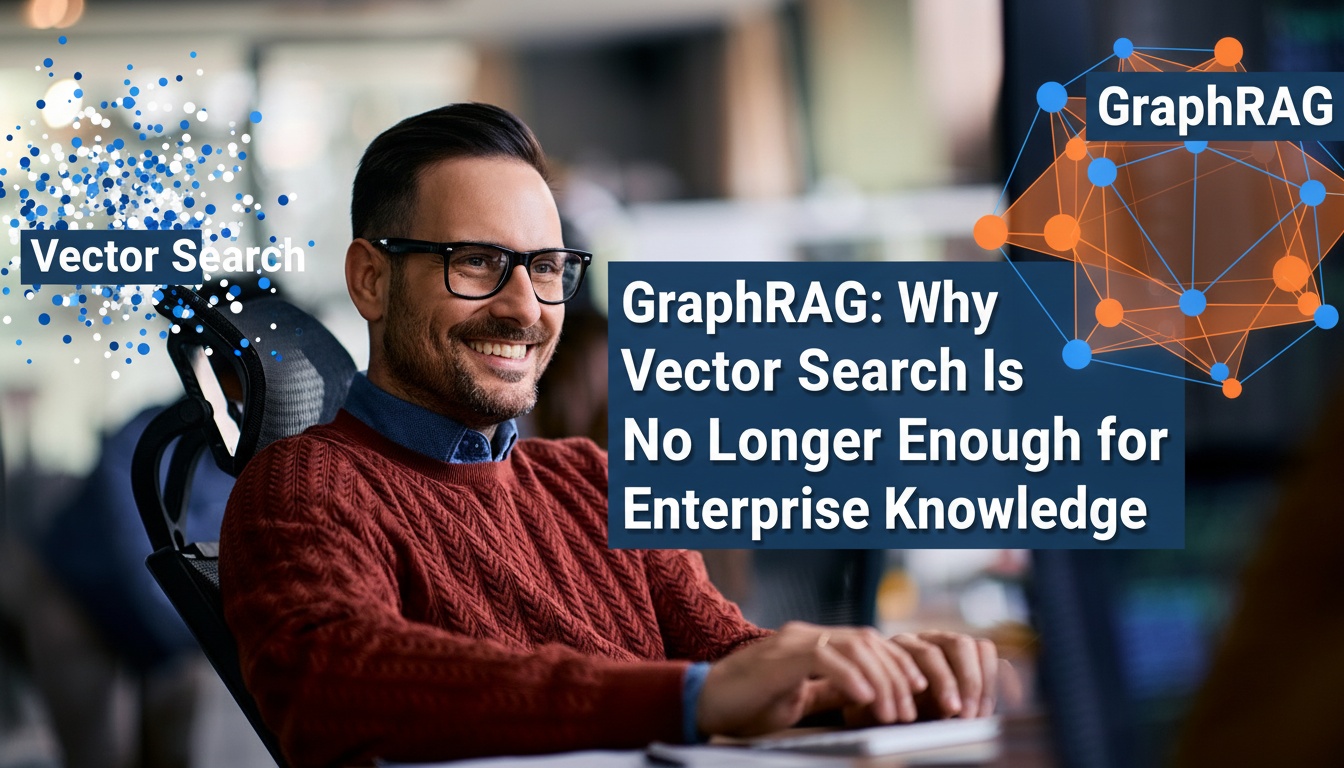
The release of GraphRAG methodologies by major research labs marks a definitive shift in how we approach retrieval-augmented generation (RAG). For the past year, the industry standard has been simple: chunk documents, embed them into vectors, and retrieve via semantic similarity. This worked for narrow queries, but it is fundamentally breaking down under the weight of enterprise complexity. The news signal isn't just a new library; it is the realization that vector databases, while powerful, cannot answer "global" questions—queries that require understanding the entire dataset's structure, such as "What are the primary themes across all client feedback?" or "How do these five regulations interact?" If you are relying solely on cosine similarity to navigate your proprietary knowledge base, you are flying blind. You are retrieving fragments without understanding the map, and in high-stakes environments, that leads to hallucinations and missed context.
Plavno’s Take: What Most Teams Miss
At Plavno, we see a critical failure pattern in production RAG systems: the assumption that semantic overlap equals semantic relevance. Most teams stop at implementing a vector store like Pinecone or Milvus and call it a day. They miss that vector search is inherently "local." It finds the chunk that looks like the question, not the chunk that explains the answer in the context of the broader document set.
The mistake is treating unstructured text as a bag of words rather than a network of concepts. When a user asks a question that requires synthesizing information dispersed across hundreds of documents—common in legaltech and e-discovery—vector search returns a random sampling of relevant chunks, often missing the connecting tissue. The result is a generic, hallucinated summary. Teams get stuck because they try to solve this with "bigger context windows" or "reranking models," which are band-aids. The root cause is architectural: you lack a knowledge graph to structure the relationships between your data points.
What This Means in Real Systems
Implementing GraphRAG isn't just an add-on; it changes the data ingestion pipeline entirely. In a standard RAG stack, you ingest text, chunk it, and send it to the embedding model. In a GraphRAG architecture, we insert a heavy LLM-driven extraction step upstream.
Here is the production reality: you must use an LLM (like GPT-4o or Claude 3.5) to extract entities (nodes) and relationships (edges) from every document. This data is then loaded into a graph database (e.g., Neo4j or NebulaGraph). But the real magic—and the complexity—happens in the "community detection" phase. We use algorithms like Leiden to cluster these nodes into hierarchical communities. We then prompt the LLM again to generate natural language summaries for these communities.
When a query comes in, the system doesn't just look for similar text; it traverses the graph to identify relevant communities and retrieves their pre-generated summaries. This shifts the compute burden from query time to indexing time. The trade-off is significant: your indexing costs will skyrocket. We observe indexing costs for GraphRAG to be 10x to 50x higher than standard vector RAG because you are running expensive LLM inference over every token to build the graph. However, this allows for sub-second retrieval of complex, holistic answers that would otherwise require scanning thousands of chunks.
Why the Market Is Moving This Way
The shift toward GraphRAG is driven by the falling cost of intelligence and the rising cost of error. Six months ago, running an LLM over every document to extract entities was prohibitively expensive. Today, with the rise of cheaper, high-throughput models and the commoditization of inference, it is economically viable to spend compute at indexing time to buy quality at query time.
Furthermore, enterprises are moving beyond simple chatbots. They are building agents that need to reason over data. An agent cannot reason if it cannot see the connections between data points. The market is realizing that "dumb" retrieval (vector search) limits "smart" generation. We are seeing a surge in demand for AI consulting specifically focused on data architecture because teams have hit the ceiling of what naive vector search can achieve. They need the structure that only a graph can provide to enable multi-step reasoning and tool use.
Business Value
The business case for GraphRAG is clear when you look at "global" query performance. In standard RAG pilots, we see success rates (accuracy measured by human evaluators) around 60-70% for specific fact-finding questions. However, for holistic questions (e.g., "Summarize the risks in this dataset"), accuracy often drops below 40%.
With GraphRAG, our benchmarks show that accuracy on holistic queries can jump to 80-90%. This is not a marginal improvement; it is the difference between a system that requires constant human supervision and one that can operate autonomously. Consider a scenario in financial services: analyzing 10,000 earnings reports. A vector search might pull up mentions of "debt" but miss the narrative trend of "increasing leverage" across the sector. GraphRAG connects the entity "Company A" to "Debt" to "Q3 2023," allowing the system to synthesize a trend analysis. The value here is risk reduction—catching a systemic risk that a keyword search would miss.
Real-World Application
Mergers and Acquisitions (M&A) Due Diligence
An investment bank uses GraphRAG to ingest thousands of documents from a target company. Instead of searching for "litigation," they query, "Show me the network of entities involved in ongoing legal disputes." The graph reveals that a subsidiary, not the parent company, is the primary litigant, a nuance buried in footnotes that vector search flattened. This changes the valuation model immediately.
Pharma Research and Development
A biotech firm needs to understand the interaction between proteins and compounds across 50,000 research papers. Vector search finds papers mentioning "Protein X," but GraphRAG maps the interaction pathways, identifying that "Compound Y" inhibits "Protein X" only in the presence of "Gene Z." This accelerates target identification by weeks, saving millions in R&D spend.
How We Approach This at Plavno
We do not treat GraphRAG as a plug-and-play library. We treat it as a data engineering challenge. When we build custom software development projects involving knowledge management, we start by defining the ontology. What are the entities? What are the relationships? If you don't define this, the LLM will hallucinate a messy graph that is worse than useless.
We also implement strict guardrails on the extraction pipeline. We use smaller, faster models for the initial entity extraction to keep costs manageable, reserving the most capable models for the community summarization phase. We also architect for "graph freshness." Unlike vector databases where updating a document is a simple upsert, updating a graph requires re-running community detection, which can be slow. We design incremental update pipelines that only re-index affected subgraphs, ensuring the system remains operational without requiring a full nightly rebuild.
What to Do If You’re Evaluating This Now
Audit your failures: Categorize the questions your system fails on. If they are mostly "global" or "holistic" questions, GraphRAG is the solution.
Start with a hybrid approach: Keep your vector store for low-latency, specific fact retrieval. Layer a graph on top for complex reasoning. This gives you the best of both worlds—speed and depth.
Budget for indexing: Calculate your token costs for the extraction phase. It will be high. Ensure you have a strategy for using cost-effective models (like GPT-4o-mini or Llama 3) for the heavy lifting of entity extraction.
Don't ignore the ontology: Work with domain experts to define the types of entities and relationships that matter. A generic graph is rarely useful in a specialized industry.
Conclusion
Vector search was the first step in grounding LLMs in enterprise data. GraphRAG is the second, and arguably more critical, step. It moves us from "searching for text" to "reasoning over knowledge." For organizations looking to move beyond simple AI chatbot development into true intelligence augmentation, the graph is not optional. It is the infrastructure required to turn unstructured noise into a structured, queryable asset. The teams that adopt this architecture now will build systems that don't just retrieve information but actually understand it.
 Chat GPT
 Perplexity
 Claude
 Gemini