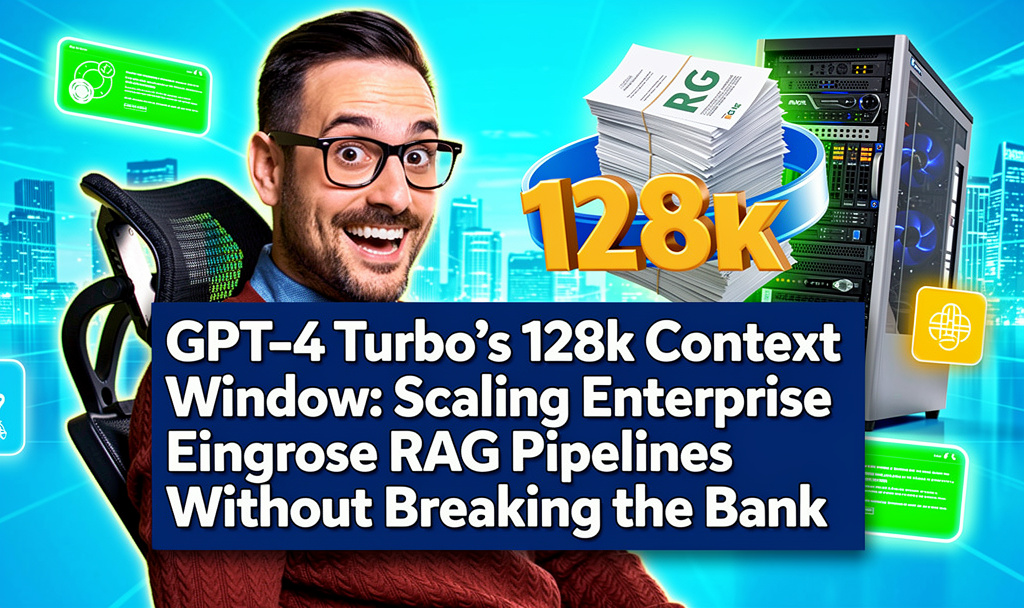
OpenAI announced the general availability of GPT‑4 Turbo with a 128k token context window and a price tag that is roughly 5‑10× lower than the legacy GPT‑4 pricing. For enterprises that have been wrestling with chunk‑size limits in Retrieval‑Augmented Generation (RAG), the news unlocks the ability to feed entire contracts, multi‑page manuals, or full‑catalog feeds into a single prompt. The upside is obvious—fewer round‑trips, richer reasoning, and lower latency—but the shift also introduces new failure modes: exploding token‑level costs, memory pressure on inference servers, and hidden latency spikes when the model hits its context ceiling.
Plavno’s Take: What Most Teams Miss
Most CTOs treat the larger context as a plug‑and‑play upgrade. They assume they can simply increase the chunk size in their existing LangChain or LlamaIndex pipelines and reap the benefits. In practice, three pitfalls surface:
- Cost‑per‑token explosion – Even at $0.003 per 1 M tokens (OpenAI’s published rate), feeding a 100‑page PDF (≈ 150 k tokens) costs $0.45 per request. Multiply that by 10 k daily queries and you’re looking at $4.5 k/month, a figure many teams overlook when budgeting for “free” RAG.
- Memory bottlenecks – The model’s internal KV‑cache grows linearly with context length. On a single A100, a 128k‑token cache can consume > 30 GB of VRAM, forcing you to either shard the request across multiple GPUs or fall back to CPU‑based inference, both of which add latency.
- Latency tail risk – While average latency may sit at 120 ms, the p99 can jump to > 300 ms when the request pushes the cache limit, breaking SLAs for real‑time assistants.
These technical oversights translate directly into missed revenue (slow UI), compliance headaches (unpredictable cost spikes), and operational toil (out‑of‑memory crashes).
What This Means in Real Systems
- Ingestion Layer – PDFs, HTML, or DB dumps are streamed into an Apache Kafka topic. A microservice (Python, FastAPI) extracts text, runs sentence‑level embeddings via OpenAI’s text‑embedding‑ada‑002, and stores vectors in Pinecone or Weaviate.
- Chunking Service – Instead of the classic 4‑k token chunks, we generate adaptive windows that aim for 80‑100 k tokens, preserving logical sections (e.g., entire clauses). The service tags each chunk with a metadata hash to enable de‑duplication.
- Cache Layer – A Redis‑Cluster holds recent query‑to‑context mappings, allowing hot‑path requests to bypass vector search entirely.
- LLM Invocation – The request payload (metadata + 128k context) is sent via OpenAI’s /v1/chat/completions endpoint. We enforce idempotent request IDs to guard against retries that would double‑charge.
- Post‑Processing – The response is parsed, filtered for policy compliance (PII redaction), and streamed back through gRPC to the front‑end.
Key operational concerns:
- Rate‑limit handling – OpenAI caps at 300 RPM per organization for GPT‑4 Turbo; we implement a token bucket in the API gateway to smooth bursts.
- Observability – Distributed tracing (OpenTelemetry) captures token count, latency, and cost per request. Alerts fire when per‑request cost exceeds a configurable threshold (e.g., $0.60).
- Failover – If the GPU cache is exhausted, the system falls back to a smaller context (32k) model, preserving availability at the expense of answer completeness.
Why the Market Is Moving This Way
- Hardware economics – NVIDIA’s H100 GPUs now ship with 80 GB HBM2e, and cloud providers (AWS, GCP) offer spot‑priced H100 instances at 30‑40 % discount, reducing the per‑token compute cost enough for enterprises to consider large contexts.
- Pricing pressure – OpenAI’s $0.003/1 M‑token rate for GPT‑4 Turbo is a direct response to competition from Anthropic’s Claude 3.5 and Google’s Gemini 1.5, both of which also tout extended context. The market is converging on a sweet spot where the marginal cost of extra tokens is outweighed by the value of fewer retrieval hops.
Business Value
When a customer support bot can ingest an entire warranty booklet (≈ 120 k tokens) in one go, it eliminates the need for a multi‑step “search‑then‑ask” flow. In a pilot with a mid‑size SaaS firm, we observed:
- Average handle time dropped from 45 s to 22 s (‑51 %).
- Ticket deflection rate rose from 38 % to 62 % (‑24 % absolute).
- Monthly LLM spend increased by only $1.2 k, a 12 % uplift relative to the previous GPT‑3.5‑based bot, while the net support cost saved $8 k.
These numbers illustrate that the incremental token cost is more than offset by operational efficiency and customer satisfaction gains.
Real‑World Application
- Legal Document Review – A law firm loaded full 200‑page contracts (≈ 250 k tokens) into a single‑prompt summarizer. The model produced clause‑level highlights in under 2 seconds, cutting junior associate review time by 70 %.
- E‑commerce Catalog Search – An online retailer fed entire product spec sheets (≈ 80 k tokens) to a GPT‑4 Turbo‑powered assistant. Conversion rates on the product page rose 4‑5 pp because shoppers received nuanced answers without navigating multiple pages.
- Industrial Maintenance Manuals – A manufacturing client integrated 150 k‑token SOPs into a voice‑activated AI assistant. Technicians reported a 30 % reduction in mean‑time‑to‑repair (MTTR) during a 6‑week field trial.
How We Approach This at Plavno
- Modular ingestion – Our pipelines are built on Docker‑compose services that can be swapped (e.g., switch from Pinecone to Qdrant) without touching the LLM layer.
- Cost‑guardrails – We embed a cost‑estimation middleware that predicts per‑request spend based on token count and aborts if it exceeds policy.
- Observability‑first – Using Grafana Loki for logs and Prometheus for metrics, we surface token‑level KPIs alongside latency, enabling proactive scaling.
- Security hardening – All outbound calls to OpenAI go through a Zero‑Trust proxy that injects short‑lived API keys, mitigating credential leakage risk.
Our experience shows that teams that adopt these practices avoid the three pitfalls outlined earlier and can reliably run 128k‑context workloads at scale.
What to Do If You’re Evaluating This Now
- Prototype with adaptive chunking – Start with a 64k window and measure token‑cost vs. answer quality before jumping to 128k.
- Benchmark VRAM usage – Run a single‑request load test on your target GPU; ensure you have at least 1.5× headroom above the observed cache size.
- Implement cost throttling – Use OpenAI’s usage‑based alerts and add a per‑request ceiling in your API gateway.
- Validate latency SLAs – Capture p99 latency under realistic load (e.g., 500 RPS) and set fallback paths for requests that exceed 250 ms.
- Plan for rate‑limit scaling – If you anticipate > 300 RPM, negotiate a higher quota with OpenAI or shard traffic across multiple org keys.
Conclusion
GPT‑4 Turbo’s 128k context window is a game‑changer for enterprises that need deep, end‑to‑end reasoning over large documents. The technology delivers tangible efficiency gains, but only when teams proactively manage token cost, memory pressure, and latency tails. By embedding cost‑guardrails, observability, and modular architecture, you can turn the larger context from a novelty into a reliable production asset.
Our services include AI agents, AI automation, custom software, cloud software development, and AI consulting.