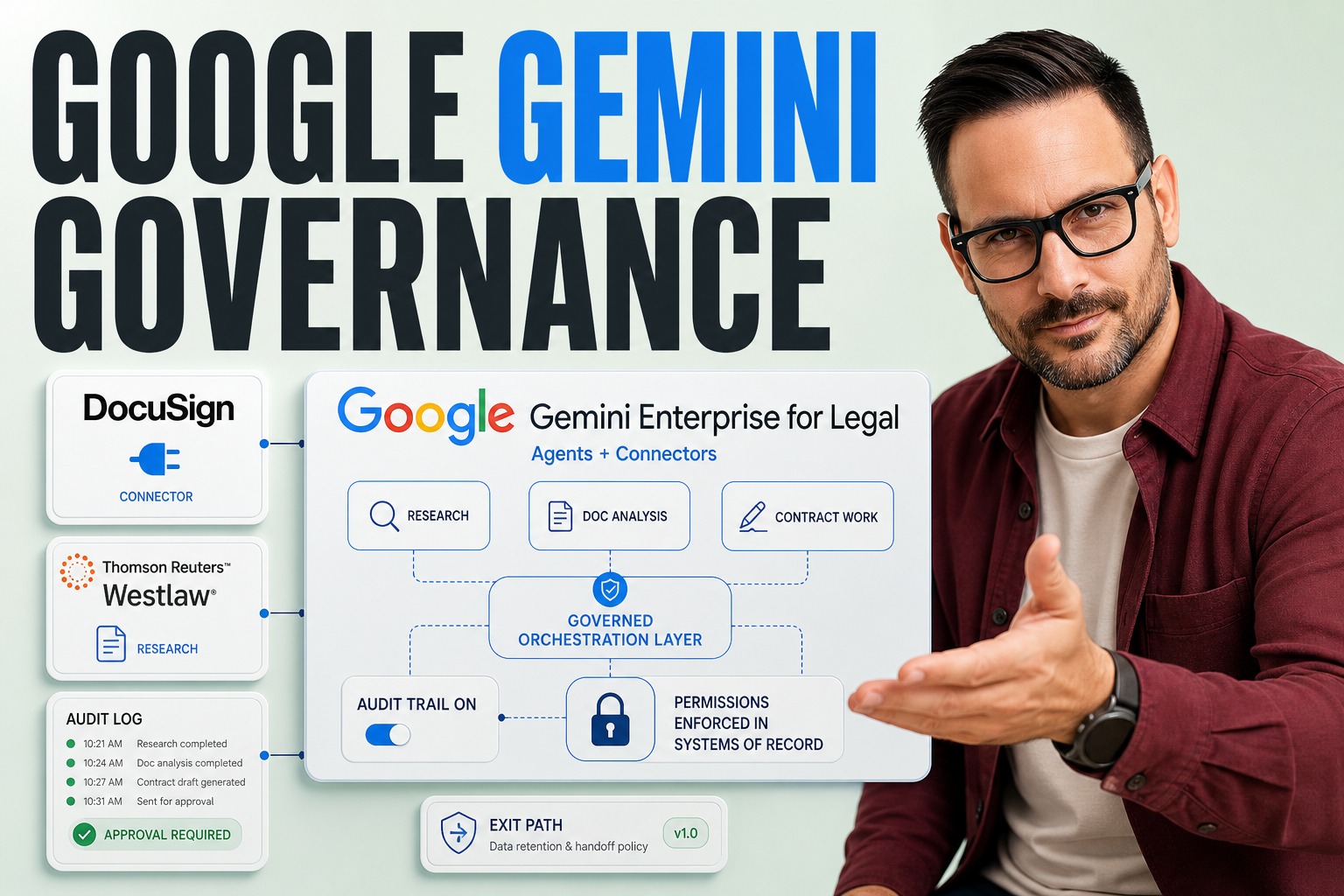
Is Google really moving from chatbots into legal software workflows? → Yes: Gemini Enterprise for Legal is positioned for law firms and corporate legal teams, with AI agents aimed at research, document analysis, and contract-related work.
What is the real engineering question behind the market reaction? → It is not whether AI can draft faster; it is whether an AI platform can sit on top of your existing systems and quietly become the new workflow layer.
Should we treat Gemini Enterprise for Legal as a replacement for tools like Westlaw or DocuSign? → Not exactly; the signal is orchestration and connectivity, because Google highlights connectors (including DocuSign) that let it route work across tools.
What decision do CTOs need to make this quarter? → Whether to adopt an AI platform inside regulated legal workflows without creating a new single point of failure in governance, auditability, and vendor lock-in.
What angle are we taking at Plavno? → The competitive risk is at the connector and orchestration layer, so your response should be to design for tool boundaries, data permissions, and audit trails before you scale AI agents.
The search question teams are really asking after Gemini Enterprise for Legal
Google Cloud CEO Thomas Kurian announced Gemini Enterprise for Legal, and investors immediately treated it as a threat to traditional legal and contract software, with Thomson Reuters and DocuSign falling Tuesday. The search-driven question we see from CTOs and legal ops leaders is concrete: how do we adopt Gemini Enterprise for Legal (and similar platforms) for research and contract work without letting an AI layer become the de facto system of record for legal decisions?
Central claim: Google’s move into legal workflows changes the engineering practice that matters most from choosing a better model to controlling orchestration and connectors, and the right response is to build a governed integration boundary where agents can act, but cannot redefine your workflow, audit trail, or data permissions.
Quick Answer: should a legal team integrate Gemini Enterprise for Legal now?
Yes, if you treat it as an orchestration layer that can connect to legal data and workflow systems, not as a magic replacement for your existing stack. The safest adoption pattern is to constrain Gemini’s agents to well-defined tasks like research, document analysis, and contract-related work, while keeping your source systems (knowledge bases, contract repositories, and signature platforms) in control of access policy and audit history. In practice, your architecture decision is whether your workflow engine remains yours, or quietly becomes the AI platform.
- Adopt for bounded work, not end-to-end autonomy: Use AI agents where outputs can be verified and logged, and avoid letting a single agent own the full contract lifecycle without hard checkpoints.
- Keep data permissions in the systems that already enforce them: Even if Gemini can connect to legal data, you still want your identity and authorization rules to be enforced by your existing data and workflow systems.
- Treat connectors as critical infrastructure: Google listing DocuSign among connectors is not just a convenience; it is a path for the AI layer to become the traffic director of your contract workflow.
- Plan for coexistence with incumbent vendors: Thomson Reuters’ Westlaw, Practical Law, and CoCounsel are not instantly displaced; the more immediate change is that AI platforms can sit on top of them and repackage value.
Why this announcement matters more than another enterprise AI feature drop
The market signal here is not generic excitement about AI. It is fear that AI companies are moving from general-purpose chatbots to specific, high-value software workflows, which is exactly where legal teams spend budget and where risk is highest. Gemini Enterprise for Legal is explicitly aimed at law firms and corporate legal teams and is paired with a parallel Gemini Enterprise offering for financial services, which implies a deliberate push into regulated, process-heavy domains where workflow ownership is the moat.
The dominant shift: AI platforms are trying to sit on top of your legal stack
Google’s positioning is telling: Gemini Enterprise for Legal can connect with legal data and workflow systems and use AI agents for research, document analysis, and contract-related work. That combination is the shift. The threat is not that a model can summarize a contract; it is that a platform can coordinate your tools, route tasks, and capture user intent, which is how software categories get bundled. When Google highlights DocuSign among connectors, it signals a future where signature and agreement management become steps inside an AI-directed flow.
The stock moves are a proxy for architecture risk, not just earnings fear
Thomson Reuters fell 4% and DocuSign dropped 3.2% Tuesday on the announcement, and earlier this year Anthropic’s legal-focused tools triggered a much sharper selloff that pushed Thomson Reuters down as much as 18%. For engineering leaders, these moves map to a real system concern: when the orchestration layer changes, switching costs shift. You can keep the same repositories and contract tools, but the layer that users interact with can become the AI platform.
Where engineers should expect Gemini-style agents to break first: orchestration boundaries
In production legal workflows, failures rarely look like a single wrong answer; they look like misrouted work, missing context, and untraceable decisions across systems. When an agent spans research, document analysis, and contract-related work, it crosses boundaries between knowledge sources, document stores, and execution tools like e-signature. That is why connector design and governance matter more than prompt quality. At Plavno, we treat the orchestration boundary as the system to harden.
Teams should assume that as AI platforms sit on top of existing tools, the integration graph becomes the product. If your legal workflow depends on a chain of connectors, the platform that brokers those connectors can accumulate power over policy and user behavior, even if the underlying data never moves. The correct response is to define what actions are allowed, what inputs are authoritative, and where audit evidence is written.
- Cross-system identity drift: If the AI platform sees a user differently than your contract repository or knowledge base, you can end up with outputs that appear authorized but are not provably compliant.
- Invisible context substitution: Research and analysis tasks can silently change depending on which connector is providing documents, which creates inconsistencies that legal teams only notice after decisions are made.
- Audit gaps at the handoff: When an agent hands off a draft or a clause suggestion to a workflow tool, the question becomes whether the final system stores enough evidence to reconstruct why that output happened.
- Tool-level policy bypass: If the AI layer can call actions through connectors, you must ensure it cannot indirectly do what the user is not permitted to do directly inside the target system.
The real competition: workflow ownership versus data ownership
Google listing connectors, including DocuSign, is a reminder that enterprise AI platforms do not need to replace incumbent systems to win. They can sit above them and own the interaction surface: search, agent-driven task routing, and contract work initiation. Thomson Reuters’ legal assets such as Westlaw, Practical Law, and CoCounsel remain valuable, but the value capture changes when another layer mediates access. In this model, your data stays put, but your workflow becomes portable.
Why Thomson Reuters launching Thomson 1.0 the day before is the wrong lesson to copy
Thomson Reuters launched Thomson 1.0, described as an open-weight legal-focused large language model, just a day earlier. It is tempting to read that as the answer: build or buy a legal model. But Google’s signal is that the model is only one component of an enterprise AI platform designed to connect to workflow systems and drive tasks through agents. For many teams, chasing a model roadmap distracts from the immediate engineering need: control the workflow layer that mediates research and contract decisions.
Open-weight models do not automatically solve governance and liability
Even if a legal team prefers an open-weight model strategy, governance does not come for free. The hard parts are still operational: permissions, audit trails, and deterministic integration behavior across document stores and contract systems. Gemini Enterprise for Legal is explicitly about connecting with legal data and workflow systems; that is where real risk concentrates. A better model cannot fix a poor boundary design that allows an agent to act without a durable record.
The right architecture response: make the AI platform a client, not the controller
When a platform can connect to legal data and workflow systems, it can become the controller by default unless you deliberately constrain it. The pattern we recommend is to treat Gemini Enterprise for Legal as a powerful client of your systems, not as the system that defines what happened. That means your contract repository, matter management process, and signature workflow remain authoritative for state, while the AI layer provides suggestions and drafts that are accepted through controlled gates.
Define the authoritative systems of record: Decide which system owns contract status, which owns matter notes, and which owns signature completion, then ensure AI outputs cannot overwrite those states directly.
Constrain agent actions to explicit tool calls: For research, analysis, and contract work, require every action to map to a known operation in a target workflow system, rather than free-form execution.
Write audit evidence where compliance teams already look: Ensure that when an agent produces analysis or drafts, the evidence lands in your existing legal workflow systems, not only inside the AI platform.
Treat connectors as change-managed dependencies: Any connector, including to DocuSign, should be versioned and monitored like a critical integration, because it becomes a production dependency.
Plan an exit path before you scale usage: If the AI layer becomes the interaction surface, you need a migration strategy that preserves prompts, policies, and logs in your own control plane.
How Gemini Enterprise for Legal changes vendor strategy for DocuSign-style platforms
DocuSign fell 3.2% Tuesday, and Google highlighting DocuSign among connectors captures why. Connectors allow an AI platform to route work into signature and agreement systems while owning the user experience. For engineering leaders, the question becomes: do we integrate in a way that increases our dependence on a single AI platform to reach DocuSign, or do we preserve direct integration paths that keep our workflow portable? This is not anti-DocuSign; it is about avoiding a single mediator.
Plavno’s position: enterprise AI wins when you operationalize agents like production services
At Plavno, we see the industry moving from general-purpose chatbots to agent-driven workflow automation, and legal is a prime target because the tasks are text-heavy and high-value. Our stance is that the deciding factor is not model branding, but whether you can run AI agents with the same operational discipline as any production service: clear ownership, controlled interfaces, monitored dependencies, and auditable outcomes. That is exactly how we approach AI agents development when the workload touches contracts and regulated data.
We also advise leaders to separate experimentation from integration. You can pilot research and document analysis quickly, but the moment the AI layer connects into workflow systems, you have introduced a new coordination service into your architecture. That is the moment to formalize policy, logging, and integration testing, because the blast radius stops being a single wrong summary and becomes an incorrect contract step.
The Gemini Enterprise for Financial Services parallel is a warning about the playbook
Google launched a parallel Gemini Enterprise offering for financial services at the same time. Even without more details, this pairing implies a repeatable strategy: pick a regulated domain, build workflow connectivity, then ship agents for the high-frequency tasks. For CTOs, that suggests legal will not be a one-off. If your company spans legal and finance workflows, it is rational to standardize governance patterns now so you do not reinvent controls for each domain platform.
What changes for SaaS buyers: the moat moves to distribution and orchestration
The article’s broader context is that investors are increasingly separating AI beneficiaries from companies whose core products could be automated or bundled into AI platforms. Engineering leaders should translate that into procurement reality: vendors will increasingly compete on who owns the workflow surface, not who stores the documents. If an AI platform becomes the place where work starts, then downstream SaaS tools can be commoditized into connectors. That pressure is why the gap between SaaS winners and losers is widening.
| Decision you must make | If the AI platform controls it | If you control it |
|---|---|---|
| Where tasks start (research, analysis, contract work) | The AI UI becomes the default entry point for legal work | Your portal or workflow system remains the front door |
| How connectors are governed (for example to DocuSign) | Connector changes can redefine behavior without your change process | Integrations are versioned and monitored under your standards |
| Where audit and evidence live | Logs may be fragmented across platforms | Evidence is consolidated where compliance already audits |
| Vendor exit path | Switching implies rebuilding workflow habits | Switching is mostly a connector and policy change |
How to evaluate Gemini Enterprise for Legal in practice without a lab-grade fantasy
Evaluation should mirror production reality: real legal data, real workflow constraints, and real accountability. Gemini Enterprise for Legal is marketed as connecting with legal data and workflow systems and using agents for research and contract tasks, so your pilot must include those boundaries instead of testing only standalone chat. If your proof of concept never touches the systems that enforce permissions and store decisions, it will not uncover the integration failures that matter.
- Start from a workflow artifact, not a prompt: Pick an actual contract-related task and trace every system it touches, then require the AI layer to operate through those same boundaries.
- Measure governance completeness, not answer fluency: The key question is whether you can reconstruct who asked for what, what data was accessed, and what downstream step occurred.
- Test connector failure modes deliberately: When a connector is slow, misconfigured, or denied, observe whether the agent fails safely or invents a path that looks correct but is not.
- Force human accountability points: For document analysis and research tasks, design where a person must accept, reject, or escalate, and verify those controls work under realistic load.
Real-world adoption patterns that survive legal scrutiny
Most legal organizations will not start by letting an agent run a full contract lifecycle. They start where review is repetitive and risk can be bounded: research assistance, first-pass document analysis, and clause comparison. The architectural key is that the AI output must be treated as an intermediate artifact that flows into your existing systems, not as a final decision. This is where AI automation can be valuable, but only when automation is paired with explicit approval and evidence capture.
- Research with controlled citation trails: Even if the AI assists, teams need a durable link between the question, the data source accessed through connectors, and the final memo stored in the legal system.
- Document analysis as a triage layer: Agents can flag likely issues, but the result should route into an existing review workflow where ownership and sign-off are already defined.
- Contract-related work with templated constraints: Drafts and clause suggestions can be useful, but they should be constrained by organizational templates and accepted only through established contract tools.
- Workflow routing as the high-leverage win: The most practical early value is routing the right document to the right reviewer; that is also where orchestration errors can cause the most harm.
Risks you cannot hand-wave away: the AI layer becomes the audit target
Legal teams do not just need correct outputs; they need defensible process. If Gemini Enterprise for Legal sits on top of your legal data and workflow systems, then auditors and internal stakeholders will eventually ask how the AI layer made decisions, what it accessed, and whether it could have acted outside policy. The risk is not only hallucinated content; it is an opaque path from request to action across connectors. That is why we recommend treating the AI layer as an auditable service boundary.
| Risk that appears in production | Why it is amplified by connectors and agents | What a robust design emphasizes |
|---|---|---|
| Unclear provenance of analysis | The agent may pull context from multiple systems and present a single narrative | Traceable access and evidence stored in systems of record |
| Policy drift over time | Connector configurations evolve, changing what data is reachable | Change control and continuous integration testing for workflows |
| Hidden dependency on a platform UI | Users learn the AI front door and stop using native tools | Preserve direct paths and keep workflow ownership explicit |
How Wall Street’s SaaS split shows up in your budget planning
The article notes a widening gap between SaaS winners and losers as Wall Street reassesses durable moats, even as software stocks have staged a recovery this month. It cites August returns over 40% for Paycom Software and Palantir Technologies, and drops of 27% and 22% for Trade Desk and AppLovin, plus the IGV ETF rising 7.7% so far in August while remaining 3.6% lower for the year. For CTOs, the takeaway is not trading; it is vendor longevity and roadmap risk.
- Assume bundling pressure accelerates: When AI platforms move into high-value workflows, incumbent tools may respond by bundling AI features or changing licensing in ways that affect your total cost of ownership.
- Budget for integration, not only seats: The harder spend is often engineering time to keep connectors stable and auditable as the platform evolves, especially when agents touch contracts.
- Watch competitive repositioning: Thomson Reuters launching Thomson 1.0 and Google pushing Gemini Enterprise for Legal show vendors shifting strategies quickly, which can invalidate last quarter’s assumptions.
- Procurement needs architecture input: If legal ops buys an AI platform without IT governance, you risk creating a parallel workflow surface that security and compliance cannot properly oversee.
Choosing a delivery model: why this is not a side project for one engineer
Because Gemini Enterprise for Legal is designed to connect with legal data and workflow systems, implementing it responsibly touches identity, permissions, logging, and downstream tool integration. That scope usually exceeds a lightweight experiment. We often see teams succeed when they treat the work like a product integration with clear ownership, rather than a single sprint of prompt tuning. If you need capacity quickly but want architectural control, a structured outsourcing model can help you build the integration and governance layer without stalling core product delivery.
- Platform engineer ownership beats ad hoc scripts: When connectors become dependencies, you need owners who can monitor, test, and evolve them.
- Legal, security, and IT must share definitions: Terms like authorized access, record of decision, and retention must be operationalized in the systems, not agreed in a meeting.
- Release management matters: AI platform updates can change behavior; you need a way to validate workflows before they affect contract operations.
- Incident response must include AI interactions: When something goes wrong, the team must be able to trace what the agent accessed and what actions it attempted across systems.
A practical decision framework: when to say yes, no, or not yet
We would say yes when the use case is bounded, the connectors can be governed, and your organization is prepared to treat the AI layer as part of the production workflow. We would say no when the goal is end-to-end contract autonomy without strong auditability, because the failure mode will be procedural, not just linguistic. We would say not yet when you cannot define your systems of record or cannot commit to maintaining integration health. This is where targeted AI consulting pays for itself.
If you only evaluate model output quality, you will approve a platform that later rewires your workflow through connectors; evaluate who controls state, policy, and audit evidence instead.
Closing insight: treat Gemini Enterprise for Legal like a new layer in your stack
The most important implication of Gemini Enterprise for Legal is that AI is being packaged as a workflow layer for law firms and corporate legal teams, not as a standalone assistant. That is why the announcement moved markets and why it should move your architecture planning. If you want the value of agent-driven research and contract work without surrendering governance, design the boundaries now: authoritative systems, controlled connectors, and auditable handoffs. At Plavno, we can help you implement that boundary as custom software development so the AI layer serves your process, not the other way around.
Author: Plavno team
Last updated: August 2026
 Chat GPT
  Perplexity
  Claude
  Gemini
