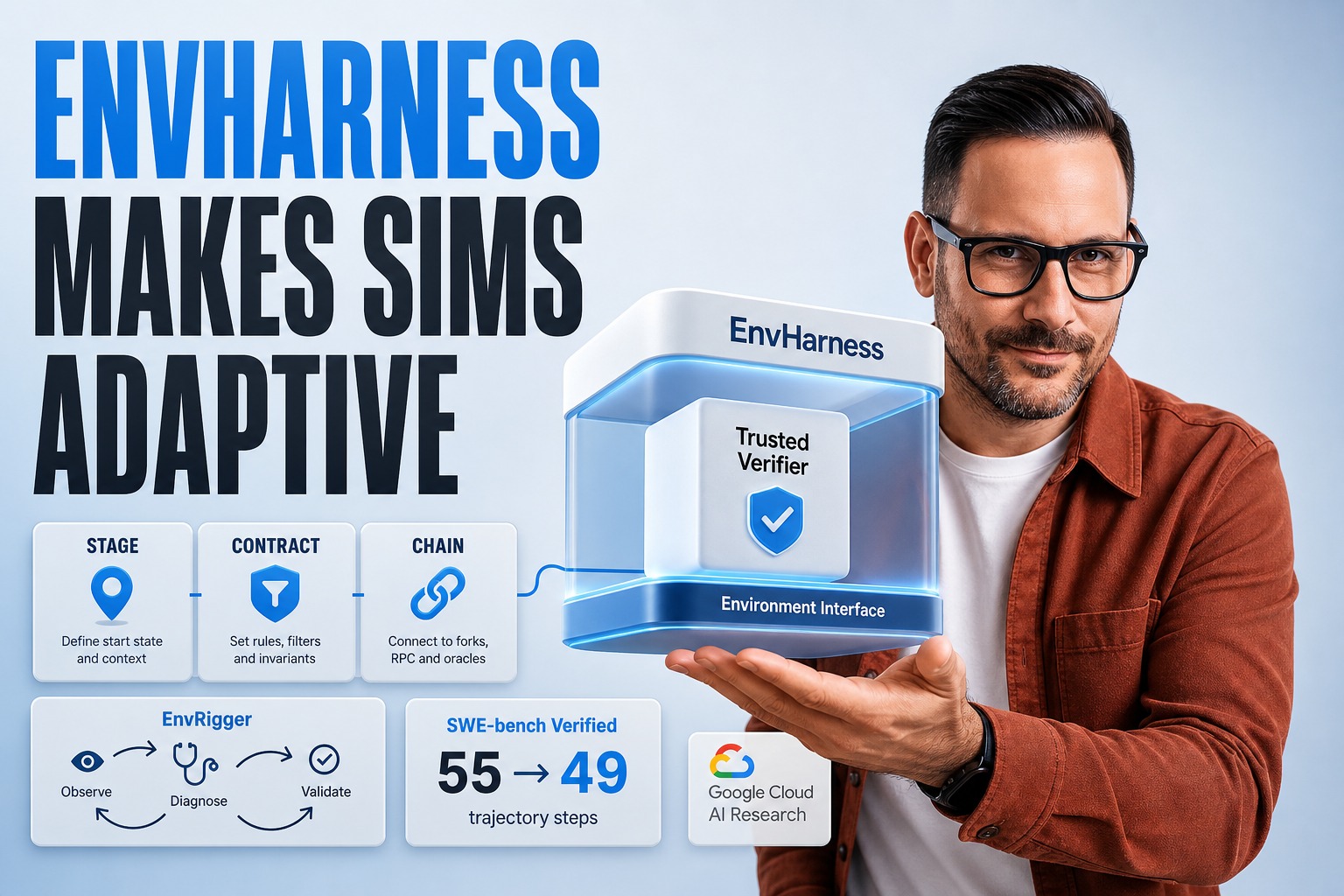
Is EnvHarness actually the news signal engineers should care about? → Yes: it reframes agent training as an environment problem, not a model problem, by making a static simulator programmable without touching its verifier.
What’s the primary question we should answer before adopting it? → How do we create adaptive agent training environments while keeping our existing, trusted grading and sandbox infrastructure intact?
Why does this matter this quarter for enterprise teams? → Because static task pools flatten as agents improve, and teams burn engineering cycles rebuilding simulators instead of systematically surfacing the next failure mode.
What’s the practical engineering bet behind EnvHarness? → Put a controllable wrapper at the environment interface (start state, observation, allowed actions, time horizon) and drive it with failure diagnosis loops.
What’s the catch we have to plan for? → The architecture is lightweight, but the adaptation loop is compute-hungry and only makes sense in resettable, low-side-effect sandboxes.
Quick Answer: how do we build adaptive training environments for AI agents without rebuilding simulators?
Use an environment wrapper that sits between the agent and a trusted, already-verified sandbox, then programmatically reshapes start states, observations, and allowed actions to target the agent’s current failures. Our position at Plavno is that this changes the engineering priority: you should invest first in an ‘environment harness’ layer (like the open-source EnvHarness) and only second in generating brand-new simulators, because preserving the original verifier is what keeps training signals reliable.
- Keep the verifier sacred: the fastest way to poison agent learning is to let the success signal drift; EnvHarness is valuable precisely because it leaves the underlying environment and its grader intact while changing what the agent experiences.
- Treat difficulty as a control surface: stages, contracts, and chains let teams dial tasks toward what the agent is currently bad at, instead of hoping random sampling finds rare edge cases.
- Optimize the interaction boundary, not the model: most production failures show up as skipped steps, premature submissions, or missing inspection actions; an interface-level wrapper can force those behaviors to be practiced.
- Budget for rollouts, not refactors: the main trade-off is computational—diagnosing weaknesses and validating modifications takes multiple runs—while the core environment can remain unchanged.
- Only do this where reset is cheap: containerized coding sandboxes and web automation test systems are a natural fit; live production systems with irreversible side effects are not.
The dominant signal: ‘environment harnessing’ is becoming the control plane for agent training
EnvHarness is an open-source (Apache 2.0) framework from Google Cloud AI Research and academic partners that turns static agent training environments into programmable ones by inserting a layer around the existing environment. The key shift is architectural: instead of rebuilding simulators or endlessly adding tasks, we can keep the environment and its trusted verifier and reshape the experience the agent has—where it starts, what it can see, what actions are allowed, and how long the task lasts—so training keeps pressure on the agent’s weaknesses.
Why engineers should care more about ‘task distribution’ than ‘model upgrades’
In a static environment pool, the agent quickly learns the common paths and then improvement stalls because truly challenging situations become rare; the input material explicitly calls out that teams may have to sample exponentially more environments to find meaningful edge cases as the agent improves. That is an engineering bottleneck, not an ML curiosity: it translates into more compute spent on uninformative episodes and more staff time spent crafting yet another benchmark or simulator instead of shipping a reliable agent.
| Training strategy | What changes over time | What tends to break first |
|---|---|---|
| Static environments | Nothing; the agent must adapt to a fixed distribution | Coverage plateaus as hard cases become rare; sampling becomes inefficient |
| Generated environments (LLM or synthesized tools) | The environment pool expands | Correctness and stable feedback signals become hard to guarantee |
| Environment harnessing (EnvHarness) | The presentation of a trusted environment adapts to the agent | Compute costs from repeated rollouts and validation of modifications |
The non-obvious benefit: you can change behavior without changing ‘what correct means’
The engineering gold in EnvHarness is not that it can make tasks harder; it’s that it can force specific behaviors while keeping the same ground-truth checker. If a coding agent tries to submit a patch without running tests, a harness-level contract can intercept that premature submission and push the agent back into running the suite—yet the repository and human-written unit tests remain untouched and still decide correctness. That separation is how you scale training without eroding trust in evaluation.
Our central claim: agent training stalls at the environment interface, so wrap the environment before you replace it
At Plavno, we see the same pattern across domains: failures that matter in production are rarely ‘the model can’t reason,’ but ‘the agent didn’t look,’ ‘the agent took a shortcut,’ or ‘the workflow silently skipped a constraint.’ EnvHarness argues—convincingly—that the right response is to instrument and control the agent–environment boundary with a programmable harness, because it targets those orchestration failures while preserving the environment’s original verifier.
This is also why EnvHarness is more than a research convenience. In reported experiments across five benchmarks (software engineering, web navigation, office work, embodied tasks), agents learning from EnvHarness-modified environments improved by up to 9 points on held-out tasks, and on SWE-bench Verified the average trajectory shortened from 55.01 to 49.61 steps. That is a concrete signal that changing the interface can change competence, not just training comfort.
The architectural move: a programmable shell around an existing environment
EnvHarness mirrors what many teams already do on the agent side with an agent harness: tools, memory, context management, and execution loops around an LLM. Here, the programmable layer sits on the other side of the interaction: a customized environment equals a static environment plus EnvHarness. The agent still talks through the same interface, but the wrapper can modify start conditions, observations, action availability, and time horizon while leaving the simulator and verifier unchanged.
Stage modifies start state: you can move where the agent begins or pre-complete early steps so training concentrates on later, error-prone parts of a workflow.
Contract modifies interaction: you can filter actions, alter responses, or restrict what the agent sees, which is ideal for fixing behaviors like missing inspection or relying on shortcuts.
Chain composes tasks: you can join tasks so success requires longer trajectories, forcing the agent to preserve goals and budget actions across steps.
Bridge standardizes integration: you expose an environment via a common interface so the wrapper can sit outside the runtime instead of modifying it.
EnvRigger drives adaptation: you diagnose recurring failures from rollouts, write harness modifications targeting those failures, and validate solvability before keeping them.
Why ‘fewer steps’ is operationally meaningful, not just a benchmark statistic
A shorter trajectory on SWE-bench Verified is not merely about elegance. In many enterprise sandboxes, each step is a tool call, a shell interaction, a browser action, or a test run—each with latency and cost, and each increasing the chance of an execution failure. When EnvHarness training reduces average steps from 55.01 to 49.61, it implies an agent that is less prone to wandering, redundant navigation, and late-stage mistakes. Even when you are not directly optimizing for cost, fewer steps usually means fewer opportunities to violate guardrails.
The practical rule: if you can’t change the environment’s ‘difficulty’ without touching the verifier, you don’t have an agent training system—you have a benchmark you will outgrow.
Stage, Contract, Chain: the levers that map cleanly to enterprise failure modes
EnvHarness’s three primitives matter because they correspond to how enterprise agents actually fail. Stages deal with initialization and partial progress; contracts deal with unsafe, lazy, or brittle interactions; chains deal with goal persistence and long-horizon planning. In real sandboxes—repositories with tests, internal web apps, or office-like document systems—those are exactly the control points teams want without rewriting the entire simulator.
- Stage for ‘missing prerequisite’ failures: when an agent fails because it never discovers a dependency, staging can start it deeper in the task or hide key objects so the agent must practice discovery.
- Contract for ‘unsafe shortcut’ failures: when an agent tries to skip checks, contracts can block premature completion paths while still letting the original verifier decide correctness.
- Contract for ‘insufficient inspection’ failures: if the agent answers without reading below the fold, a contract can enforce scrolling before retrieval actions, producing training traces that reward thoroughness.
- Chain for ‘context loss’ failures: multi-step automations often fail because the agent forgets earlier goals; chaining forces persistence across longer trajectories.
EnvRigger turns failure patterns into targeted constraints—at the cost of more rollouts
EnvHarness becomes a system, not a static toolkit, once you add EnvRigger: an ‘Observe → Diagnose → Write → Validate’ loop that automatically decides how to reshape the environment based on the agent’s weaknesses. The architecture stays clean because the wrapper changes conditions, not the underlying task or grader, but the operational trade-off is explicit in the input: this approach is more computational than architectural, because the loop needs multiple rollouts to find patterns and verify that modifications remain solvable.
| EnvRigger phase | What it inspects or produces | Why it matters operationally |
|---|---|---|
| Observe | Multiple trajectories of success and failure | You need enough runs to see repeatable failure patterns, not one-off noise |
| Diagnose | Recurring behaviors (for example skipping tests) | Diagnosis determines whether you should change start state, interaction rules, or horizon |
| Write | Candidate stages/contracts/chains | The modification must target a weakness without changing the verifier |
| Validate | Fresh rollouts on the modified environment | Prevents keeping changes that make tasks unsolvable, too easy, or uninformative |
Treat the adaptation loop as a test pipeline: if you can’t validate that a modification still yields a useful and solvable task, you’re just generating brittle curriculum.
Where EnvHarness fits in a real enterprise stack: Docker sandboxes, web test rigs, office tenants
The input material is clear that EnvHarness can attach ‘outside’ containerized software workflows, which is why it is immediately relevant to enterprise CI/CD-style sandboxes. If your coding environments already run inside isolated Docker or Kubernetes containers, the harness can act as a lightweight outer plugin on top of the existing test runner, preserving the container image, the codebase, and the internal unit tests. That is a better adoption story than rewriting your environment to match a new simulator framework.
At Plavno, we typically pair this style of harnessing with a deployment-oriented view of the sandbox: state reset must be reliable, actions must be interceptable, and the verifier must remain authoritative. When those conditions are true, adding a wrapper becomes an infrastructure move—similar to adding a proxy or policy enforcement layer—more than a research rewrite. This is why teams already investing in cloud software development can often integrate environment harnessing as an extension of existing container orchestration and test infrastructure.
- Coding sandboxes with unit tests: the repository and test suite form the trusted verifier; the harness enforces behaviors like running tests before submission without rewriting the grader.
- Web automation test systems: the harness can reshape observations and action availability to train better browsing habits, like inspecting the full page before answering.
- Office-style environments: document and spreadsheet tasks benefit when the harness can change visibility and workflow constraints while preserving correctness checks.
- Embodied-task simulators with stable resets: if the simulator already supports reset-and-step interactions, a wrapper can systematically surface the next navigation or search failure mode.
Why we prefer wrapping trusted environments over generating new ones
Generating new environments can look attractive, but the input highlights the core engineering risk: you still have to check correctness, and an LLM acting as a simulator can produce incorrect transitions or drifting feedback signals. Even synthesized executable environments can contain logic errors. EnvHarness’s bet is that enterprises should start from a smaller set of high-quality environments with trusted ground-truth verifiers and ‘amplify’ them through controlled reshaping rather than replace them with a new, potentially unreliable generator pipeline.
Verifier trust beats novelty: a new environment is only useful if its success signal is correct; a wrapper keeps correctness anchored to the original grader.
Domain coupling is real: environment-generation pipelines tend to be tied to specific domains, while interface-level wrappers can be reused across sandboxes that share interaction patterns.
Static distributions reappear: even a large generated pool can become ‘another static pool’ if it does not adapt as the agent improves.
Debugging shifts left: when the wrapper is the only moving part, you can audit modifications without diffing an entire simulator codebase.
Compute is easier to budget than correctness: rollouts cost money, but incorrect transitions and drifting rewards cost confidence in everything downstream.
EnvHarness is an argument for curriculum control without synthetic ground truth: keep the world real (or at least verifiable) and only manipulate what the agent is allowed to do and see.
Decision logic for this quarter: when EnvHarness is the right bet—and when it isn’t
EnvHarness makes the most sense when you already have a sandbox you trust and you can reset it cheaply. The input draws a hard boundary: avoid running the diagnostic loop directly against systems with irreversible side effects or expensive resets, such as live production databases, real customer accounts, or physical robots. In those cases, you need a simulator, a test tenant, or a restorable copy of the production environment before an adaptation loop is responsible engineering.
- Adopt when resets are reliable: if you can reset state quickly and deterministically, you can afford the rollouts EnvRigger needs to observe, diagnose, and validate modifications.
- Adopt when your verifier is already strong: repositories with unit tests or sandboxes with clear correctness checks are ideal because the harness doesn’t have to invent success signals.
- Hold off when actions have real-world side effects: if a step can mutate production data or impact customers, you need a safer mirror environment before you instrument adaptation.
- Hold off when you can’t intercept interactions: if you cannot filter actions or shape observations at the interface layer, you’ll end up modifying the simulator, defeating the point.
Where we see immediate enterprise wins: coding agents, web agents, and office automation
EnvHarness has already been tested on SWE-bench Verified, WebArena, OfficeQA, SpreadsheetBench, and ALFWorld, which conveniently map to the domains enterprises are trying to operationalize: software engineering, browser-based workflows, office work, and embodied tasks. The reported results are not just directional. Skills learned from EnvHarness environments outperformed those learned from unchanged environments across all five benchmarks, and in a scaling experiment on SWE-bench Verified the base agent moved from 47.67% to 54.79% as the EnvHarness training pool grew to 300 environments.
| Domain | Benchmark named in the input | Example of what the harness changes |
|---|---|---|
| Software engineering | SWE-bench Verified | Prevent premature patch submission; force test execution while keeping unit tests as the grader |
| Web navigation | WebArena | Restrict retrieval actions until the agent scrolls, training it to inspect content below the fold |
| Office and data work | OfficeQA, SpreadsheetBench | Adjust visibility and workflow constraints while preserving correctness checks |
| Embodied tasks | ALFWorld | Change initial placement of objects or remove shortcuts to force search and multi-step navigation |
The strongest signal is not a single score; it’s that EnvHarness continued improving where original and generated environment curves flattened earlier.
The risks you still own: compute budgets, reset semantics, and harness-induced brittleness
EnvHarness reduces simulator churn, but it does not remove operational risk; it relocates it. The input is explicit that EnvRigger needs multiple rollouts to diagnose weaknesses and validate modifications, and it describes a basic cycle using five rollouts of the original task and five rollouts of a candidate modification, with up to five write-and-validate iterations. That can become a real budget line item, especially if your agent is expensive to run or your environment is slow to reset.
The other risk is subtle: once you can modify observations and allowed actions, you can accidentally train ‘policy compliance’ rather than competence. For example, if your contract prevents certain shortcuts, you might improve behavior in the harnessed environment while masking failures that will reappear in production where those constraints don’t exist. The input’s emphasis on preserving the verifier helps, but it doesn’t guarantee that every harness rule corresponds to a real-world constraint.
- Compute becomes the throttle: adaptation requires repeated rollouts; you will feel this cost before you feel architecture friction.
- Reset quality becomes a correctness dependency: if resets are flaky, your diagnosis loop will learn the wrong patterns from inconsistent state.
- Harness rules can overfit: a contract that forces ‘good hygiene’ may produce brittle compliance if production doesn’t enforce the same constraints.
- Debugging moves to the boundary layer: the wrapper is now a core part of the system; it needs review, testing discipline, and change control like any other critical component.
| Risk category | What triggers it | What ‘good’ looks like |
|---|---|---|
| Rollout cost | Many observe/validate iterations | Clear budgets and run policies so adaptation doesn’t become unbounded experimentation |
| Unsafe side effects | Running against production-like systems | Use test tenants, simulators, or restorable copies before enabling adaptation loops |
| Rule overfitting | Contracts enforce behaviors not present in production | Contracts mirror real guardrails you can also enforce at runtime |
| Reset brittleness | Non-deterministic environment resets | Deterministic reset-and-step semantics before you trust diagnoses |
If you wouldn’t ship a proxy without tests and change control, don’t ship an environment harness without them either.
Plavno’s stance: make environment programmability a product capability, not a research sidecar
We think EnvHarness is a practical blueprint for enterprise teams, but only if it is treated like infrastructure. The wrapper is an interface layer that shapes what the agent can do and see, and the adaptation loop is a pipeline that must be validated the way you validate a CI system. When we build agents, we focus less on ‘more tasks’ and more on making the sandbox adjustable without rewriting its core—because the moment you lose trust in the verifier, training velocity turns into operational risk.
If you’re investing in agentic systems now, the decision is not whether to adopt EnvHarness specifically; it’s whether to adopt the pattern: keep the underlying environment stable and verifiable, and put adaptivity at the boundary. That is exactly the kind of engineering we deliver in AI agents development: turning experiments into repeatable pipelines where training, evaluation, and runtime guardrails are aligned.
Author: Plavno team. Last updated: September 2026. If you want to assess whether your current sandbox can support harness-based adaptation without destabilizing your verifier, we can run an architecture review focused on reset semantics, interception points, and validation loops.
- Start from one trusted sandbox: pick the environment where your verifier is strongest (often a repository with unit tests or a well-instrumented web test rig) and prove you can reshape experience without touching the grader.
- Instrument failures as first-class artifacts: collect trajectories and categorize recurring misses, because EnvRigger-style adaptation only works when diagnosis is about patterns, not anecdotes.
- Design contracts that mirror real guardrails: if you force behaviors like running tests, ensure production workflows can enforce similar constraints so training doesn’t become ‘harness compliance.’
- Treat validation as a gate, not a suggestion: keep modifications only if they create useful, solvable training examples; otherwise you’ll generate noise at scale.
- Budget rollouts explicitly: decide where the compute spend is justified and where a smaller, stable training pool is the better engineering choice.
 Chat GPT
  Perplexity
  Claude
  Gemini
