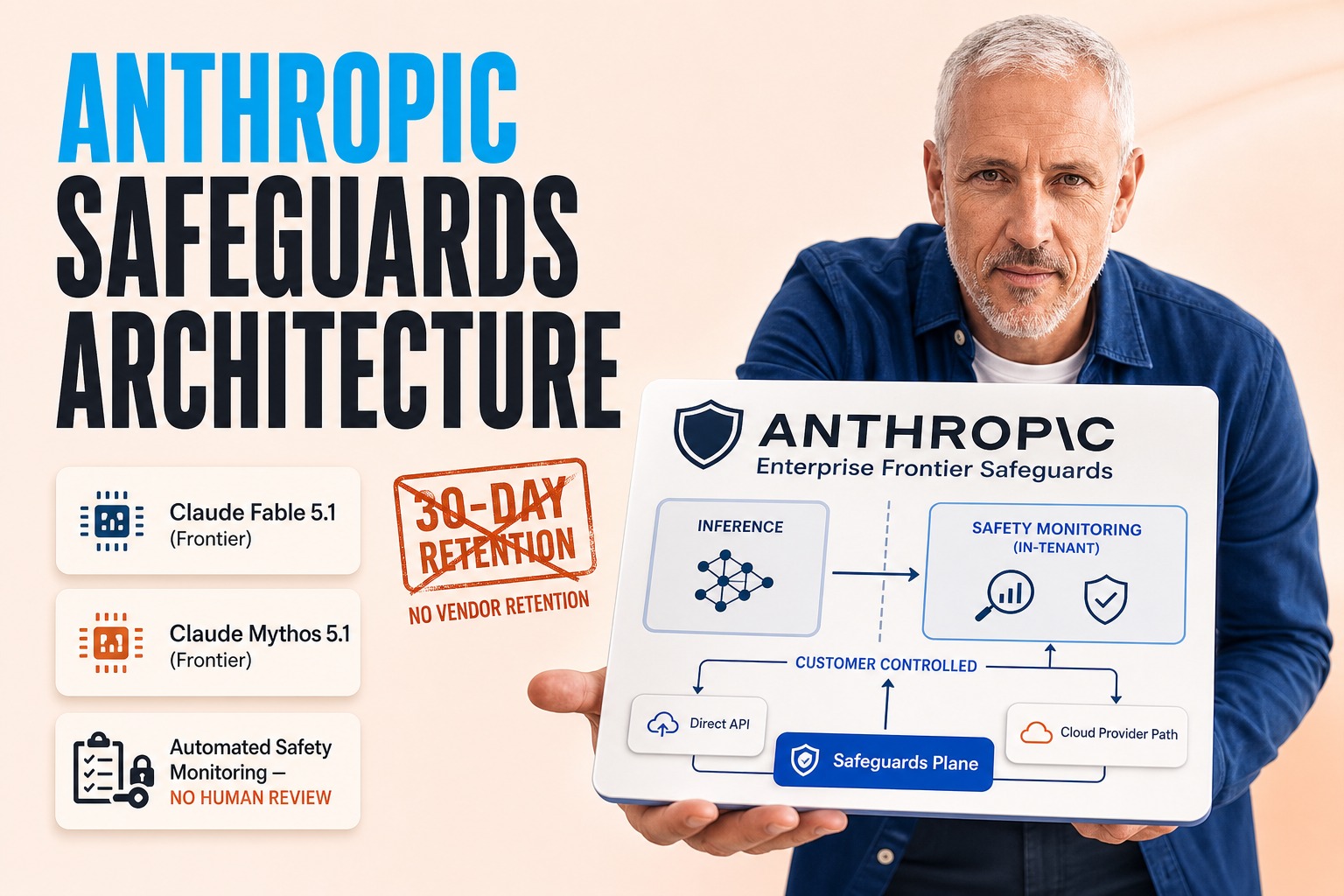
Did Anthropic just reverse its 30-day retention requirement for business traffic? → Not exactly; it introduced Enterprise Frontier Safeguards, a new enterprise control layer that lets businesses control review, storage, and management, including automated safety monitoring with no Anthropic human review.
What’s the real engineering question behind this policy shift? → How do we run frontier LLM workloads while keeping safety monitoring and privacy posture compatible, without creating a new data-exposure surface through retention, replay, or human review.
Why does this matter this quarter, not “someday”? → Anthropic said it expects accelerated deployment on customers’ most sensitive workloads, and broader availability is targeted for this fall, so architecture choices you make now will decide whether you can move fast later.
What should a CTO or security lead decide first? → Whether you can accept vendor-side retention/review in any form, or whether you need an architecture where monitoring happens on your systems and your data.
What’s the non-obvious angle we’re taking at Plavno? → The hardest failures won’t be “model misbehavior”; they’ll happen where safety telemetry meets enterprise logging, IAM, and retention controls—the integration seam is now the risk boundary.
If you treat AI safety monitoring as “a vendor feature,” you will ship a compliance problem; in enterprise, safety monitoring is just another regulated telemetry pipeline, and it must inherit your logging, access control, and retention rules.
The dominant signal: Anthropic is pushing safety monitoring to the customer’s side of the wall
Anthropic’s move to Enterprise Frontier Safeguards is a clear market signal: retention-based safety monitoring became a deployment blocker for enterprises, so the architecture is shifting toward controls that run ‘on their systems and their data.’ Our central claim is that this change breaks the old practice of delegating safety and misuse defense to the model provider; the right response is to design an explicit enterprise-controlled safety telemetry layer that is auditable, automatable, and compatible with your privacy posture.
Quick Answer: How do we use Claude frontier models without inheriting 30-day retention exposure?
Enterprise Frontier Safeguards implies a practical path: separate model inference from safety monitoring, and make safety monitoring operate under your storage, review, and access controls. Anthropic says enterprises will be able to control how their data is reviewed, stored, and managed, and they can do automated safety monitoring where no Anthropic human review is required.
For engineers, the decision is less about which Claude model is ‘best’ and more about whether your deployment can support a customer-controlled monitoring plane across both access paths Anthropic mentioned: direct access to Anthropic and access through a cloud provider. If you can’t enforce enterprise retention and audit on that monitoring plane, you should assume the policy debate will resurface at the worst possible time: procurement sign-off.
Frontier models made retention a security control, and that’s why enterprises pushed back
Anthropic introduced a 30-day retention requirement for all traffic on Claude Fable 5 and Mythos 5 to defend against misuse and ‘complex and novel’ cyberattacks, while pledging not to use that data for non-safety purposes like model training. That’s a coherent security posture for a vendor, but it collides with how enterprise security teams classify prompts and outputs: as potentially sensitive records that must fit pre-existing retention and access policies.
| Deployment context (from the policy shift) | What Anthropic said about retention/review | What it forces engineers to design for |
|---|---|---|
| Claude Fable 5 / Mythos 5 under the June policy | 30-day retention for all traffic to help defend against misuse and complex/novel cyberattacks; not used for non-safety purposes like training | Treat prompts/outputs as regulated data; isolate sensitive workloads or delay rollout until controls exist |
| Enterprise Frontier Safeguards (new solution) | Businesses can control review, storage, and management; automated safety monitoring can run with no Anthropic human review; not charged | Build a customer-controlled monitoring plane and integrate it with enterprise IAM, logging, and retention |
| Non-enterprise subscribers using Mythos-class models | June 30-day retention policy still applies | Assume vendor retention; avoid sensitive workloads or introduce strict redaction/minimization upstream |
| Access via cloud provider versus direct access | Controls will work whether accessed directly or through a cloud provider | Ensure consistent telemetry, audit, and policy enforcement across both network and identity paths |
Where enterprise AI deployments actually leak: logging, replay, and human review
In production, sensitive exposure rarely comes from a single ‘stored prompt.’ It comes from the operational machinery around AI: request tracing, application logs, support ticket attachments, incident ‘replay’ tooling, and the human processes that accompany safety review. The moment a vendor requires retention, your org has to reason about who can access that retained data, under what circumstances, and how it maps to your own incident response workflow.
Enterprise Frontier Safeguards matters because it explicitly targets those failure modes: Anthropic says enterprises will be able to control how data is reviewed, stored, and managed, and can run automated safety monitoring with no Anthropic human review. Architecturally, that implies a shift from ‘vendor-held evidence’ to ‘customer-held evidence,’ which is exactly what security and compliance teams usually demand—provided you can implement it without breaking observability or weakening misuse defense.
- Retention becomes an integration requirement: The model call is easy; the hard part is ensuring that every prompt/output that could be captured by observability tooling is governed by enterprise retention policy.
- Safety review becomes an access-control problem: If human review exists anywhere in the pipeline, the question becomes whose identities, whose audit logs, and whose approvals control it.
- Cloud-provider paths double the surface area: When access can be direct or via a cloud provider, you must keep policy parity across two identity and network perimeters.
- Cyberattack defense competes with privacy posture: The vendor wants more telemetry to detect ‘complex and novel’ attacks; the enterprise wants less data leaving its boundary.
- Model upgrades trigger governance churn: New releases like Claude Fable 5.1 and Mythos 5.1 can reopen approvals if the data-handling story is not stable.
The real trade-off is centralized vendor scanning versus in-tenant scanning
Anthropic’s framing is explicit: they still want ‘the scanning that we really need,’ but implemented so enterprises do not have to compromise on privacy posture because it stays ‘on their systems and their data.’ For engineering leadership, that translates into a trade-off between outsourcing scanning and evidence collection to the vendor versus running a monitoring layer under your own control.
Vendor-held monitoring: Faster to start, but it inherits the vendor’s retention window and review processes, which can conflict with internal policy and regulated-data boundaries.
Customer-held monitoring with automation: Aligns with enterprise governance because storage and access are yours, but it forces you to operationalize safety telemetry like any other security signal.
Hybrid during rollout: Because Enterprise Frontier Safeguards rolls out in phases and broader availability is targeted for the fall, many teams will run mixed modes; the risk is inconsistent handling between workloads.
Direct versus cloud-provider access: If teams use both paths, you must standardize the same monitoring and storage rules across both, or your ‘secure’ posture becomes workload-dependent.
Enterprise Frontier Safeguards changes your reference architecture more than your model choice
The biggest architectural change is that safety monitoring becomes a first-class component of the system, not a side effect of using a provider. If the enterprise can control review, storage, and management, then your AI platform needs an explicit boundary where raw prompts/outputs can be minimized, classified, and routed into the monitoring workflow your org will actually accept.
At Plavno, when we design agentic or assistant workflows, we treat model calls as just one dependency in a broader pipeline that includes identity, policy enforcement, and audit. This is why the market is moving toward a ‘safeguards plane’: you can build assistants and agents, but you only get them into regulated environments when safety monitoring is compatible with enterprise controls. That is also why teams evaluating AI agents development should treat monitoring and retention requirements as architecture drivers, not contract footnotes.
- A data-classification boundary before inference: Sensitive inputs should be identified and minimized before they ever become part of any safety telemetry stream.
- A monitoring plane that can run without vendor human review: If automated safety monitoring is possible, it should connect to your existing SOC and audit processes rather than creating a parallel review universe.
- Unified policy across access methods: Because safeguards should work via direct access or through a cloud provider, your platform needs consistency across network, IAM, and logging paths.
- Evidence storage under enterprise retention: If data is stored at all for safety, it must live in repositories governed like other regulated records, with explicit retention and deletion.
Why cloud-provider access paths matter as much as direct API access
Anthropic explicitly said Enterprise Frontier Safeguards controls will work whether users access its technology directly or through a cloud provider. That sounds like a convenience feature, but it is also a warning: enterprises will inevitably have multiple integration routes, and each route can introduce different logging defaults, identity contexts, and storage locations.
Identity and authorization alignment: If direct access uses one IAM approach and cloud-provider access uses another, you must ensure that ‘who can see safety evidence’ is identical in both paths.
Observability parity: Cloud-provider integrations often create separate traces, logs, and dashboards; if safety monitoring is automated, you need consistent signal quality and audit across both.
Data egress and boundary assumptions: Teams often assume cloud-provider paths are ‘more enterprise,’ but the real question is where data is reviewed and stored, and under whose controls.
Change management: When models update (for example, Claude Fable 5.1 and Mythos 5.1), you want one upgrade playbook across access paths to avoid governance drift.
Turning ‘control how data is reviewed, stored, managed’ into operational reality
The phrase ‘control how data is reviewed, stored and managed’ sounds like product messaging until you map it onto real enterprise operations. Review means who can see flagged interactions, under what approvals, and how that review is audited. Storage means where safety evidence lives, what encryption and key ownership applies, and how deletion is enforced. Management means the lifecycle: incident response, legal hold, and the ability to prove to internal governance that the policy is actually implemented.
This is where we see engineering teams underestimate scope: the model provider can offer controls, but you still have to integrate them into your organization’s security engineering. In practice, that often means routing automated safety monitoring events into existing SIEM/SOAR processes, aligning retention with internal policy, and validating that the monitoring plane does not become a new breach multiplier. When stakes are high, we advise pairing platform work with cybersecurity and penetration testing focused specifically on AI telemetry, not just the application surface.
- A defined ‘safety evidence’ data model: If you cannot describe what is stored for safety, you cannot govern it, and compliance will treat it as uncontrolled logging.
- Separation of duties for reviewers: Review workflows should map to real enterprise roles, not ad-hoc admin access in an AI console.
- Retention-by-policy, not retention-by-default: Safety evidence should follow the same retention controls as other security artifacts, with deletion and audit.
- Incident response that includes the model pipeline: If safety monitoring exists to defend against misuse and cyberattacks, your IR runbooks must explicitly include it.
Plavno’s perspective: treat safety telemetry like security telemetry, or it will fail procurement
Anthropic said it spent hundreds of hours working with customers and that enterprises will be able to do automated safety monitoring without Anthropic human review. We read that as customers insisting on a familiar model: safety signals are fine, but they must be produced and retained inside the enterprise’s governance framework, just like authentication logs or DLP events.
For teams building assistants, agents, and workflows, this shifts the work from ‘prompt engineering’ to ‘telemetry engineering.’ You need a plan for evidence capture, access control, and retention that can survive a procurement review. That is the mindset we bring in AI consulting: we assume the technical blocker is rarely the model; it is the inability to prove where sensitive data goes when safety monitoring is turned on.
- Design for audit first: If you can’t demonstrate who accessed what safety evidence and why, the system will be treated as ungoverned.
- Minimize data before monitoring: Automated monitoring is still monitoring; only send what you can justify storing under policy.
- Assume mixed deployment modes during rollout: Because safeguards roll out in phases, plan for inconsistent capabilities and avoid letting the ‘temporary mode’ become permanent.
- Treat integrations as the primary attack surface: Anthropic cited ‘complex and novel’ cyberattacks; those typically exploit orchestration and permissions, not the model weights.
This is a sales and roadmap signal: enterprises are buying governance, not just intelligence
Anthropic generates the vast majority of its revenue by selling to enterprises and is widely expected to be heading toward a massive IPO. In that context, the retention policy change is not just a technical footnote; it is a buying requirement being turned into a product surface. OpenAI introduced its own data retention solution earlier this month, and Anthropic is now making the controls explicit and free for enterprises.
The Salesforce partnership preview reinforces the same point: Anthropic’s CEO described the solution as ensuring Salesforce customer data remains private and models ‘don’t run out of control,’ emphasizing the ‘huge amount of effort’ in managing permissions for the integration. That is exactly where enterprise deals are won or lost. If your architecture cannot express and enforce permissions around AI data flows, the model’s capabilities—improved coding, knowledge work, and research in Claude Fable 5.1 and Mythos 5.1—won’t matter to your risk committee.
The hidden cost layer is governance churn every time the vendor policy changes
When a vendor changes retention rules, you often have to redo internal approvals, DPIAs, and security exceptions—even if your application code didn’t change. The practical response is to keep the AI provider policy at arm’s length by building an internal control plane for storage and review. If safeguards are free and designed to work across access paths, the teams that win will be the ones that can swap policy modes without rewriting the product.
Evaluate this in practice by locating your ‘unacceptable exposure’ boundary
A good evaluation does not start with a demo of model quality; it starts with a data-flow diagram and the question: where, exactly, does your organization refuse to let prompts and outputs persist? If the answer is ‘outside our controlled storage,’ then any vendor-side retention—whether for 30 days or otherwise—is a governance hazard. Enterprise Frontier Safeguards changes the decision logic because it offers a way to keep scanning while keeping evidence on your side.
A workable decision logic: if you can’t audit the reviewer, you can’t approve the review
Anthropic’s promise that automated safety monitoring can run with no Anthropic human review is not just about privacy optics; it is about auditability. In practice, enterprises approve processes they can audit and revoke. If your deployment requires external human review for safety, then you’re approving someone else’s access-control model. If your deployment can keep review and storage in-tenant, you can align it with your own identity, auditing, and incident response.
The safest early wins are workloads where monitoring is valuable but data is highly sensitive
Anthropic expects accelerated deployment on customers’ most sensitive workloads. That usually means organizations have been waiting for a policy-compatible monitoring story before turning on AI in places like customer operations or internal knowledge work. The new models Claude Fable 5.1 and Mythos 5.1 are positioned as improved for coding, knowledge work, and research, which are also exactly the categories that tend to touch proprietary data.
A practical rollout approach is to choose workflows where automated safety monitoring adds clear value but where you can also constrain what data enters the model interaction. This is where teams often connect safeguards to broader automation programs, because safety monitoring becomes one more enterprise control integrated into existing orchestration. If your roadmap includes process-level automation, AI automation should be evaluated alongside safeguards so you don’t build parallel pipelines for ‘automation’ and ‘safety.’
Salesforce-style integrations prove the point: permissions are the product
Anthropic highlighted heavy permission work for Salesforce integration. That’s a strong hint about where enterprise AI is headed: integrations are less about calling a model endpoint and more about building a permissions lattice across systems of record. The stronger the model becomes, the more it will be asked to touch sensitive systems, and the more the permissioning and monitoring layer becomes the real differentiator.
Even with safeguards, the riskiest part is still the enterprise plumbing around the model
Enterprise Frontier Safeguards can reduce exposure by letting businesses control review, storage, and management, and by enabling automated monitoring with no Anthropic human review. But it does not eliminate the common enterprise failure mode: sensitive data leaking into places you forgot existed—debug logs, analytics pipelines, support tools, and replicated environments.
Rollout in phases means ‘policy inconsistency’ is the default state for months
Anthropic said safeguards will roll out in phases and aims for broader availability this fall. During phased availability, teams will naturally mix workloads: some under safeguards, others under older retention constraints, and some deferred. That mixed state is exactly when organizations make accidental promises to customers or regulators that are not universally true. Engineers need to design deployment boundaries so it is always clear which workloads are covered by which controls.
Closing insight: the real risk boundary moved from the model to the monitoring channel
Anthropic originally required 30-day retention to defend against misuse and complex cyberattacks; now it’s offering a way to do scanning while keeping monitoring on the customer’s systems and data. That tells us the industry is converging on a new truth: the monitoring channel is part of the product, and it must be architected like any other security-sensitive integration.
If we had to make one recommendation for the quarter: treat Enterprise Frontier Safeguards as an opportunity to standardize your AI control plane. Don’t decide model-by-model or team-by-team. Decide once how safety evidence is stored, who can review it, and how retention is enforced—then let product teams move quickly within that boundary.
When enterprises adopt frontier models, the winning architecture is the one that can prove, end-to-end, that safety monitoring did not create a new shadow data store.
What we would implement now so you can adopt safeguards fast when availability broadens
We would start by designing the AI stack so that safety monitoring can be switched from vendor-held to customer-held without changing the business workflow. That means the application layer never assumes that prompts/outputs can be replayed from a vendor retention store, and the observability layer never treats model interactions as ‘just another debug log.’ With phased rollout expected and broader availability targeted for the fall, the teams that prepare this abstraction now will compress deployment timelines later.
If your internal team is stretched, the fastest path is usually augmenting delivery capacity while keeping architecture ownership in-house. We often support this through outstaffing when clients need senior platform engineers to integrate AI monitoring into existing IAM, logging, and retention systems without pausing product work.
Author: Plavno team. Last updated: September 2026.
 Chat GPT
  Perplexity
  Claude
  Gemini
