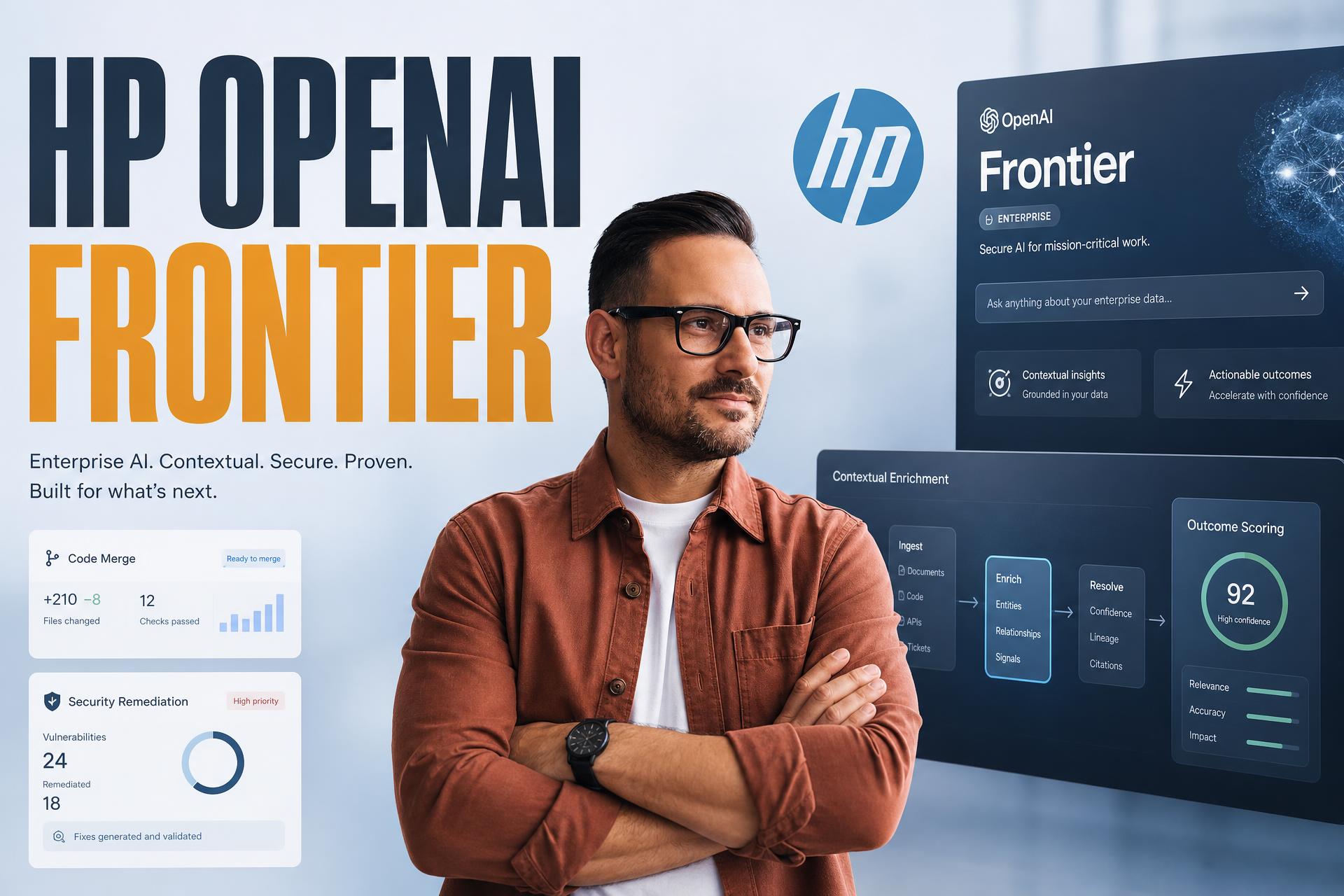
What did HP achieve with its OpenAI Frontier pilot? → HP’s engineers cleared hundreds of merge requests in weeks and its security team patched multiple vulnerabilities in a single day.
Why is this partnership newsworthy for CTOs? → It shows a real‑world shift from experimental AI to a unified operational layer that touches pricing, stores, and support.
What core question does this article answer? → How should leaders evaluate an enterprise AI platform that promises end‑to‑end operational transformation?
What is the hidden risk most teams overlook? → The platform’s success hinges on orchestration and outcome verification, not just model size.
What will we argue about the right response? → CTOs must build governance and real‑time feedback loops before scaling AI agents.
Enterprise AI Is No Longer a Side Project
HP’s expansion of its strategic partnership with OpenAI Frontier marks a decisive move from isolated pilots to a company‑wide operational backbone. The pilot phase demonstrated that AI‑driven code review and vulnerability remediation can compress weeks of work into days, but the real breakthrough lies in the platform’s ability to surface context, manage workflows, and evaluate outcomes across disparate business units. For leaders, this signals that the next generation of AI platforms must be treated as orchestration hubs, not merely as data‑oriented services.
The decisive factor is governance: without a real‑time verification layer, even the most capable model cannot guarantee reliable enterprise outcomes.
From Proof‑of‑Concept to Production‑Scale AI
During the pilot, HP’s software engineers leveraged the Frontier model to triage and merge hundreds of pull requests, cutting the development cycle dramatically. Simultaneously, the security team used the same model to identify and remediate critical vulnerabilities in a single day—work that previously consumed up to a month. These results proved that AI can accelerate both speed and quality, but they also revealed a deeper truth: the model’s raw capability mattered far less than the surrounding orchestration framework that fed it the right context and validated its actions.
The Orchestration Layer Is the Real Engine
When AI agents are embedded directly into daily workflows, they become part of a larger decision‑making loop. HP’s Frontier deployment introduced a unified operations platform that tracks program state, supplies contextual signals, and scores outcomes in real time. This layer ensures that each AI‑generated suggestion is grounded in the current business reality, and that any deviation is caught before it propagates downstream.
- Contextual Enrichment – The platform aggregates runtime metadata from CI/CD pipelines, security scanners, and ticketing systems to give the model a live view of the environment.
- Outcome Scoring – Every AI recommendation is scored against predefined success criteria, such as merge latency or vulnerability severity reduction.
- Feedback Loop – Human reviewers provide instant feedback, which the system logs for continuous model refinement.
Why Model Size Alone Is No Longer the Differentiator
OpenAI’s Frontier model is powerful, but HP’s experience shows that a larger model does not automatically translate into better operational results. The critical advantage came from the platform’s ability to surface the right information at the right moment, and to verify that the AI’s output achieved the intended effect before it was committed to production.
The Governance Imperative for Enterprise AI
HP’s rollout emphasizes that governance must be baked into the AI layer from day one. The Frontier platform enforces access controls, audit trails, and compliance checks, allowing security teams to delegate routine remediation while retaining oversight of high‑risk decisions. This governance model frees human talent to focus on strategic, creative work rather than repetitive triage.
- Access Controls – Role‑based permissions restrict which agents can modify production code or security configurations.
- Audit Trails – Every AI‑initiated change is logged with timestamps, user identifiers, and rationale.
- Compliance Hooks – The platform integrates with existing regulatory frameworks to flag actions that violate policy.
Measuring Real‑World Impact
The pilot’s quantitative outcomes—hundreds of merge requests processed in weeks and multiple vulnerabilities fixed in a day—are compelling, yet they only tell part of the story. HP’s broader metric suite now includes mean‑time‑to‑resolution, developer satisfaction scores, and the proportion of AI‑generated changes that pass automated verification without human rework. These indicators provide a clearer picture of whether the AI layer is truly adding value or merely shifting workload.
The Hidden Cost of Unverified AI Actions
When AI agents act without a verification step, organizations risk silent failures: mis‑merged code, undetected security gaps, or compliance breaches. HP’s platform mitigates this risk by mandating a verification checkpoint that evaluates each AI suggestion against live system state before it is applied.
- Verification Checkpoints – Automated tests run immediately after an AI‑generated change, blocking any that introduce regressions.
- Rollback Mechanisms – The system can revert to the last known good state if a verification step fails.
- Human‑in‑the‑Loop Alerts – Teams receive instant notifications when an AI action is rejected, enabling rapid manual review.
Scaling the Orchestration Model Across Business Units
HP plans to extend the Frontier platform to pricing, retail stores, and customer support. In each case, the AI agents will act as round‑the‑clock operational guides, reducing latency between information receipt and action. This expansion reinforces the claim that the orchestration layer, not the model itself, drives enterprise‑wide transformation.
The Strategic Decision for CTOs
For technology leaders evaluating a platform like OpenAI Frontier, the question is no longer “Is the model good enough?” but rather “Can the platform integrate governance, context, and outcome verification into our existing stack?” The answer determines whether the AI investment scales or stalls at the pilot stage. CTOs must therefore prioritize integration capabilities, real‑time feedback loops, and the ability to enforce policy across all AI‑driven workflows.
Prioritize orchestration over model size; it’s the only path to sustainable AI‑enabled operations.
Building a Future‑Ready AI Operations Layer
HP’s partnership illustrates a blueprint for enterprises: start with a focused pilot, embed the AI within a governance‑rich orchestration platform, and then expand to mission‑critical domains. The key is to treat the AI platform as a service that supplies context, validates outcomes, and enforces policy, rather than as a black‑box model that produces predictions.
Comparative Evaluation of Enterprise AI Platforms
| Feature | HP + OpenAI Frontier | Typical Vendor AI Suite |
|---|---|---|
| Contextual Integration | Live CI/CD, security scanner feeds | Static data imports |
| Real‑Time Outcome Scoring | Built‑in verification checkpoints | Post‑hoc analytics |
| Governance Controls | Role‑based access, audit trails | Limited admin UI |
| Extensibility | Seamless rollout to pricing, support, stores | Siloed modules |
| Human‑in‑the‑Loop | Immediate alerts on failures | Manual review only |
Why the Comparison Matters for Your Roadmap
The table highlights that platforms which embed orchestration and verification outperform those that rely on batch analytics and loose governance. For a CTO, this means the selection criteria shift toward integration depth, policy enforcement, and the ability to scale verification logic alongside AI adoption.
Practical Steps to Assess an Orchestration‑First AI Platform
When evaluating a solution, leaders should examine four pillars: contextual data pipelines, outcome verification mechanisms, governance frameworks, and extensibility across business domains. Each pillar should be scored against concrete criteria such as latency, audit completeness, and the proportion of automated actions that pass verification without human intervention. Our approach aligns with cloud software development best practices.
- Data Pipeline Audit – Verify that the platform can ingest live metadata from your CI/CD, ticketing, and security tools.
- Verification Logic Review – Ensure automated tests and scoring rules exist for each AI‑driven action.
- Governance Mapping – Confirm role‑based access, audit logging, and compliance hooks align with your policies.
- Domain Extensibility – Check that the platform can be extended to pricing, retail, and support without major re‑architecture.
Real‑World Scenarios Where Orchestration Pays Off
Consider a global retail chain that uses AI agents to adjust pricing in real time. By feeding live sales data into the orchestration layer, the AI can propose price changes, which are then scored against profit‑margin thresholds before being applied. Similarly, a customer support center can route tickets to AI‑generated answers, but only after a verification step confirms the response meets quality standards. In both cases, the orchestration layer prevents costly missteps and ensures consistent outcomes. These patterns also apply to AI‑voice assistant projects (AI voice assistant development) and broader AI software initiatives (AI software development industry).
| Scenario | AI Action | Orchestration Role |
|---|---|---|
| Code Merge | Auto‑approve pull request | Context from CI, verification against test suite |
| Vulnerability Fix | Patch deployment | Security feed, compliance check, rollback if needed |
| Dynamic Pricing | Adjust price points | Live sales feed, profit margin scoring |
| Support Ticket | Generate answer | Knowledge base lookup, quality gate |
Risks of Ignoring Orchestration
If an organization adopts a powerful model without embedding it in a governance‑rich orchestration platform, it faces silent failures, regulatory exposure, and erosion of trust among engineers. The AI may appear to work in isolation, but without verification, errors can propagate unnoticed, leading to production outages or security breaches.
- Silent Regression – Unverified changes can break downstream services.
- Compliance Gaps – Lack of audit trails may violate industry regulations.
- Talent Drain – Engineers lose confidence in AI assistance when errors surface.
- Scale‑Barrier – Without a unified layer, expanding AI to new domains becomes costly.
The Bottom Line for CTOs This Quarter
HP’s experience demonstrates that the decisive factor for enterprise AI success is the orchestration hub, not the raw model. CTOs should therefore allocate budget and resources to building or acquiring platforms that provide real‑time context, outcome verification, and robust governance. Only then will AI agents move from experimental pilots to reliable production workhorses that accelerate development, security, and customer experience.
| Decision Factor | Recommended Action |
|---|---|
| Integration Depth | Choose platforms with native CI/CD, security, and ticketing connectors |
| Verification Mechanism | Deploy automated scoring and rollback before scaling AI agents |
| Governance | Implement role‑based access and audit logging from day one |
| Extensibility | Pilot in one domain, then replicate orchestration patterns across others |
Next Steps for Your Organization
If you’re ready to move beyond proof‑of‑concepts, start by mapping your existing data pipelines to an AI orchestration framework. Run a focused pilot that includes verification checkpoints, then measure outcomes against the four pillars outlined above. Use the insights to build a governance‑first roadmap that can scale AI agents across pricing, support, and security functions. By following HP’s playbook, you can turn AI brilliance into dependable operational advantage.
How Plavno Can Help You Accelerate AI Orchestration
At Plavno we specialize in designing governance‑rich AI platforms that integrate seamlessly with your existing toolchain. Our AI‑agents development service (AI agents development) builds the orchestration layer you need, while our digital transformation consulting (digital transformation) ensures alignment with compliance and business goals. Partner with us to embed real‑time verification, role‑based controls, and extensible AI workflows that deliver measurable ROI.
 Chat GPT
 Perplexity
 Claude
 Gemini