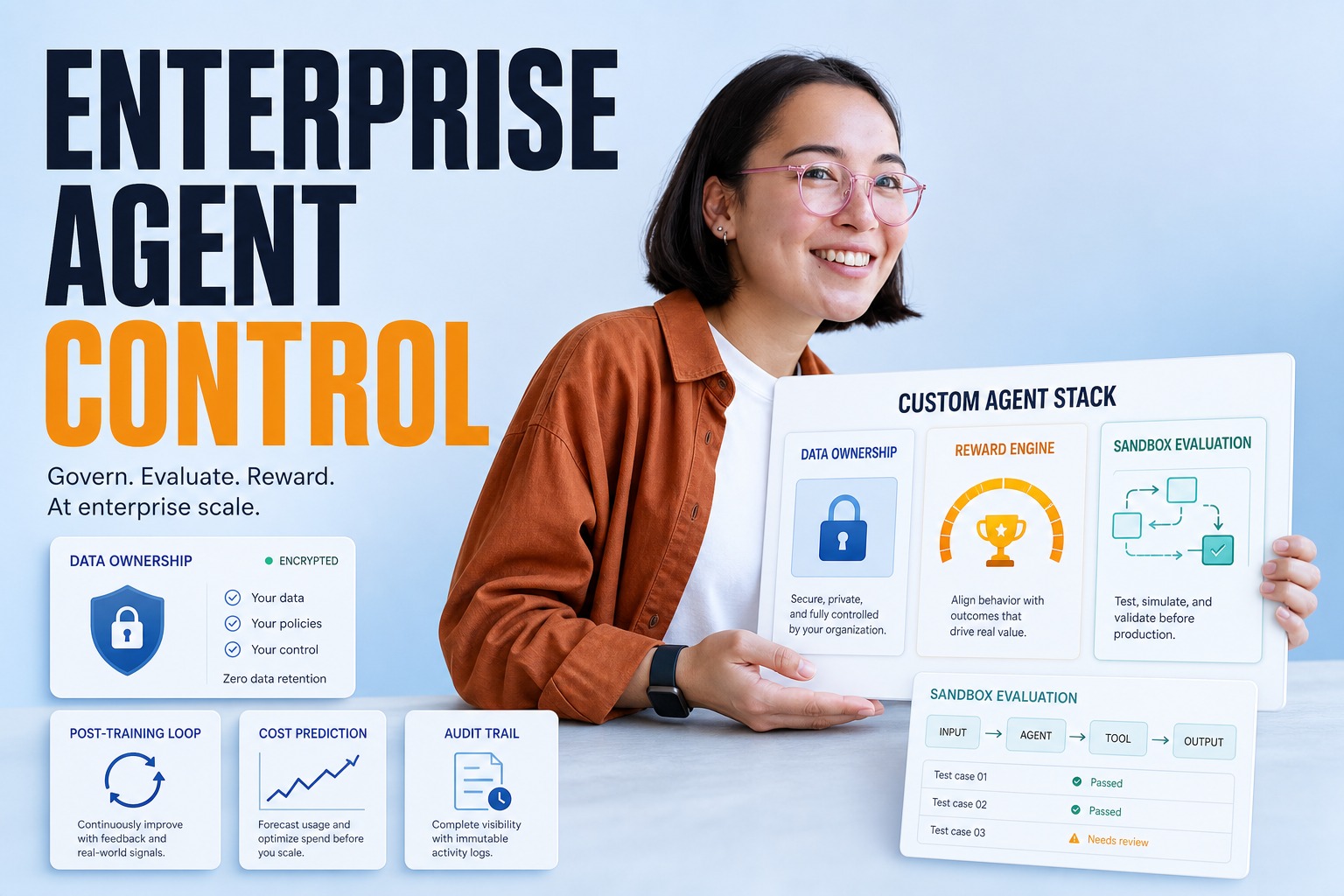
Is the rise of enterprise AI agents changing how we buy AI services? → Yes, the focus is shifting from raw model scores to owning the post‑training loop.
Do we need to build our own evaluation sandboxes? → Absolutely, reliable agents require custom testbeds that mirror real workflows.
Will controlling reward signals cut costs? → Controlling rewards lets teams fine‑tune smaller models, avoiding expensive API calls.
Can we still use frontier models inside a private stack? → They become components, not the whole architecture.
What does Prime Intellect’s funding mean for us? → It validates a market for turnkey agent infrastructure.
Quick Answer: Own the Post‑Training Loop, Not Just the Model
The most decisive factor for enterprises adopting AI agents today is whether they can control the data, reward signals, and evaluation environments that shape agent behavior. When a company owns this post‑training loop, it can trade off raw model size for reliability, auditability, and cost efficiency, turning a generic API into a purpose‑built service that aligns with narrow business workflows. Learn more about our AI agents development.
Why the Frontier‑API Wrapper Model Is No Longer Sufficient
Frontier‑API wrappers give you instant access to the latest large language models, but they expose a single‑dimensional contract: prompt‑in, text‑out. That contract hides the complexities of reward engineering, data provenance, and continuous evaluation, forcing teams to accept opaque performance and unpredictable pricing. In contrast, an enterprise stack that bundles compute, reinforcement learning pipelines, and sandboxed evaluation lets engineers iterate on the exact metrics that matter to their product.
| Aspect | Frontier‑API Wrapper | Enterprise Agent Stack |
|---|---|---|
| Data ownership | Limited (provider‑hosted) | Full control, on‑prem or cloud |
| Reward shaping | Not exposed | Custom reward functions, cost‑aware |
| Evaluation sandbox | None (black‑box) | Dedicated test environments, repeatable metrics |
The Core Claim: Control Over the Post‑Training Loop Determines Success
Our central argument is that enterprise AI agent reliability now hinges on owning the post‑training loop—data, reward signals, and evaluation sandboxes—so buying decisions must prioritize control infrastructure over raw model performance. This claim challenges the prevailing belief that the most powerful model automatically wins, and it forces CTOs to rethink procurement as a platform decision rather than a model selection.
- Data sovereignty matters – Keeping training data in‑house eliminates compliance risk and enables fine‑grained feature engineering.
- Reward engineering is a lever – Tailoring reward functions aligns agent incentives with business KPIs, reducing hallucinations.
- Sandbox fidelity drives confidence – Realistic evaluation environments surface failure modes before production.
- Cost predictability comes from self‑hosting – Controlling compute and runtime avoids volatile per‑token pricing.
- Auditability requires versioned pipelines – End‑to‑end traceability supports regulatory review and continuous improvement.
How Prime Intellect’s Funding Signals a Market Shift
Prime Intellect’s $130 million Series A, led by Radical Ventures and backed by NVIDIA, Intel, and Dell, pushes its valuation past $1 billion and confirms a $100 million ARR. The capital is earmarked for building an integrated stack that bundles compute access, reinforcement learning, evaluation environments, and deployment tooling. For practitioners, the signal is clear: investors see a sustainable business in providing the infrastructure that lets enterprises own the entire agent lifecycle, not just the model.
From Model‑Centric to Workflow‑Centric Architecture
When the architecture is built around a specific workflow—such as a customer‑service ticket triage or a compliance‑review loop—the agent becomes a deterministic component of the pipeline. This shift forces engineers to design data pipelines, reward schemas, and sandbox simulations that reflect the exact steps of the business process, rather than relying on generic prompt engineering.
The Practical Trade‑Offs of Building Your Own Stack
Choosing to build or buy an enterprise‑grade agent stack introduces trade‑offs in engineering effort, time‑to‑market, and operational overhead. Teams must weigh the upfront cost of developing custom reinforcement learning pipelines against the long‑term savings from reduced API spend and improved reliability. Moreover, ownership of the stack brings responsibilities for monitoring, security, and compliance that were previously abstracted away.
Key rule: If you cannot audit the reward signal, you cannot guarantee the agent’s alignment with business goals.
Evaluating the True Cost of Control
The headline $130 million raise masks a deeper economic narrative: enterprises are willing to invest in control because the hidden costs of opaque APIs—unexpected latency spikes, compliance breaches, and model drift—are far higher. By internalizing the evaluation sandbox, firms can run continuous A/B tests, enforce SLAs, and predict cost per interaction with far greater accuracy.
Map the workflow – Document each step where the agent will intervene, from input ingestion to final action.
Define reward metrics – Align each metric with a business KPI, such as resolution time or error rate.
Construct the sandbox – Build a test harness that mirrors production data, edge cases, and compliance checks.
Engineering Implications for CTOs This Quarter
First, allocate budget for a dedicated data‑engineer team to curate training corpora and maintain versioned datasets. Second, invest in a reinforcement‑learning framework that can plug custom reward functions into the model training loop. Third, provision sandbox environments—potentially using containerized orchestration platforms like Kubernetes—to run deterministic evaluations before each deployment. This three‑pronged approach transforms the AI procurement process from a vendor‑selection exercise into a strategic infrastructure project.
The Role of Cloud‑Native Tooling
Modern cloud providers now offer managed reinforcement‑learning services, but they still require you to supply the reward definition and evaluation datasets. Leveraging these services reduces operational burden while preserving the core claim: control over the post‑training loop remains the decisive factor.
Plavno’s Perspective on Agent‑Centric Infrastructure
At Plavno we have helped enterprises integrate custom AI agents into existing product lines, emphasizing the same control pillars highlighted by Prime Intellect. Our experience shows that teams that embed reward engineering early avoid costly re‑training cycles later. By partnering with us, clients gain access to a proven methodology for building sandboxed evaluation pipelines that scale with their data volumes. Our services include AI automation, AI consulting, and digital transformation.
Business Impact: From Cost Savings to Competitive Moats
When a firm owns its evaluation sandbox, it can benchmark agent performance against internal KPIs, negotiate better terms with cloud providers, and protect proprietary data from external exposure. This translates into measurable cost reductions—often 30‑40 % lower spend on inference—and creates a defensible moat as competitors cannot replicate the finely tuned reward structures without access to the same data.
| Metric | Pre‑Control Stack | Post‑Control Stack |
|---|---|---|
| Inference cost per 1k tokens | $12 (variable) | $7 (predictable) |
| Compliance incidents | 4 per year | 0–1 per year |
| Time to iterate on reward tweaks | Weeks | Hours |
Risks and Limitations of the Control‑First Approach
While owning the post‑training loop brings many benefits, it also introduces new challenges. Building and maintaining a sandbox requires expertise in reinforcement learning, data engineering, and continuous integration. Organizations must guard against over‑engineering—spending months on a sandbox that never sees production traffic. Additionally, the security surface expands as more internal data flows through training pipelines, demanding robust access controls.
Practical insight: Start with a minimal sandbox that covers the most critical failure modes, then expand iteratively.
How to Evaluate This Strategy in Practice
When deciding whether to adopt an enterprise‑grade agent stack, senior engineers should run a decision matrix that scores each option on data ownership, reward flexibility, sandbox fidelity, and total cost of ownership. The matrix should be populated with concrete numbers—such as projected API spend versus internal compute cost—and weighted according to strategic priorities. This quantitative approach turns the abstract claim into a concrete business case that can be reviewed by the board.
Closing Insight: The Future Is a Controlled Agent Ecosystem
The industry is moving from a model‑centric mindset to a workflow‑centric ecosystem where the true differentiator is how tightly an organization can bind data, rewards, and evaluation into a repeatable loop. Companies that invest now in building that loop will reap the benefits of lower costs, higher reliability, and a strategic advantage that cannot be replicated by a simple API subscription.
- Invest in data pipelines – Build pipelines that feed clean, labeled data directly into reinforcement‑learning jobs.
- Standardize reward definitions – Create a library of reward functions aligned with business metrics.
- Automate sandbox deployment – Use IaC tools to spin up identical test environments for each release.
- Monitor drift continuously – Implement telemetry that alerts when agent behavior deviates from sandbox expectations.
- Iterate rapidly – Shorten the feedback loop between sandbox failures and model updates.
Next Steps for Your Organization
Begin by auditing your current AI agent usage: identify where you rely on pure API calls and where you could benefit from a custom sandbox. Allocate a cross‑functional team to prototype a reward‑engineered reinforcement‑learning loop for a single high‑impact use case, such as automated ticket routing. Measure the cost differential and performance uplift, then scale the approach across other workflows.
Remember: the real ROI comes from the ability to predict and control agent outcomes, not from the size of the underlying model.
Call to Action
If you’re ready to transition from a generic API wrapper to a controlled, enterprise‑grade AI agent stack, let’s discuss how Plavno can accelerate your journey. Our expertise spans data ownership, reward engineering, sandbox creation, and cloud‑native deployment, ensuring you capture the full business value of AI agents.
 Chat GPT
  Perplexity
  Claude
  Gemini
