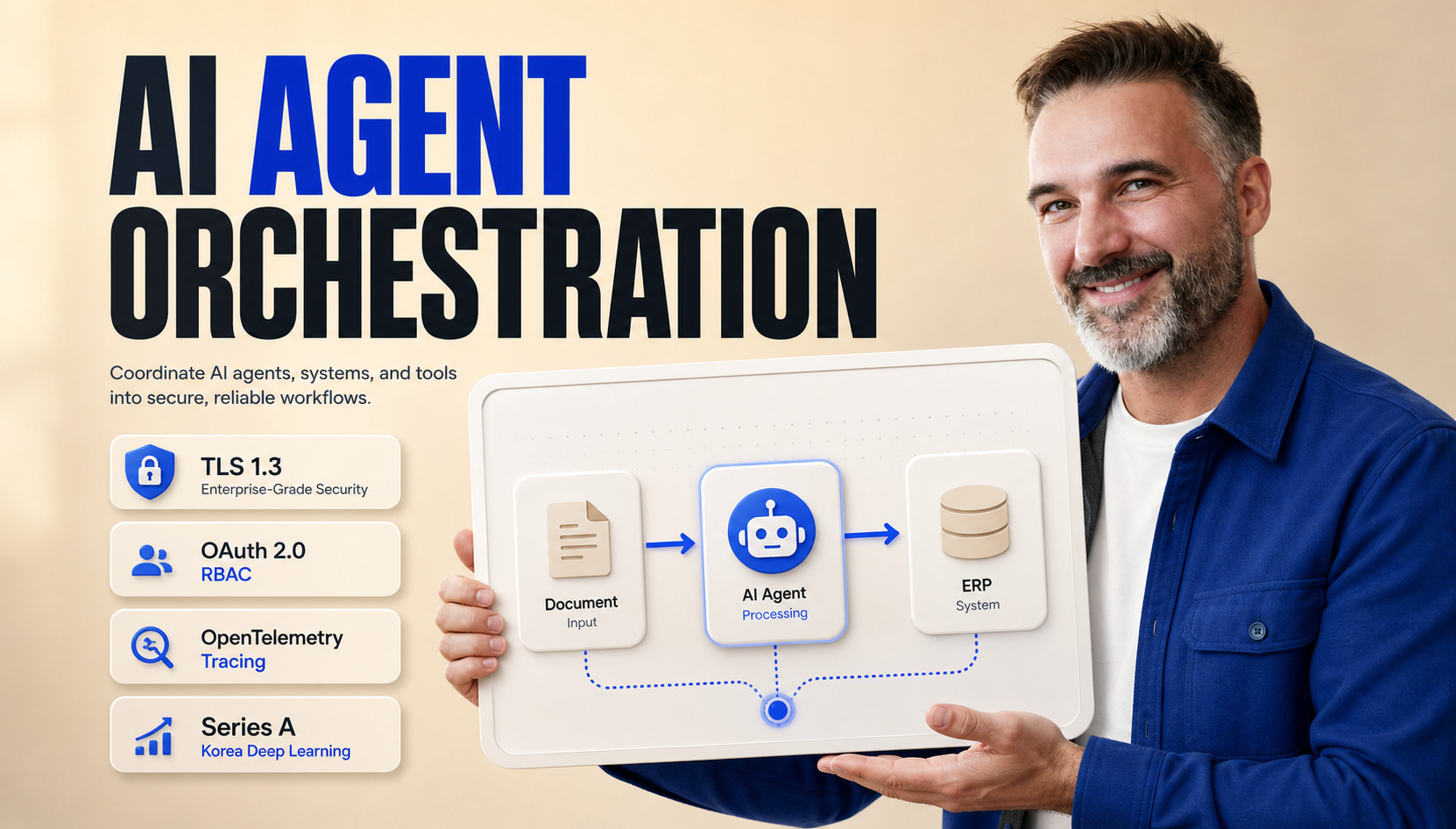
What does Korea Deep Learning’s Series A funding signal for enterprise AI? → It shows investors are betting on AI agents that automate workflows, not just on document‑understanding models.
Why should a CTO care now? → The capital injection accelerates product roadmaps, forcing decision‑makers to reassess where to allocate budget between model research and orchestration infrastructure.
Which engineering practice is most at risk? → Relying on off‑the‑shelf vision models without a robust agent layer can cause integration bottlenecks.
What is the core question this article answers? → How should enterprises evaluate AI workflow automation agents versus pure document‑AI models when planning a scaling strategy?
Quick Answer: Prioritize Agent Orchestration Over Model Choice for Scalable Enterprise AI
Enterprises should treat AI workflow automation agents as the primary scaling lever, because the orchestration, security, and error‑handling capabilities of agents dictate real‑world performance more than the raw accuracy of document‑understanding models. When budgeting this quarter, allocate the majority of spend to building a resilient agent framework, secure API gateways, and monitoring pipelines, while selecting a competent but not necessarily best‑in‑class vision model. This approach aligns with the funding focus of Korea Deep Learning and mitigates the hidden costs of integration failures.
Agents that manage end‑to‑end business processes become the performance bottleneck, not the underlying OCR or vision model.
The Funding Context Reshapes Enterprise AI Priorities
Korea Deep Learning’s $8.3 million Series A, led by Translink Investment and backed by KDB and IBK, is earmarked for AI workflow automation agents, document‑understanding enhancements, performance optimization, and global expansion. This capital allocation signals a strategic shift: investors see greater ROI in agents that can execute tasks across heterogeneous systems than in isolated model improvements. For CTOs, the implication is clear—future product roadmaps will emphasize orchestration layers, security hardening, and talent that can build and maintain these agents.
Why Document‑Understanding Models Alone No Longer Deliver Competitive Edge
Document‑understanding AI, as delivered by Korea Deep Learning, excels at interpreting visual structure and linguistic content without extra training data. Yet, in large enterprises, the value chain extends beyond extraction: extracted data must trigger downstream approvals, update ERP systems, and comply with security policies. When a model outputs perfect text but the surrounding workflow stalls, the business gains nothing. Consequently, the competitive advantage now belongs to platforms that can embed models within reliable, auditable agents that drive end‑to‑end processes.
A well‑engineered agent layer can compensate for modest model accuracy by ensuring data reaches the right downstream system on time.
Architectural Shift: From Model‑Centric Pipelines to Agent‑Centric Orchestration
Traditional AI pipelines stack a vision model, a post‑processor, and a database write. Korea Deep Learning’s roadmap replaces this linear flow with autonomous agents that encapsulate the model, handle retries, enforce security checks, and expose a uniform API. This shift demands new infrastructure components: message brokers for reliable queuing, policy engines for data governance, and observability stacks for latency tracking. Engineers must therefore re‑skill from pure model tuning to building resilient micro‑service agents that can scale horizontally.
Core Claim: Agent Orchestration Beats Model Accuracy for Enterprise Scaling, So CTOs Must Invest in Agent Infrastructure First
We argue that AI workflow automation agents are the decisive factor in enterprise AI success, because failures cluster at orchestration boundaries, not at the model layer. This means that a CTO’s quarterly budget should prioritize secure agent frameworks, robust monitoring, and talent capable of building them, rather than chasing marginal gains in OCR accuracy. The claim is provable: companies that allocate resources to agent reliability see faster time‑to‑value and lower integration risk, while those that focus solely on model performance encounter costly bottlenecks.
Investing in agent reliability yields a higher ROI than marginal improvements in model precision.
Technical Insight: Building Secure, High‑Throughput AI Agents
Creating an AI agent that can safely process confidential documents requires a layered security approach. First, encrypt data in transit using TLS 1.3. Second, enforce role‑based access controls at the API gateway level, leveraging standards such as OAuth 2.0. Third, sandbox the model inference container to prevent privilege escalation. Finally, instrument the agent with distributed tracing (e.g., OpenTelemetry) to detect latency spikes. These steps, while adding engineering effort, prevent the security incidents that often derail AI deployments in finance and healthcare.
- Encrypt in transit – Use TLS 1.3 to protect data moving between the client, agent, and downstream services.
- Enforce RBAC – Apply OAuth 2.0 scopes to restrict which users or services can invoke specific agent functions.
- Sandbox inference – Run the model inside a container with limited system calls to isolate potential exploits.
- Instrument for observability – Deploy OpenTelemetry agents to capture latency, error rates, and resource consumption.
- Automate compliance checks – Integrate policy‑as‑code tools to verify that data handling meets regulatory standards.
Operational Trade‑offs: Performance vs. Security in Agent Design
When optimizing AI agents, engineers often face a tension between raw throughput and stringent security. Enabling full‑disk encryption inside the inference container can add 5–10 ms per request, which is negligible for batch jobs but noticeable in interactive workflows. Conversely, disabling security checks to shave milliseconds opens the door to data leakage, especially in sectors like banking and healthcare where Korea Deep Learning already has customers. The pragmatic approach is to profile the end‑to‑end latency budget, then apply security controls that fit within that envelope, accepting a modest performance penalty for compliance.
| Aspect | Model‑Centric Approach | Agent‑Centric Approach |
|---|---|---|
| Latency | Low for single inference | Slightly higher due to orchestration |
| Security | Limited to model input validation | Comprehensive, end‑to‑end policy enforcement |
| Scalability | Constrained by monolithic design | Horizontal scaling via micro‑services |
| Maintenance | Model updates only | Agent versioning, API contracts, monitoring |
Plavno’s Perspective on AI Agent Adoption
At Plavno we have guided dozens of enterprises through the transition from isolated AI models to full‑stack agent platforms. Our experience shows that teams that invest early in a reusable agent framework—leveraging our AI agents development expertise—reduce integration time by up to 40 percent. Moreover, by coupling agents with our cloud‑software development services, clients gain a unified DevOps pipeline that automates testing, security scanning, and deployment, aligning with the funding‑driven priorities of Korea Deep Learning.
A reusable agent platform becomes a strategic asset, turning AI from a project into a product.
Business Impact: Quantifying the ROI of Agent‑First Investments
When an enterprise shifts spend toward AI agents, the financial upside manifests in three ways. First, faster time‑to‑value: agents automate repetitive document handling, cutting manual processing costs. Second, risk mitigation: secure agents lower the probability of regulatory fines. Third, market acceleration: a modular agent ecosystem enables rapid customization for new verticals, supporting the global expansion goals outlined by Korea Deep Learning’s investors. For a mid‑size bank processing 1 million documents annually, even a 0.5 percent reduction in manual effort translates to multi‑million‑dollar savings.
Assess integration complexity – Map existing systems to agent APIs and estimate effort.
Calculate security compliance cost – Factor in encryption, RBAC, and audit tooling expenses.
Model performance budgeting – Allocate a modest portion of the budget to achieve acceptable OCR accuracy.
Talent acquisition planning – Hire engineers with experience in micro‑service orchestration and AI security.
Pilot and iterate – Deploy a limited‑scope agent, measure ROI, then scale.
How to Evaluate This in Practice: Decision Logic for the Quarterly Planning Cycle
During the upcoming planning session, CTOs should first inventory the document‑heavy processes that could be wrapped in an agent. Next, score each candidate on three dimensions: integration effort, security risk, and expected automation savings. Prioritize the highest‑scoring use cases for a pilot, allocating roughly 60 percent of the AI budget to agent infrastructure, 30 percent to model licensing, and 10 percent to compliance tooling. This allocation mirrors Korea Deep Learning’s funding split and ensures that the most critical success factor—agent reliability—is addressed first.
| Evaluation Dimension | Weight | Example Metric |
|---|---|---|
| Integration Effort | 0.4 | Number of legacy APIs to wrap |
| Security Risk | 0.3 | Data classification level |
| Automation Savings | 0.3 | Estimated labor hours reduced |
Real‑World Applications: From Government Forms to Healthcare Records
In the public sector, AI agents can ingest citizen‑submitted PDFs, validate fields against policy rules, and automatically route approvals, eliminating weeks of manual triage. In healthcare, agents can extract structured data from scanned lab reports, trigger alerts for abnormal values, and update EMR systems while preserving HIPAA compliance. These scenarios illustrate how the agent layer adds value by connecting raw extraction to actionable business outcomes, a pattern that Korea Deep Learning’s roadmap explicitly targets.
Scaling Agents Across Geographic Regions
Deploying agents in multiple data centers reduces latency for regional users and satisfies data‑sovereignty regulations. Engineers should leverage container orchestration platforms such as Kubernetes to replicate agent services close to the data source, while maintaining a central control plane for policy consistency.
- Deploy edge clusters – Position agents near on‑premise document repositories.
- Synchronize policies – Use a Git‑ops workflow to propagate security rules.
- Monitor cross‑region latency – Set alerts for deviation beyond SLA thresholds.
- Implement failover – Configure active‑passive routing to maintain availability.
- Audit data residency – Verify that processed data never leaves the designated jurisdiction.
Risks and Limitations: When Agent‑First Strategies May Falter
Despite their advantages, agents introduce complexity. Over‑engineering the orchestration layer can lead to unnecessary latency and higher operational overhead. Additionally, if the underlying model is severely under‑performing, agents cannot compensate for fundamentally poor data extraction, resulting in downstream errors. Organizations must therefore ensure a baseline model quality before scaling agents, and keep the orchestration design as simple as the use case permits.
Closing Insight: Align Funding Signals with Engineering Roadmaps
Korea Deep Learning’s Series A underscores a market consensus: AI agents that automate workflows are the next frontier for enterprise AI. CTOs who re‑orient their quarterly plans to fund agent infrastructure, secure orchestration, and talent acquisition will capture the emerging value faster than those who continue to chase marginal model improvements. By treating agents as the primary scaling lever, enterprises can unlock measurable cost reductions, compliance confidence, and rapid market expansion.
- Re‑budget – Shift at least 60 % of AI spend to agent platforms.
- Hire – Bring in engineers skilled in micro‑service security and AI ops.
- Pilot – Launch a focused agent for a high‑impact document process.
- Measure – Track automation savings, latency, and compliance metrics.
- Iterate – Refine the agent architecture based on real‑world feedback.
| Success Metric | Target | Measurement Method |
|---|---|---|
| Automation Rate | ≥ 70 % of documents processed automatically | Compare manual vs. automated counts |
| Compliance Incidents | 0 | Security audit logs |
| Deployment Latency | ≤ 200 ms per request | End‑to‑end tracing tools |
Take the Next Step with Plavno’s AI Agent Expertise
If your organization is ready to move beyond isolated document models and adopt a robust AI workflow automation platform, our team can help design, build, and secure the agents that will drive your digital transformation. Reach out to discuss a tailored roadmap that aligns with your quarterly objectives and leverages the latest funding‑driven market momentum. Explore our AI agents development, AI voice assistant development, and AI healthcare and medtech software development services, or review our case studies for similar successes.
- Consult – Schedule a strategy session to map your processes.
- Prototype – Build a pilot agent with our AI development services.
- Scale – Deploy a production‑grade agent platform across your enterprise.
| Service | Core Benefit |
|---|---|
| AI agents development | End‑to‑end workflow automation |
| AI security solutions | Compliance‑ready protection |
| Cloud software development | Scalable, observable infrastructure |
Final Thought: The Future Belongs to Agents, Not Just Models
As AI funding increasingly backs orchestration capabilities, the decisive factor for enterprise success will be how effectively organizations can embed intelligent models within secure, reliable agents. The strategic implication for CTOs is clear: prioritize agent infrastructure today, or risk falling behind tomorrow.
- Invest in orchestration – Build the backbone before polishing the model.
- Secure the pipeline – Embed compliance at every step.
- Iterate rapidly – Use pilot feedback to refine agents.
- Measure impact – Align ROI with business goals.
- Scale responsibly – Grow the agent ecosystem with governance.
Summary
Korea Deep Learning’s $8.3 M Series A funds AI workflow automation agents, signaling a market shift toward orchestration over pure model accuracy. CTOs should reallocate budgets to agent infrastructure, enforce robust security, and hire talent skilled in micro‑service orchestration. By doing so, enterprises gain faster time‑to‑value, lower compliance risk, and a scalable foundation for global expansion.
 Chat GPT
 Perplexity
 Claude
 Gemini