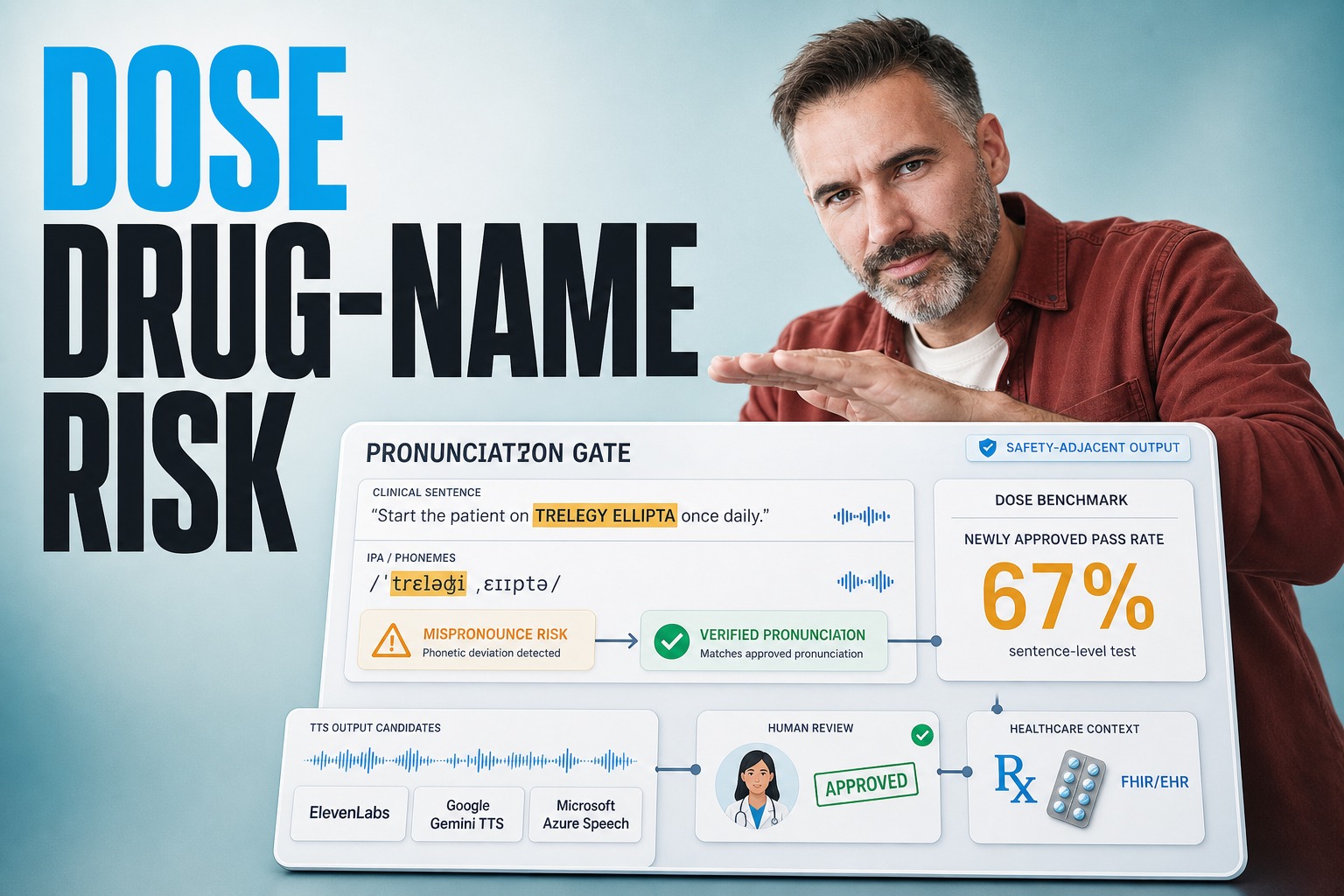
Are drug-name mispronunciations now a measurable production risk for voice AI? → Yes: the DOSE benchmark shows leading text-to-speech systems can mispronounce up to one in three newly approved drug names when spoken in clinical sentences.
What is the real engineering question we should answer this quarter? → How to design a healthcare voice pipeline that stays safe when vocabulary changes faster than model training data.
Is this mainly a ‘pick a better model’ problem? → Mostly no: DOSE indicates the biggest accuracy collapse happens on newly approved names, which points to data freshness and governance, not just model quality.
Where do these failures hurt in the real world? → In refill confirmations, telehealth read-backs, and medication reminders, where audio removes the safety net of correct on-screen spelling.
What is the non-obvious response? → Treat pronunciations as a managed dependency with its own release process, rather than a side effect of whatever TTS API you purchase.
Quick Answer: How do we stop TTS from mispronouncing drug names in production?
We stop treating pronunciation as an emergent property of a vendor model and start treating it as governed content. DOSE tested nine text-to-speech models on 274 drug names (146 newly approved) and found newly approved names cause sharp pass-rate drops, with leading models failing roughly one in three or worse. The right response is a ‘pronunciation supply chain’: clinical term intake, verified references, controlled rollout, and runtime guardrails around TTS APIs, supported by AI consulting that aligns engineering, QA, and patient-safety stakeholders.
- Design for novelty, not averages. DOSE’s overall range (63.1% to 80.3% across all nine models and all 274 names) hides the operational truth: newly approved drug names are the stress case your system will repeatedly encounter as approvals keep coming.
- Assume sentence context increases failure surface. DOSE embedded each drug name in a real clinical sentence, which mirrors production phrasing and introduces coarticulation and prosody effects that aren’t exposed by isolated-word testing.
- Treat vendor TTS as an untrusted subsystem. ElevenLabs eleven_v3 scored 93.0% on established names but 67.1% on newly approved; Google Gemini TTS scored 89.1% then 61.6%. That gap is a system-design problem, not a ‘prompting’ problem.
- Gate releases on domain tests, not general speech quality. DOSE uses a 0–5 pronunciation scale with 4+ as pass; if a forgiving threshold still yields large failure rates, production acceptance criteria must be explicit and domain-specific.
- Put humans where the risk concentrates. When your pipeline speaks newly approved or high-risk names, you need a deliberate review or verification path, not blanket human fallback that destroys the ROI of automation.
DOSE turned ‘we’ve heard complaints’ into a procurement-grade signal
Synthio Labs’ DOSE benchmark matters because it isolates one failure mode that healthcare voice teams have historically treated as anecdotal: drug-name pronunciation accuracy. DOSE ran nine models against 274 drug names, including 146 newly approved, and evaluated names inside clinical sentences rather than single tokens. That choice makes the benchmark operationally relevant: a refill bot or telehealth assistant rarely says a drug name alone. For CTOs, DOSE is a forcing function to put pronunciation on the same decision axis as uptime, latency, and cost when selecting a TTS service.
The central claim: the failure is at the vocabulary freshness boundary, so your architecture must own pronunciations
Our position at Plavno is that DOSE’s headline is not ‘models are bad at medicine.’ The headline is that general-purpose TTS breaks when the world changes faster than training data, and drug approvals are a reliable change stream. DOSE shows every tested model drops on newly approved names, with examples as severe as 67.1% and 61.6% pass rates for leading systems. Engineers can disagree and argue for waiting on vendors, but that choice implicitly accepts recurring pronunciation regressions each time new names enter your product.
The ‘newly approved’ split is the only number that should change your design
DOSE’s structure is the signal: 146 newly approved names are where pass rates collapse across models, precisely because established names have had years to leak into captions, databases, and everyday speech. When ElevenLabs falls from 93.0% to 67.1% and Gemini TTS from 89.1% to 61.6%, the engineering takeaway is not about those vendors in isolation; it’s about the temporal mismatch between regulatory approvals and model refresh cycles. Your pipeline must absorb novelty intentionally.
| What DOSE measured | Why it maps to production | What it implies for system owners |
|---|---|---|
| 274 drug names spoken inside clinical sentences | Real voice apps speak names within longer instructions, confirmations, and reminders | You need end-to-end evaluation, not a lab-style isolated pronunciation check |
| 146 newly approved vs established names | New names lack representation in training data at the model’s cutoff | Expect recurring regressions unless you maintain an external pronunciation source |
| 0–5 scoring with 4+ as pass | Passing does not require perfection, only recognizable speech | Failures at this threshold are operationally meaningful, not rubric artifacts |
| Nine models; overall pass range 63.1%–80.3% | Weakness is not confined to one product | Vendor choice helps, but governance and guardrails are the bigger lever |
Why sentence-level TTS is the hard mode in healthcare voice apps
DOSE’s decision to evaluate inside clinical sentences is the part many teams underestimate. In production, your TTS layer must handle medical jargon surrounding the drug name, patient-specific cadence, and the tendency for assistants to compress information into single utterances for speed. Even if a model can pronounce a token in isolation, sentence prosody can distort syllables enough to harm recognizability. That means your risk isn’t just pronunciation accuracy; it’s pronunciation stability under realistic phrasing.
If you only test drug names as isolated words, you are validating a behavior your users will almost never experience.
The engineering mistake is thinking ‘better model’ will eliminate a name that didn’t exist at training cutoff
The DOSE results strongly suggest a data-timing issue: newly approved names are engineered to be distinct and often don’t map cleanly to common English phonetics, so a model is forced into guesswork when it lacks prior exposure. Bigger general capability does not automatically solve ‘unknown proper noun’ in speech synthesis. In practice, teams that bet solely on swapping TTS vendors are optimizing the wrong layer; the persistent failure mode is novel vocabulary, and novel vocabulary will keep arriving.
- Vendor refresh cycles will not match clinical novelty cycles. Drug names can enter your product as soon as approvals happen, while model training and deployment operate on slower cadence; the mismatch is structural, not accidental.
- Overall scores hide the risk distribution. DOSE reports an overall pass range (63.1%–80.3%), but the operational harm concentrates where the model’s exposure is lowest: newly approved names and, in Azure’s case, generic drug names.
- Audio removes the ‘spell-check’ safety net. In text, the correct spelling is visible even if a person misreads it; in voice, the user receives only sound, which amplifies confusion for visually impaired or elderly patients.
- Automation increases blast radius. A human mispronouncing a name is one-off; a bot mispronouncing a name across thousands of reminders or refill calls is a repeatable systemic defect.
- Procurement language is behind reality. Many RFPs ask about general quality, not domain pronunciation in clinical context; DOSE provides a template for turning that gap into measurable acceptance criteria.
The ‘pronunciation supply chain’ is the only scalable response to newly approved drugs
If we accept DOSE’s core finding that newly approved names cause consistent drops across models, then the engineering response has to be procedural as much as technical. We design a pronunciation supply chain the same way we design a dependency supply chain: intake of new terms, verification against a reference, controlled rollout, and observability in production. This is where AI automation becomes practical: the goal is not to eliminate humans, but to place them at the point of maximum risk while keeping the rest of speech generation automated.
Where guardrails belong in a telehealth or pharmacy voice architecture
In a real system, TTS is only one step inside a larger workflow: a dialog manager decides what to say, a text layer constructs the sentence, and a TTS provider speaks it. DOSE tells us the TTS provider will not be consistently reliable on new names, so the right place for controls is upstream and downstream of TTS, not inside the model. Upstream, you need term detection and policy routing; downstream, you need monitoring tied to specific vocab classes like newly approved drugs.
Microsoft Azure’s ‘fewer than half’ on INNs changes what ‘safe default’ means
DOSE’s mention that Microsoft Azure passed fewer than half of generic drug names (INNs) is a different class of warning than ‘newly approved is hard.’ INNs are the standardized names that appear on labels and forms; if a platform struggles here, the risk is not confined to edge novelty but to routine operations. Even without an exact percentage, the direction of the result implies that teams embedding Azure AI Speech into healthcare flows must add stronger checks before trusting generic-name readouts.
- Policy routing before synthesis. When your system detects a drug name in the outgoing text, route that segment through a stricter path, because DOSE indicates this token class is disproportionately error-prone across vendors.
- Segmented utterance composition. Many production assistants concatenate multiple facts into one sentence for speed; separating the drug name into a controlled phrase reduces the surface area where sentence prosody can degrade recognizability.
- Fallback that preserves meaning, not just audio. A naive retry just repeats the same mistake; a useful fallback changes how the name is presented, including slower cadence or alternate phrasing, while keeping clinical meaning intact.
- Telemetry keyed to vocabulary class. Track failures by ‘newly approved’ versus ‘established’ categories, because DOSE shows category-based performance cliffs that aggregate monitoring would conceal.
- Human-in-the-loop for the novelty band. DOSE makes a strong case that newly approved drugs should trigger a review or verification step, at least until your system has validated pronunciations against a reference.
DOSE’s pass threshold (4 out of 5) is forgiving, which makes failures more actionable
DOSE scores pronunciations on a 0–5 scale with 4+ as pass, meaning a model does not need to be perfect to be considered acceptable. That matters because it removes a common excuse in speech evaluation: that tests are overly strict. If a forgiving bar still produces newly approved pass rates like 67.1% and 61.6% for leading systems, then teams should assume their own real-world rates will vary with sentence patterns, patient accents, and workflow context and plan controls accordingly.
Define what counts as a ‘drug-name event’ in your pipeline. In practice, this is a classification problem in the text layer: which tokens are drug names, which are dosages, and which are instructions, because each has different safety implications when spoken.
Bind drug names to a reference pronunciation source. DOSE used verified reference pronunciations; production systems need an equivalent reference that is versioned and auditable so you can explain what your bot was intended to say on a given date.
Introduce an acceptance gate that mirrors DOSE’s context. DOSE tested drug names inside clinical sentences; your QA should do the same, because a model can succeed on a word list and still fail when embedded in realistic phrasing.
Deploy a controlled rollout for newly approved names. The DOSE split shows novelty is the risk band; you want a slower, observed ramp for this category compared to established names that have broader exposure.
Operationalize incident response for mispronunciations. Treat mispronounced medication names as production incidents with a fix path: update the reference, adjust routing, and re-validate the impacted utterances before the next automated call batch.
Procurement changed: you now need a pronunciation SLA, not just a latency SLA
DOSE gives buyers language to ask for the right proof. If a vendor can demo natural speech but cannot show drug-name performance in clinical context, you are buying aesthetics, not safety. We advise treating DOSE-style results as a minimum disclosure: how a model performs on established versus newly approved, and what the vendor’s update process is when new drugs enter the market. This is also where software development consulting matters: the contract and the architecture must agree on who owns the failure when speech is wrong.
A TTS contract without domain pronunciation commitments is an agreement to rediscover the same failure every time the vocabulary changes.
How we evaluate drug-name pronunciation risk at Plavno before we ship voice features
At Plavno, we treat medication speech as a safety-adjacent subsystem, even when the product is ‘just reminders.’ DOSE’s category splits push us to evaluate by vocabulary class: established, newly approved, and generic INNs, because each class has different exposure and error characteristics. We do not assume a single vendor choice will hold across all classes; we assume we will need a layered design with references, monitoring, and escalation paths, often packaged as AI agents development where the agent orchestrates policy and verification around a TTS provider.
| Decision you must make | What DOSE suggests | Practical stance for this quarter |
|---|---|---|
| Choose one TTS vendor for all utterances | All nine models show meaningful limits; newly approved names drop across the board | Use one primary vendor, but architect for policy routing and exceptions |
| Treat ‘overall pass rate’ as success criterion | Overall 63.1%–80.3% blends easy and hard categories | Require separate reporting for newly approved vs established names |
| Assume generic names are ‘safe’ | Azure passed fewer than half of INNs in DOSE’s disclosure | Add extra validation even for routine generics |
| Assume benchmark failures are academic | DOSE used clinical sentences; that is how production speaks | Test in sentence context and tie results to release gates |
How to read DOSE without overfitting your entire strategy to one benchmark
We should not pretend DOSE is the only truth, especially because the public disclosure names only three vendors and does not enumerate the remaining six models. But DOSE is valuable precisely because it is narrow: it measures a failure mode that is easy to ignore until it becomes a support ticket or a patient-safety escalation. The right way to use it is to treat it as a design constraint: expect a consistent performance cliff on newly approved names, and treat vendor performance as one input into a broader governance and testing program.
Business impact is not hypothetical: mispronunciation scales faster than clinical training
The input article highlights why this is a market issue now: voice AI is already in refill confirmations, telehealth read-backs, and medication reminders, and DOSE shows the systems can fail at the point where a user needs clarity most. From a business standpoint, this creates two costs that compound: remediation costs when users escalate to humans, and reputational costs when a brand becomes associated with confusing medication calls. Technically, it also creates platform risk: voice features get bundled into larger suites, so a single high-profile failure can contaminate perception of unrelated capabilities.
- Medication reminders for elderly patients. If a reminder app speaks a newly approved name incorrectly, a patient may not recognize it, especially when they manage many prescriptions; audio-only delivery removes the ability to visually cross-check spelling.
- Pharmacy refill confirmation calls. Automated calls operate at scale; a repeated mispronunciation can produce repeated misunderstandings across a call batch, creating a support spike that looks like ‘call center load’ but originates in synthesis.
- Telehealth medication read-backs. When a bot reads back prescribing information, a mispronounced drug name can create a mismatch between what the clinician intended and what the patient hears, even if the underlying text record is correct.
- Enterprise healthcare software embedding a cloud speech platform. The article notes Azure AI Speech is embedded broadly; when a platform has domain gaps, they propagate into downstream products that did not explicitly choose that risk.
- New approvals arriving continuously. DOSE’s newly approved subset is the recurring stress case; each approval cycle introduces a new batch of names that are likely to be out-of-distribution for the deployed model.
Real deployment patterns that survive novel vocabulary better than ‘just say it again’
In practice, teams that succeed with healthcare voice systems treat high-risk tokens as structured data, not plain text. Instead of passing a single natural-language sentence to a TTS API and hoping pronunciation works, they constrain how drug names appear in utterances, and they log every drug-name event so they can correlate user confusion with specific outputs. When we build AI assistant development, we typically separate dialog policy from speech rendering so that pronunciation controls can evolve without rewriting the entire assistant.
The safest voice systems do not ‘sound smarter’; they reduce the degrees of freedom around the words users cannot afford to misunderstand.
The risks you still carry even after you add pronunciation controls
Even with a pronunciation supply chain, you are not done. DOSE is focused on drug-name synthesis, but real incidents often happen at boundaries: when the system chooses the wrong drug name in text, when a patient mishears similar-sounding names, or when monitoring fails to detect drift as new utterance templates ship. You also carry vendor risk: the input article notes no public responses from named vendors as of writing, which implies fixes may arrive silently, changing behavior without clear release notes. This is why we pair voice safety work with AI security solutions thinking: you need control, auditability, and change detection, not blind trust.
| Residual risk | Why it persists after ‘fixing pronunciation’ | What to instrument |
|---|---|---|
| Similar-sounding drug confusion | Drug-name confusion predates AI; mishearing can happen even with correct pronunciation | User confirmation flows for high-risk names and error reports tied to utterance IDs |
| Silent vendor behavior changes | Vendors may update models without a public statement; DOSE notes a lack of responses so far | Canary tests on your key drug-name set before and after any vendor update |
| Template drift | Product teams change phrasing; sentence context affects pronunciation | Regression tests using your real clinical sentences, not a word list |
| Scale amplification | Automation repeats the same defect thousands of times | Alerting on repeated failures by drug name and by newly approved category |
The quarter plan: ship safer healthcare voice AI without waiting for a perfect TTS model
DOSE is a warning shot that the next failure will not be exotic; it will be the next newly approved name your product has to speak. The practical plan is to make pronunciations a managed dependency: build a reference process, test inside clinical sentences, and route high-risk names through stricter paths. If you need to move quickly, we recommend staffing for systems integration more than model experimentation, which is where hire developers engagements help teams build the pipeline, monitoring, and governance layers that vendors do not ship by default.
Closing insight: DOSE is really about every domain-specific proper noun your product will ever speak
Drug names are simply the clearest example of a broader engineering truth: general-purpose TTS is brittle at the edge of vocabulary, and the edge keeps moving. DOSE quantified that brittleness with nine models, 274 names, clinical-sentence context, and a pass threshold of 4 out of 5, producing newly approved pass rates as low as 61.6% and 67.1% for leading systems and highlighting Azure’s struggle with INNs. Author: Plavno team. Last updated: September 2026.
 Chat GPT
  Perplexity
  Claude
  Gemini
