Is ChatGPT Ads now a serious acquisition channel or still an experiment? → OpenAI says its ad business is already at a $1 billion annualized revenue run rate and is expanding self-service to India, Europe, the Middle East, and North Africa, which signals operational maturity, not a pilot.
What changed this week that forces an engineering decision? → Ads are available in more than 40 countries and appear in ChatGPT for both Go subscribers and the free tier, so we should assume customers will encounter ads in conversational flows at meaningful scale.
What is the primary question we should answer before spending budget? → How do we advertise on ChatGPT in a way that is measurable and safe when OpenAI says advertisers do not access private conversations and ads do not influence answers.
What will break if we treat this like normal search ads? → Attribution and governance break first because the user journey starts inside a chatbot with its own labeling rules and privacy boundaries, then spills into our web apps, APIs, and CRM.
What is Plavno’s angle? → The hard part is not creative or prompts; it is building an enterprise-grade measurement and risk architecture around ChatGPT as a new front door.
The real news signal: ChatGPT Ads just crossed from novelty to infrastructure
OpenAI says its advertising business reached a $1 billion annualized revenue run rate roughly 200 days after launch, with ChatGPT Ads now available in more than 40 countries and self-service rolling out across India, Europe, the Middle East, and North Africa. For engineers, the signal is not the revenue number; it is that ChatGPT, with 1 billion weekly active users, is being productized as a paid distribution layer that our systems will have to interoperate with.
If we treat ChatGPT Ads like another marketing channel, we will mis-measure it; we have to treat ChatGPT as an external runtime where privacy boundaries, labeling rules, and answer integrity constraints dictate what instrumentation and data flows are even possible.
Quick answer: should we run ChatGPT Ads this quarter?
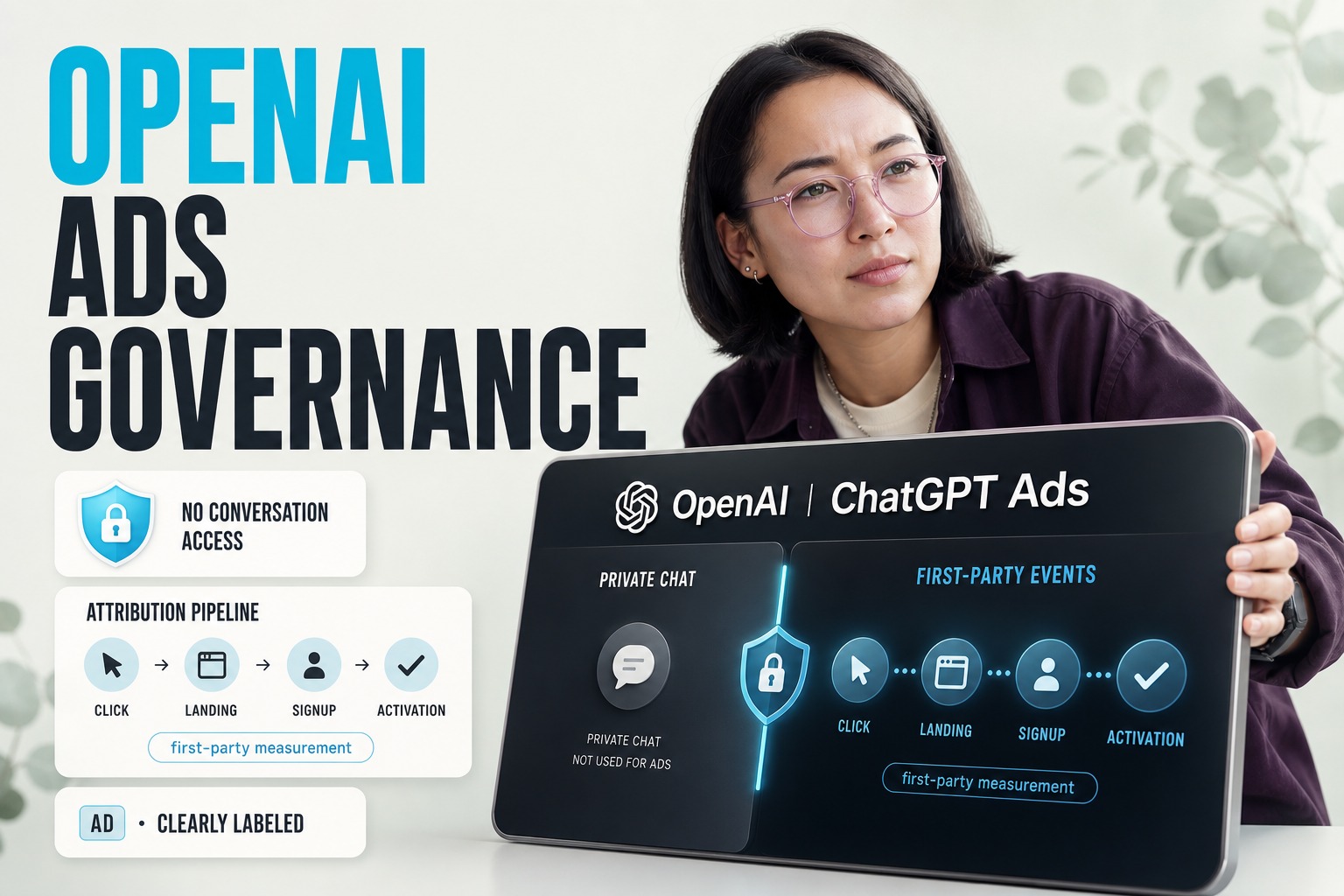
Yes, but only if we can instrument outcomes without relying on conversation-level data. OpenAI says ads are clearly labeled, do not influence ChatGPT answers, and advertisers do not have access to users’ private conversations, so the only reliable path is first-party conversion measurement on our properties plus tight governance on what we claim, what we log, and how we handle user intent that arrives from a chatbot.
Our central claim: conversational ads shift the engineering center of gravity from model choice to boundary design
OpenAI’s position is that ads do not influence answers and that advertisers cannot access private conversations, which means the model is not the optimization surface for advertisers; the boundary between ChatGPT and our stack is. We can debate whether that separation will hold in every edge case, but we cannot build a quarter’s plan on assumptions that contradict the stated constraints.
The right response is to engineer for boundary conditions: deterministic landing experiences, conversion events we control, and governance that assumes the user’s intent is high-signal but cannot be copied out of ChatGPT logs. At Plavno, we see this as a classic systems problem: you win by designing an attribution and risk pipeline that is compatible with the platform, not by endlessly tweaking messaging or over-indexing on which AI vendor feels most aligned.
Ads that do not influence answers still change product reality
Even if ads never touch the answer generation path, they still change the user’s mental model of what ChatGPT is: not just a tool, but a marketplace surface. That matters because our funnel now begins in a conversational UI where the user can ask follow-up questions before and after seeing an ad, then decide to visit our site, call our API, or sign up for a subscription. Engineering has to anticipate that the first touchpoint is not a landing page; it is an evolving dialogue we do not host.
The main architectural risk is not hallucination in the model; it is ungoverned state transfer when a user arrives from ChatGPT with expectations we did not encode into our product, support flows, or compliance posture.
The hidden constraint: OpenAI is building an ad system, not handing you user context
OpenAI is explicit that advertisers do not have access to private conversations. Practically, this pushes measurement and personalization back onto first-party systems: our web analytics, our identity and consent stack, our CRM, and our data warehouse. In other words, ChatGPT Ads can initiate demand, but it cannot be the place we do user-level segmentation the way many teams do with other ad platforms.
OpenAI also says ads are clearly labeled and do not influence answers, which implies we should design for a clean separation between informational trust and commercial action. That separation is good for users, but it forces us to invest in post-click experiences that can carry the burden: high-clarity product pages, authenticated demos, well-structured trial onboarding, and API-first entitlements. When we advise clients through AI consulting, this is the pivot we emphasize: treat ChatGPT as a referral environment with strict data boundaries, not as a place to harvest intent.
What self-service rollout really means for engineering teams
Self-service access expanding into India, Europe, the Middle East, and North Africa is not just a sales milestone; it is an operational promise that onboarding, billing, and campaign management are becoming repeatable. For us, that changes the internal calculus: marketing will move faster, and engineering will be asked to keep up with landing variants, region-specific disclosures, and downstream support load.
If we are not ready, the failure mode is predictable. A campaign drives users into a signup flow that was built for warm inbound traffic, our backend rate limits get hit by new trial users, and sales receives leads with context we cannot reconstruct because the conversation is private by design. In practice, the organizations that succeed are the ones that already run disciplined release management for growth surfaces: feature flags, analytics event governance, and a clean handoff into CRM, customer support, and product telemetry.
Treat ChatGPT as a new front door to your APIs, not a banner slot
OpenAI positions ads as part of a diversified business model alongside enterprise offerings, consumer subscriptions, and usage-based APIs. That framing matters because it tells us ChatGPT is being monetized across multiple layers, and ads are simply one layer that will route attention. If our product is API-driven, ChatGPT traffic will test the maturity of our developer onboarding, documentation IA, token-based access patterns, and support escalation.
The engineering move is to align acquisition with activation. We want a deterministic path from ad click to a controlled environment where we can validate identity, capture consent, and record outcomes. That usually means creating dedicated flows in our web or mobile app that are stable under campaign load, and building automation that keeps marketing experiments from creating operational incidents. This is where AI automation becomes a growth enabler: not automating content, but automating the safe movement of leads and events through our stack.
If the click can land anywhere, you cannot govern anything; tight landing contracts are the foundation of safe conversational acquisition.
The measurement problem you cannot outsource to the platform
OpenAI says it will introduce additional formats, objectives, buying options, and measurement capabilities, but we cannot plan our quarter around future tooling. We should assume that whatever measurement exists, it will not include access to private conversations, and it will not let us reconstruct the reasoning path that led a user to click. That leaves us with classic first-party measurement: pageview-to-signup-to-activation instrumentation and a coherent event taxonomy.
This is where teams get stuck, because their current stack often treats analytics as an afterthought. If our product is a SaaS app, we need clean mapping between anonymous session identifiers, authenticated users, and account-level entities in CRM. If our product is usage-based, we need to connect signup sources to API key issuance and downstream usage events. This is not glamour work, but it is exactly the work that makes a new acquisition channel real.
Privacy by statement is not privacy by design
OpenAI says advertisers do not have access to users’ private conversations, which is an important boundary but not a complete privacy solution for us. The moment a user leaves ChatGPT and lands on our properties, we become the data controller for whatever we collect. If we are tempted to capture free-form intent in an open text field because we cannot see the conversation, we may accidentally recreate the same sensitivity risks inside our own logs.
| ChatGPT Ads readiness choice | What you must have in your stack | What can go wrong if you skip it |
|---|---|---|
| Run a limited campaign now | First-party conversion events, stable landing flows, CRM handoff discipline | Leads you cannot qualify, signups you cannot attribute, support burden you did not forecast |
| Wait for more platform measurement | A plan to ship instrumentation anyway, so waiting does not become stalling | Competitors learn the channel while you remain blind to real funnel friction |
| Decide not to run ads | A deliberate alternative acquisition plan and a way to monitor channel shifts | Your brand appears in conversational journeys without you controlling the experience |
Why the ad promise forces better interface contracts
When the platform says the ad does not influence answers, it implicitly says the user will decide with both informational and commercial signals in view. Our interface contract must therefore be unambiguous: what we offer, what it costs, how trials work, and what happens after signup. In engineering terms, this is a demand for idempotent flows, predictable error handling, and telemetry that can survive high-intent bursts without collapsing into ambiguous states.
- Define a conversion event you can defend: tie success to an action on your own systems, such as account creation, qualified demo booking, or activated API usage, so reporting does not depend on conversational context.
- Stabilize landing endpoints under campaign load: treat the landing page and signup API as production-critical surfaces with SLOs, caching strategy, and rollback plans.
- Build a strict event taxonomy before experimentation: ensure product analytics events map cleanly to CRM entities and billing objects, so attribution does not rot over time.
- Instrument trust signals as product telemetry: track where users drop because they do not understand pricing, permissions, or data handling, since the conversation before the click is not visible to you.
- Coordinate brand claims with runtime behavior: align ad messaging with what your app, support, and onboarding actually do, to avoid churn driven by expectation mismatch.
Where teams overspend: prompt polishing instead of funnel hardening
Because ChatGPT is an AI product, organizations instinctively reach for AI levers: rewriting copy, iterating on messaging, and debating how the model might describe them. But OpenAI’s own statement that ads do not influence answers means the core technical work is downstream, not in the chatbot. Our experience is that the bottleneck is almost always activation: broken signup flows, unclear entitlement boundaries, and missing telemetry across web, backend, and CRM.
If we want to make ChatGPT Ads a scalable channel, we should treat it like launching a new integration partner. That implies ownership boundaries, release cadence, and incident readiness. Marketing will naturally iterate quickly once self-service is available across more regions, but engineering has to ensure that rapid iteration does not create compliance drift or operational fragility. This is a governance pattern, not a model pattern.
Start with a single journey that ends in a verifiable outcome on your systems, not a soft metric, so you can decide quickly whether the channel is real.
Create a dedicated landing and onboarding path that is insulated from unrelated product experiments, so attribution does not get polluted by parallel changes.
Connect the journey to your CRM with account-level identifiers, so sales and support can act without needing conversation transcripts.
Run the campaign only after you can observe drop-offs end to end, from click to activation, because you will not be able to debug using ChatGPT conversation logs.
Expand geography only when your consent, localization, and support readiness can keep up with the markets where self-service is rolling out.
The geo expansion problem: Europe is not just another checkbox
OpenAI is rolling out self-service across India, Europe, the Middle East, and North Africa, and each region forces different operational assumptions even before we talk about regulation. Localization is not only translation; it is pricing display, support hours, and how you route new leads internally. If you cannot keep your post-click experience coherent across regions, the ad buy will amplify inconsistency rather than growth.
- Localization as a deployment problem: build region-aware content delivery and product configuration, so landing pages, signup flows, and disclosures remain consistent.
- Consent and analytics governance: ensure your consent management and analytics tooling can produce reliable first-party measurement without over-collecting sensitive intent.
- Identity and access patterns: decide how you handle SSO, email verification, and account provisioning across regions, because ad-driven signups spike edge cases.
- Operational routing into CRM and support: ensure leads flow to the right sales and support queues with enough context to act, even when you cannot see the chat.
- Latency and reliability expectations: treat onboarding and activation as a performance surface, because a conversational user expects immediate completion after deciding.
What OpenAI’s separation of ads and answers implies for brand safety
OpenAI states that ads are clearly labeled and do not influence ChatGPT’s answers. As advertisers, we should read this as an integrity contract: the platform is signaling that the user’s trust in answers must not be compromised by paid placement. That is good, but it also means our brand can be judged in a context where the user expects neutrality from the surrounding content.
| Risk area in ChatGPT Ads | What OpenAI states | What we must engineer on our side |
|---|---|---|
| Answer integrity | Ads do not influence ChatGPT answers | Ensure ad claims are verifiable in-product and reflected in onboarding and docs |
| Conversation privacy | Advertisers do not access private conversations | Avoid building lead capture that recreates sensitive free-form intent in your own logs |
| User trust in labeling | Ads are clearly labeled | Design landing pages and signup flows that continue the transparency, not a bait-and-switch |
Brand safety becomes a runtime property, not a policy PDF
In conversational environments, users ask follow-ups immediately. If your ad leads to an experience that contradicts what the user believes they learned in the chat, trust collapses fast and support cost spikes. The technical implication is that brand safety is enforced by runtime behavior: what your app actually does, what your API returns, how your billing works, and how your support responds when a user arrives with high intent.
- Product-truth alignment: treat ad messaging as a contract that must match entitlements, pricing, and capabilities in production environments.
- Telemetry for expectation mismatch: instrument where users abandon because they expected a different flow, since you cannot introspect the chat to diagnose it.
- Security review of landing and onboarding: harden the surfaces that will see new traffic bursts and attempted abuse, and validate them with cybersecurity and penetration testing.
- Incident playbooks for growth surfaces: define who owns outages on signup, billing, and API key issuance when campaigns are running.
- Data minimization in lead capture: prefer structured fields and controlled workflows over open-ended text boxes that encourage users to paste sensitive context.
The operational stack you need before you buy meaningful volume
OpenAI is positioning ads alongside enterprise offerings, subscriptions, and usage-based APIs, which suggests that high-value users will be present in ChatGPT just as they are in enterprise SaaS ecosystems. If our product has a serious enterprise motion, we should assume that ad-driven users may ask for security docs, procurement-friendly billing, and admin controls immediately after the click.
This is why the evaluation cannot be owned by marketing alone. We need product and engineering to confirm that the path from interest to adoption is technically smooth: identity flows, account provisioning, billing, and permissions. In many organizations, these are stitched together across web apps, backend services, and third-party systems. If that stitching is fragile, ads simply reveal it faster. Teams that have invested in custom software development to unify these surfaces tend to unlock new channels more safely, because they can ship controlled journeys rather than improvising them.
Validate that your post-click journey can complete without human intervention, because conversational users will not tolerate slow handoffs.
Ensure your signup and activation systems have clear ownership and on-call coverage during campaigns, because acquisition incidents are still incidents.
Confirm that CRM, billing, and product analytics share a consistent account identity, so leads do not become duplicates and activation does not get lost.
Decide what you will not collect, since you cannot rely on chat transcripts and might be tempted to over-ask users for context.
Treat geo expansion as a product release, not a targeting toggle, because self-service availability across regions will tempt premature scaling.
Real-world applications: where ChatGPT Ads fits and where it will disappoint
ChatGPT Ads will tend to fit best where the user can decide quickly and verify value fast: clear SaaS offerings, API products with immediate activation, and services with a well-defined qualification path. OpenAI says it will explore new ways for businesses to interact with consumers in more native ways in ChatGPT, which implies the surface could evolve beyond simple placements; we should plan for iterative integration rather than a one-time campaign.
Where it will disappoint is where the conversion requires deep context that only exists in the conversation, because OpenAI says advertisers cannot access it. If your sales cycle depends on diagnosing a complex situation from free-form text, you will have to rebuild that qualification inside your own controlled intake. At Plavno, we often bridge that gap by designing agent-backed intake and routing on the enterprise side, not inside the platform, using patterns from our AI agents development work: structured questions, controlled data capture, and deterministic handoffs into CRM and case management.
The risks you should assume even if the platform promise holds
Even if OpenAI’s separation of ads from answers is perfectly implemented, user perception may still blur the line, and your brand will be judged in a mixed informational-commercial environment. Operationally, the biggest risk is that the channel scales faster than your onboarding and support can handle, because self-service rollouts remove friction for campaign creation but not for your downstream operations.
Another risk is organizational: teams will argue about performance using inconsistent definitions of success. If marketing reports clicks while engineering reports activations and finance reports revenue, you will not converge on a decision. The fix is boring but necessary: define a single cross-functional metric tied to a first-party event and make every system report against it. Without that, ChatGPT Ads becomes politics, not a channel.
- Attribution ambiguity: users may click after multiple conversational turns, and you will not see the upstream context, so you must rely on first-party event chains you control.
- Operational overload: campaigns can create spikes in signup, billing questions, and API key issuance, stressing the most failure-prone parts of many stacks.
- Trust fragility: in a chatbot environment, mismatched expectations generate immediate backlash, so transparency in landing and onboarding is non-negotiable.
- Data handling drift: in trying to replace missing conversation data, teams may collect sensitive intent in their own systems and create new compliance exposure.
- Internal misalignment: different teams will optimize different metrics unless you unify definitions across analytics, CRM, and finance.
The closing insight: ChatGPT Ads is a systems test disguised as a marketing channel
OpenAI’s ad business hitting a $1 billion annualized revenue run rate and expanding across more than 40 countries tells us the surface is real and will be encountered by our customers. But OpenAI’s own constraints, especially that ads do not influence answers and advertisers do not access private conversations, mean the winners will be the teams that engineer clean post-click systems: measurement, governance, identity, and reliable onboarding.
If you are considering ChatGPT Ads and want to avoid building a fragile attribution stack or a leaky intake flow, we can help you design the end-to-end architecture and operating model so marketing can move fast without breaking production. Author: Plavno team. Last updated: August 2026.
 Chat GPT
  Perplexity
  Claude
  Gemini
