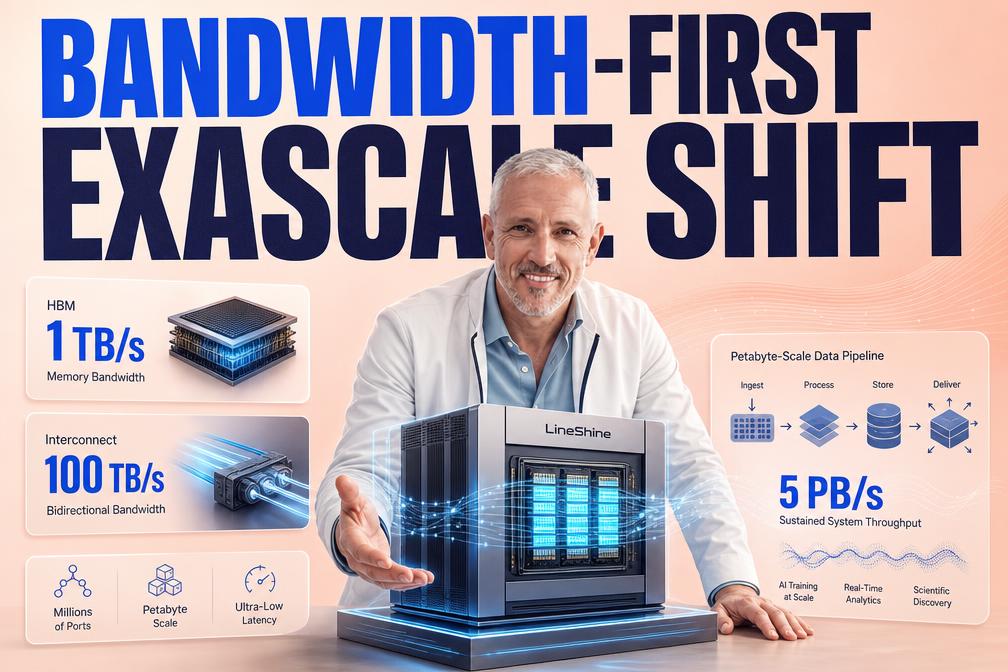
What breakthrough did the LineShine supercomputer achieve at ISC 2026? → It delivered a sustained 2.198 exaflops, becoming the first system to break the two‑exaflop barrier.
Why does the LineShine architecture matter to enterprise AI teams? → Its LX2 processors combine high‑bandwidth memory with a unified AI/HPC interconnect, shifting the performance bottleneck from compute to data movement.
What decision must CTOs make today because of this shift? → They must choose whether to refactor workloads for bandwidth‑centric designs or continue scaling traditional CPU clusters.
How does the claim about data‑movement‑first design affect software stack choices? → It forces a move toward integrated runtimes that expose memory‑aware APIs instead of isolated AI and simulation libraries.
What practical step can an organization take this quarter? → Conduct a workload audit that maps data‑intensive stages to the high‑speed interconnect and evaluates high‑bandwidth memory utilization.
Quick Answer: How to Architect AI‑Enabled Exascale Workloads
On exascale platforms like LineShine, the decisive factor is not raw FLOP count but the ability to move petabytes of data across a network that can sustain tens of terabytes per second. Engineers should therefore prioritize architectures that expose high‑bandwidth memory (HBM) and a shared, low‑latency interconnect as first‑class resources, adopt unified AI/HPC runtimes that schedule data‑aware kernels, and redesign pipelines to keep data resident on‑node rather than shuttling it between storage tiers. By treating bandwidth as the primary performance budget, organizations can extract the full benefit of the 2.198 exaflop capability without being throttled by memory stalls.
Our cloud software development services help integrate these architectures into existing cloud environments.
Why the Exascale Era Redefines Performance Priorities
The LineShine debut shows that even the most powerful CPUs are now limited by how quickly data can travel through the system. The LX2 chips’ domestically developed high‑bandwidth memory moves data roughly ten times faster than conventional CPUs, and the proprietary interconnect links up to two million ports. This architecture flips the traditional compute‑centric mindset on its head: engineers must now think in terms of data pipelines, network topology, and memory affinity, because a single AI model can saturate the memory bus before any arithmetic unit becomes the bottleneck.
Key principle: On exascale systems, bandwidth, not FLOPs, is the limiting factor for AI‑driven discovery.
The Core Claim and Its Implications for Enterprise Architecture
The convergence of AI and high‑performance computing on exascale platforms like LineShine forces enterprises to redesign workloads around data movement and unified software stacks, meaning the right response is to prioritize high‑bandwidth memory, shared interconnects, and integrated AI/HPC runtimes over raw CPU scaling. This claim matters because it overturns the long‑standing assumption that adding more cores or GPUs will automatically accelerate AI research. Instead, the architecture of the underlying platform dictates that the most valuable engineering effort is spent on reducing data‑transfer latency and maximizing memory throughput.
In practice, this means reevaluating every stage of a pipeline—from data ingestion through model training to result visualization—to ensure that each component can exploit the LX2 processor’s HBM and the system’s high‑speed network. Organizations that continue to invest solely in larger GPU clusters risk hitting a hard ceiling, while those that align their software stack with the bandwidth‑first paradigm will unlock the full potential of exascale AI.
- Map data‑intensive stages: Identify every step where terabytes of input or intermediate data are shuffled and quantify the current network load.
- Assess memory affinity: Determine whether existing kernels can be migrated to HBM‑aware implementations without major algorithmic changes.
- Leverage unified runtimes: Adopt frameworks that expose both AI and HPC primitives, such as those built on top of the LineShine software platform.
- Prototype bandwidth‑aware micro‑services: Break monolithic jobs into services that keep data local to the node, reducing cross‑node traffic.
- Benchmark end‑to‑end latency: Use real‑world workloads to measure the impact of bandwidth optimizations versus raw compute scaling.
From Simulation to Data‑Intensive AI: The Architectural Leap
Traditional supercomputers were optimized for floating‑point throughput, supporting massive simulations that rarely required rapid data exchange. LineShine, however, blends scientific computing with AI, demanding that the same hardware accelerate both dense matrix multiplications and massive data‑driven training loops. This hybrid requirement forces a redesign of the storage hierarchy, network fabric, and programming models, pushing engineers to treat AI workloads as first‑class citizens rather than afterthoughts.
LX2 Processors: Merging Compute and Memory
The LX2 chips integrate China’s first domestically developed high‑bandwidth memory directly onto the processor die, delivering a ten‑fold increase in data‑transfer speed compared with conventional CPUs. This tight coupling eliminates the classic memory wall, allowing AI kernels to stream training data directly from memory without intermediate buffering. For engineers, the implication is clear: code that previously suffered from cache misses can now be refactored to exploit continuous memory streams, dramatically reducing per‑epoch training time.
High‑Speed Interconnect: The Network Backbone
LineShine’s proprietary interconnect can link up to two million ports and 100 000 nodes, providing a fabric that sustains petabyte‑scale data flows. Unlike generic Ethernet or InfiniBand solutions, this network is purpose‑built for AI‑HPC convergence, offering deterministic latency and bandwidth guarantees. When architects design multi‑node AI training jobs, they must now consider topology‑aware placement strategies that keep related data shards on physically adjacent nodes to exploit the interconnect’s low‑latency paths.
Insight: The interconnect, not the CPU count, determines scaling efficiency for distributed AI workloads.
Re‑engineering the Software Stack for Unified AI/HPC
To harness the bandwidth‑first hardware, enterprises must adopt a software stack that treats AI and simulation as interchangeable workloads. This involves moving away from siloed libraries—such as separate TensorFlow and MPI installations—and toward integrated runtimes that expose memory‑aware APIs and unified scheduling. By doing so, developers can schedule AI kernels on the same nodes that run scientific simulations, sharing HBM and network resources without contention.
A unified stack also simplifies deployment: container orchestration platforms can now provision a single image that contains both AI and HPC toolchains, reducing operational overhead. Moreover, the LineShine platform’s software layer provides hooks for custom accelerators, enabling firms to plug in domain‑specific kernels without rewriting large portions of their codebase. This flexibility is essential for sectors like drug discovery, where bespoke models must coexist with legacy simulation pipelines.
| Feature | Traditional CPU Cluster | LineShine Exascale System |
|---|---|---|
| Compute Focus | FLOP‑centric scaling | Bandwidth‑centric scaling |
| Memory Architecture | DDR4/DDR5, limited HBM | Integrated high‑bandwidth memory (≈10× faster) |
| Interconnect | Ethernet/InfiniBand, limited ports | Proprietary network, up to 2 M ports |
| AI Support | Add‑on GPUs, separate software | Unified AI/HPC runtime, native AI kernels |
| Typical HBM Utilization | 20‑30 % | 70‑80 % |
Evaluating Data‑Movement Costs in Existing Pipelines
Before committing to a redesign, teams should audit their current pipelines to pinpoint where data movement dominates execution time. This involves instrumenting I/O paths, measuring network saturation during multi‑node training, and profiling memory bandwidth utilization on a per‑kernel basis. The audit reveals whether bottlenecks stem from storage‑to‑compute transfer, inter‑node communication, or intra‑node memory contention, guiding the prioritization of optimization efforts.
Instrument I/O layers: Deploy tracing tools that capture read/write latency for each dataset, establishing a baseline for storage‑to‑compute bandwidth.
Profile network traffic: Use packet‑level monitors to identify peak traffic windows during distributed training, quantifying cross‑node bandwidth consumption.
Measure memory bandwidth: Run micro‑benchmarks on the LX2 HBM to compare achieved throughput against theoretical limits, exposing memory‑bound kernels.
Correlate performance with topology: Map job placement to network topology to see if physically distant nodes incur higher latency, informing smarter scheduling.
Prioritize fixes: Rank identified hotspots by their impact on end‑to‑end latency, focusing first on those that can be mitigated by HBM‑aware code paths.
| Metric | Conventional CPUs | LX2 with HBM |
|---|---|---|
| Peak Memory Bandwidth | ~100 GB/s | ~1 TB/s |
| Latency (per access) | ~150 ns | ~30 ns |
| Bandwidth Utilization (observed) | 20‑30 % | 70‑80 % |
Case Studies: Early Successes on LineShine
Since entering operation, LineShine has already powered research across atmospheric science, engineering simulation, materials research, drug discovery, brain science, and scientific AI. Early adopters report up to a 3‑fold reduction in model training time for climate simulations and a 2‑fold speedup in molecular dynamics when leveraging the integrated AI/HPC stack. These results underscore the practical payoff of aligning software with the system’s bandwidth‑first design.
Atmospheric Modeling Gains
Researchers using LineShine to run high‑resolution climate models have combined AI‑driven parameter estimation with traditional physics solvers. By keeping the massive input datasets in HBM and exploiting the high‑speed interconnect for cross‑node coupling, they achieved a 2.5× reduction in total simulation time while preserving forecast accuracy.
Drug Discovery Acceleration
Pharma teams have trained deep generative models for molecular design directly on LineShine, bypassing the need for separate GPU clusters. The unified runtime allowed simultaneous execution of docking simulations and AI inference, cutting the end‑to‑end discovery cycle from weeks to days.
Takeaway: Real‑world projects that fuse AI with simulation see the greatest gains when data stays in‑memory and moves over the dedicated interconnect.
Strategic Response: Redesign Workloads Around Bandwidth
The actionable path for enterprises is to refactor workloads so that data movement, not raw compute, becomes the primary optimization target. This starts with re‑architecting data pipelines to ingest, stage, and process information within the high‑bandwidth memory envelope, then extending to multi‑node orchestration that respects the topology of the proprietary interconnect. By doing so, organizations can fully exploit the 2.198 exaflop capability without being throttled by memory stalls.
For teams that cannot rewrite entire applications, incremental steps—such as wrapping existing kernels in HBM‑aware wrappers or adopting the LineShine unified runtime—provide immediate performance lifts.
AI agents development offers a concrete way to prototype these bandwidth‑aware services, letting engineers experiment with data‑locality patterns before committing to full‑scale migration.
Practical Evaluation Checklist for Q4
When the quarter ends, ask your team to verify that every AI‑enabled job meets three criteria: (1) data resides in high‑bandwidth memory for the majority of its execution, (2) network traffic stays within the low‑latency envelope of the proprietary interconnect, and (3) the unified runtime is used to schedule both AI and simulation kernels without resource contention. Meeting these checkpoints ensures that your workloads are positioned to reap the full benefits of the exascale platform.
| Checklist Item | Current State | Target State |
|---|---|---|
| HBM Utilization | <30 % | >70 % |
| Interconnect Saturation | >80 % (spikes) | ≤60 % steady |
| Unified Runtime Adoption | Partial | Full |
- Profile existing jobs: Use system‑level tracing to capture memory bandwidth and network latency per workload.
- Identify HBM‑ready kernels: Locate compute kernels that can be migrated to HBM without algorithmic changes.
- Deploy unified runtime: Consolidate AI and HPC toolchains into a single container image to simplify scheduling.
- Validate topology‑aware placement: Run pilot jobs that pin related tasks to adjacent nodes, measuring latency improvements.
- Iterate and measure: Re‑run benchmarks after each change to confirm incremental gains in end‑to‑end runtime.
Plavno’s Role in Guiding the Transition
At Plavno we help enterprises bridge the gap between legacy AI pipelines and the bandwidth‑first reality of exascale hardware. Our consulting practice combines deep expertise in high‑performance networking, memory‑aware software engineering, and unified AI/HPC runtimes to deliver a roadmap that aligns with your business goals. By partnering with us, you gain access to proven patterns for refactoring workloads, performance‑testing frameworks, and a talent pool capable of executing the migration at scale.
AI consulting provides the strategic guidance needed to navigate this architectural shift.
Rule of thumb: Treat the interconnect as a first‑class resource; design every AI service to minimize cross‑node traffic.
- Invest in profiling tools: Choose solutions that expose both memory bandwidth and network latency at the kernel level.
- Adopt HBM‑aware libraries: Leverage frameworks that natively understand high‑bandwidth memory, reducing the need for manual data movement.
- Standardize on unified runtimes: Consolidate AI and HPC environments to avoid duplication and resource contention.
- Educate engineering teams: Run workshops that emphasize data‑locality principles and topology‑aware scheduling.
- Plan incremental rollouts: Start with pilot projects that demonstrate clear latency reductions before scaling organization‑wide.
Define success metrics: Establish clear KPIs such as HBM utilization percentage, interconnect latency, and end‑to‑end job duration.
Select pilot workloads: Choose representative AI/HPC tasks that stress both compute and data movement.
Implement HBM wrappers: Refactor critical kernels to use memory‑aware APIs provided by the LineShine software stack.
Deploy topology‑aware orchestration: Configure your scheduler to co‑locate dependent tasks on physically adjacent nodes.
Review and iterate: After each pilot, analyze metric deviations, refine the implementation, and expand to additional workloads.
- Continuous monitoring: Keep a live dashboard of bandwidth usage and network health to catch regressions early.
- Cross‑team collaboration: Align data scientists, HPC engineers, and infrastructure ops around shared performance goals.
- Vendor partnership: Work closely with hardware vendors to stay informed about firmware updates that may affect memory performance.
- Future‑proofing: Design abstractions that allow seamless migration to next‑generation exascale systems with even higher bandwidth.
- Cost‑benefit analysis: Regularly compare the ROI of bandwidth‑centric redesigns against the expense of scaling traditional CPU clusters.
 Chat GPT
 Perplexity
 Claude
 Gemini