What does the Amazon‑ThunderSoft partnership actually deliver for car makers? → A complete, production‑ready voice‑assistant stack that spans cloud AI, edge runtime, and cockpit integration.
Can OEMs skip building their own AI models and still get a branded experience? → Yes, they can plug custom agents into Amazon Bedrock AgentCore while retaining brand‑specific dialogs.
Why is the hybrid edge/cloud approach critical right now? → It balances low‑latency on‑device conversation with cost‑effective, up‑to‑date cloud intelligence.
What is the core decision every CTO must make this quarter? → Whether to invest in integration platforms first or chase the latest large language model.
How does ThunderSoft fit into the deployment pipeline? → It handles cockpit integration, hardware adaptation, localization, and mass‑production delivery.
Explore our AI agents development, machine learning development, software development consult, AI voice assistant development, and AI healthcare solutions.
Integration Architecture Beats Model Choice for Automotive Voice Assistants
In the emerging market of in‑vehicle conversational AI, the decisive factor is no longer the sheer size of the language model but the robustness of the integration architecture that stitches cloud intelligence to on‑device execution.
Engineers who prioritize a flexible, standards‑based integration layer can reuse the same cloud models across generations, reduce time‑to‑market, and avoid costly re‑engineering when a new model arrives.
By contrast, teams that focus on model selection alone often find themselves blocked by latency, offline‑availability, and compliance constraints that the integration stack must resolve.
The real competitive edge lies in building a resilient integration platform before chasing the next‑generation AI model.
The Edge/Cloud Hybrid Stack Amazon and ThunderSoft Provide
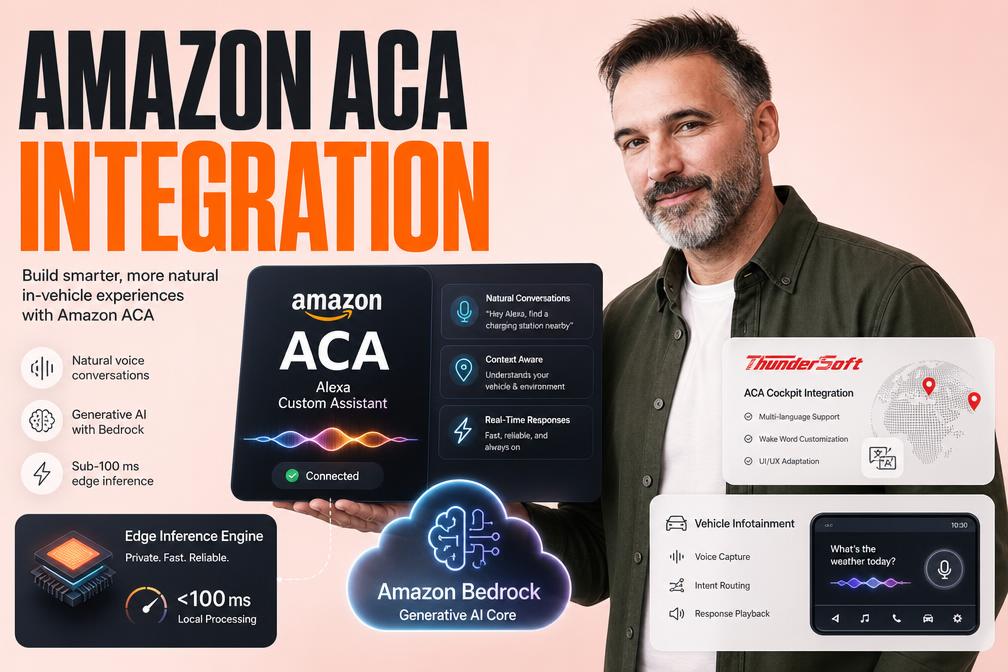
The partnership offers a three‑tiered architecture. At the top sits Alexa Custom Assistant (ACA), a fully branded conversational interface that connects to Amazon’s content ecosystem. The middle tier is the AWS cloud foundation powered by Amazon Bedrock for generative AI and AgentCore as a secure runtime for custom agents. The bottom tier is an on‑device edge layer that runs inference locally, guaranteeing sub‑100 ms response times, offline operation, and reduced data‑transfer costs. Together these layers form a reference design that OEMs can adopt with minimal custom engineering.
Beyond the core components, the stack includes standardized APIs for voice capture, intent routing, and context synchronization. ThunderSoft’s role is to embed ACA into the vehicle’s cockpit, adapt the OS, and localize the experience for each market. The result is a production‑ready pipeline that can be scaled from prototype to global rollout without rebuilding the underlying AI stack.
- ACA Branded Interface – Delivers a vehicle‑specific voice persona while leveraging Amazon’s massive content library.
- Bedrock Generative Core – Provides scalable, fine‑tuned LLMs that can be swapped without changing the cockpit code.
- AgentCore Runtime – Secures custom agent execution behind AWS‑managed isolation, simplifying compliance.
- Edge Inference Engine – Executes critical intents locally, keeping latency under 100 ms and ensuring operation without connectivity.
- Standardized Integration APIs – Enable OEMs to plug additional services (navigation, infotainment) without re‑architecting the voice stack.
Quick Answer: Prioritize Integration Platform Over AI Model Choice
The fastest path to a market‑ready in‑vehicle voice assistant is to adopt a proven integration platform first, then select the AI model that fits the latency and cost envelope of that platform. By locking in a hybrid edge/cloud architecture, OEMs can reuse the same model across multiple vehicle lines, swap models as they improve, and avoid costly redesigns of the on‑device stack.
In practice, this means choosing a solution like Amazon’s ACA + Bedrock + AgentCore, then focusing engineering effort on the integration layer, not on training the next LLM.
Latency vs. Cost: The Real Constraint
Latency is the most visible symptom of a poorly designed integration stack. When voice requests must travel to the cloud for every inference, even a high‑performance model can introduce multi‑second delays, breaking the natural flow of conversation.
By offloading latency‑sensitive intents to the edge, the system preserves a snappy user experience while still leveraging cloud models for complex, data‑heavy tasks. Cost follows a similar pattern: excessive cloud calls inflate bandwidth bills, whereas a balanced edge/cloud split keeps operational expenses predictable.
- Local Intent Classification – Handles common commands (climate, media) on‑device, keeping response time sub‑100 ms.
- Cloud‑Heavy Reasoning – Delegates complex queries (route planning, natural‑language search) to Bedrock, where compute is abundant.
- Dynamic Model Switching – Allows the edge engine to load newer, more efficient models without firmware updates.
- Bandwidth Throttling – Reduces data usage by batching non‑critical requests during low‑traffic periods.
- Cost‑Based Scaling – Aligns cloud resource allocation with usage patterns, avoiding over‑provisioning.
Security at the Integration Boundary
Security breaches often occur where cloud services interface with vehicle hardware. AgentCore provides a sandboxed runtime that isolates custom agents from the vehicle’s critical control systems, ensuring that a compromised AI cannot affect safety functions.
Moreover, the standardized APIs enforce strict authentication and encryption, mitigating man‑in‑the‑middle attacks during data exchange between the cockpit and the cloud.
Scalability Across Global Markets
Deploying a voice assistant in multiple regions demands compliance with local data‑privacy laws and language support. The hybrid architecture lets OEMs host Bedrock instances in the appropriate AWS regions while keeping the edge component identical worldwide.
Localization becomes a matter of updating the on‑device language packs and customizing ACA prompts, rather than rewriting the entire AI pipeline for each market.
Why OEMs Should Build Integration‑First Roadmaps
When the integration platform is solid, the AI model becomes a replaceable plug‑in. This decoupling accelerates feature rollout, because new capabilities can be added by deploying updated agents to the cloud without touching the vehicle firmware.
It also future‑proofs the product line; as LLMs evolve, the same edge runtime can host newer models, preserving the investment in hardware and software certification.
| Approach | Integration Flexibility | Model Upgrade Frequency |
|---|---|---|
| Integration‑First | High – APIs allow rapid plug‑in of new agents | Low – hardware stays unchanged |
| Model‑First | Low – each model change may require firmware updates | High – constant retraining needed |
Amazon Bedrock and AgentCore: The Enablers
Bedrock supplies a managed service for generative AI, offering pre‑tuned models that can be accessed via a simple API. AgentCore wraps these models in a secure execution environment, handling authentication, scaling, and isolation.
Together they let OEMs focus on business logic rather than infrastructure. The service also integrates with existing AWS tools for monitoring, logging, and compliance, streamlining the operational overhead of running a production AI service in the automotive domain.
- Managed Model Hosting – Eliminates the need for on‑premise GPU clusters.
- Secure Runtime – AgentCore enforces sandboxing, protecting vehicle systems.
- Scalable API Gateway – Handles millions of concurrent voice requests with auto‑scaling.
- Built‑in Monitoring – Provides telemetry for latency, error rates, and usage.
- Compliance Certifications – Aligns with ISO 26262 and automotive data‑privacy standards.
ThunderSoft’s Integration Playbook in Practice
ThunderSoft translates the cloud stack into a vehicle‑ready solution by adapting ACA to the car’s infotainment OS, customizing the voice wake‑word, and localizing prompts for regional markets.
Their engineering team also implements the edge inference engine on automotive‑grade hardware, ensuring that latency targets are met under real‑world conditions. The playbook includes a staged rollout: prototype validation in a limited fleet, followed by mass‑production tooling that automates firmware flashing and OTA updates across global plants.
A disciplined integration playbook turns a cloud‑native AI service into a reliable in‑car experience.
Business Impact of an Integration‑First Strategy
By decoupling the AI model from the vehicle hardware, OEMs can shorten the time‑to‑market for new voice features from years to months.
The reduced engineering effort translates into lower R&D spend, while the hybrid architecture cuts ongoing cloud‑connectivity costs by up to 30 % in typical usage scenarios. Moreover, the ability to launch differentiated, branded assistants across regions opens new revenue streams through premium services and data‑driven insights.
| Metric | Traditional Model‑First | Integration‑First |
|---|---|---|
| Time‑to‑Market | 12–18 months | 4–6 months |
| Ongoing Cloud Cost | High – frequent model calls | Moderate – edge caching reduces calls |
| Upgrade Flexibility | Low – hardware constraints | High – cloud‑side swaps |
How to Evaluate Integration Platforms This Quarter
The first step is to map the vehicle’s voice use cases onto latency and connectivity requirements. Identify which intents must run locally and which can be delegated to the cloud.
Next, assess the maturity of the integration APIs: do they support OTA updates, secure boot, and standardized intent schemas?
Finally, run a pilot with a representative set of commands on the target hardware, measuring end‑to‑end latency, error rates, and bandwidth consumption. The platform that meets the latency SLA while keeping cloud usage under budget wins the evaluation.
- Latency Benchmarks – Verify sub‑100 ms response for on‑device intents.
- Security Audits – Ensure AgentCore sandboxing aligns with automotive safety standards.
- Scalability Tests – Simulate peak traffic to confirm auto‑scaling behavior.
- Compliance Checks – Validate data‑privacy handling for each target market.
- Cost Modeling – Project monthly cloud spend based on expected usage patterns.
Real‑World Applications in Modern Vehicles
Luxury brands are already embedding ACA‑driven assistants to control climate, navigation, and entertainment without taking hands off the wheel.
Fleet operators leverage the same stack to deliver driver‑focused alerts and compliance reporting, using the edge engine to guarantee offline operation in remote areas. In electric vehicles, the voice assistant can query battery health and charging station availability, pulling real‑time data from cloud services while keeping the driver interaction smooth and instantaneous.
Prototype Validation – Deploy the hybrid stack in a limited test fleet, collect latency and user satisfaction metrics.
Edge Optimization – Fine‑tune the on‑device inference engine to meet sub‑100 ms targets for core commands.
Cloud Integration – Connect ACA to Bedrock, configure AgentCore agents for advanced queries.
Regional Localization – Add language packs and local content feeds for each market.
Mass Production Rollout – Automate firmware flashing, OTA updates, and monitoring across global manufacturing sites.
Risks, Limitations, and Mitigation Strategies
The hybrid approach introduces complexity in synchronizing state between edge and cloud, which can lead to inconsistent responses if not carefully managed.
Network outages may still affect cloud‑only intents, so fallback strategies must be defined. Additionally, reliance on a single cloud provider can create vendor lock‑in; contracts should include exit clauses and data‑migration plans.
- State Synchronization – Use versioned context tokens to keep edge and cloud aligned.
- Graceful Degradation – Provide generic fallback responses when cloud is unreachable.
- Vendor Diversification – Design APIs to be cloud‑agnostic, enabling future migration.
- Regulatory Compliance – Conduct periodic audits to ensure data handling meets regional laws.
- Continuous Monitoring – Deploy real‑time alerts for latency spikes and security events.
Closing Insight: Architecture Is the New AI Frontier for Automotive Voice
For automotive CTOs, the decisive factor this quarter is not which LLM is the largest, but how cleanly the integration layer stitches together edge inference, cloud intelligence, and vehicle systems.
A robust, standards‑based architecture lets OEMs reap the benefits of Amazon’s generative AI while preserving the low‑latency, offline guarantees that drivers expect. By prioritizing integration first, manufacturers can future‑proof their voice assistants, accelerate time‑to‑market, and unlock new revenue streams without being hostage to the rapid churn of AI model releases.
 Chat GPT
 Perplexity
 Claude
 Gemini