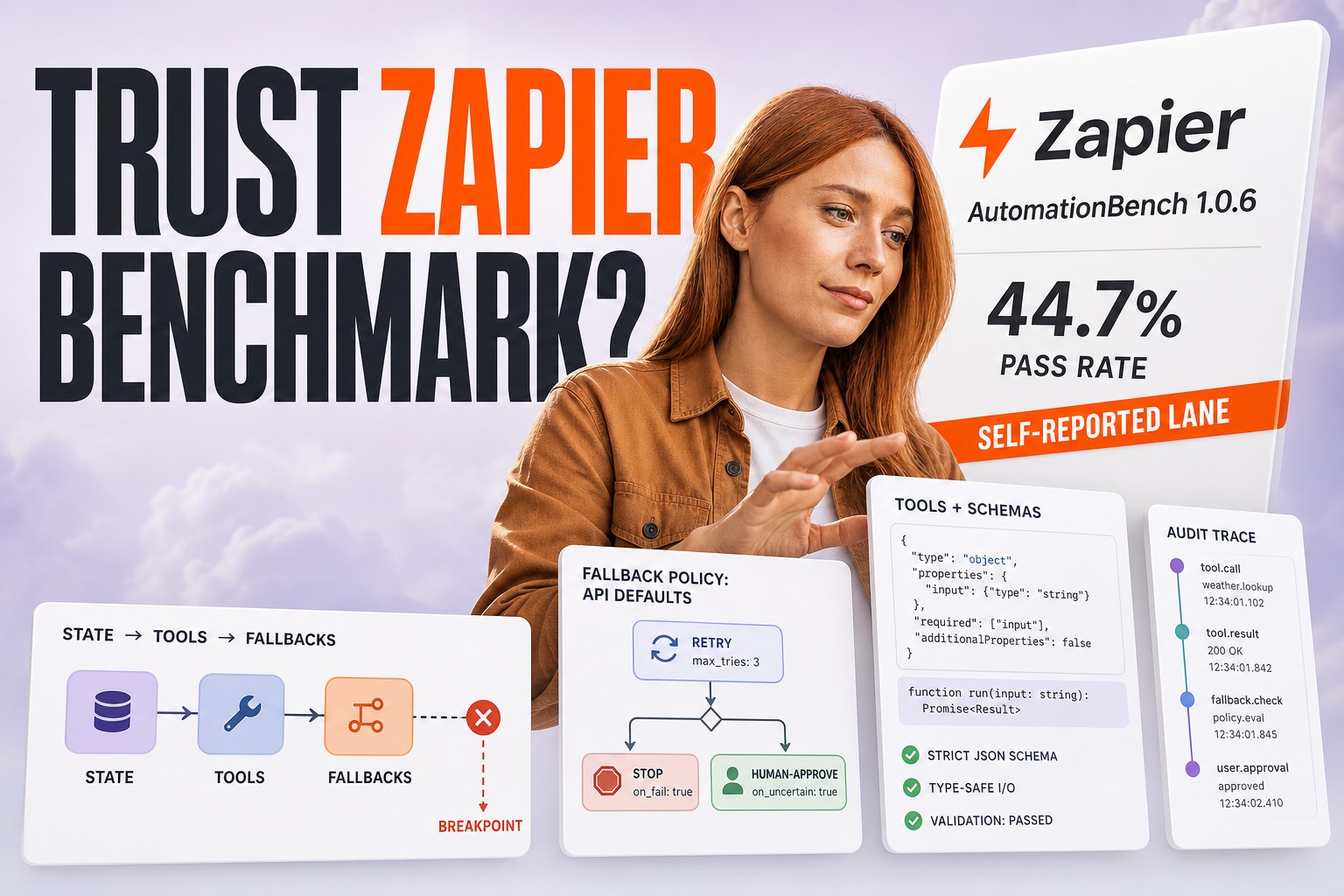
Is AutomationBench (Zapier 1.0.6) a reliable way to pick an automation model? → It is a useful signal for agentic workflow capability, but the current lane is compiled from provider self-reports, so it should not be treated as an independent buying decision.
What is the dominant signal this week? → Zapier’s private AutomationBench release 1.0.6 is being used as a headline metric for long-horizon automation, with a single reported run showing Claude Sonnet 5.5 at 44.7% pass rate.
What is the primary search question we need to answer? → Should we trust an AutomationBench score when selecting a model for production workflow automation across APIs and SaaS apps?
Why does this matter right now for engineering leaders? → The benchmark is labeled current and refreshed quarterly, which tempts teams to switch models quickly, even though provenance, simulation gaps, and fallback behavior usually dominate real incident rates.
What is the non-obvious angle we take at Plavno? → AutomationBench is most valuable as a design constraint for orchestration and reliability, not as a leaderboard for model selection; if we treat it as procurement guidance, we optimize the wrong layer.
Quick Answer: should you trust an AutomationBench score for Zapier-like automation?
You should treat an AutomationBench (Zapier 1.0.6) score as a narrow capability signal, not a reliable predictor of production success. This lane is compiled from provider self-reports and is based on simulated business workflows across applications and API endpoints, so it cannot substitute for your own evaluation harness, tool permissions model, and incident-oriented testing around fallbacks and long-horizon state.
- Use the score to bound ambition, not to pick a vendor. A pass rate can help us estimate how often an agent might finish a long-horizon workflow without intervention, but it does not tell us what fails: auth, rate limits, schema drift, retries, or tool selection. In practice those non-model failures dominate outage volume and on-call time in automation platforms.
- Treat provenance as part of the metric. When a benchmark row is displayable evidence rather than an independent run, the score is inseparable from the provider’s harness choices, prompt scaffolding, and tool wrappers. If we do not control those layers, we cannot reproduce or debug the outcome when the same workflow fails against our own Salesforce, NetSuite, or internal APIs.
- Make fallbacks first-class in evaluation. The reported run used API default fallbacks, and in production the fallback policy is where cost, latency, and correctness collide. A strong model with weak fallback governance can still create silent data corruption, duplicate actions, or compliance risk when the agent ‘keeps going’ after a tool error.
- Map simulated apps to your integration reality. AutomationBench covers simulated workflows across forty-seven applications, but your actual environment includes custom fields, bespoke approval steps, private endpoints, and inconsistent API semantics. For engineering decisions, we care less about generic app breadth and more about how your top workflows behave under retries, idempotency constraints, and token-limited context.
- Decide architecture before deciding models. If we build around deterministic workflow primitives, auditable state, and explicit tool contracts, we can safely swap models as the benchmark refreshes. If we build around implicit agent autonomy, model changes amplify instability because the orchestration layer has no guardrails.
What the AutomationBench (Zapier 1.0.6) release actually changes for engineering teams
AutomationBench (Zapier 1.0.6) pushes a market shift from chat-oriented evaluation toward end-to-end workflow completion across simulated applications and API endpoints. The practical change is that CTOs now feel pressure to justify automation architecture decisions with a single pass-rate number, even though the benchmark’s own framing warns that rows are compiled from provider self-reports and not used to rank models overall.
Separate capability from credibility before you compare anything. If the lane is based on self-reports, we should assume the score reflects a specific harness and wrapping strategy, not an independently verified baseline we can bank on.
Read the benchmark as a workflow taxonomy, not a leaderboard. The most actionable artifact is the existence of long-horizon automation tasks across simulated apps, which tells us what classes of orchestration failures to anticipate and test.
Treat the private evaluation set as a different product surface than the public subset. When a lane stays separate from the public subset and other variants, it is signaling that results may not translate across sets or harnesses.
Ask what fallbacks did during failures, not only whether the task passed. A pass rate hides whether the system recovered through retries, alternate tools, or silent assumptions; those mechanics determine operational risk in production.
Central claim: benchmark scores fail at the orchestration boundary, so your response must be architectural
Our position at Plavno is that AutomationBench (Zapier 1.0.6) makes a real point about long-horizon automation being hard, but it also exposes why model scores routinely mislead engineering leaders: failures in workflow automation concentrate at orchestration boundaries where state, tools, and fallbacks interact, not in the raw language capability implied by a single pass rate.
The right response this quarter is not a model switch based on a reported 44.7% pass rate; it is to harden the automation system so model choice becomes a configurable component. That means explicit tool contracts, deterministic state transitions, and auditable fallback policies, plus an internal evaluation harness that runs your top workflows against your own APIs and SaaS tenants.
If a benchmark row is provider self-reported and the tasks are simulated, the score is not a property of the model alone; it is a property of the model-plus-orchestrator bundle, which is exactly the bundle you will rebuild differently in production.
Why a 44.7% pass rate is a planning input, not a procurement decision
Claude Sonnet 5.5 leading the AutomationBench (Zapier 1.0.6) table at 44.7% tells us that long-horizon automation remains failure-prone even for top models, which should immediately shift planning toward exception handling. In a real Zapier-like product, ‘did it pass’ is less important than ‘what did it do when it didn’t pass,’ because retries, partial actions, and inconsistent tool outputs are where customer trust erodes.
Where long-horizon automation actually breaks: state, tools, and fallbacks
Long-horizon automation fails when the agent must carry state across many tool calls, reconcile tool outputs that do not match expectations, and decide whether to retry, branch, or stop. That is why a benchmark framed around completing workflows across simulated applications and API endpoints is directionally correct, but it also means your production system will fail differently based on your auth model, rate limits, idempotency design, and the way your orchestrator resolves tool errors.
- State drift across turns becomes a data integrity issue. In production, an agent might update a CRM record and later discover a downstream system rejected the change, leaving business objects inconsistent. The benchmark pass rate cannot reveal whether the system maintained a durable workflow state machine in Postgres, relied on transient context, or used an event log that supports compensation.
- Tool selection is often a wrapper problem, not an LLM problem. Teams frequently expose too many tool variants with overlapping semantics, leading to wrong calls even when the model is competent. Whether you wrap tools as strongly typed functions, validate arguments at the gateway, or normalize responses in a service layer usually determines failure frequency more than model brand.
- Authentication and permissions create ‘correct but forbidden’ failures. In enterprise automation, OAuth scopes, service accounts, and tenant isolation policies block actions that would be valid in a simulated environment. Without a permission-aware tool router and clear error taxonomy, the agent will waste budget looping, or worse, it will switch to a less safe alternative path.
- Rate limiting and backoff policy dominate tail latency. Long-horizon workflows hit SaaS APIs repeatedly, so even mild throttling can cascade into timeouts. An orchestrator that centralizes retries and backoff with observability via OpenTelemetry can stabilize behavior, whereas ad hoc retries inside the agent prompt tend to create unpredictable load patterns.
- Fallbacks hide failure modes unless you instrument them. The input notes that the run used API default fallbacks; in production, default behavior can mask systemic tool errors. If we do not log which fallback path executed and why, we cannot distinguish a true model success from a recovery that violated policy or produced degraded output.
Simulated workflows across forty-seven applications still do not match your integration surface
AutomationBench (Zapier 1.0.6) references simulated business workflows across forty-seven applications, which is helpful for thinking about breadth, but production integrations are defined by edge cases. Your Salesforce instance has custom objects; your ticketing system has bespoke routing; your internal APIs may have undocumented constraints; and your security posture may require step-up approvals. Those details are where automation reliability is won or lost, regardless of how well a model performs in simulation.
Simulation can tell us whether an agent can navigate a generic workflow graph, but only your own tenant data and API behavior can tell us whether the automation will be safe, repeatable, and debuggable under real permissions and real failure conditions.
How we evaluate automation models when the benchmark is display-only and self-reported
At Plavno, we treat a benchmark like AutomationBench as a prompt to build an internal evaluation harness, not as a substitute for it. We start from the workflows you actually monetize, then replay them against a staging environment that mirrors your auth scopes, rate limits, and tool schemas. We instrument every tool call, every retry, and every fallback decision so engineering can attribute failures to the model, the tool wrapper, or the orchestration policy.
When teams ask us whether they should switch models based on the latest reported score, we reframe the decision: can your system isolate model changes from workflow semantics? If not, switching models is operationally risky because even small differences in tool argument formatting or error recovery will surface as regressions. This is where AI agents development becomes an engineering discipline rather than a model shopping exercise.
Provenance is part of the metric: private set, public subset, and separate lanes
The AutomationBench (Zapier 1.0.6) lane is described as Zapier’s private release evaluation set, and it is explicitly kept separate from the six-hundred-task public subset and other variants. For engineering decision-making, that separation matters more than the score itself, because it tells us the harness, tasks, and assumptions are not interchangeable. A procurement decision based on one lane can lock you into a system that performs differently when you test on your own workflows.
- Ask whether the result is independently reproducible. If a provider can share the exact task harness, tool schemas, and prompt scaffolding used for the self-report, your team can validate it internally. If not, you should assume the score is directional marketing rather than an engineering baseline.
- Ask what ‘simulated applications’ means for tool fidelity. Simulation can vary from highly realistic API contracts to simplified endpoints that avoid messy edge cases. In production, brittle JSON shapes, pagination quirks, and partial failures are routine, so fidelity determines how much the score transfers.
- Ask how the benchmark handles credentialing and permissions. Real workflows often fail because the agent is not allowed to do something. If the benchmark does not model permission boundaries, it can inflate the apparent automation readiness of any model.
- Ask how the system handles irreversible actions. Automation in finance ops, security response, or customer data management requires idempotency keys, dry-run modes, and human approvals. If the benchmark tasks do not enforce those constraints, the score won’t tell you whether the agent is safe.
- Ask for failure traces, not just pass rate. Engineering teams need tool call logs, error categories, and fallback paths to design mitigations. Without traces, you cannot translate a benchmark result into concrete reliability work.
What API default fallbacks imply for cost control, correctness, and safety
The reported run used API default fallbacks, which implies the evaluation allowed some automatic recovery behavior rather than strict failure on tool errors. In production, default fallbacks are a double-edged sword: they can improve completion rates, but they can also produce silent degradation, where the workflow ‘finishes’ with wrong fields, duplicated actions, or skipped checks. The engineering decision is whether to centralize fallbacks in the orchestrator with policy controls, or to let them happen implicitly inside model-driven reasoning.
| Fallback posture | What it optimizes for | What it risks in production |
|---|---|---|
| API default fallbacks | Higher apparent completion and smoother demos | Hidden degradation, hard-to-debug partial correctness, policy violations |
| Strict fail-fast orchestration | Clear failure signals and easier incident triage | More human intervention and lower completion in edge cases |
| Human-in-the-loop escalation | Safer execution for irreversible actions | Throughput limits and longer cycle time when approvals pile up |
| Policy-gated retries and tool switching | Balanced completion with governance | Higher engineering effort to define policies and maintain them |
Quarterly refresh cadence changes how you manage regressions, not just how you pick models
AutomationBench (Zapier 1.0.6) is described as refreshed quarterly and marked current, which can encourage a mindset of frequent switching. In practice, the refresh cadence should push you toward regression management: can you safely upgrade models without breaking critical workflows? That means stable tool interfaces, contract tests for wrappers, and observability that can compare behavior across model versions. This is often where AI consulting pays off: building a measurement and governance loop that survives model churn.
A quarterly benchmark refresh is only useful if your delivery process can absorb model changes without turning workflow automation into a continuous incident.
Business impact is driven by reruns and exceptions, not by headline completion rates
In real businesses, the cost of automation is dominated by what happens after the first failure: reruns, manual cleanup, customer-facing corrections, and internal escalations. A pass rate on simulated workflows does not tell you how often a workflow requires a second attempt, whether it produces duplicate records, or how quickly your team can diagnose the cause. If you cannot trace a workflow end-to-end through your orchestrator, the business will experience automation as unpredictability rather than leverage.
How we decide this quarter: switch models, or harden orchestration around the model you have?
When leaders ask whether the AutomationBench score justifies switching to the current leader, we advise making a narrower decision: will a model change reduce your top incidents, or will it simply change the shape of failures? If your automation stack already has explicit state, tool contracts, and a governed fallback policy, model choice becomes a tuning knob. If it does not, switching models is often a distraction from the engineering work that actually reduces risk and increases completion. This is the core promise of AI automation when it is implemented as an engineered system rather than a prompt bundle.
- If your failures are mostly tool and integration issues, switching models won’t help. Teams often discover that the dominant failures come from brittle connectors, inconsistent field mappings, and missing idempotency. In that situation, a different model will still call the same endpoints and trigger the same throttling, but now you also inherit new tool formatting quirks to debug.
- If your failures are mostly planning and long-horizon coherence issues, a model change may matter. Some workflows require the agent to maintain intent across many steps, handle branching, and recover from partial failures. A stronger model can reduce the frequency of ‘lost thread’ errors, but only if your orchestrator captures state and constrains tool use so the model cannot wander.
- If your environment is permission-constrained, governance beats raw capability. In regulated orgs, the question is not whether the agent can complete a workflow; it is whether it can do so within allowed scopes and with audit trails. A benchmark based on simulated apps will not reveal how the system behaves when it hits a forbidden action or needs an approval path.
- If your product must be explainable, you need traces more than scores. Customer support and enterprise buyers will demand to know why a workflow changed a record or sent a notification. Without tool call logs, policy decisions, and reason codes, you cannot meet that demand, regardless of the model’s benchmark performance.
- If you expect frequent model upgrades, invest in isolation layers now. A stable tool gateway, schema validation, and contract tests let you upgrade models with controlled blast radius. Without these, quarterly refresh cycles create constant regressions that erode confidence and adoption.
Real deployments that match the benchmark shape: workflow products, back-office automation, API-first SaaS
The closest production analogs to AutomationBench are systems that coordinate many API calls across multiple applications over a long horizon. That includes Zapier-like workflow products, internal back-office automation that touches HR, finance, and CRM systems, and API-first SaaS platforms that embed ‘do it for me’ automation. In each case, the engineering differentiator is not whether the model can reason; it is whether the system constrains actions, records state, and can recover safely when tools fail.
| Production scenario | Where it tends to break | Control that matters most |
|---|---|---|
| CRM and support workflow automation | Duplicate updates and inconsistent fields after partial failures | Idempotency, durable state, and connector contract tests |
| Finance and billing operations | Irreversible actions executed without approvals | Human-in-the-loop gates and auditable policy enforcement |
| Security and IT automation | Over-broad permissions and unsafe remediation steps | Least-privilege tool access and strict action constraints |
| Multi-app onboarding workflows | Rate limits, schema drift, and missing prerequisites | Centralized retries, validation, and dependency checks |
Risks you cannot benchmark away: compliance, access, and irreversible side effects
Even if a benchmark is current and refreshed quarterly, it cannot encode your compliance rules, access boundaries, or risk tolerance for irreversible actions. Production automation touches identity systems, customer data, and regulated records; the failure mode is not only ‘task did not pass,’ but ‘task partially passed in a way that creates liability.’ That is why we treat security reviews, permission modeling, and adversarial testing as first-class work alongside model evaluation, often in partnership with cybersecurity and penetration testing.
- Silent partial completion can be worse than visible failure. A workflow that quietly writes the wrong value to a customer record can create long-lived downstream issues across analytics, billing, and customer success. Benchmarks that report only pass rate do not capture the operational cost of correcting a silent error.
- Connector sprawl creates unpredictable permission surfaces. As teams add integrations, tool capabilities expand faster than governance. Without a centralized tool registry and permission-aware routing, an agent can discover ‘creative’ paths to act, which may violate internal policies even if the workflow appears to succeed.
- Auditability becomes non-negotiable in enterprise sales. Buyers will ask for evidence: who triggered the automation, what tools were called, what data was read or written, and why. If your system cannot produce an audit trail from orchestrator logs, a benchmark score will not close the gap.
- Long-horizon workflows amplify small reliability gaps. A minor connector flake or a subtle schema mismatch can cascade over many steps, especially when retries and fallbacks are implicit. Without structured state and explicit retry policies, long-horizon automation turns intermittent API issues into chronic instability.
- Vendor self-reports can hide operational assumptions. A model might appear strong under a specific prompt, tool wrapper, and fallback posture. If your production assumptions differ, you can pay the migration cost and still end up with the same incident profile.
Plavno’s stance: AutomationBench is an early warning system, and the fix is to own your evaluation loop
AutomationBench (Zapier 1.0.6) is telling the market something important: long-horizon automation across simulated applications and API endpoints is still hard, and even the reported leader is far from perfect. We should accept that message, but we should not outsource our engineering judgment to a display-only, self-reported lane. The correct move is to build an internal loop that measures your workflows, your connectors, your permissions, and your fallback policies, so benchmark shifts become inputs to experimentation rather than triggers for rushed platform rewrites.
Author: Plavno team. Last updated: September 2026. If you want a second set of eyes on your orchestration and evaluation design before you commit to a model switch, we can review your workflow topology, connector contracts, and observability plan and help you turn agent automation into something you can operate confidently; start the conversation at Plavno contact.
 Chat GPT
  Perplexity
  Claude
  Gemini
