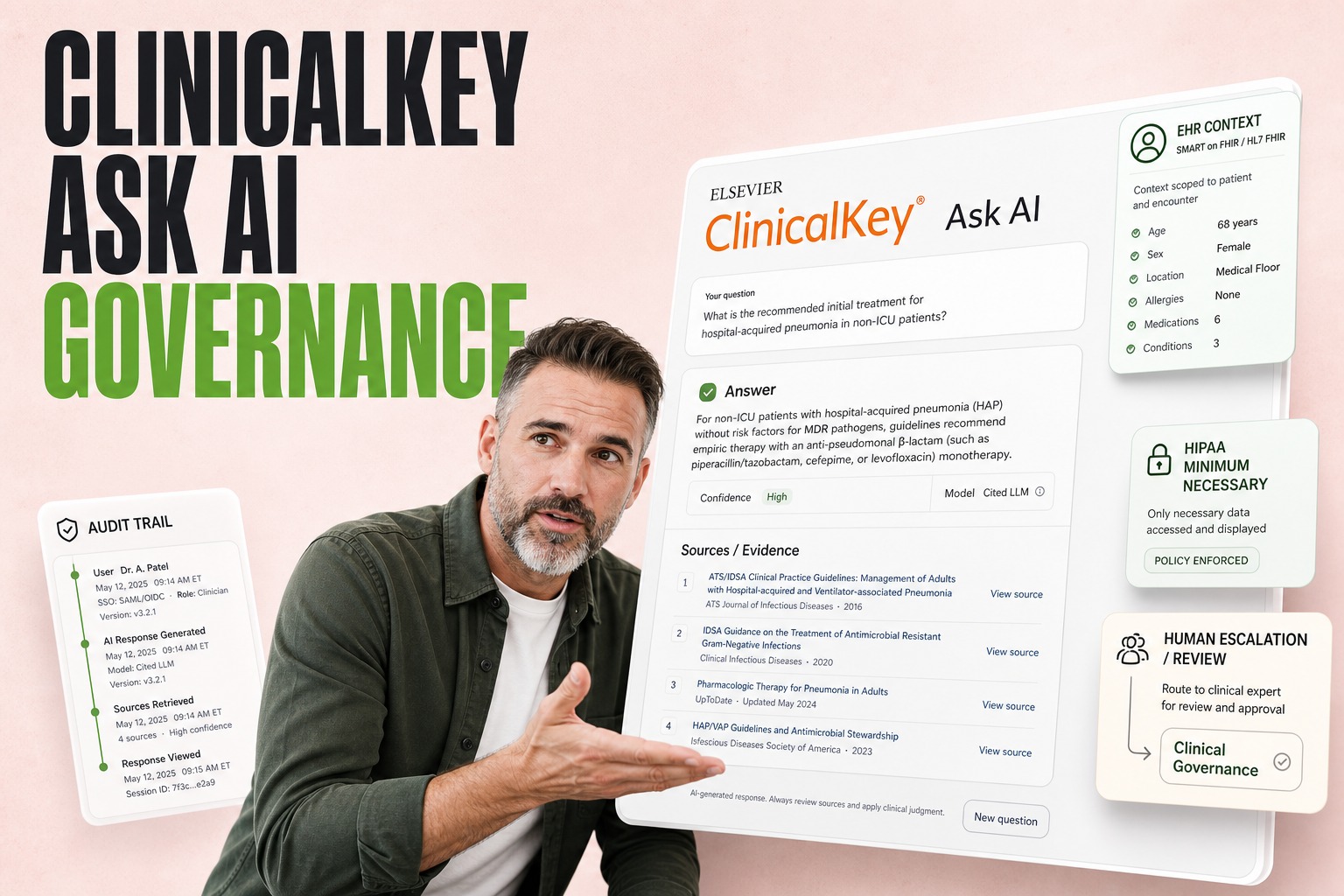
What changed this week that should matter to a hospital CTO? → Elsevier made the Ask AI feature in ClinicalKey available to more than 1,500 hospital sites in the US, which signals a shift from isolated experiments to scaled deployment expectations.
What is the primary question we should be answering before enabling it? → How do we deploy Ask AI in ClinicalKey as a production clinical decision support capability without creating new risk at the workflow, audit, and governance layers?
What will break first if we treat this like just another AI add-on? → The integration seams: identity, EHR context, provenance of answers, and the ability to show what the system referenced when a decision is questioned.
What is Plavno’s angle on this rollout? → Model capability is not the limiting factor; the limiting factor is whether we can operationalize Ask AI like a managed clinical knowledge service with evidence traceability and controlled release across sites.
What should an engineering leader decide this quarter? → Whether to enable Ask AI broadly, gate it behind a controlled rollout, or keep it off until we have the monitoring, audit trails, and clinical governance required for scaled use.
Quick Answer: should we enable Ask AI in ClinicalKey across our hospital system?
Yes, if we are prepared to run it as a production clinical knowledge dependency rather than a chatbot feature. Elsevier making Ask AI available to more than 1,500 US hospital sites implies this will quickly become a normalized clinician workflow, so the right decision is to pair enablement with strict governance, provenance requirements, and integration controls (EHR context, SSO, logging) that make answers reviewable after the fact.
If Ask AI is reachable from the clinician’s workflow, it must be governable like any other clinical decision support surface: controlled release, auditable outputs, and a documented path from question to supporting source material.
The real signal: Ask AI jumped from pilot to platform at more than 1,500 US hospital sites
Elsevier did not merely announce another AI concept; it expanded availability of an Ask AI feature inside ClinicalKey to more than 1,500 hospital sites in the US. That scale matters because it changes the operational baseline. When a capability is that broadly reachable, it stops being a discretionary experiment owned by an innovation team and becomes part of the clinical knowledge fabric that IT, compliance, and risk teams must support.
At Plavno, our central claim is specific and arguable: this expansion changes engineering practice because the highest-impact failures will happen at governance and workflow boundaries, not inside the language model, and the right response is to deploy Ask AI as a managed clinical knowledge service with provenance, auditability, and controlled integration into EHR context. Reasonable engineers can disagree and say model quality dominates; we see the opposite in real deployments where the hard questions arrive after adoption.
Where this changes engineering practice in 2026 budgets
When availability spans more than 1,500 US hospital sites, the budgeting conversation shifts from a single department’s tooling to cross-site operations: identity integration, network policies, standardized logging, and support runbooks. In practice, that means the teams that own Okta or Entra ID, SIEM, and EHR integration (HL7 FHIR or proprietary APIs) are now on the critical path, not just the clinical informatics team.
Why the hardest part is not the model
Hospitals rarely lose trust because a model is imperfect in a vacuum; they lose trust because nobody can explain why a specific answer appeared in a specific patient context. Ask AI being inside a clinical decision support environment raises the bar: you need provenance, versioning, and audit trails that survive safety reviews, incident tickets, and clinician complaints. Those are architecture problems, not prompt problems.
- Scaled availability forces enterprise controls: once Ask AI is accessible across many sites, we must standardize SSO, session management, and role-based access so a clinician’s identity and privileges travel with the request, even when launched from different portals or embedded surfaces.
- Clinical context becomes a data contract: if we pass patient or encounter context from an EHR via HL7 FHIR or vendor APIs, we need explicit scoping rules, minimum-necessary design, and a documented boundary of what the AI surface can see and store.
- Provenance is the real reliability feature: even if an answer is clinically reasonable, it becomes operationally unusable if we cannot show what source material supported it at the moment it was displayed to the clinician.
- Monitoring must be clinical, not just technical: latency, error rates, and uptime matter, but so do unsafe pattern signals like repeated re-asks, high disagreement by users, or escalations to human experts that indicate the workflow is failing.
- Change management is now part of engineering scope: enabling Ask AI broadly means release notes, training pathways, and feedback loops have to be built into the product surface, because the system will be judged by day-to-day usability under time pressure.
Treat Ask AI like a clinical knowledge service, not a UI feature
Ask AI is framed as a feature, but the deployment reality is closer to a shared service: an always-on interface to clinical knowledge that clinicians will rely on under time pressure. The engineering response is to define a service contract that covers identity, context, logging, and escalation paths, and then integrate it in a way that makes evidence review routine rather than exceptional. This is the posture we bring in AI consulting engagements when teams want fast adoption without hidden risk.
Architecture that survives real-world clinicians: provenance and traceability beat clever prompting
In a hospital environment, the question is not whether Ask AI can generate a plausible answer; the question is whether we can trace how that answer was formed in a way that stands up to clinical governance. Practically, we want every response to be tied to a trace: the user identity, the context scope, the time, and the supporting materials that the system relied on. Without that, adoption becomes fragile, because the first contested recommendation turns into an unresolvable argument.
- Evidence linkage as a first-class output: in production, we want the response to carry explicit references to supporting content, because clinicians and reviewers need to verify quickly without reverse-engineering the model’s reasoning.
- Request and response journaling with minimization: we typically log prompts and answers for audit and safety analysis, but we also design redaction and scope rules so that logging does not become a privacy liability when the system is used from patient-context screens.
- Versioning of the knowledge surface: when the underlying content or AI behavior changes, we need a way to correlate user feedback or incidents to the version that produced the output, otherwise post-incident reviews degrade into guesswork.
- Escalation paths inside the workflow: the system should make it easy to hand off to a human expert, a librarian, or a clinical governance channel when uncertainty is high, because forcing clinicians to leave the workflow to validate an answer is how unsafe shortcuts appear.
- Guardrails that are policy-driven, not prompt-driven: prompts can help tone and format, but hospital safety depends on enforceable rules at the service layer, such as when patient context is allowed, which roles can query which content, and how responses are displayed.
The integration point that makes or breaks adoption: EHR context and identity
Ask AI can be reachable from many entry points, but the highest-risk entry point is the one embedded in an EHR workflow where patient context is present. If we integrate via SMART on FHIR, or pass context through vendor APIs, we need to decide what the AI surface is allowed to know about the patient, and how that context is constrained to the minimum necessary for the clinician’s question. This is where identity and context must travel together, or the system becomes un-auditable.
Operational controls you need the day you switch it on
The day Ask AI becomes available broadly is the day it becomes an operational system: it needs runbooks, incident response, and clear ownership across IT, clinical informatics, and compliance. Even when the vendor hosts the feature, our hospital still owns the user experience, access pathways, and the consequences of downtime or confusing behavior. Treating enablement as a checkbox is how teams end up with shadow usage and fragmented safety posture.
- Identity and access management integration: we want SSO through SAML or OIDC, role mapping aligned to clinical roles, and explicit session behavior so that access is deterministic across devices and sites rather than dependent on cached states.
- Network and endpoint policy alignment: once clinicians can access Ask AI from multiple environments, we need consistent policies across managed devices, VDI, and segmented networks, otherwise support tickets and workarounds become the real product.
- Centralized logging and correlation: we typically route key events into SIEM tooling so we can correlate spikes in use, failures, or suspicious patterns to specific sites, roles, and time windows, rather than relying on anecdotal complaints.
- Incident response playbooks: if answers are contested or the service becomes unavailable, we need a defined path for clinicians to proceed safely, and a defined path for engineering to capture relevant traces without expanding privacy exposure.
- Site-by-site rollout controls: enabling across a multi-site system should be reversible per site, because local workflows and governance maturity vary, and a single failure can cascade through shared training and trust.
A governance-first deployment pattern that scales across sites
When a feature becomes available to more than 1,500 hospital sites nationally, we should assume clinicians will compare experiences, share screenshots, and develop expectations fast. Governance cannot be retrofitted after adoption; it has to be present at the moment of first use. The deployment pattern we favor is staged enablement with clear service ownership: one group owns identity and access, another owns clinical governance criteria, and engineering owns observability and release controls.
In practice, this looks less like we turned on AI and more like we published a new clinical knowledge endpoint with defined inputs, outputs, and accountability. It is the difference between a tool that quietly improves decision-making and a tool that creates recurring risk committee meetings. The point is not to slow adoption; the point is to prevent the first high-profile failure from freezing adoption system-wide.
Data boundaries: what stays inside the hospital network
Even if Ask AI is vendor-provided, our architecture still needs explicit boundaries. We decide whether clinicians can launch it only from managed devices, whether patient context can be passed at all, and where request traces are stored. In real hospital environments, network segmentation, VDI constraints, and identity federation shape what is technically possible more than any product roadmap.
Auditability: how you answer the first safety review
The first time a clinical leader asks why an answer appeared, the best answer is not the model said so, it is a reproducible trace: who asked, under what role, what the system referenced, and how the display was framed. That implies audit logs designed for review, not just for debugging. It also implies retention policies and access controls so audit data does not become a new compliance exposure.
| Deployment posture | When it fits | What engineering must own |
|---|---|---|
| Broad enablement | Mature governance and strong identity/logging foundations | Centralized observability, release controls, and fast rollback by site |
| Staged rollout by site/service line | Mixed maturity across locations or specialties | Feature gating, training loops, and governance sign-off gates |
| Restricted access (pilot) | Unclear risk appetite or weak audit readiness | Controlled cohorts, enhanced logging, and a defined evaluation protocol |
| Keep disabled until ready | No capacity for monitoring or governance | A time-boxed readiness plan so disabled does not become permanent drift |
Plavno’s position: vendor choice is secondary to your integration contract
Elsevier expanding availability is the market signal, but the engineering decision is local: what contract do we enforce between the AI surface and our clinical environment? We can be excited about Ask AI, and we still must define how it authenticates users, how it receives context, what it logs, and how it fails safely. When teams ask us about building similar capabilities, we often start from the same premise used in AI agents development: the agent is not the model, it is the system around it.
Business impact shows up in operations, risk, and clinician time—not in an AI line item
Hospital leadership will ask whether enabling Ask AI reduces pressure on clinicians, improves decision confidence, or speeds access to evidence. Those are valid outcomes, but the costs appear in different places: identity engineering, governance time, support workflows, and risk management. The organizations that win are the ones that treat this as a digital capability rollout, not a novelty feature, which is consistent with how we approach digital transformation programs where workflow is the true product.
- Clinician time and cognitive load: if Ask AI is embedded where clinicians already work, it can reduce context-switching, but if it is not properly scoped it can create extra verification steps that offset any time savings.
- Support and escalation volume: broad availability typically increases it said something weird tickets, so the real cost is building a triage pathway that distinguishes usability issues, knowledge issues, and potential safety concerns.
- Risk committee and governance overhead: if we cannot demonstrate traceability, leadership will compensate by adding process gates, which slows adoption and increases the ongoing operational tax.
- Vendor management and renewals: once clinicians depend on a feature, renewal leverage changes; the business impact includes negotiating for observability hooks, audit access, and integration flexibility.
- Reputation and trust: a single incident where an answer cannot be explained can chill adoption across sites, which turns the investment into sunk cost even if the tool was helpful in many routine cases.
Real-world workflows where Ask AI helps—and where it becomes liability
Ask AI is most valuable in high-frequency, evidence-driven questions where clinicians want fast orientation and a pointer to supporting material. It becomes liability in ambiguous cases where the user expects certainty, or where the interface makes it too easy to treat the output as a directive rather than a starting point. This is not an argument against enablement; it is an argument for designing the experience so the right kind of question is encouraged and the wrong kind is frictioned.
- Point-of-care knowledge lookups: clinicians often need a quick answer and then a route to deeper evidence; if the system supports that behavior, it aligns with real workflow under time pressure.
- Cross-specialty orientation: in large systems, clinicians cover outside their narrow specialty; an AI Q&A surface can help them frame the question and identify what to verify, but only if the output is clearly positioned as support, not instruction.
- Training and onboarding moments: residents and new hires may rely heavily on Q&A tools; this amplifies the need for governance because early habits become institutional norms.
- Edge-case decision-making: when the question is rare or high-risk, any missing provenance becomes intolerable; this is where we need explicit escalation and verification paths.
- Documentation-adjacent usage: if clinicians start using Ask AI to phrase notes or explanations, the risk shifts from decision support to documentation accuracy, and the hospital must be ready to detect and govern that drift.
Latency and availability are non-negotiable in clinician-facing AI
In clinical workflows, a slow or intermittently unavailable tool is not merely annoying; it trains clinicians to abandon it or to develop workarounds that bypass governance. Even when the AI is vendor-hosted, we still own network path reliability, DNS and proxy behavior, and how the feature is surfaced inside EHR or intranet portals. This is why we push teams to treat the integration like any other high-availability dependency, using patterns we commonly implement in cloud software development for mission-critical internal platforms.
- Network path consistency across sites: large hospital systems have uneven network environments; if one site has higher latency or blocked endpoints, adoption will fragment and clinicians will blame the tool rather than the path.
- Degraded-mode behavior: the interface should clearly communicate when the service is unavailable and provide a safe alternative path, because silent failures lead to repeated retries and mistrust.
- Caching and content delivery trade-offs: performance improvements often involve caching, but caching interacts with governance, freshness, and auditability; we need explicit rules so performance does not undermine traceability.
- Capacity planning for peak clinical hours: usage tends to cluster; the real test is whether the system remains responsive during peak clinical workflows, not during off-hours demos.
- Observability tied to user experience: monitoring should measure what clinicians feel—time to first usable answer, error visibility, and retry behavior—so we can detect workflow failure before it becomes a safety complaint.
How to evaluate Ask AI in practice: the acceptance test is scenario coverage
The most useful evaluation is not a generic accuracy score; it is scenario coverage across real clinical question types and contexts, including failure modes. Because Ask AI is now broadly available in the market, hospitals will feel pressure to enable it quickly, but evaluation should still be grounded in the workflows that matter: what questions are asked, what context is available, and how the system behaves when it cannot answer confidently. This is how we keep the system aligned with clinical reality rather than demo theater.
- Define the question taxonomy you actually see: we typically start by sampling real knowledge queries from clinicians (de-identified where required) and grouping them into types, because the system can behave very differently across question classes.
- Test with and without patient context: if the tool is reachable from an EHR, we need to validate how context changes outputs and whether users understand what the system is using.
- Measure verification friction: an answer that requires a long manual verification path is not a productivity win; evaluation should include how quickly a clinician can confirm the supporting material.
- Assess escalation usability: if the tool is unsure, does it guide the user to the next best step, or does it force the clinician to guess? The best systems make uncertainty operationally manageable.
- Run a governance rehearsal: before broad enablement, simulate a contested answer review and confirm you can retrieve logs, references, and configuration state without scrambling.
The risk that risk officers will focus on: provenance gaps, not hallucinations as a concept
Many discussions fixate on hallucinations, but governance teams tend to focus on something more actionable: can the hospital demonstrate how outputs were derived and what the clinician saw at the time? If the answer is no, every incident becomes harder to investigate and harder to remediate. Elsevier’s expansion makes this urgent because once clinicians depend on Ask AI, provenance is no longer a nice-to-have; it is the difference between manageable risk and unbounded exposure.
- Unreviewable outputs create unresolvable disputes: if clinicians disagree with an answer, we need to show what supported it; otherwise the argument becomes subjective and trust degrades.
- Policy cannot be enforced after the fact: governance needs pre-defined constraints on where Ask AI can be used and what it can access, because retroactive policing of usage rarely works in busy clinical settings.
- Site variance amplifies risk: multi-site systems have different workflows and training; without standardized provenance and auditability, one site’s misuse becomes everyone’s reputational problem.
- Change drift becomes invisible: if we cannot correlate changes in behavior to versions or configuration, then quality issues look random, and teams respond by restricting access instead of fixing root causes.
- Escalation without traceability becomes noise: when users flag problems, engineering needs reproducible context; otherwise feedback becomes anecdotal and the system cannot improve safely.
Security and privacy: the question your CISO will ask first
The first CISO question is usually simple: what data leaves our environment, under what identity, and where is it stored? Even without making assumptions about Ask AI’s internal implementation, we can say the integration posture determines a lot: whether access is through managed devices, whether patient context is transmitted, and how logs are retained. For hospitals, the pragmatic move is to validate the entire request path with the same rigor we apply in cybersecurity and penetration testing for clinical systems, because AI surfaces quickly become high-value targets.
- Identity federation as the control plane: SSO is not just convenience; it is the mechanism that ties usage to roles and enables revocation, which is essential when access must be restricted quickly.
- Minimum-necessary context design: if patient context is used, we must scope it tightly and document it, because over-sharing context increases breach impact and complicates compliance.
- Logging without leakage: auditability requires logs, but logs must be designed to avoid storing sensitive context unnecessarily; otherwise the audit system becomes the breach.
- Threat modeling of embedded surfaces: if Ask AI is embedded in portals or EHR-adjacent apps, we need to consider clickjacking, session fixation, and token theft risks that are common in enterprise web integrations.
- Vendor dependency as a risk factor: broad availability can accelerate adoption, but it also concentrates risk; engineering should plan for how to operate safely during vendor outages or policy changes.
Build vs buy vs extend: deciding who owns the last mile
Elsevier expanding Ask AI availability does not remove the need for hospital-owned engineering; it clarifies where it should be focused. We rarely recommend rebuilding what a mature clinical knowledge vendor provides, but we strongly recommend owning the last mile: integration, policy enforcement, observability, and workflow design. That ownership requires capacity, and many hospital IT organizations meet that capacity need by adding specialized teams through outstaffing rather than trying to hire for every niche role permanently.
Start from workflow surfaces, not feature toggles: identify exactly where clinicians will access Ask AI (intranet, mobile, EHR-adjacent links), because each surface implies different identity, network, and privacy requirements.
Define the data contract for context: decide whether patient context is allowed, what minimum fields could be passed, and what must never be transmitted; write it down as an enforceable policy, not a verbal agreement.
Design for provenance at the moment of response: ensure that whatever is displayed can be reviewed later with supporting materials and configuration state, because safety reviews happen after incidents, not during demos.
Implement observability that ties to clinical experience: instrument the end-to-end journey, including launch point, time to usable answer, and escalation clicks, so you can detect adoption problems and safety risks early.
Roll out with reversible gates: enable by site or cohort, collect structured feedback, and keep rollback simple; broad availability in the market should not pressure you into irreversible changes inside your own system.
The fastest way to lose clinical trust is to ship AI without a reviewable trail; the fastest way to keep trust is to make verification and escalation part of the normal interaction.
Closing insight: success looks like boring reliability, not impressive demos
Elsevier making Ask AI available to more than 1,500 US hospital sites is the clearest sign yet that AI Q&A inside clinical decision support is moving into the default toolchain. That does not mean every hospital should enable it everywhere overnight; it means every hospital should decide, deliberately, how to operate it as a clinical knowledge dependency with identity, context, provenance, and governance designed in.
At Plavno, we approach these rollouts as systems architecture work: we make the integration auditable, the controls enforceable, and the workflow safe under real clinical pressure.
Author: Plavno team. Last updated: August 2026.
If you are enabling Ask AI (or a similar CDS AI surface) across multiple sites, we can help you define the operating model and build the last-mile integration so your first safety review is routine instead of a crisis.
 Chat GPT
  Perplexity
  Claude
  Gemini
