What new legal theories are being applied to AI chatbots and voice agents? → Plaintiffs are fitting wiretap, biometric privacy, and right‑of‑publicity statutes to AI‑driven conversational tools.
Why does this matter for companies in advertising, banking, and healthcare? → Those sectors rely heavily on AI‑powered customer interaction, exposing them to multi‑million‑dollar liability.
Which statutes are most at risk today? → The federal Wiretap Act, California’s CIPA, Illinois’ BIPA, and emerging right‑of‑publicity laws.
What is the core decision this article answers? → How should engineering teams redesign AI product pipelines to satisfy existing privacy statutes.
What is the actionable takeaway? → Embed consent, data‑minimization, and usage‑restriction controls at every stage of the AI lifecycle.
Quick Answer: How to Safeguard AI Voice and Chat Systems Against Wiretap and Privacy Laws
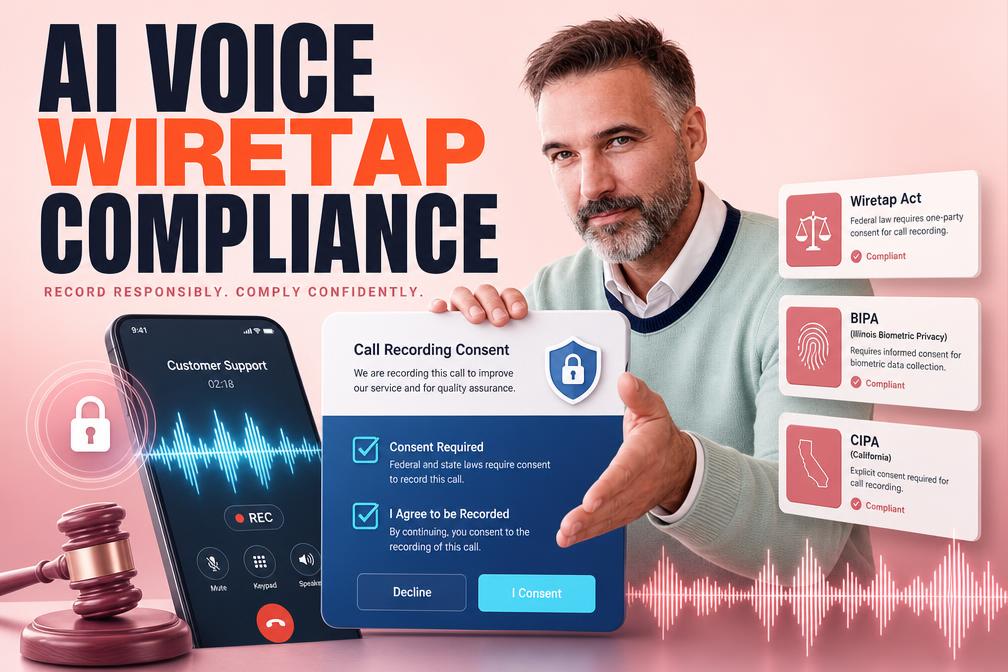
Companies must treat AI conversational agents as direct collectors of protected communications. That means obtaining explicit consent before recording, limiting retention to the minimum period required, and isolating training‑data pipelines from production traffic. Engineering teams should embed statutory‑compliant consent dialogs, audit data flows for biometric identifiers, and enforce strict access controls. By building these safeguards into the product architecture—not merely polishing model accuracy—organizations dramatically reduce exposure to wiretap, biometric privacy, and right‑of‑publicity lawsuits.
| Statute | Core Requirement | Typical AI Violation |
|---|---|---|
| Wiretap Act / ECPA | Prior consent for interception of communications | Recording calls for model training without user notice |
| California Invasion of Privacy Act (CIPA) | Written notice and opt‑out for electronic communications | Using session‑replay data to improve AI without disclosure |
| Illinois Biometric Information Privacy Act (BIPA) | Written consent, limited retention, and disclosure for biometric data | Continuous voiceprint collection for voice assistants without consent |
Why Existing Privacy Laws Are Suddenly Targeting AI Voice Assistants
The legal landscape has shifted because AI vendors are no longer passive data processors; they actively harvest raw audio and text to refine models, often without explicit user permission. Courts now view that activity as a direct interception of communications, comparable to traditional wiretap violations. This reinterpretation expands liability beyond the narrow “ordinary course of business” exception, especially when the same data is monetized across multiple clients. Consequently, engineers must re‑examine data pipelines that were once considered low‑risk.
- Implicit consent assumptions – Treating user‑initiated calls as automatically authorized for training, ignoring statutory notice requirements.
- Cross‑client data sharing – Re‑using recorded interactions from one customer to improve services for another, triggering wiretap claims.
- Unbounded retention – Storing voice recordings indefinitely for future model updates, violating BIPA’s data‑destruction mandates.
- Lack of audit trails – Failing to document who accessed raw audio, making it impossible to prove compliance.
- Inadequate user disclosures – Omitting clear language about how recordings will be used for AI improvement.
The Expanding Legal Landscape Across Sectors
Recent cases illustrate how courts are applying legacy statutes to modern AI systems. In Ambriz v. Google, the Ninth Circuit treated the contact‑center AI as a participant rather than a third‑party eavesdropper, allowing claims to proceed. Lisota v. Heartland Dental upheld the “ordinary course of business” exception only when the data remained internal, rejecting claims that the vendor sold recordings for advertising. Meanwhile, Taylor v. ConverseNow and Tate v. VITAS allowed CIPA claims to survive when AI tools were used in customer‑facing contexts. These rulings signal that the same statutes governing call‑recording vendors now govern AI voice agents, creating a unified risk surface for advertisers, banks, and healthcare providers.
The emerging right‑of‑publicity threat compounds these risks. In Lehrman & Sage v. Lovo, courts permitted claims that voice actors’ recordings were repurposed for commercial AI clones without meaningful consent. State laws such as Tennessee’s ELVIS Act and California’s AB 1836 further codify liability for unauthorized synthetic likenesses. Together, these developments force engineering teams to treat consent, data‑minimization, and usage‑restriction as core product requirements—not after‑thought compliance checks.
Wiretap and Eavesdropping Theories in Recent Cases
Courts are dissecting whether AI‑driven call‑recording platforms constitute “electronic communications” under the Wiretap Act. The Ambriz decision emphasized that an AI that actively participates in a conversation is a “party to the communication,” thereby sidestepping the third‑party exception. Conversely, Lisota found that internal use for model improvement does not constitute public interception, provided the data never leaves the organization for commercial exploitation. The split outcomes underscore that the decisive factor is the intended downstream use of the recordings, not merely the act of capturing them.
Biometric Privacy Risks for Facial and Voice Analytics
Illinois’ BIPA has become the benchmark for biometric privacy litigation, and its reach now extends to AI systems that continuously capture voiceprints or facial scans. The Clearview settlement demonstrated that even publicly sourced images can trigger BIPA liability when used without notice or consent. For AI voice assistants, each utterance can be treated as a biometric identifier, meaning that every interaction must be accompanied by a written consent form and a clear retention schedule. Failure to honor these obligations can generate statutory damages that quickly eclipse the value of the underlying technology.
- Implement consent dialogs – Prompt users before any recording, storing the consent record alongside the audio.
- Segment training pipelines – Separate raw data collection from model training environments to avoid cross‑client contamination.
- Enforce retention limits – Automatically purge recordings after a predefined period aligned with statutory guidance.
- Audit biometric captures – Flag any voice or facial data that could be classified as a biometric identifier.
- Maintain transparent logs – Record who accessed each audio file and for what purpose, enabling rapid compliance verification.
The Emerging Right‑of‑Publicity Threat to Synthetic Voices
Right‑of‑publicity statutes protect an individual’s control over the commercial use of their voice, likeness, or name. Recent litigation, such as Lehrman & Sage v. Lovo, shows courts are willing to allow claims when AI vendors repurpose recorded voice talent for broader product offerings without explicit, granular consent. State‑level statutes, including California’s AB 1836 and Tennessee’s ELVIS Act, codify these protections, creating a patchwork of obligations that span the United States. For companies deploying AI voice assistants, the risk is not merely reputational—it translates directly into exposure to statutory damages and injunctive relief.
| State | Right‑of‑Publicity Scope | Notable AI‑Related Provision |
|---|---|---|
| California | Broad protection of name, voice, likeness | AB 1836 requires consent for any synthetic replica used commercially |
| Tennessee | Specific to voice cloning | ELVIS Act imposes liability on both creators and distributors of unauthorized voice models |
| New York | Traditional publicity rights, no specific AI clause | Courts may apply existing law to AI cloning cases on a fact‑by‑fact basis |
Consent and Licensing as the New Foundations of AI Development
When an AI vendor collects voice data, the legal footing hinges on the consent language embedded in the original recording agreement. Broad, catch‑all clauses that merely mention “use for product improvement” are insufficient under emerging statutes. Instead, contracts must delineate the exact purposes—such as training a commercial voice assistant—and obtain written acknowledgment from the talent. This granular approach not only satisfies statutory notice requirements but also provides a defensible licensing framework should a right‑of‑publicity claim arise.
In practice, this means establishing a consent management layer that tracks each contributor’s permissions, ties them to specific model versions, and enforces usage restrictions through automated policy enforcement. By treating consent as a first‑class citizen in the data pipeline, organizations can prevent downstream disputes and align with both privacy and publicity statutes. This strategy also dovetails with broader compliance initiatives, such as GDPR and CCPA, creating a unified governance model for all personal data.
- Standardized consent forms – Use templates that explicitly list permissible AI uses, including commercial deployment.
- Versioned permission tracking – Associate each consent record with the specific model iteration it applies to.
- Automated policy enforcement – Deploy tooling that blocks any training job lacking a valid consent flag.
- Periodic consent renewal – Re‑engage contributors on a scheduled basis to maintain up‑to‑date permissions.
- Legal review of licensing clauses – Ensure contracts reflect the latest state‑level publicity statutes.
Common‑Law and Unfair Competition Claims Around Data Scraping
Beyond statutory privacy claims, plaintiffs are leveraging common‑law doctrines such as unfair competition, trespass to chattels, and unjust enrichment to target AI developers who scrape large volumes of user‑generated content. In Reddit v. Anthropic, the plaintiff alleged that the defendant’s model training constituted an unlawful appropriation of proprietary data assets, invoking unfair competition theory without invoking copyright law. The case now hinges on whether state law claims are preempted by federal copyright protections, a question that will shape the future of AI data‑scraping litigation.
Similarly, Reddit v. Perplexity frames unauthorized scraping as misappropriation of a valuable data asset, emphasizing the absence of a licensing agreement and the failure to honor user‑deletion requests. These disputes illustrate that AI developers cannot rely solely on the lack of copyright infringement to shield themselves; they must also address the broader contractual and competitive implications of data extraction.
Embedding statutory compliance into the AI product lifecycle is a non‑negotiable engineering discipline; without it, legal exposure eclipses any performance gains.
Embedding Statutory Compliance Into the AI Product Lifecycle
Compliance cannot be an after‑the‑fact checklist. It must be woven into the design, development, and deployment phases of every AI voice or chat system. Early‑stage data‑collection modules should enforce consent dialogs and store consent receipts in tamper‑proof logs. Model‑training pipelines need to verify that every data point carries a valid consent flag before it is ingested. Finally, production services must enforce real‑time usage policies that prevent unauthorized access to raw recordings.
By treating these controls as first‑class components, engineers can reuse compliance modules across multiple projects, reducing duplication of effort and ensuring consistent legal posture across the organization. This modular approach also simplifies future updates when statutes evolve or new jurisdictions are added.
Operationalizing Compliance Across Teams
The practical implementation of these controls requires cross‑functional collaboration. Product managers must define the consent scope and communicate it to engineering. Data engineers build pipelines that automatically tag and purge recordings based on retention schedules. Security teams enforce access controls and monitor for anomalous data‑exfiltration attempts. Legal counsel provides the statutory interpretations that drive policy definitions. When each discipline owns a slice of the compliance stack, the organization can move quickly from risk identification to mitigation.
Automation is the key enabler. Leveraging policy‑as‑code frameworks, teams can codify consent requirements, biometric‑identifier detection, and retention rules directly into infrastructure‑as‑code scripts. Continuous compliance testing becomes part of the standard CI pipeline, surfacing violations before code reaches production. This systematic approach transforms compliance from a manual, reactive process into a proactive, measurable engineering practice.
- Policy‑as‑code implementation – Encode consent and retention rules into IaC templates for automated enforcement.
- Real‑time data tagging – Apply immutable metadata to each audio file indicating consent status and expiry.
- Automated audit logging – Capture every access event in a centralized log for rapid forensic analysis.
- Cross‑team governance – Establish a compliance steering committee with representatives from product, engineering, security, and legal.
- Regular statutory reviews – Schedule quarterly updates to reflect new case law and legislative changes.
Why Architecture Beats Model Choice for Legal Risk
When it comes to litigation exposure, the underlying model—whether a large‑scale transformer or a fine‑tuned specialist—matters far less than the surrounding data‑handling architecture. A powerful model can amplify legal risk if it ingests unconsented recordings, while a modest model that respects statutory boundaries can operate safely. Engineers therefore need to prioritize secure data pipelines, consent verification, and retention enforcement over chasing the latest model performance metrics.
The distinction becomes stark in sectors like healthcare, where HIPAA‑aligned privacy controls already exist. Adding AI‑specific consent layers on top of existing safeguards yields a compliance‑first architecture that satisfies both sector‑specific and emerging AI statutes. This architectural focus also simplifies cross‑jurisdiction deployments, as the same compliance modules can be reused regardless of the underlying model.
Legal risk is driven by data flow, not by model size; secure pipelines are the true safeguard.
Plavno’s Perspective on Building Future‑Proof AI Systems
At Plavno we view statutory compliance as a core pillar of AI product engineering. Our approach blends deep legal expertise with scalable software architecture, ensuring that every AI voice assistant we deliver incorporates consent capture, biometric safeguards, and right‑of‑publicity controls from day one. By aligning our development processes with the latest privacy statutes, we help clients in advertising, banking, and healthcare launch AI products that withstand litigation scrutiny while delivering measurable business value.
Our teams work closely with legal counsel to translate evolving case law into concrete engineering requirements. Whether it is integrating BIPA‑compliant consent dialogs into a telehealth chatbot or enforcing CIPA‑style opt‑out mechanisms for a marketing AI, we embed compliance directly into the product backlog, sprint planning, and release governance. This partnership model accelerates time‑to‑market while protecting our clients from costly legal setbacks. Our services include AI agents development, digital transformation consulting, AI voice assistant development, and demand forecasting solutions.
- AI‑agents development services – Custom voice assistant creation with built‑in privacy controls /services/ai-solutions/ai-agents-development
- Digital transformation consulting – Aligning AI strategy with regulatory roadmaps /services/digital-enterprise/digital-transformation
- Compliance‑by‑design frameworks – Policy‑as‑code libraries for consent and data retention
- Cross‑industry expertise – Tailored solutions for advertising, banking, and healthcare domains
- Ongoing legal monitoring – Continuous updates based on new case law and statutory amendments
Business Impact: Cost, Reputation, and Competitive Advantage
The financial stakes of non‑compliance are stark. BIPA settlements have reached multi‑million‑dollar valuations, as illustrated by the Clearview settlement that involved a 23 % equity stake worth roughly $52 million. Similar exposure exists under wiretap statutes, where statutory damages can multiply per violation. Beyond direct costs, litigation erodes brand trust, especially in regulated sectors like healthcare where patient confidence is paramount.
Conversely, firms that proactively embed compliance into AI products can differentiate themselves in the market. Demonstrating robust privacy safeguards becomes a selling point for enterprise customers, reducing sales friction and accelerating contract negotiations. Moreover, a compliance‑first architecture reduces the need for costly retrofits after a lawsuit, preserving engineering bandwidth for innovation rather than remediation.
Proactive compliance transforms legal risk into a market differentiator, not a cost center.
- Regulatory risk assessment – Quantify potential statutory damages based on current case trends.
- Brand reputation scoring – Measure customer trust impact of privacy‑focused AI features.
- Time‑to‑market analysis – Compare rollout speed with and without built‑in compliance modules.
- Cost‑benefit modeling – Evaluate engineering effort versus avoided litigation exposure.
- Strategic partnership mapping – Align with vendors that share a compliance‑first philosophy.
Map statutory obligations – Identify all applicable privacy, wiretap, and publicity laws for each operating region.
Design consent architecture – Build UI flows and data‑tagging mechanisms that capture and enforce user permissions.
Integrate policy‑as‑code – Encode retention, access, and usage rules into CI/CD pipelines for automated compliance.
Validate through audits – Conduct regular internal audits and third‑party assessments to verify adherence.
Iterate with legal updates – Refresh the compliance framework whenever new case law or legislation emerges.
The disciplined, four‑step compliance loop is the fastest path to legally resilient AI deployments.
 Chat GPT
 Perplexity
 Claude
 Gemini