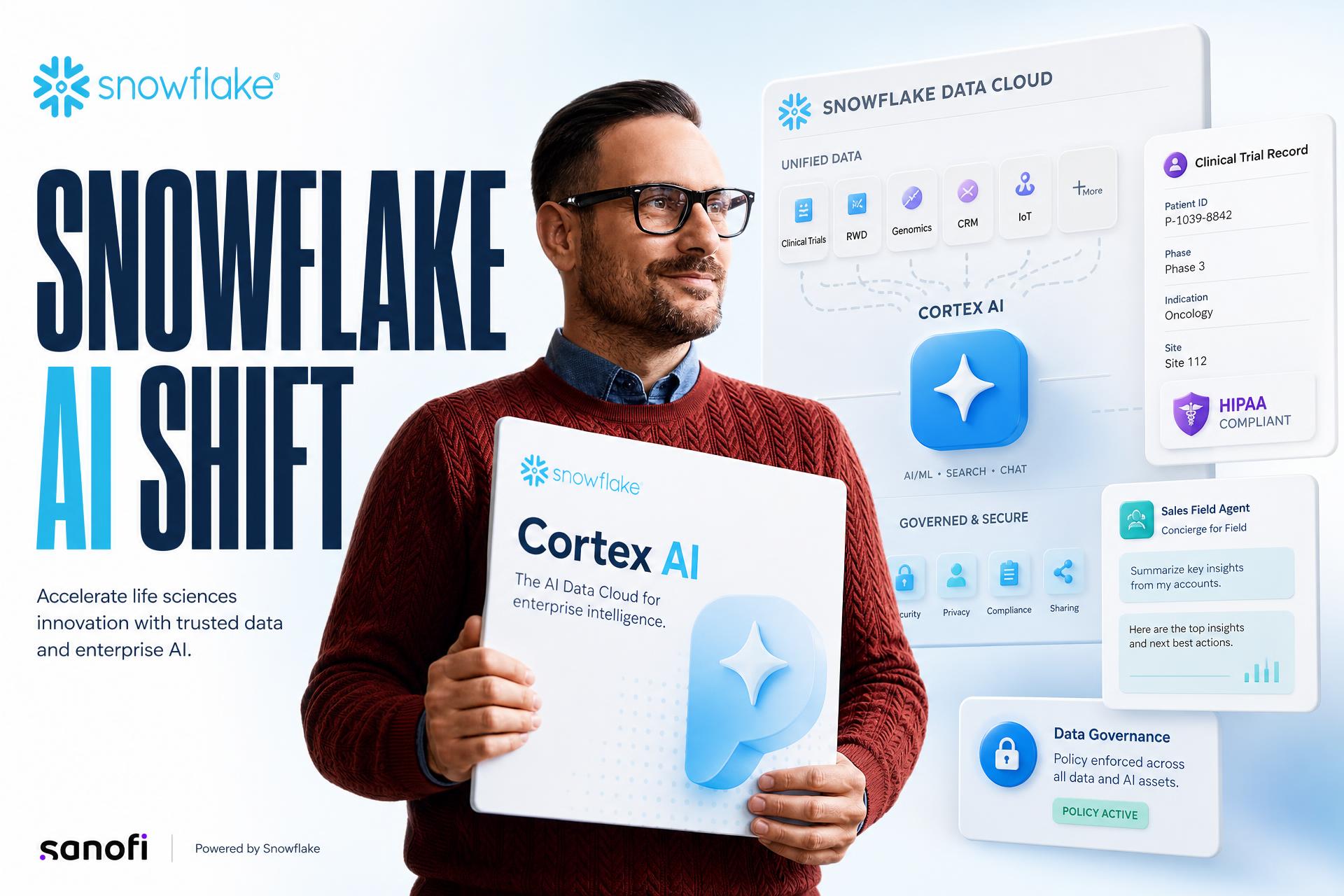
What is the core shift Sanofi announced at Snowflake Summit 26? → Sanofi is moving its entire AI program onto Snowflake’s AI Data Cloud, using Snowflake Cortex and Elementum to run agents directly on its unified data.
Why does this matter to a CTO in pharma today? → It forces a rethink of legacy‑heavy data pipelines and shows a path to enterprise‑wide AI at scale.
Which engineering decision does this article answer? → Whether to layer AI on existing siloed systems or to adopt an AI‑native platform that lives on a single data foundation.
What is the unique angle we will argue? → That the real bottleneck is not model choice but the data‑centric architecture; the correct response is to redesign the data stack around an AI‑ready cloud.
How will we help you evaluate this shift? → By walking through the technical trade‑offs, operational impacts, and concrete decision criteria for a quarterly rollout.
Quick Answer: Build AI on a Unified Data Cloud, Not on Top of Fragmented Legacy Systems
The most reliable way for a biopharma organization to achieve enterprise‑wide AI at scale is to migrate its data to an AI‑native cloud platform—such as Snowflake—and then develop agents that run directly on that governed data. Layering AI on top of legacy SaaS creates latency, cost, and lock‑in, whereas a unified data foundation eliminates data movement, enables consistent governance, and lets AI agents like Sanofi’s “Concierge for Field” deliver real‑time insights across R&D, manufacturing, and commercial functions.
Key principle: The performance and business impact of AI in biopharma are determined by where the model lives, not by how clever the model is.
The Architectural Leap Behind Sanofi’s AI Blueprint
Sanofi’s partnership with Snowflake and Elementum replaces a patchwork of dashboards and siloed pipelines with a single Snowflake data lake that stores raw clinical, manufacturing, and sales data. Snowflake Cortex AI and the CoWork personal agent sit on top of that lake, allowing engineers to author workflows that query, transform, and score data without ever extracting it to a separate application. This eliminates the “ETL‑to‑AI” friction that traditionally costs millions in development and operational overhead.
- Unified governance: A single set of policies enforces HIPAA‑level security across all datasets.
- Zero‑copy data access: Snowflake’s architecture lets AI agents read data in place, avoiding costly data replication.
- Scalable compute: Elastic warehouses spin up only when an agent runs, keeping compute spend proportional to usage.
- Integrated ML services: Cortex AI provides built‑in model hosting, versioning, and monitoring without external tooling.
- Rapid iteration: Elementum’s AI workflow builder lets data scientists prototype agents in hours instead of weeks.
How “Concierge for Field” Demonstrates the Power of Data‑Centric AI
The field‑sales agent illustrates the end‑to‑end value chain: a rep asks for a pre‑call plan, the agent instantly queries physician prescribing history, ranks the highest‑priority contacts, pulls prior engagement notes, and emails a ready‑to‑use plan. What previously required hours of manual research across multiple CRM and analytics tools now completes in seconds, proving that proximity of AI to the data source directly translates into productivity gains.
Why Legacy‑Heavy Architectures Fail at Scale
When AI is layered on top of fragmented SaaS, each integration point becomes a potential failure mode: data latency, schema drift, and compliance gaps multiply. Sanofi’s earlier environment produced “thousands of dashboards” but left most data untapped because the pipelines to move data into analytics tools were brittle and costly. By collapsing those pipelines into a single Snowflake instance, the organization removes the need for custom extract‑transform‑load jobs, reduces operational risk, and gains a single source of truth for every AI agent.
| Aspect | Legacy‑Heavy Stack | Snowflake‑Centric Stack |
|---|---|---|
| Data Movement | Multiple ETL jobs, batch latency hours | Zero‑copy, sub‑second access |
| Governance | Disparate policies per system | Unified, audit‑ready policies |
| Compute Cost | Over‑provisioned servers, idle capacity | Elastic warehouses, pay‑as‑you‑go |
| Integration Time | Weeks to months per new AI use case | Hours to days with Elementum |
The Trade‑Offs of a Unified AI‑Ready Platform
Adopting a single data cloud does not eliminate all complexity. Teams must invest in data modeling, schema standardization, and cross‑domain data ownership. The shift also requires cultural change: data engineers become custodians of a shared lake, and product owners must define clear data contracts. However, the upside—reduced latency, lower total cost of ownership, and the ability to spin up agents across R&D, procurement, HR, and sales—is compelling enough that the engineering effort pays off within a single fiscal quarter.
Non‑obvious insight: The hardest part of scaling AI is not training models; it is aligning data ownership and governance across business units.
Building an Enterprise‑Wide AI Roadmap on Snowflake
The first step is to inventory every data source that feeds AI use cases—clinical trial results, manufacturing batch records, sales CRM data, and HR talent metrics. Next, map these sources to a unified Snowflake schema, applying consistent naming and security tags. With that foundation, teams can use Elementum to author agents that call Snowflake’s SQL engine, invoke Cortex models, and return results directly to downstream applications. The roadmap should prioritize high‑impact, low‑effort pilots such as “Concierge for Field” before expanding to R&D hypothesis testing.
Catalog critical data assets – Identify the datasets that drive revenue, compliance, and scientific insight.
Define a unified schema – Consolidate overlapping tables, standardize data types, and enforce governance tags.
Migrate to Snowflake – Load raw files into Snowflake stages, then use Snowpipe for continuous ingestion.
Prototype agents with Elementum – Build a simple workflow that queries a single table and returns a JSON payload.
Scale and monitor – Deploy the agent to production, enable Cortex model versioning, and set up alerts for latency or data quality anomalies.
Why the Decision Belongs in the CTO’s Quarterly Planning
The CTO must decide whether the organization’s AI ambitions can survive on a patchwork of legacy tools or require a strategic data platform shift. The Sanofi case shows that the ROI of a unified AI‑ready cloud materializes quickly: sales reps gain actionable intelligence in seconds, R&D teams accelerate drug‑target validation, and manufacturing can predict batch yields with the same data foundation. Delaying this shift locks the company into costly integration projects that will never deliver the same speed.
Plavno’s Perspective on Data‑Centric AI Adoption
At Plavno we have helped multiple life‑science firms migrate legacy data warehouses to cloud platforms. We see the same pattern: organizations that invest early in a unified data lake and pair it with AI‑native tooling achieve faster time‑to‑value and lower operational risk. Our AI‑agents‑development service (AI agents development) can extend Snowflake’s Cortex capabilities, building custom agents for R&D hypothesis generation, procurement optimization, or compliance monitoring. Additionally, our AI voice assistant development and digital transformation services help organizations modernize end‑to‑end processes.
- Strategic advantage: Unified data enables cross‑functional insights that siloed systems cannot provide.
- Speed to market: Agents built on Snowflake can be deployed in days, not months.
- Cost predictability: Elastic compute means you only pay for the queries you run.
- Talent leverage: Data engineers focus on modeling, while domain experts author agents via low‑code workflows.
- Future‑proofing: The platform supports emerging models (e.g., foundation models) without re‑architecting pipelines.
Real‑World Applications Beyond Field Sales
The same architecture that powers “Concierge for Field” can be reused for clinical trial recruitment, where an AI agent matches patients to trial criteria in real time, or for manufacturing quality control, where an agent monitors sensor streams and predicts out‑of‑spec batches before they occur. Because all agents query the same Snowflake lake, knowledge learned in one domain can be transferred to another, accelerating innovation across the enterprise.
- Clinical trial matching – AI reads EHR data, filters by inclusion criteria, and notifies investigators instantly.
- Supply‑chain risk detection – Agent watches supplier performance tables and flags potential shortages.
- HR talent analytics – Agent correlates hiring data with project outcomes to recommend skill‑gap hiring.
- Regulatory reporting – Agent assembles required data fields for FDA submissions automatically.
- Product lifecycle management – Agent predicts product demand using sales and market data stored in Snowflake.
Engineering Considerations for Snowflake‑Based Agents
When designing agents on Snowflake, engineers must account for query latency, warehouse sizing, and model inference costs. Snowflake’s micro‑partitioning ensures that even large clinical datasets can be scanned efficiently, but poorly written SQL can still cause performance bottlenecks. Leveraging Snowflake’s result caching and clustering keys reduces repeat query cost. For model inference, Cortex AI offers on‑demand serving, but teams should batch predictions where possible to amortize compute.
Governance and Compliance in a Unified Data Lake
Biopharma data is subject to GDPR, HIPAA, and local regulations. Snowflake’s native role‑based access control (RBAC) and dynamic data masking let organizations enforce fine‑grained policies without building custom middleware. Every AI agent inherits these controls, ensuring that a sales‑oriented agent cannot inadvertently expose patient‑level data. Auditing is centralized, making it easier for compliance teams to generate reports for regulators.
Operationalizing AI Agents at Scale
Productionizing agents requires CI/CD pipelines that version both the SQL logic and the underlying models. Snowflake’s native support for Git integration enables automated deployment of stored procedures that encapsulate agent logic. Monitoring should include latency SLAs, error rates, and model drift metrics. Alerting can be configured via Snowflake’s alerting framework or integrated with external observability platforms.
| Factor | Impact on AI Agent Performance |
|---|---|
| Warehouse size | Directly influences query latency; choose smallest size that meets SLA. |
| Data clustering | Reduces scan range, especially for time‑series clinical data. |
| Model serving mode | On‑demand vs. batch; on‑demand offers instant answers but higher per‑call cost. |
| Caching strategy | Result cache can cut repeat query time by up to 90%. |
Business Impact: Quantifying the Value of Data‑Centric AI
Sanofi’s “Concierge for Field” cuts the manual research time for a sales rep from hours to seconds, translating into more calls per day and higher conversion rates. Early internal estimates suggest a 20 % uplift in call efficiency, which at Sanofi’s scale means millions of dollars in incremental revenue. R&D teams report faster hypothesis validation because real‑world evidence can be queried directly, shortening drug‑candidate selection cycles by weeks. Manufacturing sees reduced waste as predictive agents flag out‑of‑spec batches before they are produced.
- Revenue acceleration – Faster sales prep leads to higher win rates.
- R&D productivity – Direct data access shortens discovery timelines.
- Operational savings – Predictive maintenance reduces downtime.
- Compliance confidence – Unified governance eases audit preparation.
- Strategic agility – New AI agents can be spun up in days, keeping pace with market demands.
How to Evaluate This Strategy in Your Organization
Begin with a pilot that mirrors Sanofi’s field‑sales use case: select a high‑visibility business unit, map its data to Snowflake, and build a simple agent that returns a pre‑call plan. Measure key metrics—time‑to‑insight, user adoption, and cost per query. If the pilot achieves a measurable efficiency gain, expand the data model to include R&D datasets and repeat the same rapid‑prototype cycle. Use the numbered roadmap above to keep the rollout disciplined and aligned with quarterly objectives.
Bottom line: The decisive factor for AI success in biopharma is the proximity of the model to a trusted, unified data lake, not the sophistication of the model itself.
Closing Insight: The Future Is Agentic, Not Model‑Centric
Sanofi’s partnership with Snowflake shows that the next wave of AI in life sciences will be driven by agents that orchestrate data, models, and business logic on a single platform. Engineers who continue to treat AI as an add‑on to legacy systems will find themselves hamstrung by integration costs and compliance risk. The strategic move is clear: adopt an AI‑native data cloud, redesign your data architecture, and let agents do the heavy lifting.
 Chat GPT
 Perplexity
 Claude
 Gemini