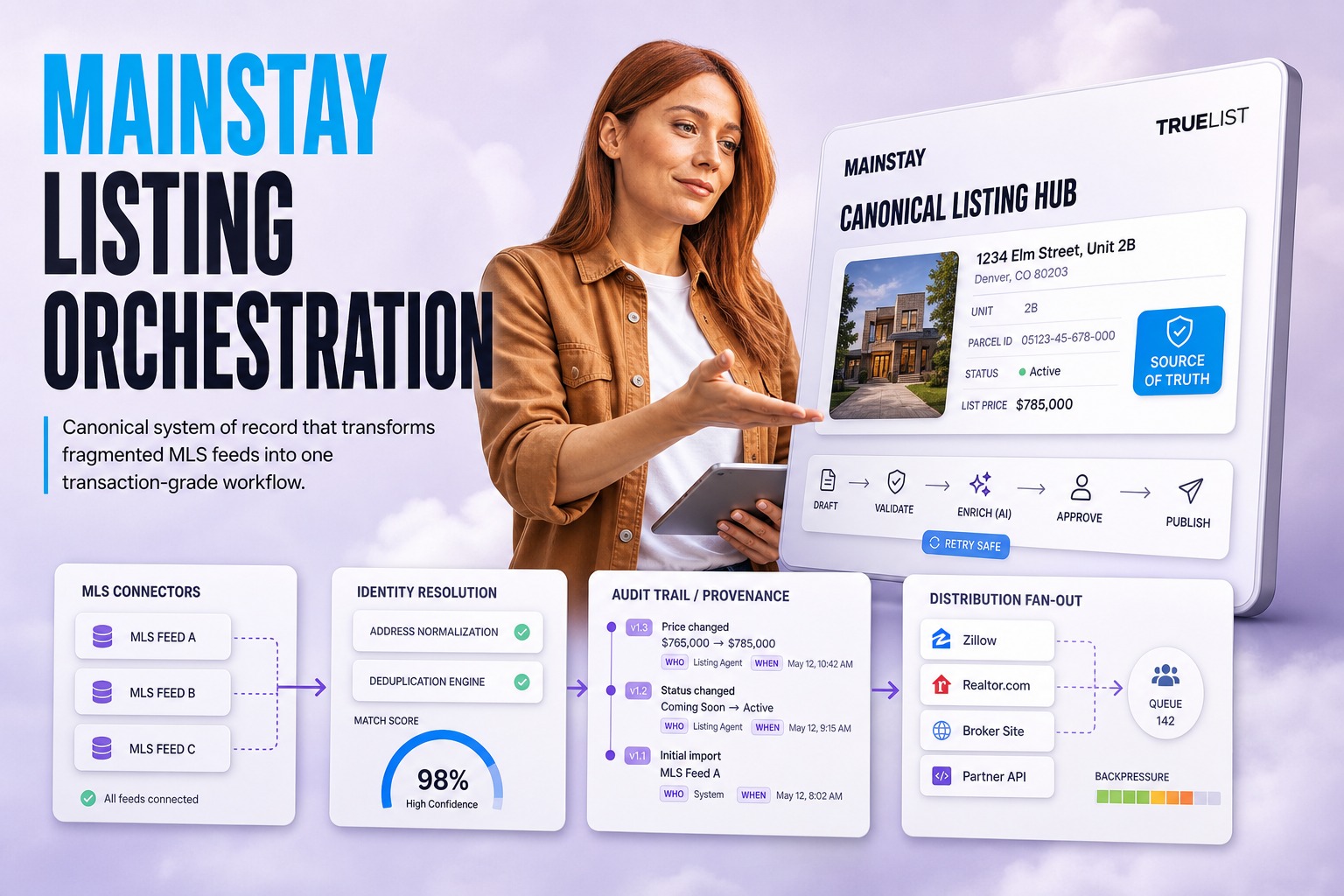
What is the dominant signal in this week’s real estate AI market? → Mainstay acquired Truelist alongside an $18M growth round, signaling consolidation toward AI that runs listings and transactions as a unified system, not a standalone content tool.
What is the primary search question engineers will be asked to answer this quarter? → How do we architect an AI-powered listing platform that works across fragmented MLS systems without turning our data pipeline into a permanent fire drill?
Why does this matter to CTOs beyond real estate tech companies? → The pattern is the same anywhere "records" and "workflows" are fragmented: AI only scales when you own a canonical data model, not when you optimize prompts.
What is our central claim at Plavno? → Listing AI breaks at the system-of-record boundary, not inside the model—so the correct response is to invest first in normalization, state, and governance, then add generation.
What should you walk away with? → A practical architecture lens, evaluation logic, and operational risks for deploying listing automation across multiple MLS feeds, broker tools, and investor-grade transaction systems.
Quick Answer: how do you build an AI-powered listing platform across multiple MLS systems?
You build it like a transaction system, not a writing assistant: a canonical property record, deterministic sync and identity rules, and workflow orchestration that can survive partial failures. The model can help create and enrich listing content, but the hard engineering work is reconciling conflicting MLS inputs, preserving provenance, and ensuring every downstream channel sees the same state. If you cannot do that, AI accelerates inconsistency.
If you want listing AI to scale, treat every MLS and portal as an external system with unreliable truth, and make your internal canonical record the only source of state.
The Truelist–Mainstay signal: AI is moving from listing content to operational control
Mainstay describes itself as an intelligent system of record that automates data and transactions across the residential real estate lifecycle, and it has said it facilitated more than $12 billion in real estate transactions while serving 95% of the 60 largest residential real estate investors. Truelist, founded in 2024, built an AI-powered listing platform to help brokers and agents manage, create, and distribute listings across fragmented MLS systems. Put together, the market signal is not that AI can write better listing descriptions; it is that the winning product is the one that can keep records consistent while automating the work around them.
For an engineering leader, that changes the decision you should make this quarter. Instead of asking which model provider produces the best prose, you should ask whether your architecture can reconcile MLS fragmentation, enforce data contracts across partners, and produce auditability when the same property flows through multiple tools. That is why consolidation matters: it pushes listing AI toward enterprise-grade reliability expectations.
If you cannot normalize listings, AI just amplifies MLS fragmentation
A listing platform that spans multiple MLS systems is fundamentally an integration and state-management problem. AI can generate titles, remarks, and feature highlights, but those outputs are only useful if you can anchor them to a stable property identity, a consistent attribute schema, and a versioned record of changes. In practice, your bottleneck becomes ingestion reliability, conflict resolution, and distribution guarantees to broker sites, portals, and downstream investor workflows.
- Canonical record first, channels second. A broker wants one authoritative property record that can be rendered into MLS-specific payloads, portal feeds, and internal CRM views without reinterpreting meaning every time.
- Identity resolution is the real ML problem. Matching an address, unit, and parcel across sources usually matters more than generating text, and it drives every downstream automation decision.
- Change detection beats full refresh. Without incremental updates via events, CDC, or diffing, you will either overload downstream APIs or ship stale listings when upstream sources lag.
- Distribution must be idempotent. When MLS or portal endpoints fail, retries must not duplicate media, pricing history, or status transitions; otherwise your platform becomes a reconciliation tool for humans.
Canonical property model is the product, not the prompt
When teams underestimate this, they build a "listing generator" that feels productive in demos but collapses in production under edge cases: condos with shared addresses, delayed status updates, conflicting square footage, or partial media sets. A canonical model is not just a database schema; it is the set of invariants your system promises to uphold across integrations. That implies strict ownership boundaries: ingestion services translate external fields into internal semantics, and only then does AI enrichment happen.
Define your internal semantics before mapping. Decide what "bedrooms," "living area," "status," and "days on market" mean inside your system, then map each MLS feed into those definitions instead of letting the external field names drive your product.
Implement entity identity as a service. Put address parsing, unit normalization, and dedup logic behind a dedicated API so every pipeline stage uses the same matching decisions rather than re-implementing them in multiple jobs.
Version the record, not just the content. Store revisions of the canonical property record so downstream consumers can reason about when a price or status changed, and so support teams can audit disputes.
Separate facts from generated fields. Keep MLS-sourced facts immutable and traceable, and store AI-generated text, tags, or summaries as derived fields with explicit provenance.
Design for "unknown" and "conflict" states. Your model must allow for missing values and disagreements between sources without forcing a brittle choice that later corrupts reporting and compliance.
Where the real failure modes live: sync, identity, and state
Once you operate across fragmented MLS systems, failure is normal: a feed lags, an API rate-limits, a broker edits a listing in a third-party tool, or two sources disagree about the same attribute. The production question is not whether failures happen, but whether your architecture contains them. A listing platform that cannot localize failures will leak inconsistency into every downstream experience, and AI content will be blamed for what is actually a sync and state design problem.
Designing the listing pipeline as a transaction-grade workflow
To make listing automation credible for institutional investors and brokerages, we model the pipeline as a workflow with explicit states, compensation paths, and audit trails. That typically means an orchestration layer (workflow engine or event-driven saga pattern), a canonical store (relational or document with strong consistency guarantees), and connector services that isolate MLS-specific integration quirks. AI then becomes an enrichment stage that can be turned off, rolled back, or re-run deterministically when upstream facts change.
At Plavno, we see teams succeed when they treat "create and distribute listings" as an operations problem that can be automated end-to-end, not as isolated UI features. This is where AI automation becomes the right framing: the goal is fewer manual reconciliations, fewer re-entries, and fewer inconsistent copies of the same listing scattered across tools.
- Ingestion layer with strict contracts. Separate connectors per MLS or feed type, each responsible for validation, mapping, and emitting normalized events, so a breaking change does not cascade into your core.
- Workflow state machine for listing lifecycle. Model statuses and transitions explicitly, so you can enforce rules like "no publish without required fields" and "no status regression without human review."
- Derived content service for AI outputs. Store generation results separately and regenerate on demand when upstream facts change, rather than mutating core facts.
- Distribution fan-out with backpressure. Use queues and per-destination workers so portal failures do not block MLS updates, and so retries are controlled and observable.
Why institutional investors care, and brokerages should copy them
Mainstay’s positioning around an intelligent system of record and its stated scale in transactions implies a reliability bar that is closer to fintech operations than marketing content. Institutional investors have low tolerance for silent drift in records because drift turns into operational cost, reporting disputes, and transaction friction. Brokerages may not use the same language, but the pain is identical: the moment listings are out of sync across MLS, portals, and internal tools, agents lose time and clients lose trust.
| Approach | What it optimizes for | What breaks first at MLS scale |
|---|---|---|
| AI listing writer layered on top of existing tools | Speed of content creation and short-term agent adoption | Conflicting records across systems; no audit trail for edits and republishing |
| System of record with AI as enrichment | Consistency, traceability, and automation across lifecycle | Higher upfront integration cost; requires governance and ownership boundaries |
| MLS-by-MLS custom workflows | Maximum control per market | Maintenance burden; brittle changes when feeds evolve |
| Hybrid: canonical core + configurable connectors | Balances reuse with local variation | Requires disciplined contract testing and connector ownership |
AI in the loop: generation, validation, and compliance gates
The most pragmatic place for AI in a listing platform is not as the source of truth, but as an assistant that proposes derived fields which are then validated against deterministic rules. That can include generating a description from canonical facts, tagging amenities for search, or drafting distribution-ready copy for multiple channels. The engineering requirement is that these outputs remain reversible and attributable: you should be able to answer whether a phrase came from MLS data, a human edit, or a generation pass.
Generate from canonical facts only. Ensure the AI sees the normalized record rather than raw MLS payloads, so you are not amplifying upstream inconsistencies.
Validate against business rules before publish. Apply deterministic checks such as required fields, forbidden terms, and broker-defined style rules, so AI cannot bypass compliance.
Route uncertain cases to human review. When the system detects conflicts or missing critical attributes, it should pause automation and request confirmation instead of guessing.
Publish with provenance metadata. Store who or what produced each derived field and when, so support and legal teams can trace issues without scraping logs.
Regenerate on upstream change events. When price, status, or key facts change, invalidate derived content and re-run generation so content stays consistent without manual rewrites.
Choosing your integration strategy: connectors, platforms, or controlled manual ingestion
The Truelist product direction highlights a reality most teams learn late: MLS fragmentation is not a one-time integration project; it is ongoing operations. You can build MLS-specific connectors, you can rely on external aggregation platforms, or you can constrain scope by ingesting data through controlled manual workflows. The right choice depends on your appetite for long-term connector maintenance versus vendor dependency, and on how much of the lifecycle you want to automate beyond listing creation.
Any integration strategy that cannot survive upstream schema drift and partial outages will force your agents back into spreadsheets, no matter how good the AI text looks.
Evaluating vendors after the Mainstay expansion: what to ask this quarter
Mainstay’s stated intent to expand beyond institutional investors into brokerages and agents will intensify vendor conversations for teams that need listing automation. The evaluation trap is focusing on AI demo quality rather than system-of-record capability. We advise CTOs to evaluate whether a vendor can coexist with your CRM, website, and internal workflows while keeping a single canonical record and a repeatable distribution process. If you want agent-like automation, you should still judge it like an enterprise system.
Teams that do not have strong internal platform engineering often benefit from a partner who has shipped production orchestration and integration-heavy systems, which is why we treat AI agents development as an architecture engagement first and a model choice second.
- Ask for the failure story, not the success story. A credible platform can explain how it handles broken MLS feeds, duplicate listings, and conflicting edits without corrupting state.
- Probe for canonical ownership boundaries. If the vendor cannot articulate what is source-of-truth versus derived, you will inherit ambiguity that becomes support debt.
- Demand operational observability. You need per-listing tracing across ingestion, normalization, enrichment, and distribution so support can fix issues without manual forensic work.
- Check reversibility and rollback. If AI outputs cannot be reverted cleanly, every mistake becomes a ticket and a brand risk.
The quiet cost center: data contracts and change management
Even strong platforms struggle when customers treat MLS mappings and field semantics as "set and forget." In reality, every connector is a living contract between your canonical model and an external system that can change. The operational implication is staffing and process: you need automated contract tests, staging environments for connector updates, and clear ownership for approving mapping changes. Without that, you will spend your quarter firefighting subtle data drift instead of building new automation.
Start from your lifecycle scope. If you only need listing creation and distribution, your connector surface is smaller; if you aim for transaction automation across the lifecycle, treat integration as a core product.
Choose your "truth tier." Decide whether MLS is authoritative for core facts, or whether your internal edits can override and then be synchronized back.
Define conflict resolution policy early. Pick rules for source precedence, timestamps, and human approvals, because you cannot retroactively fix inconsistent history.
Budget for connector operations. Plan for ongoing schema drift, rate limits, and partner coordination as a permanent engineering line item, not a launch task.
Measure success as fewer manual interventions. The best signal is not more generated text, but fewer cases where humans must reconcile two systems.
Security and governance: why system-of-record language raises the bar
The moment you position your platform as a system of record, you inherit expectations about access control, auditability, and incident response. Even if listings feel like public data, the workflows around them touch sensitive business operations: who can change price, who can publish, and who can represent the official status of a property. A multi-MLS listing platform should therefore be designed with least-privilege, strong authentication, immutable audit logs, and clear separation of duties between ingestion, enrichment, and publishing.
This is where teams often underestimate risk, and why we routinely pair listing automation programs with cybersecurity and penetration testing before scaling distribution to more markets and more endpoints.
Real deployments we see: agents, broker ops, and investor portfolios
In production, listing AI rarely ships as one monolith; it ships as a set of services aligned to who owns the workflow. Broker ops teams want validation, publishing control, and compliance guardrails. Agents want speed, suggested copy, and reduced re-entry. Institutional investors want consistency across large portfolios and automation across lifecycle steps. The architecture that works is one where these users share the same canonical record but operate through role-scoped workflows.
- Broker operations console plus workflow enforcement. A web app backed by a workflow engine lets ops teams approve exceptions, view per-listing traces, and manage distribution retries without engineering intervention.
- Agent-facing assistant tied to the canonical record. An assistant can propose edits and generate remarks, but it must write into a controlled draft state rather than directly mutating published facts.
- Portfolio-level automation for investor reporting. Investors typically need consistent snapshots and change history, which implies versioned records and reproducible transformations.
- Marketplace-ready syndication layer. Distribution to portals and downstream channels needs durable queues, rate limit handling, and idempotent publish semantics so failures do not create duplicates.
Risks you cannot A/B test away: provenance, liability, and reversibility
The biggest risk in AI-powered listing platforms is not that the model writes awkward copy; it is that the system cannot prove what it did when a dispute happens. If an agent claims the platform changed facts, or a portal shows inconsistent status, you need an audit trail that is understandable without reading raw logs. That is why we argue for derived-field separation, immutable revision history, and explicit publish states as non-negotiable engineering constraints.
If your team is stretched thin maintaining connectors and workflows, a staffing strategy that keeps long-term ownership while adding capacity can be the difference between controlled rollout and perpetual instability, which is why some clients use an outstaffing model for integration-heavy roadmaps.
Plavno’s position: ship the data backbone first, then the AI polish
We believe the Truelist–Mainstay move makes one engineering truth unavoidable: listing AI will be judged by operational consistency, not creativity. If we cannot keep a canonical property record correct across fragmented MLS systems, every downstream AI feature becomes a liability multiplier. The right sequencing is to build normalization, identity resolution, workflow state, and observability first, then add AI enrichment where it is reversible and measurable.
Author: Plavno team. Last updated: September 2026. If you are expanding into multi-MLS markets or evaluating a system-of-record vendor right now, we can run an architecture review focused on canonical modeling, connector strategy, and rollout risk. Bring your current data flows and failure cases, and we will map the shortest path to a resilient listing automation platform.
 Chat GPT
  Perplexity
  Claude
  Gemini
