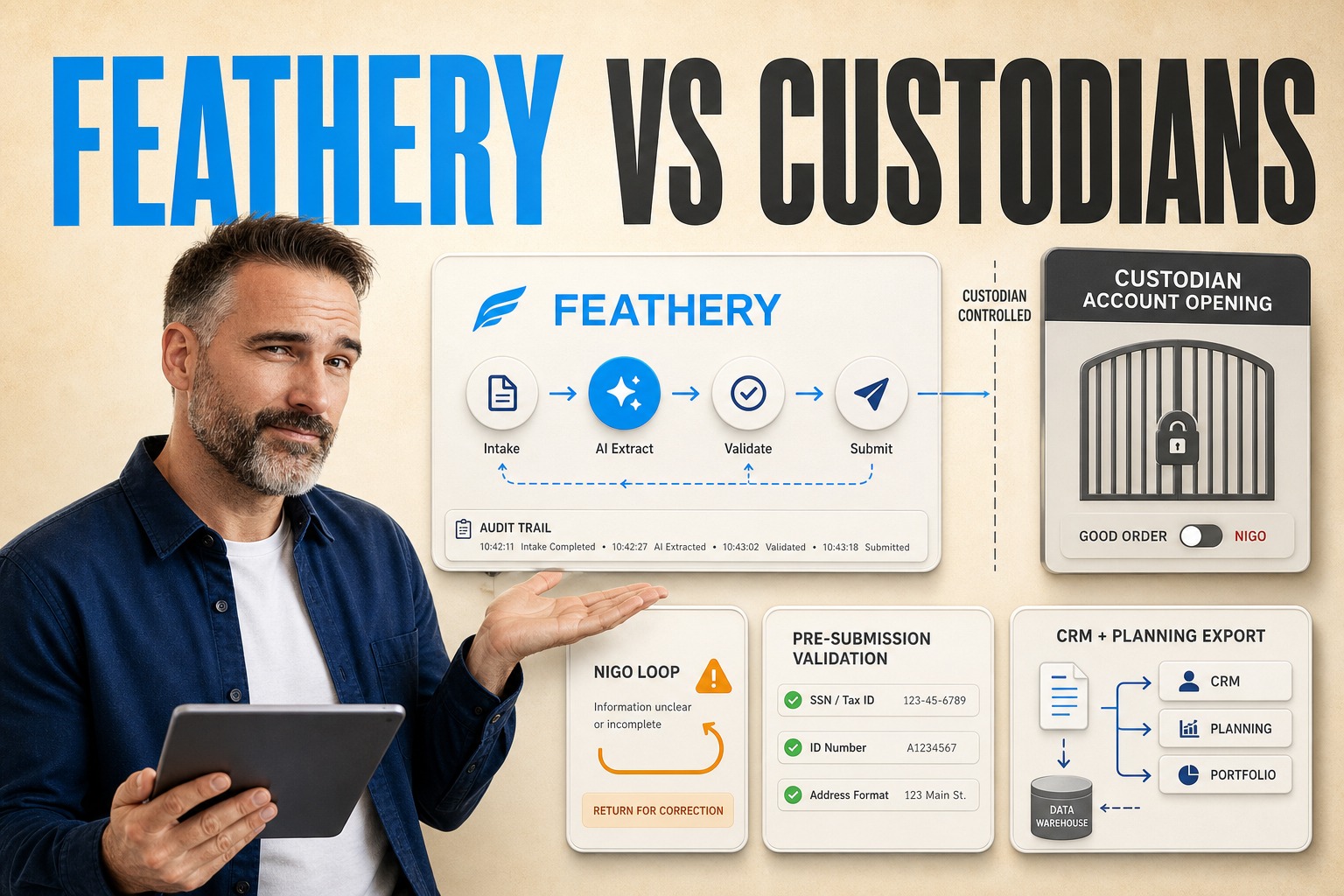
Is there a real market shift this week, or just another onboarding tool? → Feathery raising a $30 million Series A is a signal that vendors believe AI-assisted workflow and data capture around custodial account opening can become a platform, not a feature.
What’s the business/technical question CTOs at RIAs actually need answered? → Whether to buy a standalone AI onboarding/workflow product or keep demanding custodians deliver a better, included experience.
Why does this matter right now if most custodians are “paperless” already? → Paperless is not the same as automated; manual entry and weak field validation still create NIGOs and cycle time drag, which scales painfully as teams grow.
What’s our non-obvious angle at Plavno? → The failure mode isn’t “forms.” It’s the custodian-controlled process boundary plus the firm’s missing workflow and data layer; AI only helps if it changes those two constraints.
What decision can you make this quarter from this article? → You can decide if your firm is large enough—and integrated enough—to justify a standalone onboarding layer, and what architecture and governance you must require for it to pay off.
Quick Answer: when buying AI onboarding software makes sense for an RIA
Feathery’s funding round is a reminder that “account opening” is increasingly being sold as an automation layer: API-connected custodian workflows wrapped with AI-assisted workflow building, data gathering, and document extraction. The primary decision for RIAs isn’t whether that sounds modern—it’s whether you can convert it into standardization and operational control that your custodian will not (or cannot) deliver on your timeline.
At Plavno, we’d buy a standalone tool only when it can become your consistent workflow and data-capture surface across custodians and downstream systems (CRM, portfolio management, planning tools, and ideally a proprietary data warehouse), and when you can use it to reduce NIGO-causing gaps in validation and handoffs. If your operating model is still primarily “custodian-native onboarding plus manual coordination,” then AI features will feel like polish on a process you don’t own—and you’ll keep resenting the subscription.
If a vendor cannot make your onboarding process more deterministic than your custodian’s native flow, AI will mostly speed up the wrong work.
The real signal in Feathery’s $30M round: vendors are betting the onboarding layer becomes yours, not the custodian’s
Feathery completing a $30 million Series A led by Portage Ventures is not important because it proves AI is “coming to onboarding.” That’s already obvious. It matters because the bet is that advisory firms—especially larger ones—will pay to regain control over a workflow that custodians historically dictated end-to-end: what forms are required, which fields are mandatory, when something is “In Good Order,” and how many verification layers exist.
Our central claim is simple and arguable: AI-powered onboarding tools do not win by being better form-fillers; they win only when they let an RIA standardize and own its workflow and data layer across custodian boundaries—and the right response is to evaluate them like an integration and governance platform, not a point solution. A reasonable CTO could disagree and say custodian-native onboarding will catch up and make standalone tools unnecessary. That’s exactly the decision tension this quarter.
“Paperless” still produces NIGOs because the weakest link is validation across systems, not signatures
Even after most custodians moved away from wet signatures, the operational friction didn’t disappear—it shifted. The input makes the practical issue explicit: manual data entry and insufficient field validation still create NIGOs and slow the process. That’s not surprising in production terms. Account opening spans multiple systems: the advisor’s CRM, the client-facing data capture surface, the custodian’s digital account opening interface, and the firm’s downstream planning and portfolio stack. Each boundary is a chance for missing fields, mismatched formats, or compliance-driven rework.
This is why earlier generations of onboarding tools struggled with adoption in the independent RIA market despite solving a real pain. Advisors felt they were paying for a patch over a custodian problem. That sentiment doesn’t go away just because the patch now includes AI document extraction or an AI workflow builder. The economic question is whether a tool can reduce the total coordination cost enough that it stops feeling like “separately paying for what the custodian should fix.”
- Custodian-defined “good order” rules → Your team can’t fully control acceptance criteria when the custodian is the final arbiter of NIGO.
- Manual re-keying between systems → Even when a form is digital, humans often bridge gaps between CRM records, onboarding data, and custodian fields.
- Weak field validation at the edges → If validation doesn’t happen before submission, errors surface late, when fixes are slowest.
- Multiple verification layers → Each layer adds handoffs that are hard to standardize without a shared workflow model.
Where AI helps—and where it predictably doesn’t
AI document extraction can reduce effort when clients submit statements, IDs, or other paperwork that has to be mirrored into structured fields. An AI-powered workflow builder can also lower the barrier to documenting workflows that teams rely on but never formalized. But AI doesn’t change the hard boundary: the custodian still dictates the final workflow constraints and acceptance rules, and the tool still has to reconcile data into whatever the custodian requires.
The only sustainable value prop: workflow standardization plus a data layer that survives custodian changes
Feathery’s core positioning, as described, wraps custodial account opening via API connection with surrounding capabilities: an AI-powered workflow builder, a form builder for client data gathering, and AI document extraction that exports data into the advisor’s CRM, portfolio management, and planning tools, while also populating account opening and transfer paperwork with the custodian. Put differently, the vendor is attempting to become the orchestrator that sits above custodians and below your internal systems.
This is the crux: if the product is just a nicer way to push data into the custodian’s interface, the custodian eventually wins. But if it becomes your firm’s canonical workflow and data-capture surface—where you define what “ready for submission” means before the custodian ever sees it—then you’ve changed the engineering locus of control. That is why enterprise RIAs, which care about central coordination and increasingly want to own more of their data layer, are the plausible wedge: larger teams and a desire to integrate into a proprietary warehouse turn onboarding into infrastructure, not admin.
At Plavno, we would frame this as a platform decision and bring in the same diligence we’d use for any workflow engine: how brittle are the integrations, how portable is the data model, and how enforceable are validations before you hit external APIs. If your implementation cannot make failures observable and recoverable at the workflow layer, your AI enhancements will be indistinguishable from UI enhancements once volume rises.
| Approach | What you really get | What breaks first in production |
|---|---|---|
| Custodian-native digital account opening | “Included” workflow controlled by custodian | You inherit custodian UX, validation gaps, and limited customization; errors show up late as NIGOs |
| Standalone onboarding/workflow tool connected via API | A consistent front door plus orchestration around custodian steps | Integration drift and unclear ownership when custodian rules change; value evaporates if workflows aren’t standardized |
| Enterprise-built internal onboarding layer | Maximum control over workflow, data, and reporting | Highest build/maintain burden; still constrained by custodian acceptance rules and API limitations |
Treat “AI onboarding” as workflow orchestration plus data governance. If you can’t govern, you can’t automate.
API connectivity is not the moat; operational governance is
The input is clear that custodians decide which tools can access their flows and what the process looks like, even when APIs exist. That reality means API access alone is not defensible differentiation. The defensible layer is operational: how you model steps, manage exceptions, track NIGO root causes, and keep your CRM and downstream systems consistent when external requirements shift.
- Workflow ownership → The tool must make it obvious who owns each step: client, advisor, paraplanner, operations, or custodian.
- Exception handling → You need a designed path for “not in good order” events instead of ad-hoc email and manual re-entry.
- Data lineage to your systems → Exports into CRM, portfolio management, and planning tools must preserve meaning, not just fields.
- Change management → When custodian forms or required fields change, you need versioning and controlled rollout, not surprises.
How to decide “buy vs. wait vs. build” without turning it into a religious argument
The tension in the input is real: independent RIAs often expect custodians to improve onboarding directly, and some custodians can provide onboarding for free. That makes any standalone tool face a brutal bar: it must produce operational leverage that is visible to the firm, not just convenience that feels like subsidizing a custodian’s shortcomings.
We typically advise leadership teams to make the decision based on whether onboarding is already a cross-team bottleneck that threatens scale. Smaller firms can often live with localized friction because customization drives growth. Larger firms accumulate non-revenue roles and coordination cost; at that point, onboarding is no longer “an admin flow,” it’s a throughput constraint. If you’re operating at that scale—or heading there—then paying for a workflow layer can be rational, but only if you commit to standardizing the process it will encode. If you want help structuring that decision with technical and operating model alignment, this is exactly what AI consulting should look like in practice: architecture plus governance, not demos.
Define what “done” means before custodian submission, including which fields and documents are mandatory for your firm.
Map which systems are authoritative for each data element (CRM vs onboarding form vs custodian records).
Identify where NIGOs originate: missing fields, mismatched formats, or verification handoffs.
Decide whether standardization is politically possible; if not, buying automation will amplify inconsistency.
Evaluate vendors or internal build options based on how they handle exceptions, changes, and exports—not their UI.
Buying an onboarding tool without standardizing onboarding is like installing observability without agreeing what “healthy” means.
The architecture you actually need: one client data model feeding CRM, planning, portfolio, and custodial paperwork
Feathery’s described feature set—form builder, AI document extraction, and exports into CRM, portfolio management, and planning tools—points at the right architectural target: onboarding is where you first create or reconcile the client’s canonical dataset. If your firm lets each downstream system evolve its own “truth,” you will re-pay the reconciliation tax every time a client changes an address, updates beneficiaries, or moves assets.
In a well-run onboarding architecture, the onboarding tool is not just a UI. It is a data capture and validation layer that produces structured outputs suitable for your internal systems and for custodian submissions. Enterprise RIAs may extend this into their own proprietary data warehouse; the input explicitly notes that larger firms may want an onboarding tool that integrates to custodians and their own warehouse. That’s a meaningful boundary: once the warehouse becomes the audit and reporting backbone, onboarding becomes the upstream contract you must enforce. Implementing that layer reliably is not “just forms,” it’s an integration program—often the domain of cloud software development and platform engineering practices applied to advisory operations.
- Canonical onboarding dataset → A single representation of client identity, household structure, and account metadata that downstream systems consume.
- Pre-submission validation rules → Firm-defined checks that catch missing or inconsistent data before custodian submission.
- Deterministic exports → Controlled mappings into CRM, portfolio management, and planning tools to avoid silent divergence.
- Auditability → A way to answer “who changed what, when, and why,” especially when multiple teams touch the same client.
Document extraction pipelines fail on ambiguity, not accuracy
AI document extraction is powerful when the document-to-field mapping is stable. In onboarding, ambiguity is common: the same field can appear in different layouts, clients supply partial documents, and firms interpret edge cases differently. The engineering response is to treat extraction as a suggestion feeding a human-verifiable workflow step, with explicit confidence thresholds and clear accountability for overrides, rather than an invisible automation.
Security and compliance aren’t side quests when onboarding becomes an integration hub
When onboarding tools sit between clients, custodians, and your internal systems, they become a high-value conduit for sensitive data. The input doesn’t enumerate specific controls, so we won’t pretend there’s a one-size checklist. But we can state the operational truth: as soon as an onboarding tool exports data into CRM, portfolio management, and planning tools, your threat model expands from “secure one system” to “secure the transfer and the workflow.”
In practice, this is where many automation initiatives get delayed or quietly watered down. Teams want speed, but compliance wants traceability, least privilege, and clarity about where data lives and who can access it. The more your onboarding tool can act as a centralized workflow manager, the more you must treat it like a regulated system component: identity controls for staff roles, clear segregation of duties, and predictable logging around submissions and corrections. If you’re formalizing that posture, it should be paired with cybersecurity and penetration testing so your onboarding perimeter matches the business criticality you’re assigning to it.
- Expanded blast radius → One workflow layer may connect to multiple downstream systems, so a single misconfiguration can propagate.
- Role complexity → As firms scale, more non-revenue roles touch onboarding, increasing the need for precise access boundaries.
- Audit pressure → NIGO fixes and corrections create a trail; if you can’t produce it, automation becomes a liability.
- Vendor dependency risk → Your operational uptime now depends on a third party plus custodian API availability and behavior.
Making an AI workflow builder safe: you’re buying change velocity, so you need guardrails
An AI-powered workflow builder, as described, targets a genuine scaling pain: many advisory teams rely on workflows but haven’t documented them or struggle to encode them into software. The upside is faster formalization. The downside is that you can create “workflow sprawl” even faster—many slightly different flows that encode tribal knowledge and make standardization harder, not easier.
The right way to adopt an AI-assisted workflow layer is to treat it like a product: define a small set of firm-approved workflows, run them through real operational scenarios, and then expand. You are not buying the ability to create workflows; you are buying the ability to maintain them as your custodians, forms, and team structure evolve. That’s why we connect this decision to automation engineering rather than tooling preferences. When you want workflows to trigger tasks, collect data, route exceptions, and keep systems in sync, you’re effectively building operations software—which is the domain of AI automation when done responsibly.
- Workflow versioning discipline → Without it, fixes become new variants, and variants become the new normal.
- Exception-first design → NIGO handling and rework paths should be modeled explicitly, not left to “ask ops.”
- Data contract enforcement → Each workflow step should have clear inputs/outputs so exports remain deterministic.
- Operational observability → You need to see where time is spent: client waiting, internal review, custodian verification, or correction loops.
Where tools like Feathery can be a win: enterprise RIAs, legacy channels, and firms building their own data layer
The input makes an important segmentation point: Feathery’s innovation may land differently in broker-dealer and insurance channels that remain more paper-driven, and there may be select opportunities in the enterprise RIA market where scale makes centralized workflow management worth paying for. That is consistent with what we see across industries: when coordination cost is the dominant cost, workflow platforms become strategic.
For enterprise RIAs, the “own more of your own data layer” thread is the most actionable. If your operating model includes a proprietary data warehouse and you want onboarding to feed it reliably, then a vendor that can export structured data into your stack and populate custodian paperwork via API has a plausible platform role. The key is to commit to standardization so the tool becomes the consistent “front door” rather than a parallel channel that teams bypass under pressure.
Independent RIAs should be more skeptical by default, for the reason the input highlights: if custodians can provide onboarding for free, the standalone tool must justify itself with measurable reductions in rework and coordination. The value is not “AI”; the value is owning and enforcing a workflow and data contract that you can’t get from the custodian on the timeline your growth demands.
- Enterprise RIA central ops → Large teams benefit from one place to manage workflows and reduce coordination overhead.
- Firms building proprietary warehousing → Onboarding becomes the upstream system of record feeding the warehouse.
- Broker-dealer and insurance modernization → A more paper-oriented baseline increases the immediate payoff of digitized intake and workflow.
- RIA consolidators and multi-brand models → A shared onboarding layer can standardize across firms even when custodians differ.
If onboarding is the first step of your data supply chain, then an onboarding platform is upstream infrastructure—not a productivity app.
Closing insight: don’t buy “AI onboarding” unless you’re ready to own the process it automates
Custodians still control the core account opening process, and that’s why the independent RIA market has historically resisted paying for standalone tools that feel like patches. Feathery’s positioning—AI-assisted workflow building plus data capture and document extraction around API-connected account opening—can be rational, but only for firms that will use it to standardize operations and establish a durable data layer across CRM, portfolio management, and planning systems.
Author: Plavno team
Last updated: August 2026
 Chat GPT
  Perplexity
  Claude
  Gemini
