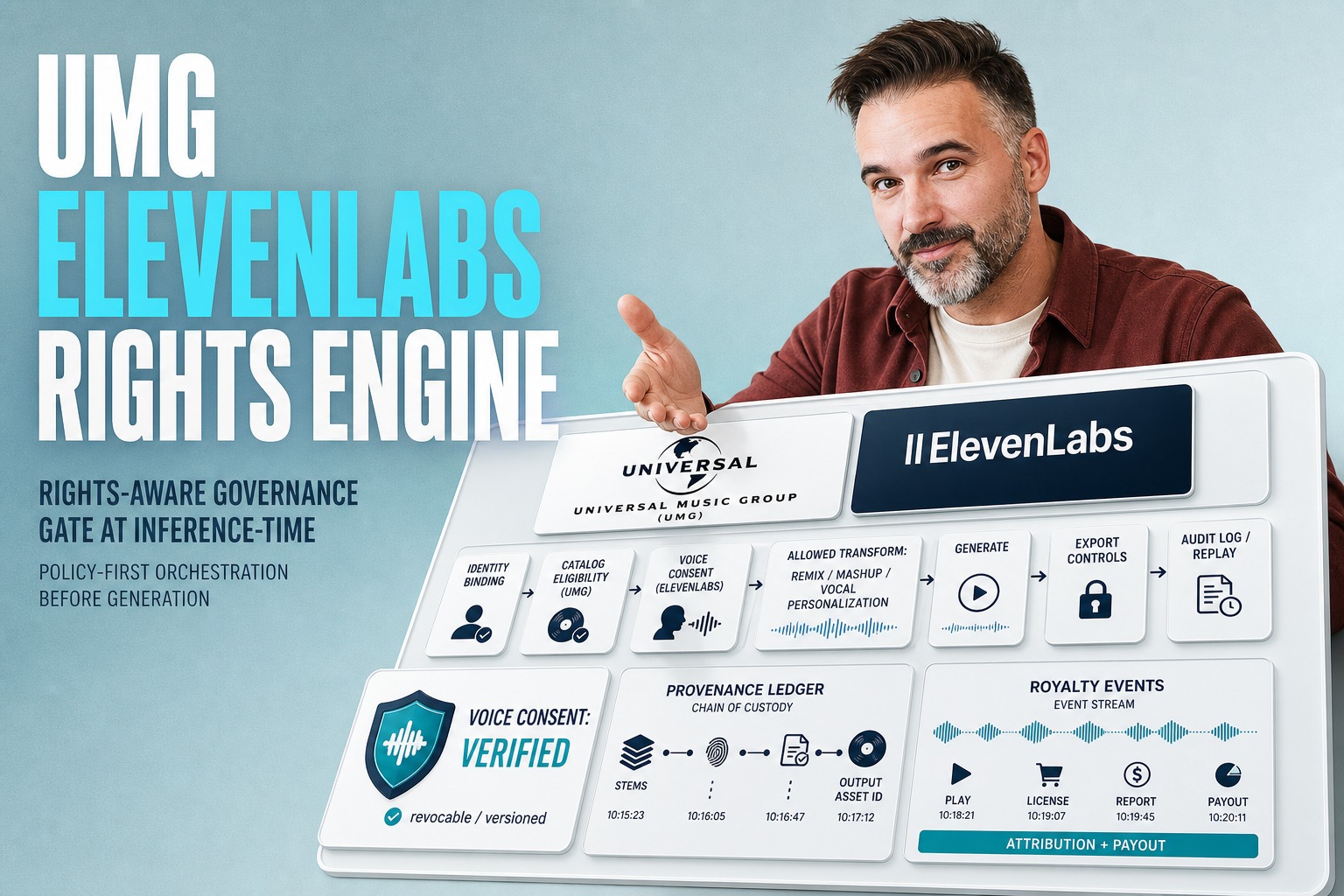
What changed this week that should move an engineering roadmap? → Universal Music Group signed a multi-year licensing deal with ElevenLabs, and they are building an AI-powered fan co-creation platform plus AI audio products for artists.
What is the primary search question behind this news? → How do we build an AI music co-creation platform with major-label licensing without triggering copyright, voice-consent, and biometric-privacy failures?
Why does it matter this quarter for a CTO? → A major label is now willing to license and productize AI music experiences, which shifts the competitive advantage from model quality to compliance-by-design and deployable rights controls.
Where do production deployments actually break? → Not in generation quality, but at the rights, consent, and identity boundaries between prompts, stems, voices, and distribution.
What is the angle we will defend? → If you do not treat rights management as a first-class runtime system (not a legal afterthought), your AI music features will be unshippable at scale.
UMG licensing ElevenLabs is the moment AI music stops being a model demo
Universal Music Group’s multi-year licensing agreement with ElevenLabs, plus a separate fan platform under development for remixes, mashups, new interpretations, and personalized vocal experiences, is the clearest signal that the market is moving from experimental generation to rights-managed product surfaces. For engineering leaders, the decision is no longer which music model sounds best; it is whether we can operate co-creation safely when a major rights holder is in the loop.
Central claim: major-label AI music products fail at the rights and identity layer, not the model layer, so the correct response is to architect policy enforcement, consent, and auditability as runtime primitives before you scale generation.
Quick Answer: how do we build an AI music co-creation platform with major-label licensing?
Build the platform as a rights-aware orchestration system where generation is downstream of policy. We only let a request reach voice or music models after we resolve who is asking, which catalog is eligible, what transformations are permitted (remix, mashup, interpretation, vocal personalization), and how compensation and attribution will be recorded. If you cannot prove consent and provenance in your logs, your feature is a liability, even if the output sounds great.
The real product is the gate between fans and catalogs, not the generator
The UMG x ElevenLabs platform is explicitly about fan co-creation with participating artists and songwriters, which means your system must decide eligibility at request time, not after content is produced. In practice, that looks less like a single model endpoint and more like an agent-style workflow that checks rights, tracks transformations, and routes requests to approved tools. At Plavno, when we build AI agents development, we treat these gates as core business logic, because the model is the easiest part to swap.
- Catalog eligibility must be computed, not assumed: the system needs a runtime decision on whether a given artist, song, or vocal is available for a given transformation and region before any generation happens.
- Transform permissions are part of the API contract: remix versus mashup versus vocal personalization should map to explicit, enforceable capabilities rather than free-form prompts.
- Provenance has to survive distribution: you need a durable link from a fan output back to the participating artist and the permitted workflow, otherwise downstream monetization and moderation become guesswork.
- Identity is a production dependency: if the platform supports personalized vocal experiences, your auth and consent model must be as robust as payments or you will recreate the same disputes seen in voice cloning.
Why this deal changes the training-data debate into an inference-governance debate
A licensing partnership with a major music company does not automatically mean your training data is clean; it means your product must behave cleanly. That is why the timing matters: Suno just launched its v6 models and publicly clarified its training data does not include recordings from UMG or Sony Music Entertainment, while UMG and Sony remain plaintiffs in the RIAA-coordinated lawsuit against Suno filed in Boston in June 2024. The market is converging on a new reality: training data arguments will continue, but revenue-grade products will be won or lost on inference-time governance.
When your platform offers remixes, mashups, and personalized vocal experiences, the operational question is what you can prove about permissions and compensation after the output exists. That pushes engineering toward request classification, policy evaluation, and auditable transformations, because those are the surfaces a partner like UMG will ultimately care about when the platform scales.
| Where risk concentrates | What the platform must decide | What engineering artifact proves it |
|---|---|---|
| Training data provenance (industry disputes are active) | What data was used for what model and whether it is permitted | Dataset registry and model lineage records tied to releases |
| Inference-time transformation | Whether remix, mashup, or reinterpretation is allowed for a specific catalog item | Policy decision logs linked to the generated asset |
| Voice and likeness usage | Whether a voice is licensed or consented for this request | Consent record plus identity binding to the requesting user |
| Distribution and fan sharing | Whether output may be exported, monetized, or re-uploaded | Distribution policy enforcement and audit trails |
Consent-based voice licensing is now the baseline expectation
ElevenLabs has already leaned into consent-based voice licensing with named talent and an approval flow in its marketplace, while also facing litigation claims about unauthorized voice use and biometric voiceprints. For a CTO, this means any AI music platform that touches vocals should assume that the consent model will be interrogated like security, not treated as an onboarding checkbox. If your fan feature includes vocal personalization, it is effectively a voice product with music attached.
If a user can produce a vocal that sounds like a person, your system must be able to answer one question instantly: who authorized this voice for this use, right now.
The architecture pattern we recommend: policy-first orchestration, model-second execution
In the UMG x ElevenLabs framing, the platform exists to let fans co-create with participating artists and songwriters while ensuring fair compensation. That is not a single endpoint; it is orchestration. We typically build this as a workflow where identity, policy evaluation, and asset lineage happen before any call to music generation or voice models. The goal is to make the system safe by construction, so your product team cannot accidentally ship an unlicensed path.
This is also where automation matters: the platform will accumulate edge cases across artists, catalogs, and regions, and manual review does not scale. At Plavno, we apply AI automation patterns to convert legal and rights rules into executable policies with clear ownership, observable decision logs, and deterministic fallbacks when rules are ambiguous.
- A policy decision point in front of generation: a service that returns allowed transformations for a given user, catalog item, and context, and blocks everything else by default.
- An identity binding that survives sessions: user accounts, device trust, and session metadata need to be attached to every generated asset to support audits and takedowns.
- A provenance ledger for transformations: each output should carry a chain of custody from source material through each allowed operation, even when users iterate.
- A compensation and attribution event stream: if fair compensation is a contractual requirement, your system needs durable events that can be reconciled with downstream payouts.
- A separate moderation and export layer: distribution rules should be enforced independently from generation so that share and monetize paths can be changed without touching models.
Where AI music platforms actually break: the boundary between tools, users, and distribution
ElevenLabs is simultaneously an infrastructure provider (voice and audio models, conversational agents) and a creator tool vendor (ElevenMusic) while the UMG-affiliated fan platform will run separately. That separation is a hint: the riskiest failures often happen when a platform mixes tool semantics (generate, edit) with marketplace semantics (share, monetize) without strong boundaries. The result is not just a legal issue; it is an engineering issue of unclear contracts between subsystems.
- Prompt-to-permission mismatch: a user request implies a transformation your UI allows, but your policy does not explicitly authorize.
- Asset mixing without lineage: mashups combine multiple sources and the system cannot reconstruct which inputs were used after export.
- Voice identity drift: a vocal personalization feature evolves, but older assets cannot be tied back to the consent state that existed at creation time.
- Distribution leakage: content created for in-platform engagement is trivially downloadable and reposted, bypassing your intended controls.
- Vendor boundary ambiguity: when using third-party APIs, your platform cannot explain which party enforced which policy for a disputed output.
Auditability is not paperwork; it is the only scalable rollback mechanism
When a dispute emerges, you rarely need the exact model weights; you need to answer which user generated what, using which permitted catalog and voice, under which rules, and where it was distributed. Without that, your only option is blunt takedowns that damage user trust and partner relationships. An audit trail also helps you change policies safely over time, because you can re-evaluate past outputs against new rules and decide what to grandfather.
If you cannot replay a decision path from request to output to distribution, you do not have governance; you have hope.
The privacy and security pressure is coming from voice, not just music copyright
The input story includes live and settled claims around voice use and biometric voiceprints, plus a consent-based model with approvals for celebrity voices. That mix is the risk profile for any platform that offers personalized vocal experiences: it pulls you into identity, privacy, and security obligations that look more like fintech or healthcare than like a creator app. In the enterprise world, this is why ElevenLabs’ voice agents are used by organizations as diverse as Deutsche Telekom, Revolut, and the Ukrainian Government.
For engineers, the uncomfortable truth is that voice consent is a security boundary. The same platform that supports remixing a track may also need protections against impersonation, unauthorized voice extraction, and account takeover that leads to abusive generation. This is where we often recommend independent threat modeling and validation through cybersecurity and penetration testing before you scale features to mass audiences.
Define the rights objects your system must reason about, including catalog items, participating artists, and the specific transformations you will ship first (remix, mashup, interpretation, vocal personalization).
Decide which user identities can invoke which rights, and require that every generation request resolves to a stable user identity and a stable policy context.
Implement a policy decision point that returns an allow or deny plus a reason, and make generation dependent on that result so policy cannot be bypassed by UI paths.
Emit provenance and compensation events for every output, so you can reconcile fair compensation obligations without retrofitting your pipeline later.
Separate distribution controls from generation controls, so you can tighten sharing, monetization, or export rules quickly if a partner changes requirements.
What to demand from vendors when licensing meets infrastructure
ElevenLabs is a high-scale audio company by any reasonable reading of the input: it reported crossing $500 million in annual recurring revenue (up from $350 million at the end of 2025), has around 450 employees per Forbes, and says employees at two-thirds of Fortune 500 companies use its products across voice, audio models, creative tools, and conversational agents in more than 70 languages. Those facts matter because they imply mature infrastructure, but they do not automatically solve your product’s rights governance. Your contracts and your architecture must still define who enforces what.
| Vendor question that matters | What we verify technically | What we keep as evidence |
|---|---|---|
| Who enforces rights at runtime, us or the provider? | Where policy decisions occur in the request path | Decision logs and system diagrams tied to release versions |
| How is consent for voices represented and revoked? | Whether consent state is queryable and versioned | Consent records linked to asset lineage |
| Can we isolate fan products from internal creator tools? | Whether environments, keys, and data stores are separated | Environment separation documentation and access reviews |
| How do we respond to disputes and takedowns? | Whether assets are traceable and removable across storage and CDN | Takedown runbooks and audit exports |
Choosing between Music API, ElevenMusic, and a separate rights-managed fan platform
The input is explicit that ElevenLabs already offers Music API for businesses and developers and ElevenMusic for generating and editing original songs, while the UMG-affiliated platform will run separately. That separation is a useful design hint: you should not assume one product surface can safely serve creators, enterprises, and fans under the same rules. Even if the same underlying models are used, the governance and distribution semantics differ enough that separation often reduces blast radius.
- If your users are developers or internal teams: an API product like Music API can fit, but only if you can enforce rights and auditing in your own stack.
- If your users are creators editing originals: a tool surface like ElevenMusic aligns, but you still need provenance and export controls if outputs mix licensed elements.
- If your users are fans co-creating with known artists: a separate platform is usually justified because identity, consent, and monetization rules become product-defining.
- If a major rights holder is involved: assume additional review workflows and reporting needs, and design the event pipeline accordingly.
- If you expect dispute volume: optimize for traceability and takedown speed, not just generation latency.
When Music API is the right starting point (and when it is a trap)
If you are building B2B features inside an existing product, an API integration can be the fastest path because it lets you control identity, policy, and distribution without inheriting a consumer platform’s assumptions. It becomes a trap when teams treat the API call as the product and forget that licensing obligations live in the orchestration layer. If you cannot answer rights questions without calling the model, you have already lost control.
When a separate fan platform is mandatory, even if it feels expensive
A fan platform that enables co-creation with participating artists implies a marketplace dynamic: fans share, remix, and expect persistence, while rights holders expect reporting and control. Mixing that with internal creator tooling typically produces inconsistent rules and data sprawl. A separate platform boundary gives you cleaner policy enforcement, clearer consent state, and a safer path to expand into new fan experiences over months and years, as the UMG and ElevenLabs announcement suggests.
Plavno’s perspective: build the rights engine before you build the magic
We do not advise clients to start by debating which audio model sounds best, because the input market signal is that partnerships and licensing will decide distribution. Instead, we start with the rights engine: identity, consent, policy evaluation, provenance, and eventing. Once that skeleton exists, you can integrate providers like ElevenLabs, support multiple product surfaces, and still maintain a single source of truth for what is allowed.
- A policy-first architecture blueprint: we map rights, transformations, and distribution rules into an enforceable runtime design, not a PDF.
- A provenance and audit data model: we define what must be stored so that disputes can be resolved without forensic chaos.
- An operational model for takedowns and reversals: we design how assets are located, removed, and reported across storage and delivery layers.
- A vendor boundary contract: we clarify which policies are enforced by your platform versus an AI provider, so accountability is unambiguous.
- A path from prototype to licensed product: we align MVP scope with what can be governed, so you can ship without creating unpayable compliance debt.
The business impact is real, but only if engineering can prove fairness and control
UMG and ElevenLabs are explicitly framing AI as a way to deepen engagement and unlock new revenue opportunities while ensuring artists and songwriters are fairly compensated. Engineering makes or breaks that promise because compensation depends on traceable events and enforceable rules, not intentions. Meanwhile, ElevenLabs’ scale signals that these systems will be integrated into serious enterprises, and that raises expectations for uptime, incident response, and clear data handling across multiple languages and jurisdictions.
The practical business trade-off is that rights-aware architecture increases up-front complexity, but it reduces the risk of shipping a feature that must be pulled back under partner pressure or litigation anxiety. In this market, the fastest team is not the one that can generate the most variations; it is the one that can expand experiences over time without renegotiating its core system every release.
| Delivery approach for a rights-aware AI music product | Where it tends to work | Where it tends to fail |
|---|---|---|
| In-house only | Strong platform teams with mature governance culture | Slow ramp on specialized audio, policy, and security expertise |
| Outsourcing for a fixed scope | Clear MVP with stable requirements | Rights rules change; fixed scopes struggle to adapt |
| Outstaffing a dedicated pod | Ongoing evolution of rules and multiple product surfaces | Requires strong internal product ownership and governance clarity |
| Hybrid (internal governance, external build) | Fast delivery with controlled policy core | Needs crisp boundaries to avoid fragmented accountability |
Staffing for this work is not about audio talent; it is about policy ownership
Teams often try to hire for generation quality first, but rights-managed co-creation is dominated by product-policy complexity and operational discipline. The most effective model we see is to keep policy ownership internal while scaling engineering capacity around it, because rules evolve as partnerships evolve. If you want speed without losing control, a dedicated outstaffed team can be the right shape, as long as your internal stakeholders own the rights logic; see our view on outstaffing.
- Treat rights as a product surface: assign a product owner and an engineering owner for policy and consent, not just for UI features.
- Make audit logs a first-class deliverable: if it is not in logs, it did not happen, and you cannot defend it.
- Plan for separations early: keep fan experiences, creator tools, and enterprise API usage isolated so governance can evolve safely.
- Assume disputes as normal operations: build takedown and reporting workflows like you build incident response.
- Use providers for models, not for accountability: vendors can supply audio infrastructure, but your platform must still prove what was allowed and why.
Closing insight: the winners will ship fewer features, but with stronger proof
The UMG x ElevenLabs signal is that AI music is entering a licensed, partner-driven era where the decisive capability is provable consent and provenance. If we architect governance as runtime infrastructure, we can safely expand from remixes to mashups to vocal personalization without rebuilding the platform each time. If you are planning a rights-managed AI audio product this quarter, we can pressure-test your architecture and vendor boundaries in a short engagement and leave you with an implementable system design. Author: Plavno team. Last updated: September 2026.
- Start with one transformation type: pick remix or mashup or vocal personalization and model the exact permissions before broadening scope.
- Instrument every decision: log identity, policy outcome, and provenance links for every output from day one.
- Separate generation from distribution: enforce export and monetization rules in a layer you can tighten quickly.
- Align contracts to system boundaries: ensure partner obligations map to actual enforcement points in your architecture.
- Design for evolution: assume rules will change over months and years, and build policy versioning and replayability accordingly.
 Chat GPT
  Perplexity
  Claude
  Gemini
