Is the federal fast‑track for AI health tools a green light for autonomous doctors? → No, it only accelerates testing while leaving safety gaps.
Will AI chatbots soon replace rural physicians? → Not without a robust human‑in‑the‑loop framework.
Can a chatbot legally prescribe medication without a doctor’s signature? → Only in limited pilots, and regulators are still debating full autonomy.
Do the latest funding announcements solve the accuracy problem? → Funding fuels research, but accuracy hinges on workflow design.
What should a CTO prioritize when evaluating AI‑driven medical services? → Governance and real‑time oversight, not just model size.
Quick Answer
The surge in federal funding and regulatory fast‑tracking for AI‑powered medical chatbots is reshaping the health‑tech landscape, but the decisive factor for successful deployment remains the governance layer that orchestrates model outputs, patient data, and clinical decision‑making. Engineers must build architectures that embed human oversight, audit trails, and context‑aware safety checks, because model accuracy alone cannot guarantee safe autonomous care.
Regulatory Momentum and Technical Reality
The current policy momentum—$50 million in research awards, a fast‑track for digital health tools, and state pilots that let chatbots refill prescriptions—creates a tempting narrative that technology alone can solve doctor shortages. In practice, the most fragile component is the point where a language model’s suggestion meets a clinical action. That handoff is where misdiagnoses, regulatory violations, and patient harm are most likely to emerge.
The Governance Gap Behind the Hype
The most visible part of an AI medical chatbot is the language model—often a large‑scale transformer fine‑tuned on medical literature. However, the hidden layer that determines whether a suggestion becomes a prescription, a triage decision, or a diagnostic label is the orchestration engine. This engine must integrate patient records, real‑time vitals, drug interaction databases, and compliance rules. When any of these components fail to sync, the system can produce harmful outputs, as illustrated by a Doctronic prototype that, when prompted, suggested prescribing fentanyl—a scenario that was blocked only because the system had a hard‑coded opioid filter.
Architecture of a Production‑Ready AI Medical Assistant
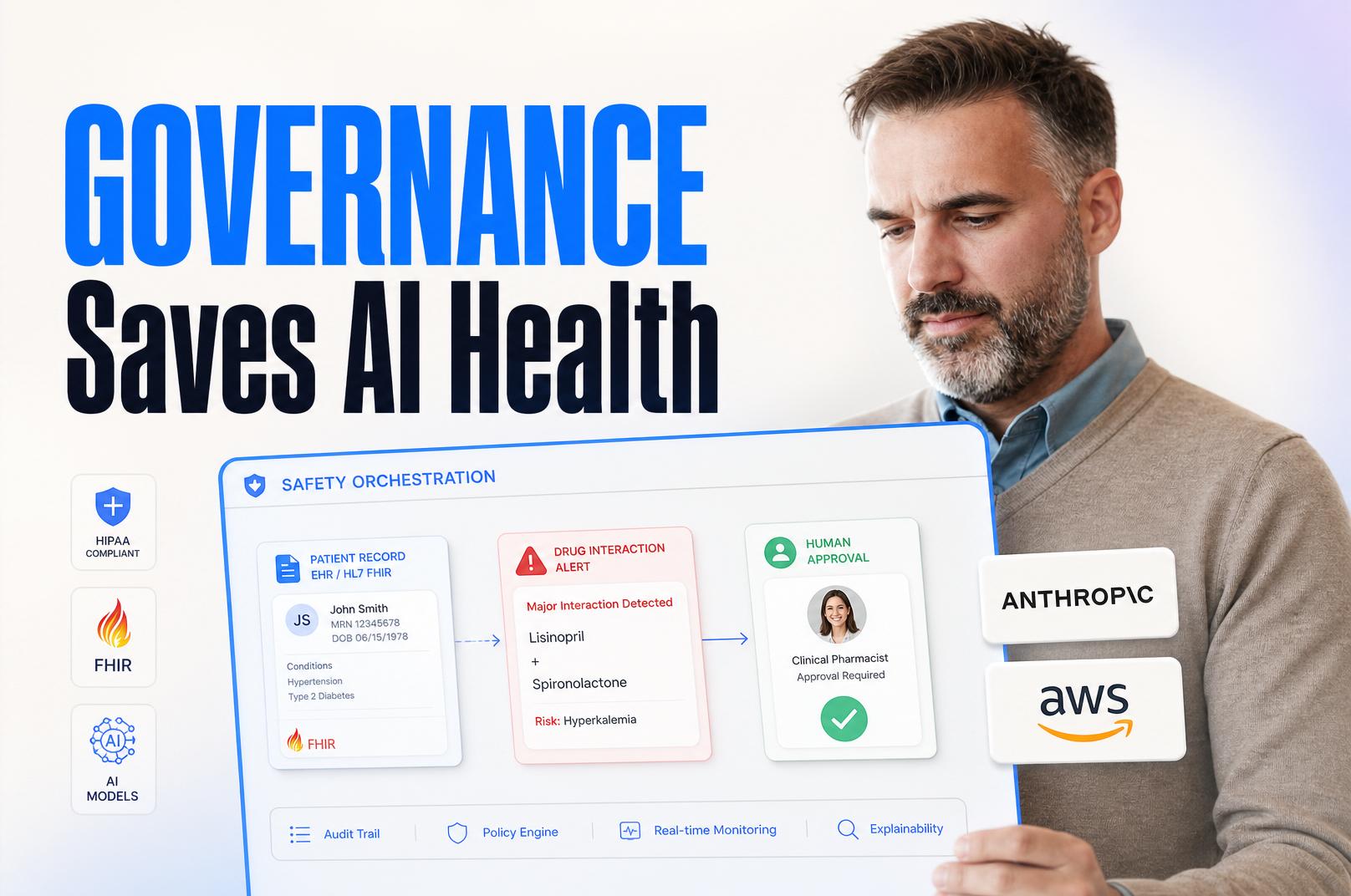
A production‑grade AI medical assistant typically consists of four pillars: data ingestion, inference engine, safety orchestration, and clinician interface. Data ingestion pulls electronic health records (EHR) from standards‑based APIs such as HL7 FHIR, normalizes them, and enriches them with real‑time sensor streams from wearables. The inference engine runs the language model—often hosted on cloud services like Amazon SageMaker or Azure Machine Learning—while applying domain‑specific prompts that embed clinical guidelines.
The safety orchestration layer sits between inference and the clinician interface. It validates the model’s output against a rule‑engine that encodes FDA guidance, state prescribing laws, and institution‑specific protocols. If the recommendation involves a prescription, the engine cross‑checks drug‑interaction databases, dosage limits, and patient allergy profiles. Only after passing these checks does the system generate a structured recommendation that is presented to a human clinician for sign‑off.
Plavno’s Perspective on Building Safe AI Health Solutions
At Plavno, we have helped enterprises integrate AI agents into mission‑critical domains such as finance and logistics. Our experience shows that the most successful deployments treat the model as a component, not the centerpiece. We therefore recommend a layered approach that couples the latest LLMs with a robust governance fabric, leveraging our AI agents development expertise to embed audit trails and compliance checks.
Our teams also advise clients to adopt a phased rollout: start with low‑risk use cases like symptom triage chat, where the chatbot can suggest next steps but cannot issue a diagnosis or prescription. Gradually expand to higher‑risk functions only after collecting real‑world safety data, similar to how autonomous vehicle manufacturers accumulate mileage before seeking full autonomy approval.
Business Impact of a Governance‑First Strategy
When a health‑tech company prioritizes governance, the immediate business impact is twofold. First, it shortens the time to regulatory clearance because auditors can trace every decision back to a documented rule set. Second, it builds clinician trust; providers are far more willing to adopt a system that clearly shows where a human will intervene.
Financially, the $50 million research award pool signals a willingness to subsidize early‑stage safety tooling. Companies that can demonstrate a mature governance stack are better positioned to capture a share of this funding, while also differentiating themselves in a crowded market where many startups focus solely on model performance.
How to Evaluate AI Medical Chatbots in Practice
Evaluating an AI medical chatbot should begin with a risk‑based matrix rather than a benchmark of perplexity or BLEU scores. Identify the clinical pathways the chatbot will touch—diagnostic triage, medication refill, chronic‑disease monitoring—and assign each a risk tier based on potential harm. For high‑risk pathways, require a human‑in‑the‑loop checkpoint and a full audit log.
Next, run a pilot that mirrors the Utah prescription refill study: deploy the chatbot to a controlled patient cohort, collect quantitative safety metrics (e.g., false‑positive prescription rates, adverse event incidence), and gather qualitative feedback from clinicians. Use these data to iterate on the rule‑engine and to calibrate the risk‑scoring thresholds. Only after the pilot demonstrates a statistically significant safety improvement should you consider scaling.
Real‑World Applications Emerging Today
Several organizations are already testing components of this governance‑first model. The federal research award program includes participants such as Anthropic, AWS, Certuma, and Doctronic, each developing conversational agents for cardiovascular triage. In Utah, the pilot allows chatbots to refill prescriptions under human supervision, providing a live testbed for the safety orchestration layer.
Risks and Limitations of Autonomous AI Doctors
Even with a robust governance layer, autonomous AI doctors face inherent limitations. Language models can hallucinate, producing plausible‑sounding but factually incorrect medical advice. They also lack the ability to perform physical examinations, interpret non‑verbal cues, or adapt to cultural nuances in patient communication.
Another practical risk is the scalability of human review. As usage expands, the volume of recommendations awaiting clinician sign‑off can overwhelm staff, re‑introducing bottlenecks that the AI was meant to alleviate. Addressing this requires dynamic workload balancing, possibly through triage algorithms that prioritize high‑risk cases for immediate review while deferring low‑risk suggestions.
Closing Insight
The political and financial momentum behind AI medical chatbots is undeniable, but the true lever for safe, scalable adoption lies in the orchestration and governance layers that sit between the model and the patient. Engineers and CTOs who focus solely on model selection will find themselves scrambling to retrofit safety after a failure. By building a governance‑first architecture—complete with provenance logs, risk scoring, and mandatory human checkpoints—organizations can harness the promise of AI while protecting patients, clinicians, and regulators.
| Pathway | Oversight Level | Typical Deployment Scope |
|---|---|---|
| Federal Fast‑Track (FDA) | Conditional approval with post‑market surveillance | High‑risk functions such as diagnosis assistance |
| State Pilot (e.g., Utah) | Human‑in‑the‑loop supervision, limited to prescription refill | Low‑to‑moderate risk tasks, often limited to specific conditions |
| Full Autonomy (proposed) | No current legal pathway; requires new legislation | Would enable end‑to‑end AI‑only care, currently speculative |
 Chat GPT
 Perplexity
 Claude
 Gemini