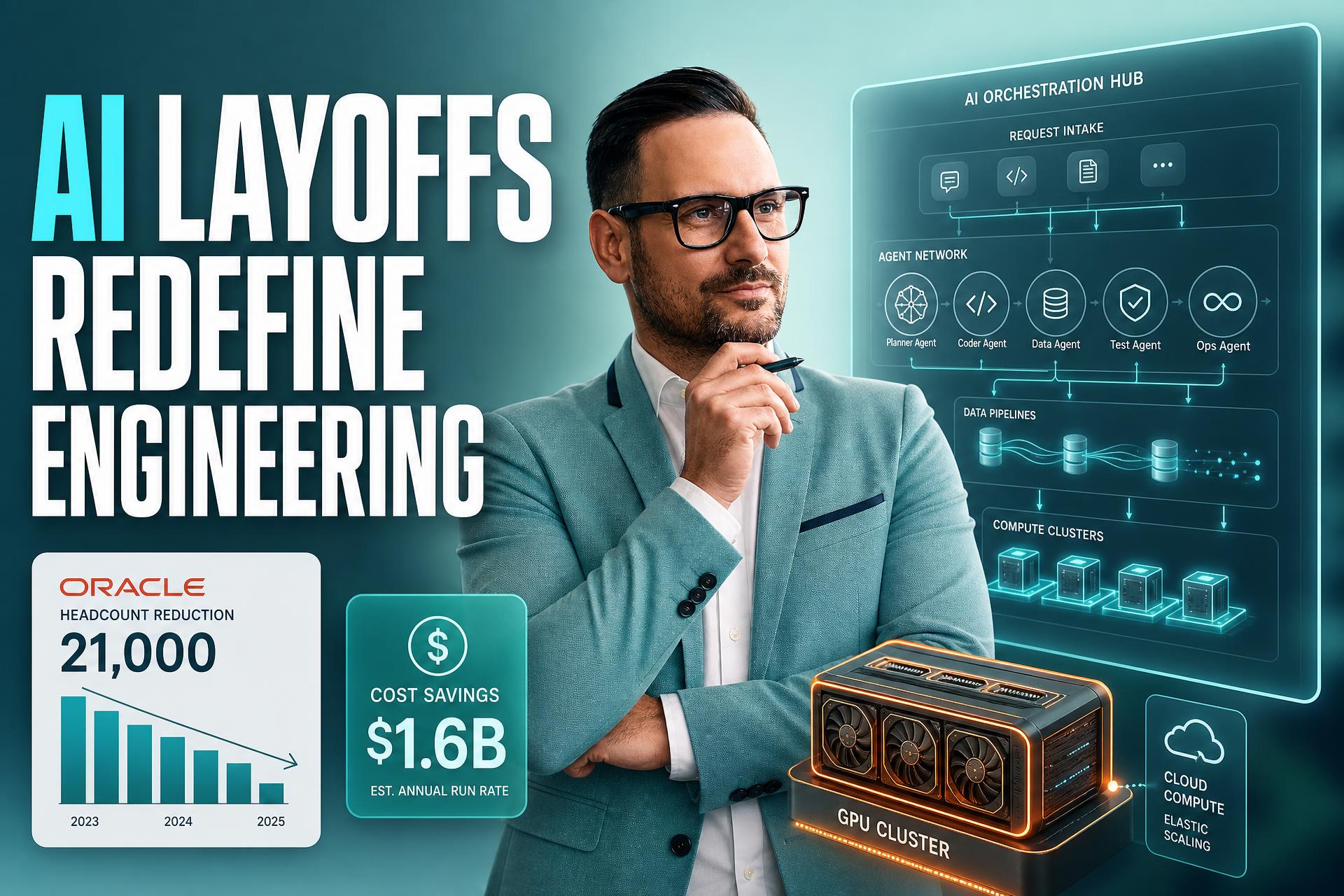
What is driving the wave of AI‑related layoffs in tech? → Companies cite “adoption and deployment of AI technologies” as the primary reason for cutting staff, with Oracle alone shedding 21,000 workers in the past year.
How does this trend affect engineering leadership decisions? → CTOs must decide whether to preserve legacy teams, re‑skill staff, or restructure around AI‑centric roles that can deliver more output with fewer people.
Is the impact limited to low‑skill jobs? → No. The cuts span middle‑management, operations, finance, legal, and even senior engineering functions, showing that AI is reshaping the entire value chain.
What actionable framework can a tech firm adopt this quarter? → A systematic assessment of AI integration points, followed by a redesign of team topology, talent acquisition strategy, and governance model, will turn the disruption into a competitive advantage.
Why AI‑Induced Layoffs Redefine Engineering Strategy
The Oracle filing that announced a 13 % headcount reduction makes clear that AI is no longer a pilot project; it is a wholesale operating model shift. When a single technology can replace dozens of routine tasks, the cost calculus pivots from salary expense to automation overhead, and engineering leaders must treat AI as a core platform rather than an optional add‑on. This re‑orientation forces a rethink of how we staff, design, and govern software delivery pipelines.
Key rule: In an AI‑first organization, the bottleneck moves from people to the orchestration layer that coordinates agents, data, and compute.
The Real Cost Driver: Automation Overhead, Not Headcount
Even as firms like Oracle, Meta, and Cisco announce thousands of cuts, the underlying expense they aim to curb is the infrastructure needed to run AI at scale—GPU clusters, data pipelines, and monitoring frameworks. Reducing headcount alone does not lower the electricity bill or the cost of model licensing; instead, the true savings emerge when the orchestration architecture is streamlined and the number of active agents is optimized.
From Workforce Reductions to AI‑Centric Delivery: What the Oracle Filing Reveals
The public filing shows Oracle’s workforce fell from 162,000 to 141,000 in twelve months, a drop of 21,000 employees directly attributed to AI adoption. This pattern mirrors the broader industry trend, where Challenger, Gray & Christmas recorded 87,714 AI‑linked cuts year‑to‑date. The signal is clear: AI is being positioned as a cost‑saving engine, and companies are willing to prune legacy staff to accelerate that vision. For engineering teams, the implication is that the next competitive advantage will come from how effectively AI agents are integrated, monitored, and scaled, not from hiring more engineers.
The second paragraph explains why the shift matters for product delivery. When AI agents handle routine ticket routing, code review triage, or data‑validation loops, the remaining engineers are expected to focus on higher‑order design, model improvement, and cross‑functional innovation. That expectation raises the bar for talent, demands new governance practices, and forces a re‑evaluation of existing development tooling. In short, the engineering organization must evolve from a people‑heavy, process‑driven model to a lean, AI‑augmented delivery engine.
- Misreading the headline: Assuming layoffs mean AI is “cheaper” than people ignores the hidden costs of model training, data storage, and continuous monitoring.
- Over‑estimating automation: Believing AI agents can replace all human judgment leads to brittle pipelines that crumble at edge cases.
- Neglecting skill gaps: Cutting middle managers without upskilling engineers creates a vacuum in coordination and governance.
- Ignoring orchestration complexity: Deploying many agents without a unified control plane multiplies latency and operational risk.
Why the Traditional Org Chart Breaks When AI Agents Scale
A classic hierarchical chart assumes a linear reporting chain, but AI agents introduce non‑linear dependencies that bypass managers, create feedback loops, and generate emergent behavior. When a single model serves dozens of micro‑services, the responsibility for performance, security, and compliance spreads across multiple product teams, making the old siloed structure ineffective. Engineers must therefore adopt a mesh‑like topology where ownership is defined by data flow rather than by managerial boundaries.
| Aspect | Pre‑AI Organization | AI‑Augmented Organization |
|---|---|---|
| Decision‑making | Manager‑driven approvals | Model‑driven policy enforcement |
| Ownership | Fixed team boundaries | Data‑centric service ownership |
| Scaling | Linear headcount growth | Exponential compute scaling |
| Risk | Human error, process lag | Model drift, orchestration failure |
The Hidden Engineering Bottleneck: Orchestration Layer
Even the most powerful language model cannot deliver value if the surrounding orchestration layer is fragile. In practice, teams discover that latency spikes, retry storms, and cascading failures appear after just three conversational turns, a symptom of poorly designed state management. The orchestration layer—responsible for routing requests, handling context, and managing retries—becomes the true point of failure, and its design dictates whether AI agents add value or introduce chaos.
Map data dependencies – Identify every upstream source the agent consumes and document versioning requirements.
Define contract boundaries – Use explicit schemas (e.g., OpenAPI) to prevent schema drift between agents and services.
Implement back‑pressure controls – Apply rate‑limiting and circuit‑breaker patterns to avoid overload during peak inference.
Centralize observability – Deploy a unified tracing system (e.g., OpenTelemetry) to correlate agent latency with downstream services.
Automate rollback – Create immutable deployment bundles that can be reverted instantly if model performance degrades.
Choosing the Right AI Integration Model for Your Stack
Selecting an integration model is not a technology decision alone; it is a strategic choice that determines how engineering resources are allocated. A tightly coupled approach—embedding a model directly into a monolithic codebase—offers low latency but forces developers to manage GPU drivers, model versioning, and security patches themselves. Conversely, a loosely coupled, API‑first pattern lets teams leverage managed inference services, reducing operational burden at the cost of additional network hops and potential vendor lock‑in.
The right answer for most enterprises lies in a hybrid strategy: core latency‑critical paths run on on‑premise inference servers, while ancillary workloads use cloud‑native APIs. This arrangement balances performance with flexibility, allowing engineering teams to focus on business logic rather than on the minutiae of model deployment. Moreover, the hybrid model creates a clear migration path: as models mature, they can be shifted from bespoke infra to scalable SaaS endpoints, freeing engineers to concentrate on innovation.
Principle: Treat AI integration as a platform decision; the choice of coupling dictates the entire engineering staffing model.
How Cloud‑Native Platforms Enable AI‑First Teams
Cloud‑native ecosystems such as Kubernetes, Knative, and Service Meshes provide the scaffolding needed to run AI agents at scale while preserving the agility that modern engineering teams demand. By abstracting compute resources, these platforms let developers declare intent—\"run this model with 4 GPU cores\"—and let the scheduler handle placement, autoscaling, and fault tolerance. The result is a predictable operational model that aligns with the DevOps mindset and reduces the need for specialized AI ops personnel.
Containerized AI Agents
Containerization isolates model dependencies, ensuring reproducible environments across development, staging, and production. Engineers can embed model artifacts, runtime libraries, and monitoring agents into a single image, then deploy it alongside micro‑services. This approach eliminates version conflicts, simplifies CI/CD pipelines, and enables rapid roll‑outs of model updates without disrupting downstream services.
Serverless Function Orchestration
Serverless platforms such as AWS Lambda or Google Cloud Functions allow AI inference to be invoked on demand, charging only for compute time. When combined with a workflow engine like Step Functions, teams can orchestrate multi‑step AI pipelines without provisioning servers, dramatically reducing idle resource costs and simplifying scaling for bursty workloads.
Edge‑Distributed Inference
Running inference at the edge—on devices or edge gateways—reduces latency and bandwidth consumption for latency‑sensitive applications like voice assistants. Edge deployment requires lightweight model formats (e.g., TensorRT) and a robust OTA update mechanism, but it frees central data centers from handling every request, enabling a more distributed engineering responsibility model.
Plavno’s Playbook for AI‑Ready Engineering
At Plavno we have codified a three‑phase methodology that helps enterprises transition from legacy staffing to AI‑augmented delivery. Phase 1 focuses on audit and mapping, identifying every process that could be automated by an AI agent. Phase 2 builds the platform layer—choosing orchestration tools, defining contracts, and establishing observability. Phase 3 executes talent realignment, hiring AI‑skilled engineers through our outstaffing model and reskilling existing staff via targeted upskilling programs. This structured approach turns the disruptive layoff signal into a growth engine.
- Audit existing workflows – Use process mining to surface repetitive tasks ripe for AI automation.
- Define AI‑agent contracts – Create explicit input/output schemas to lock down expectations.
- Select orchestration stack – Choose Kubernetes + Service Mesh for high‑throughput, or Serverless for bursty workloads.
- Implement observability – Deploy unified logging, tracing, and alerting across all agents.
- Align talent strategy – Recruit AI‑focused engineers via our outstaffing service and upskill legacy staff.
Business Impact: Cost Savings vs Innovation Velocity
The financial rationale behind the layoffs is often framed as a pure cost‑cutting exercise, yet the deeper metric is innovation velocity. Companies that merely reduce headcount without re‑architecting their AI pipelines see modest savings but suffer from slower feature delivery and higher technical debt. In contrast, firms that invest in a robust AI platform can achieve double‑digit productivity gains, faster time‑to‑market, and a measurable uplift in revenue per engineer.
| Metric | Before AI‑Centric Redesign | After AI‑Centric Redesign |
|---|---|---|
| Avg. Feature Lead Time | 12 weeks | 6 weeks |
| Compute Cost per Transaction | $0.12 | $0.07 |
| Engineer‑to‑Revenue Ratio | 1:250k | 1:400k |
| Incident MTTR (Mean Time to Recovery) | 4 hrs | 1.5 hrs |
Evaluating AI‑Centric Team Design in Practice
When assessing whether a proposed AI‑first structure will deliver value, CTOs should apply a two‑pronged lens: operational efficiency and strategic alignment. First, measure the reduction in manual effort against the added orchestration complexity; a net‑positive gain appears when the time saved exceeds the time spent on monitoring and governance.
Second, verify that the new structure supports the organization’s long‑term product roadmap, ensuring that AI agents are not isolated silos but integral components of the core value proposition.
A practical evaluation involves running a pilot on a low‑risk domain—such as automated ticket triage—tracking key performance indicators (KPIs) like request latency, error rate, and human‑in‑the‑loop interventions. If the pilot demonstrates a clear ROI within a quarter, the pattern can be scaled to higher‑impact services. Conversely, if orchestration overhead dominates, the team must revisit contract definitions or consider a tighter coupling strategy.
- KPI alignment – Ensure metrics such as latency, error rate, and cost per transaction match business goals.
- Governance readiness – Verify that compliance, security, and audit frameworks can accommodate AI‑driven processes.
- Talent availability – Confirm that the organization can source or develop engineers with model‑ops expertise.
- Scalability proof – Test the orchestration layer under load to validate autoscaling behavior.
- Change‑management plan – Prepare communication and training for teams impacted by role shifts.
Real‑World Use Cases: From Finance to Healthcare
Financial institutions are deploying AI agents to automate compliance checks, reducing manual review time from days to minutes, while hospitals are using AI‑driven triage bots to route patient inquiries, freeing clinicians to focus on critical care. In both scenarios, the underlying engineering pattern mirrors the hybrid integration model: core, latency‑sensitive functions run on dedicated inference hardware, whereas auxiliary workflows leverage managed APIs. These deployments illustrate how the same architectural principles can be applied across regulated and unregulated domains.
- Finance: AI‑enabled KYC verification cuts onboarding time by 70 %.
- Healthcare: Voice‑assistant triage reduces call center volume by 45 %.
- E‑commerce: Personalized recommendation engines increase conversion by 12 %.
- Legal: Contract analysis bots shorten review cycles from weeks to hours.
- Manufacturing: Predictive maintenance agents lower equipment downtime by 30 %.
Final Guidance for CTOs Planning This Quarter
The immediate takeaway is that AI‑driven layoffs are a symptom, not the solution. CTOs should prioritize building a resilient orchestration layer, selecting a hybrid integration model, and aligning talent pipelines with the new AI‑centric architecture. By treating AI as a platform rather than a bolt‑on, engineering organizations can convert headcount reductions into measurable gains in speed, cost efficiency, and product differentiation.
Takeaway: The decisive factor is not how many engineers you cut, but how you redesign the coordination fabric that binds AI agents to business value.
Take Action Now: Align Talent, Tools, and Governance
Start by launching a cross‑functional audit of all repetitive processes, then map each to a potential AI agent. Simultaneously, evaluate your orchestration stack—whether Kubernetes, serverless, or edge—and invest in the observability tooling needed to monitor model health. Finally, partner with a specialist provider to source AI‑savvy engineers and reskill existing staff, ensuring the organization can sustain the new AI‑first operating model.
Explore our AI solutions at AI agents development, learn about digital transformation at digital transformation, and see our cloud software development services at cloud software development. Also, check our AI voice assistant development at AI voice assistant development.
 Chat GPT
 Perplexity
 Claude
 Gemini