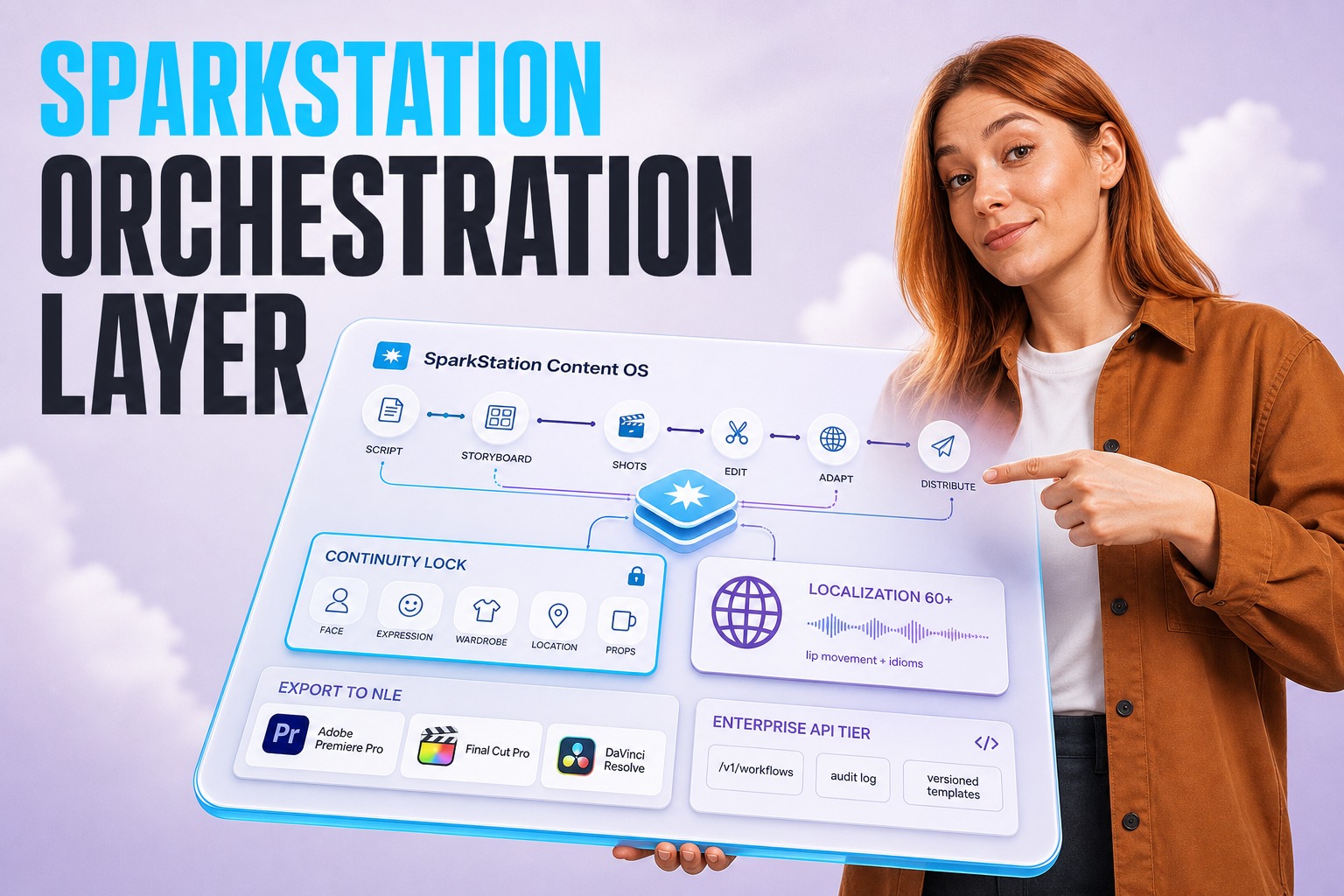
What changed this week that engineers should care about? → VerSe Innovation launched SparkStation as an AI-powered Content Operating System that orchestrates the full production workflow end-to-end, not just single-shot generation.
What is the real search question behind this launch? → How do we evaluate an AI content operating system for professional video and advertising production without breaking our existing creative pipeline?
What is the one decision a CTO has to make this quarter? → Whether to treat generative video as a set of tools bought per team, or as a platform layer integrated with editing systems and eventually automated via an enterprise API tier.
What’s the non-obvious engineering risk? → “Better models” won’t fix production failures caused by orchestration boundaries: continuity, localization fidelity, exports to NLE tools, and governance.
What angle will we take at Plavno? → We argue that production-grade AI video is won or lost above the model layer, so evaluation must focus on orchestration, continuity guarantees, and how the platform fits into real post-production and distribution systems.
The dominant signal: generative AI is becoming a production layer, not a generator
SparkStation is a clean market signal that the center of value in generative content is shifting upward. Instead of competing on whether a single model can create a striking clip, VerSe is positioning a platform that routes many creative tasks across multiple models through one interface, and keeps the workflow connected from idea and script to editing, ad-format adaptation, and distribution. For engineering leaders, the point isn’t whether SparkStation is the winner; it’s that the product category is moving toward an operating system for production.
Our central claim is straightforward and arguable: SparkStation-style platforms prove that AI video fails in production at orchestration and continuity boundaries, not at the raw generation step, so the right response is to evaluate integration, continuity control, and governance as first-class architecture requirements rather than selecting “the best model.” A reasonable team can disagree and keep buying point tools, but that approach typically collapses the moment you need consistent characters, multi-language variants, exports into established non-linear editors, and an enterprise API.
Quick Answer: what to look for in an AI content operating system for brands and studios
If you are searching for how to evaluate an AI content operating system for video production, treat it like adopting a workflow platform, not buying a creative tool. SparkStation’s headline promise is end-to-end orchestration, production-grade continuity across face, expression, wardrobe, location, and props, and localization across 60+ languages with lip movement and idioms preserved. Those are not “nice-to-haves”; they are the operational constraints that determine whether AI-generated video can enter a professional pipeline.
In practice, the evaluation should start with where the platform sits relative to your existing editing and distribution stack. SparkStation explicitly supports exports into Premiere, Final Cut, and DaVinci Resolve, which implies a hybrid model where AI accelerates upstream creation while the final cut remains in familiar NLE systems. If your organization already runs standardized creative review, compliance checks, brand approvals, and campaign trafficking, you should assess whether the platform can be governed like a production system, especially as it rolls out an enterprise API tier (planned after beta and general availability). At Plavno, we’d categorize this as workflow automation with creative constraints, which is closer to AI automation than to “prompting a model.”
If you evaluate a content operating system by sampling a few pretty outputs, you will choose the wrong platform; you need to evaluate whether the orchestration layer can keep identity and intent intact across many shots, formats, and languages.
Why “model-agnostic routing” changes your architecture more than your creative team
SparkStation’s core architectural move is a model-agnostic orchestration layer that routes each task to the AI model best suited for it, while hiding that complexity behind a single interface. The immediate business appeal is obvious: creators, agencies, and studios don’t want to bounce between disconnected tools for script work, storyboarding, shot creation, music and dialogue generation, editing, captioning, rendering, ad adaptation, and distribution. The engineering implication is more important: once a platform orchestrates multiple models, your failure modes move to the coordination layer.
In a multi-model workflow, every stage creates a contract for the next stage. Script decisions constrain shot generation; shot design constrains dialogue timing; localization constraints feed back into performance and lip movement; editing and rendering become downstream consumers of upstream metadata. When any of those handoffs are lossy, teams compensate manually, and the “AI savings” vanish. That is why the platform category matters: owning the orchestration layer means owning the handoffs.
For a CTO, the question becomes whether you want orchestration owned by a vendor platform, or whether you will end up building your own orchestration around a patchwork of AI tools anyway once scale demands it. SparkStation is explicitly making that bet, with VerSe committing more than $30 million over 24 months toward GPU infrastructure, orchestration capabilities, and specialist talent. Whether you buy or build, you are now in the business of orchestrating creative systems, not just generating assets.
Model-agnostic routing is not a feature; it’s an operational dependency
Once a platform routes tasks across different providers’ models, your production stack inherits their variability. That variability isn’t just “quality”; it manifests as inconsistent outputs across shots, different latency profiles across tasks, and shifting behavior as providers update models. Even if SparkStation abstracts providers behind one interface, your business will experience the system as a single production dependency.
This is exactly why the enterprise API tier matters. When teams start programmatically triggering workflows, attaching campaign metadata, and generating large variant sets, the orchestration layer becomes part of a broader system that includes asset management, approvals, and distribution. In that world, reliability, auditability, and change management become as critical as creative output. The organizations that succeed are the ones that treat “AI production” like software delivery: explicit interfaces between stages, clear ownership, and monitoring tied to business outcomes.
Continuity is the barrier that keeps AI video out of professional pipelines
VerSe is explicitly positioning continuity as the differentiator that moves AI-generated video into professional use. SparkStation aims to keep consistency across five elements throughout an entire production: face, expression, wardrobe, location, and props. That is a telling choice of words. It acknowledges what many teams learn the hard way: if each generated shot is treated as an independent output, you can’t cut a coherent story, you can’t keep a brand’s talent recognizable, and you can’t hand footage to editors without heavy rework.
From an engineering perspective, continuity is a cross-cutting concern. It spans identity, time, scene context, and visual constraints, and it has to persist across the entire workflow from storyboarding through editing. The systems problem is that continuity cannot be “patched in” at the end; if the platform doesn’t preserve continuity state across steps, you end up with a manual continuity department inside your agency or studio.
This is why our claim matters: the production-grade obstacle is above the model. You can swap out a generation model and still fail at continuity if your orchestration layer doesn’t carry the right context forward, enforce constraints, and expose controllable levers. Evaluating SparkStation-style platforms means evaluating how they treat continuity as a first-class production object rather than a side effect of prompts.
- Shot-to-shot identity drift: Even with a consistent concept, faces and props often mutate across shots unless the system maintains a continuity state across the production.
- Editorial rework explosion: When continuity breaks, editors in Premiere, Final Cut, or Resolve end up masking and patching instead of cutting story.
- Brand compliance failures: Wardrobe, locations, and props are not aesthetic details for brands; they are regulated or contract-bound elements that must remain stable.
- Workflow fragmentation: If continuity has to be managed in a separate tool, the “single platform” promise collapses back into tool-hopping and manual spreadsheets.
Localization at 60+ languages forces a new kind of asset pipeline
SparkStation supports production across 60+ languages and positions localization as more than translating dialogue, aiming to preserve lip movements, emotional performances, and local idioms. For engineers, this is a strong signal that “localization” is turning into a structured production workflow rather than a post-production service. When a platform promises to compress localization work that traditionally takes weeks into roughly a day, it’s implicitly claiming that it can keep video, audio, and narrative alignment intact while swapping language and cultural context.
The technical implication is that localized variants are no longer “derived exports”; they are first-class outputs. That changes how brands plan campaigns. A single campaign may need variants across languages, aspect ratios, platforms, and performance objectives, and SparkStation is explicitly targeting that scenario by combining generation, adaptation, and distribution within one system.
Engineering leaders should treat this as a pipeline design problem. Once you can generate many localized variants quickly, you need governance around what gets produced, how it’s reviewed, and what gets distributed. Otherwise, the bottleneck simply moves: from production time and cost into approval, compliance, and trafficking. SparkStation’s promise pressures every downstream system you already have.
Lip movement and idioms imply tighter coupling between script, performance, and rendering
When a platform claims it will preserve lip movements and emotional performances across languages, the workflow can’t be a simple audio swap. It suggests that localization is tied to performance representation and timing, which in turn affects how shots are created and cut. That means localization reaches back into story, dialogue generation, and editing decisions.
For a CTO, the practical question is whether your organization is ready for that coupling. If you run separate teams and tools for creative development, localization, and distribution, a unified platform will challenge those boundaries. In practice, you’ll want to know how outputs are versioned, how variants are tracked, and how editors work when each market’s cut may differ. Even if those details are not publicly enumerated, the promise itself tells you the operational direction: localization becomes a controlled, repeatable workflow step inside a production system.
When localization becomes a one-day workflow, the hard part isn’t generating more versions; it’s deciding which versions are allowed to ship.
Native exports to Premiere, Final Cut, and Resolve are about control, not convenience
SparkStation can export outputs into industry-standard non-linear editing systems including Premiere, Final Cut, and DaVinci Resolve. That detail matters because it reveals a pragmatic positioning: SparkStation is designed to plug into existing professional workflows rather than replace them. For most studios and agencies, the NLE is not just an editing tool; it’s where review, finishing, color, audio decisions, and delivery packages are managed.
From a systems view, exports are a boundary between AI orchestration and established post-production infrastructure. If AI outputs arrive in formats editors can work with directly, adoption can proceed without forcing teams to abandon tooling, training, and existing integrations. If exports are weak or lossy, the platform becomes a walled garden that stalls at the final mile.
This is also where governance lives. Many organizations have formal controls around what can be published, who signs off, and how final masters are stored. A platform that respects existing NLE-centric workflows lets you keep that control while still accelerating upstream creation. That’s a better adoption path than “rip and replace,” especially when the platform is moving toward enterprise API access and programmatic production.
| Integration stance | What it enables in the real workflow | What it risks |
|---|---|---|
| Export into NLE tools (Premiere, Final Cut, Resolve) | Editors keep established finishing and delivery practices while AI accelerates upstream creation | Lossy exports can turn into manual rebuilds, negating speed gains |
| Platform-first editing inside the AI system | Single interface and fewer tool boundaries | Governance and specialist workflows may not fit; teams resist adoption |
| Hybrid: AI for creation, NLE for final cut | Faster iteration with strong professional control points | Requires disciplined handoffs and version control between systems |
The enterprise API tier is where content OS products become engineering platforms
VerSe’s rollout plan includes an enterprise tier with API access after beta and general availability. This is the moment these platforms stop being “tools for creatives” and start becoming programmable infrastructure for marketing ops, agencies, and studios. Once APIs exist, teams will connect the content OS to upstream systems like campaign management and downstream systems like distribution and reporting, even if those integrations are built incrementally.
Engineering leaders should anticipate the new ownership questions that come with an API-enabled production platform. Who is responsible for workflow definitions? Who controls templates and brand constraints? How are credits, seats, and licensing governed when creators use credit-based pricing, studios buy seat-based SaaS, and enterprises license APIs? Those are not procurement details; they shape technical integration and operational responsibility.
At Plavno, we typically advise treating API-enabled creative platforms as systems that require product management discipline: versioned workflows, environments for experimentation, and change control. If your organization is heading toward this tier, you’ll want a clear technical evaluation strategy and, often, external support for architecture and governance. That’s exactly where AI consulting becomes practical rather than theoretical.
What to demand from an orchestration layer before you wire it into your pipeline
When your production workflow becomes orchestrated, the orchestration layer becomes your system of record for how assets were produced. Even without diving into vendor-specific implementation details, we can reason about the minimum bar: the platform must preserve continuity across a production, support localization as a first-class workflow, and reliably export into the NLE tools where final control happens.
The API tier raises the stakes because it enables scale. You can now produce many variants programmatically for different platforms and audiences, and route them through distribution. At that point, the engineering question becomes whether your organization can observe and govern the process the way you govern any other production system. The platform that wins inside enterprises will be the one that can be integrated without turning creative production into an opaque black box.
Start from an existing campaign workflow: Evaluate the platform against a real brand film or performance ad process your team already runs.
Test continuity across a multi-shot narrative: Force the system to maintain face, expression, wardrobe, location, and props across a full sequence.
Run a localization scenario, not a translation demo: Validate that language variants preserve performance and lip movement the way the platform claims.
Hand off to editors in your NLE stack: Export into Premiere, Final Cut, or Resolve and see whether editors can finish without rebuilding.
Decide whether you will need the API tier: If you foresee programmatic variant generation and distribution, treat the API as a core requirement, not a future add-on.
The real KPI is not “time to first draft”; it’s whether 24 hours becomes your new SLA
SparkStation aims to compress production timelines from several weeks to approximately 24 hours, and claims dramatic cost reduction for a 60-second brand film from a conventional ₹10–25 lakh range to about ₹50,000–₹75,000. Those numbers are provocative, but engineers should interpret them carefully. They are not merely savings; they imply a new operational cadence for creative teams.
When production becomes a 24-hour workflow, it changes how marketing and product teams behave. They will request more variants, iterate later in the process, and treat creative as something that can be regenerated on demand. That can be strategically powerful, but it also creates a new kind of technical debt: the need for workflow discipline, asset governance, and repeatable handoffs into post-production and distribution.
This is where orchestration matters more than model choice. If the platform truly connects script, storyboarding, casting, location and costume design, shot creation, music and dialogue generation, editing, captioning, rendering, ad-format adaptation, and distribution, then the output is only as reliable as the weakest workflow stage. In practice, the teams that succeed will define what “done in 24 hours” actually means for their business: which approvals are mandatory, which assets can ship, and which variants are allowed.
A 24-hour production promise is only real if your approvals, exports, and distribution can keep up; otherwise you just move the bottleneck into review and trafficking.
Production economics are changing, but rights and brand safety don’t get cheaper
VerSe’s CEO framed production cost as an “invisible ceiling” on what stories get made, arguing that lowering cost unlocks content that never cleared the production threshold before. That is a compelling product thesis, and it’s likely to be true in many organizations. But from an engineering and governance perspective, cheaper production increases the volume of content, which increases the surface area for mistakes.
This matters most for brands and agencies who operate under tight constraints: regulated industries, contractual talent usage, brand guidelines, and market-specific compliance. When a platform can produce many localized, platform-specific variants, the risk is not a single bad output; it’s systematic inconsistency that escapes review. Continuity can help with identity consistency, but it doesn’t automatically solve brand safety, legal review, or compliance.
The right operational response is to treat an AI content OS as a production system that needs controls, auditability, and clear responsibilities, especially as it expands toward enterprise API access. If you don’t plan for governance, the same speed that unlocks possibility can also accelerate failure.
- Volume-driven review overload: When timelines compress to roughly a day, the temptation is to ship without the checks that existed when production took weeks.
- Localization-specific misfires: Maintaining idioms and emotional performances across languages raises the stakes of market-specific review, not lowers it.
- Continuity versus truthfulness: Consistency across face and props can produce convincing narratives that still violate brand or legal constraints.
- Workflow accountability gaps: If no one owns the orchestration layer’s outputs end-to-end, issues get blamed on “the AI” instead of process design.
Continuity and compliance pull in opposite directions unless you design for both
Continuity aims to keep creative elements stable across a production, which is essential for professional storytelling and brand identity. Compliance and brand safety, however, often require conditional changes: market-specific disclaimers, creative restrictions, or different product representations. If your system pushes for maximum reuse and continuity across variants, you risk repeating the same mistake across every output.
The practical implication is that a content OS must support controlled divergence. Even if the platform handles localization and continuity well, your organization still needs a governance model that specifies when variants must differ and who approves those differences. The more you industrialize creative production, the more you need the same kind of structured change management you apply to software releases.
Where these platforms actually land: studios, brands, and creators share a workflow core
SparkStation targets three markets with one production workflow: filmmakers and production houses, brands and agencies, and creators and influencers. The commonality is the orchestration layer that connects many steps of production. The difference is how each market defines success and where it places human control.
Studios care about story building, script coverage, casting, location design, storyboarding, shot creation, music and dialogue generation, editing, and rendering, with exports to professional NLE systems. Brands care about image, video, UGC, and performance advertising formats, plus generating many platform-specific and localized variants. Creators care about templates and studio-grade capabilities through a credit-based model. One platform promising to serve all three means the platform is trying to standardize production primitives.
For engineering leaders, real-world adoption tends to start where the pain is immediate: agencies drowning in variant requests, studios trying to accelerate pre-production, or global brands needing localized assets quickly. The best evaluation strategy is to pick the workflow that is already constrained by time and cost and see whether the platform’s continuity and export promises hold up under that pressure.
- Agency performance ads at scale: A team iterates a single campaign into many platform-specific variants and localized versions, then exports assets for final editing and delivery.
- Studio pre-production acceleration: A production house uses end-to-end orchestration for ideation through storyboarding and shot creation, then finishes in established NLE tools.
- Creator-led UGC workflows: A creator uses templates under a credit model for faster output, but still depends on the platform’s continuity to keep identity stable.
- E-commerce catalogue creative: A brand generates catalogue-scale product creative variants, where governance and versioning become as important as generation.
Plavno’s stance: adopt content OS platforms like you’d adopt a new delivery pipeline
At Plavno, we don’t think the right question is “Should we use SparkStation?” The right question is whether your organization is ready to operationalize AI-driven production as a pipeline. SparkStation’s direction is clear: it wants to own the workflow connecting many AI models and production stages, while plugging into professional editing through exports. That is a pipeline problem.
In practice, we’d recommend a parallel-run adoption pattern. You keep your existing production workflow for high-stakes deliverables while running SparkStation-style workflows on a defined subset: a specific campaign type, a specific region’s localization, or a defined set of creative templates. The goal is to learn where orchestration boundaries break in your organization, not just whether outputs look good.
The engineering work tends to cluster around integration and operationalization rather than generation. If you’re moving toward an enterprise API tier, you need a robust cloud foundation to manage workflow runs, assets, and handoffs to downstream systems. This is where strong cloud software development practices matter, because the production layer becomes another business-critical system.
Why outstaffing often beats outsourcing when the workflow is still evolving
These platforms evolve quickly: SparkStation itself is rolling out in stages from beta to general availability and then to an enterprise API tier. When your workflow and governance are still being discovered, long fixed-scope outsourcing engagements tend to optimize for delivery against a spec that will change.
For many teams, the better model is to augment an internal product owner and creative operations lead with specialized engineers who can iterate on integrations, workflow governance, and observability as you learn. In practice, this often looks like outstaffing to keep domain ownership internal while accelerating delivery. That’s the difference between buying “a project” and building an operating capability around a new production layer.
- Fast-changing requirements: When you are still learning how continuity and localization behave in your pipeline, you need flexible iteration rather than rigid scope.
- Shared ownership with creative ops: The work spans engineering, creative leadership, and marketing operations; embedded specialists collaborate better than a distant delivery team.
- Integration-heavy effort: Exports to NLE tools and downstream distribution workflows create ongoing integration tasks rather than one-off builds.
- Governance as a product: Approval flows, variant controls, and enterprise API usage evolve like a product, not a single implementation.
Treat the orchestration layer as a product you operate, not software you install, because its real cost is long-term workflow ownership.
Buying vs building an AI content OS: the quarter you decide what you really own
SparkStation’s existence pressures every brand, agency, and studio to decide what they want to own. If a platform can reduce costs dramatically and compress production timelines to roughly a day while maintaining continuity and supporting 60+ languages, the temptation is to outsource the entire workflow to the vendor. That can be the right call, especially if your differentiator is distribution, brand strategy, or storytelling rather than production infrastructure.
But the more you depend on end-to-end orchestration, the more your competitive advantage can shift into workflow design: templates, brand constraints, localization strategy, and distribution alignment. Once enterprise API access is available, the line between “using a tool” and “running a production platform” blurs. The CTO’s quarterly decision is whether the orchestration layer will remain a vendor surface you operate manually through a UI, or whether it becomes part of your programmable stack.
We don’t think this is a philosophical choice; it’s a risk management decision. If your organization needs strict control, robust approvals, and predictable handoffs into Premiere, Final Cut, or Resolve, you should bias toward platforms that fit into your existing control points and treat continuity as a production object. If your organization needs maximal speed and experimentation, you may accept more vendor dependency. In either case, the engineering response is the same: evaluate orchestration and continuity first, because that’s where production systems succeed or fail.
 Chat GPT
  Perplexity
  Claude
  Gemini
