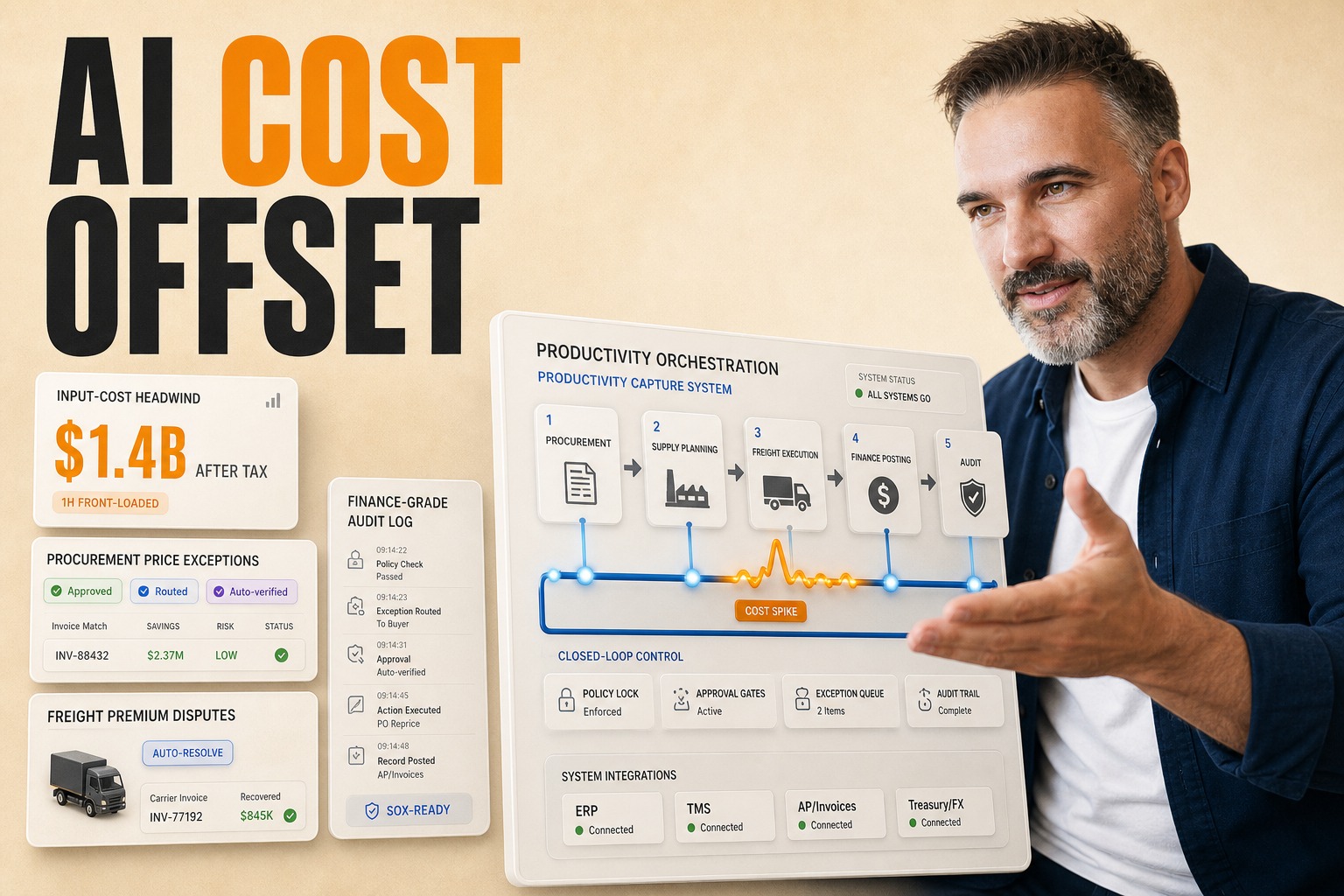
What is the dominant signal this week that changes engineering priorities? → A blue-chip operator is modeling a fiscal year where higher input costs, financing, non-operating income, and currency create a combined $1.4 billion after-tax earnings headwind, making productivity systems the primary technical lever.
What is the primary search question this article answers? → How do we design AI automation and productivity platforms that can offset supply-chain and operating cost inflation without relying on pricing or cutting brand investment.
Why does this matter this quarter, not someday? → The cost pressure is front-loaded, with much of it expected in the first half and at least a 5% EPS decline expected in the first quarter, which forces faster evaluation cycles and production-grade rollout discipline.
What decision will a CTO or VP Engineering have to make now? → Whether to fund AI-enabled workflows as core operational infrastructure (data contracts, orchestration, controls) versus isolated pilots that cannot be tied to cost-of-goods and SG&A levers.
What is the non-obvious angle? → The hardest part is not choosing a model; it is building the accounting-grade measurement and workflow boundaries where productivity savings can actually be captured and defended when reinvestment stays elevated.
Quick Answer: what is the right way to use AI automation to offset input-cost inflation?
If your P&L is absorbing a headwind like $1.4 billion after tax driven by higher input costs, interest, non-operating income, and FX, the right response is to treat AI as a productivity capture system, not an insights layer. In practice, that means connecting cost drivers (materials, energy, transportation, and premiums) to automated workflows that change decisions inside procurement, supply planning, freight execution, and spend controls, with finance-grade measurement. Model quality helps, but orchestration, data reliability, and controls determine whether savings show up in core EPS.
If you cannot trace an AI output to a decision that changes cost of goods sold or SG&A within a governed workflow, you are building analytics, not productivity.
The real shift: inflation pressure is forcing AI to prove itself in earnings, not demos
The signal is not that a consumer staples leader is experimenting with AI; it is that management is explicitly walking into a year where the math is hostile and productivity has to absorb it. The company is planning for $1 billion after tax in higher raw-material, energy, transportation, and related costs, assuming Brent crude oil around $90 per barrel, with the pressure concentrated in the first half and an EPS decline of at least 5% expected in the first quarter. When that is paired with $150 million after tax from higher net interest expense, $150 million from lower non-operating income, and $50 million from unfavorable FX, you get a blueprint for how engineering will be judged: can your systems measurably convert automation into margin defense while reinvestment remains real.
- Input-cost volatility becomes a systems problem: higher raw materials, energy, and freight premiums are not just procurement issues; they require instrumentation across planning, sourcing, and logistics workflows to react without chaos.
- Front-loaded impact compresses delivery timelines: when pressure is expected early in the year, long pilot cycles are structurally mismatched; production integration and governance need to happen fast.
- EPS drag reframes success criteria: when management describes the headwind as 56 cents per share and an 8% drag on prior core EPS, the organization needs traceable, finance-readable results, not model metrics.
- Reinvestment stays high, so cuts are not the plan: maintaining spend behind product superiority, packaging, and brand communication shifts the technical mandate toward efficiency and automation rather than budget reductions.
Central claim: AI projects fail at workflow boundaries, so productivity architecture matters more than model choice
We take a position at Plavno: what is happening is a shift from experimentation to earnings-backed execution, and it breaks the common engineering practice of building AI as a layer that sits beside operations. When inflation and financing pressures compound into a $1.4 billion after-tax hurdle, the failure mode is not that a model is slightly wrong; it is that the AI output does not cross the boundary into a governed business action, so the organization gets busy but not cheaper. The right response is to architect AI-enabled automation as a closed loop that starts with cost-driver data, produces a decision, executes that decision through an automated workflow, and reports impact in the same language finance uses to manage productivity and reinvestment.
Start from the cost lever that is explicitly modeled as a headwind, such as higher raw materials, energy, or transportation, and define the decision points that can change it.
Bind those decision points to a controlled workflow, meaning approvals, exception handling, and auditability are part of the design rather than a later add-on.
Instrument the workflow so the system can prove what changed, when it changed, and why it changed, with reporting that survives quarterly review.
Only then decide what AI technique is appropriate, because the workflow and measurement requirements will constrain latency, data freshness, and acceptable error.
Roll out in the time horizon implied by the business, which here is early-year pressure, not a long exploratory roadmap.
Translate cost headwinds into an AI roadmap built on unit economics, not feature requests
When management says higher input costs are the largest headwind and quantifies it as $1 billion after tax, the engineering roadmap should start by turning that statement into a unit-economics map of where decisions can be automated. In supply chains, the same input-cost shock can be absorbed very differently depending on whether planning is predictive or reactive, whether procurement actions are executed consistently, and whether freight execution is optimized or exception-driven. The mention of higher freight, supplier inflation, and supply-chain premiums points to workflow choke points where humans are making inconsistent calls under pressure, which is exactly where AI-enabled automation can reduce variance. But the architecture must assume the first half is where the pain hits, because systems that require long data maturation will miss the window.
What a productivity platform looks like when you expect early-year EPS pressure
A real productivity platform is not a dashboard; it is an operational nervous system that can sense cost changes and execute policy in the systems where work happens. In practice, that means integrating the sources of truth for spend and execution (the enterprise resource planning layer, procurement and supplier records, transportation and warehousing events, and financial postings) into reliable data contracts, then attaching automated workflows that standardize how exceptions are handled. The input article references scaling Supply Chain 3.0, AI-enabled brand-building tools, and automated workflows; the key engineering interpretation is that these are only valuable if they share a common measurement spine that ties actions to cost of goods sold and SG&A. Without that, you will get localized wins that cannot absorb a modeled $1.4 billion after-tax hurdle.
| Productivity lever tied to the headwind | Data boundary you must control | Automation pattern that can capture savings |
|---|---|---|
| Higher raw-material and supplier inflation | Purchase orders, contracts, and invoice matching records | Exception triage and policy-driven approvals for substitutions and price exceptions |
| Higher transportation and freight premiums | Shipment events, carrier invoices, and delivery confirmations | Automated dispute handling, routing exception workflows, and spend anomaly detection |
| Energy and related input cost shifts | Plant-level consumption and cost allocation postings | Forecast-triggered operating adjustments and variance investigation workflows |
| Financing and FX pressure amplifying earnings drag | Treasury postings and currency exposure reporting | Controls automation to prevent leakage and enforce hedging and payment policies |
Where AI-enabled brand-building tools fit, and where they do not
AI-enabled brand-building can be strategically necessary, but it should not be treated as a substitute for supply-chain productivity when cost pressure is explicit. The input article shows reinvestment can be large enough to restrain margins, citing a quarter where core operating margin declined 130 basis points as 410 basis points of reinvestment, primarily marketing, outweighed 300 basis points of SG&A productivity, even though total productivity savings reached 460 basis points. That is the engineering lesson: marketing tools may improve execution and consistency, but they rarely create defendable cost savings unless they are measured against spend efficiency and are governed like any other production system that touches budgets.
- Treat brand tooling as a spend control problem: if workflows can standardize approvals, targeting rules, and compliance, you can prevent leakage even when reinvestment stays elevated.
- Force shared measurement with finance: the system should report in the same terms leadership uses, such as operating margin and productivity savings, not only engagement metrics.
- Avoid creating parallel truth systems: if marketing data and finance data diverge, teams will argue about performance instead of improving it.
- Plan for operational load and governance: automated workflows need reliability, access control, and audit trails, or they become a risk surface rather than a productivity lever.
Automated workflows are the real savings engine, not the model
When an organization says productivity is the main offset, it is implicitly saying that execution consistency is more important than insight novelty. Automated workflows are where that consistency is enforced: routing exceptions, enforcing policy, verifying spend, and triggering actions when thresholds change. Models can prioritize what deserves attention, but only workflows can ensure the action is taken the same way every time, across plants, categories, and regions. This is why orchestration boundaries matter: if the AI output stops at a recommendation, the savings may never be realized; if the AI output becomes a controlled action in the workflow, the system can capture value and prove it.
- Exception routing with constrained actions: the system can classify and route procurement, logistics, or finance exceptions into pre-approved action sets rather than open-ended human handling.
- Spend verification as a default: automated checking of invoices, freight bills, and supplier charges reduces leakage precisely when premiums and inflation are rising.
- Policy enforcement under stress: when conditions tighten, people bypass rules; workflow automation can prevent drift and keep decisions aligned with margin defense.
- Closed-loop learning from outcomes: workflows can record what action was taken and what happened, enabling continuous improvement without relying on anecdotal feedback.
Supply Chain 3.0 should be treated like a platform migration, not an AI pilot
At Plavno, we read the phrase scaling Supply Chain 3.0 as a platform commitment: a move toward AI-enabled decisioning and automation embedded inside supply operations. The engineering implication is that you need platform thinking, because the value comes from standardization across categories and geographies, not from one-off proofs of concept. A platform approach emphasizes shared data contracts, shared workflow primitives, and a governance model that can survive quarterly scrutiny, particularly when management is balancing modest organic sales growth guidance of 1% to 3% with a heavy cost headwind.
The hard trade-off is scope versus speed. When the pressure is expected in the first half, the temptation is to build narrow automations that ship quickly, but narrow automations often fail to generalize and become brittle, creating maintenance debt exactly when productivity needs to compound. Our approach is to define a small set of reusable workflow and measurement components that can be rolled out iteratively, and to align engineering work with finance definitions of productivity improvements, like the $2.8 billion before-tax productivity improvement cited for fiscal 2026. This is where AI consulting is most valuable: not to choose a buzzword, but to design the platform boundaries that let teams ship fast without losing control of measurement, security, and auditability.
If productivity is funding reinvestment, your AI system must be auditable enough to defend savings when marketing and product spending stay high.
How to evaluate AI automation when the modeled headwind is $1 billion after tax
The evaluation method changes when leadership names the headwind and expects productivity to offset it. Instead of asking whether a model is accurate, we ask whether the automation can be deployed into the systems of record without breaking controls, and whether it produces a measurable delta that finance will accept. The input article’s framing of $1 billion after tax in higher input costs is useful because it anchors evaluation to cost categories that show up in cost of goods sold and operational spending, while the references to automated workflows and AI-enabled tools tell us the organization is already thinking about process-level leverage. This is where AI automation becomes an engineering program, not a set of isolated tickets.
A quarter-scale evaluation sequence that fits a first-half pressure window
When much of the cost pressure is expected early, evaluation has to be staged so you can ship production integrations while learning. That does not mean skipping rigor; it means selecting use cases where the workflow boundary is clear and the impact is measurable quickly, such as invoice leakage, freight disputes, or exception overload in procurement. The technical bar is that your automation must integrate with existing access control and approval flows, because the organization is simultaneously managing higher net interest expense and other earnings drags, so tolerance for governance failures is low. This approach also reduces the risk of building a recommendation engine that never gets adopted under stress.
Choose one headwind-linked workflow with a clear cost proxy, such as transportation premium disputes or supplier price exception handling, and define the start and end states.
Implement data contracts for the minimum set of records that determine cost impact, then validate that the records reconcile with finance postings.
Deploy automation in a constrained mode first, where actions are suggested but routed through standard approvals, to validate governance and exception paths.
Expand to partial automation where policy allows, while logging every action and outcome so finance and operations can audit behavior.
Only after the workflow is stable, add more advanced AI prioritization to scale throughput, because stability is what turns throughput into savings.
What to measure when leadership frames the problem as 56 cents per share
When leadership describes the burden as 56 cents per share and an 8% drag on prior core EPS, measurement cannot stay inside engineering metrics. The system must produce outputs that map to cost lines and productivity definitions used in performance reviews and investor communication. The input article gives concrete examples of productivity being tracked as basis-point improvements and before-tax productivity improvement totals, so engineering should align to that language rather than inventing its own scorecards. In practice, the key is to ensure the workflow logs are good enough to attribute changes to automation, while also capturing the reinvestment context so teams do not misread margin compression as project failure.
Real applications that hold up under scrutiny: procurement, freight, and discontinuations
The most defensible AI automation work in this environment sits where the organization already acknowledges trade-offs. On one side, there is modest sales growth guidance of 1% to 3%, including a 30 to 50 basis-point drag from brand, product-form, and go-to-market discontinuations; on the other side, there is a need to maintain spending behind product superiority and brand communication even as costs rise. That combination makes operations execution a central battlefield: discontinuations and assortment changes create planning and logistics turbulence, and turbulence increases premiums, expediting, and error. A well-architected automation layer can stabilize execution by standardizing the workflows that handle change, so discontinuations do not cascade into costly exceptions across procurement, manufacturing scheduling, and transportation.
| Application area aligned to the headwind | Critical system boundary | Typical production failure mode |
|---|---|---|
| Supplier price exceptions under inflation | Procurement records to finance postings | Recommendations that do not match approval policy, causing manual rework and no realized savings |
| Freight premium and dispute automation | Shipment events to carrier invoicing | Missing or inconsistent event data leading to false disputes and operational friction |
| Assortment discontinuation execution | Planning decisions to execution workflows | Change management gaps that create exception storms and increase expediting costs |
| Productivity reporting for reinvestment trade-offs | Operational logs to finance definitions | Metrics that cannot be audited, so savings are discounted during quarterly review |
Risks that derail productivity programs: governance drift, reinvestment optics, and FX noise
The input article is clear that the earnings headwind is not purely operational; financing and currency also matter, with $150 million after tax expected from higher net interest expense and about $50 million from unfavorable FX. Engineering teams often underestimate how these factors distort perception: if FX moves against you or interest expense rises, leadership may still demand productivity improvements, but it becomes harder to separate automation impact from macro noise. This is why governance and measurement are not paperwork; they are how you defend what your systems did. A second risk is reinvestment optics: if marketing and product investments stay elevated, margins can remain tight even when productivity improves, as shown by the quarter where 410 basis points of reinvestment outweighed SG&A productivity. The right mitigation is to design reporting that ties workflow-level savings to finance definitions and to ensure controls, access, and auditability are first-class, which is where software engineering consulting can prevent expensive rework.
Build vs partner decisions change when the timeline is the first half, not a lab cycle
When cost pressure is expected early, staffing and delivery models become part of the architecture decision. Building everything in-house can look safer, but it often delays integration work, and integration is where productivity systems succeed or fail. Partnering can look faster, but only if the partner can operate inside your governance constraints and can ship production-grade workflows rather than prototypes. The trade-off we see most often is that internal teams are strong at domain context but overloaded, while external specialists can accelerate platform components like workflow orchestration, data contract design, and reliability engineering. In those cases, a managed extension model such as outstaffing can be effective if it is tied to clear ownership boundaries: your organization retains control of policies and definitions, while the augmented team delivers the automation spine that connects AI outputs to governed action.
- Speed versus control: compressed timelines favor external acceleration, but control demands tight integration with existing approval and audit frameworks.
- Platform reuse versus point delivery: partners should be judged on whether they can build reusable workflow primitives, not just one successful demo.
- Operational ownership clarity: savings disappear when no team owns the workflow after launch, especially during high-pressure periods like early-year cost spikes.
- Measurement maturity: if finance-grade reporting is not already in place, prioritize partners who can implement measurement as part of the system, not as a separate BI effort.
Closing insight: treat AI like cost-of-goods infrastructure, because that is how it will be judged
The week’s signal is a reminder that AI only becomes strategic when it can absorb real-world headwinds that leadership can quantify. When higher input costs alone are modeled at $1 billion after tax and the total headwind reaches $1.4 billion after tax, the decision for engineering leaders is whether to keep building AI as a set of features or to build it as operational infrastructure that changes how work is executed and measured. Our central claim holds: the model is rarely the bottleneck; workflow boundaries, governance, and measurement are. If your architecture cannot move from AI output to controlled action and audited impact, you will not capture productivity, even if your models are impressive.
At Plavno, we focus on building the data and workflow spine that makes AI measurable and safe in production, particularly for supply-chain and enterprise automation programs that must withstand quarterly review. If you are modernizing systems to support AI-enabled workflows, it usually requires foundational engineering in identity, access control, reliability, and integration patterns across operational systems and finance reporting, which is why cloud software development often becomes the enabling layer. Author: Plavno team. Last updated: September 2026.
 Chat GPT
  Perplexity
  Claude
  Gemini
