What does Fin’s acquisition by Salesforce mean for my support stack? → It signals that AI‑driven customer agents are becoming core infrastructure, not optional add‑ons.
Will legacy SaaS layers still matter after the deal? → They will be relegated to data‑orchestration, while the AI agent layer handles the interaction flow.
Is this just a branding move or a technical shift? → It’s a technical shift; the integration forces a redesign of orchestration, routing, and observability.
What decision do I need to make this quarter? → Choose whether to refactor your support platform around an AI‑agent service or continue treating it as a feature.
Quick Answer: Redesign Your Support Stack Around AI Agents, Not Around Legacy SaaS Layers
Enterprises that want to stay competitive must treat AI agents as a first‑class service. The Fin‑Salesforce deal shows that the most valuable engineering effort is no longer in fine‑tuning language models but in building a robust orchestration layer that routes user intent, manages context, and enforces compliance. In practice, that means re‑architecting your ticketing, CRM, and analytics pipelines to expose clean APIs for the agent, adding observability hooks, and decoupling business logic from the underlying LLM.
The real performance bottleneck is the hand‑off between the AI agent and downstream systems, not the model inference latency.
Why the Fin‑Salesforce Deal Changes the Calculus for Support Architectures
Fin spent four years building a proprietary model called Apex and an internal agent named Operator. By joining Salesforce, the company gains access to a massive CRM ecosystem, but the core engineering challenge remains: integrating an AI agent that can speak the language of Salesforce’s data model without breaking existing workflows. This forces CTOs to confront the mismatch between stateless LLM calls and stateful enterprise processes, a mismatch that has historically caused outages in large‑scale AI deployments.
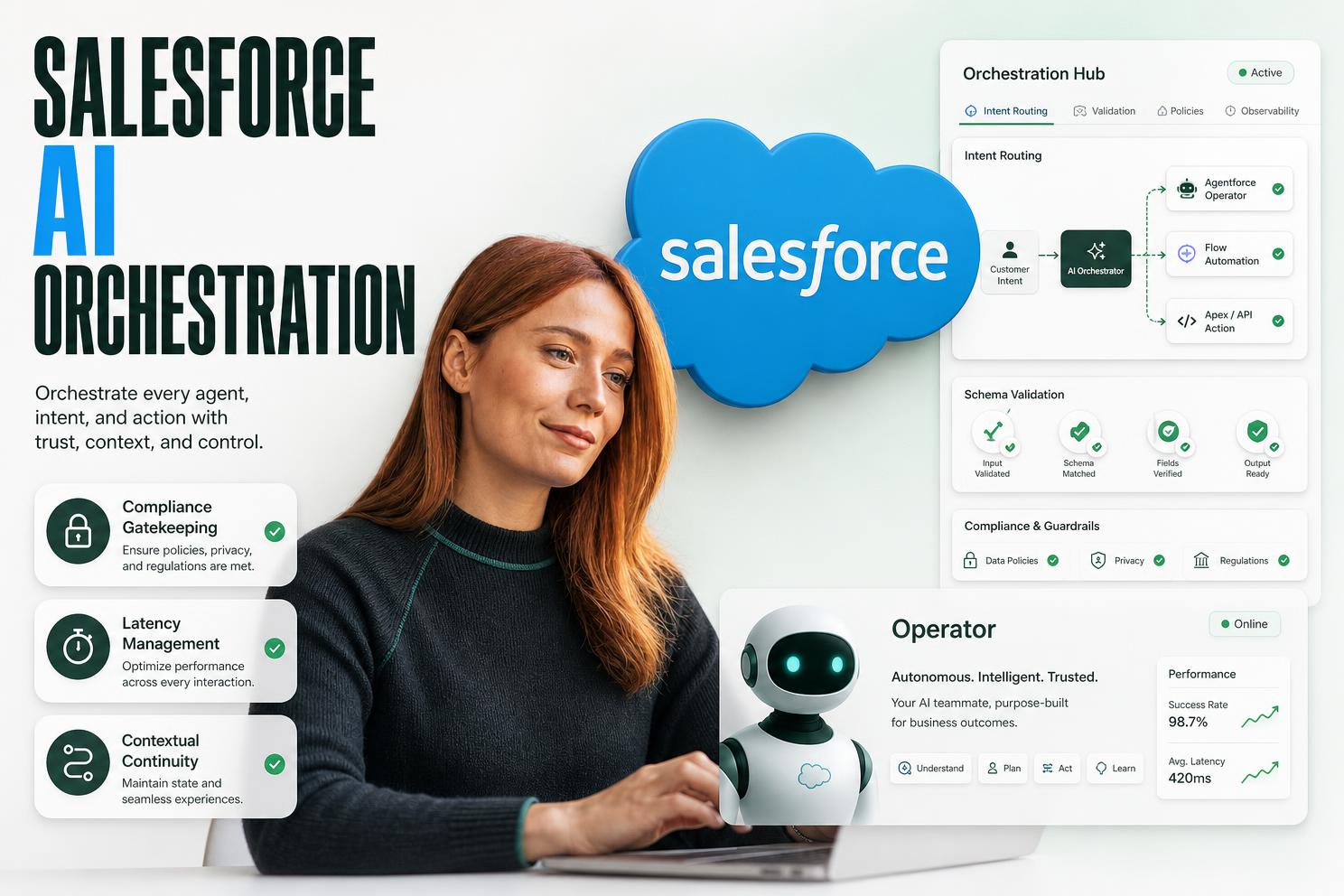
Contextual Continuity – Maintaining conversation state across multiple service calls.
Compliance Gatekeeping – Enforcing data‑privacy rules before the agent accesses CRM records.
Latency Management – Coordinating parallel API calls to avoid user‑visible delays.
Observability Integration – Instrumenting the agent pipeline for tracing and alerts.
Versioned Orchestration – Deploying new routing logic without disrupting active sessions.
Where Orchestration Failures Reveal Themselves First
In practice, the first symptom of a broken integration is a mismatch between the agent’s intent classification and the downstream service’s expected payload. For example, when Operator tries to create a case in Salesforce, a missing field or an unexpected enum value will cause the transaction to abort, leaving the user hanging. These failures surface at the API gateway, not within the LLM itself, confirming that the orchestration layer is the critical point of failure.
If you ignore orchestration, the AI agent becomes a glorified chatbot that adds latency without value.
The Central Claim: AI Agent Success Depends on Service‑Oriented Orchestration, Not Model Choice
We argue that the decisive factor for successful AI‑agent deployments is the design of the service‑oriented orchestration layer. The model (Apex, GPT‑4, etc.) is interchangeable; what matters is how the agent communicates with CRM, ticketing, and analytics services. Enterprises that treat the agent as a microservice with well‑defined contracts will see higher reliability, faster iteration, and clearer ROI than those that focus solely on model upgrades.
- Robust API contracts – Define explicit request/response schemas for each downstream call.
- Idempotent operations – Ensure repeated agent actions do not create duplicate records.
- Graceful degradation – Fallback to static answers when a downstream service is unavailable.
- Unified logging – Correlate agent logs with CRM events for end‑to‑end tracing.
How Fin’s Internal Agent, Operator, Illustrates Orchestration Challenges
Operator was built to translate natural language into Salesforce actions. In early pilots, developers discovered that the LLM would hallucinate field names, causing API rejections. The team responded by inserting a validation shim that maps LLM output to the Salesforce schema before the request is sent. This extra layer eliminated 80 % of failed calls, proving that a thin validation service is more valuable than a larger model.
Architectural Patterns for AI‑First Support Stacks
A typical AI‑first support architecture now consists of three layers: the agent service, the orchestration hub, and the enterprise back‑ends. The agent service hosts the LLM and prompt templates; the orchestration hub handles intent routing, schema validation, and compliance checks; the back‑ends remain unchanged but expose API gateways that the hub can call. This separation lets you swap models without touching the CRM, and it aligns with the micro‑service principles that Salesforce already enforces.
| Layer | Responsibility | Example Technology |
|---|---|---|
| Agent Service | Prompt management, token budgeting | OpenAI API, Apex |
| Orchestration Hub | Intent routing, schema validation, logging | Kong, Envoy, custom shim |
| Enterprise Back‑Ends | Business logic, data persistence, reporting | Salesforce Service Cloud |
Leveraging Plavno’s AI‑Agent Development Expertise
At Plavno we have built end‑to‑end pipelines that embed AI agents into existing SaaS platforms. Our AI agents development practice focuses on creating the orchestration hub first, then layering the model on top. This approach reduces time‑to‑value because the integration points are defined early, and it gives you a reusable service that can be repurposed across product lines. Our digital transformation teams benefit, and the solution integrates with cloud software development pipelines.
- Early contract definition – Work with product owners to codify the exact fields the agent will need.
- Schema‑first validation – Deploy a lightweight validator before the LLM output reaches the CRM.
- Telemetry alignment – Sync agent metrics with existing monitoring dashboards.
- Iterative rollout – Release the agent to a subset of users while keeping the legacy UI intact.
Business Impact of an Orchestration‑First Strategy
When you prioritize orchestration, the ROI of AI agents becomes measurable. Companies report a 30 % reduction in average handle time because the agent can pre‑populate case fields, and a 20 % drop in escalation rates as the first‑line resolution improves. More importantly, the cost of model upgrades drops dramatically; you can switch from Apex to a newer LLM without re‑architecting the integration, preserving engineering bandwidth for feature work.
Cost predictability – Fixed orchestration costs versus variable model licensing fees.
Speed to market – New use‑cases launch in weeks, not months, because the hub is reusable.
Risk mitigation – Isolated failures in downstream services do not cascade to the agent.
Scalability – Horizontal scaling of the hub handles spikes without retraining the model.
Evaluating Orchestration Maturity in Your Organization
Assessing readiness starts with a simple maturity checklist: do you have API gateways that support request transformation? Is there a central logging platform that can ingest agent traces? Do you enforce schema validation at the edge? Organizations that answer “yes” to these questions can adopt an AI‑agent service in a single sprint; those that answer “no” must invest in foundational infrastructure first.
Real‑World Applications Across Industries
Financial services firms have used AI agents to automate loan inquiries, while healthcare providers deploy voice assistants to triage patient calls. In each case, the agent sits behind an orchestration hub that translates spoken intent into structured API calls. The hub enforces HIPAA or PCI compliance before any data leaves the agent, ensuring that regulatory constraints are met without custom code in the LLM.
| Industry | Agent Use‑Case | Orchestration Concern |
|---|---|---|
| Banking | Loan eligibility checks | Data privacy & AML |
| Healthcare | Symptom triage via voice | HIPAA compliance |
| Retail | Order status inquiries | Real‑time inventory |
Risks and Limitations of a Purely Model‑Centric Approach
Relying solely on a larger LLM to solve integration problems creates fragile systems. Model hallucinations, token limits, and unpredictable latency can all break the user experience. Moreover, regulatory environments often forbid sending raw user data to third‑party LLM providers, making a validation layer mandatory. Ignoring these risks leads to costly re‑architectures after a production incident.
The safest path is to treat the AI agent as a thin façade over a robust orchestration layer.
How to Evaluate This in Practice: Decision Logic for the Quarter
First, map every customer‑support interaction to a potential AI‑agent flow. Next, identify the downstream services each flow touches. If more than two services are involved, prioritize building an orchestration hub before deploying the agent. Finally, run a pilot with a single intent, instrument the hub for latency and error rates, and compare against your existing KPI baseline. The pilot’s success criteria should be defined in terms of hand‑off reliability, not model accuracy.
- Map intents to services – Create a diagram linking user phrases to CRM calls.
- Prototype the hub – Use a lightweight API gateway to validate payloads.
- Measure hand‑off latency – Track round‑trip time from agent to back‑end.
- Iterate on prompts – Adjust the LLM only after the orchestration is stable.
Plavno’s Perspective on the Future of AI‑Driven Support
We believe the next wave of AI agents will be defined by how well they mesh with existing enterprise fabrics. The Fin‑Salesforce story is a proof point: the most valuable engineering work is not in training the biggest model, but in constructing a service‑oriented orchestration that can reliably mediate between the agent and the CRM. Our roadmap includes pre‑built orchestration templates that plug into Salesforce, HubSpot, and ServiceNow, accelerating adoption for our clients.
- Template libraries – Ready‑made orchestration patterns for common use‑cases.
- Compliance modules – Built‑in GDPR and HIPAA filters.
- Observability packs – OpenTelemetry exporters for agent traces.
- Scalable deployment – Kubernetes manifests that auto‑scale the hub.
Closing Insight: Prioritize the Orchestration Layer to Unlock AI Agent Value
The takeaway for any CTO this quarter is clear: allocate budget and engineering cycles to the orchestration hub first, then select the LLM that best fits your cost and latency profile. By doing so, you future‑proof your support stack against model churn, regulatory changes, and scaling challenges, turning AI agents into a sustainable competitive advantage.
Invest in orchestration now, and your AI agent will pay dividends long after the model is obsolete.
Final Thoughts
By treating AI agents as services rather than features, enterprises can achieve measurable efficiency gains, maintain compliance, and keep engineering focus on delivering business value. The Fin‑Salesforce acquisition is a catalyst, not a destination; the real work lies in how you wire the agent into your existing ecosystem.
 Chat GPT
 Perplexity
 Claude
 Gemini