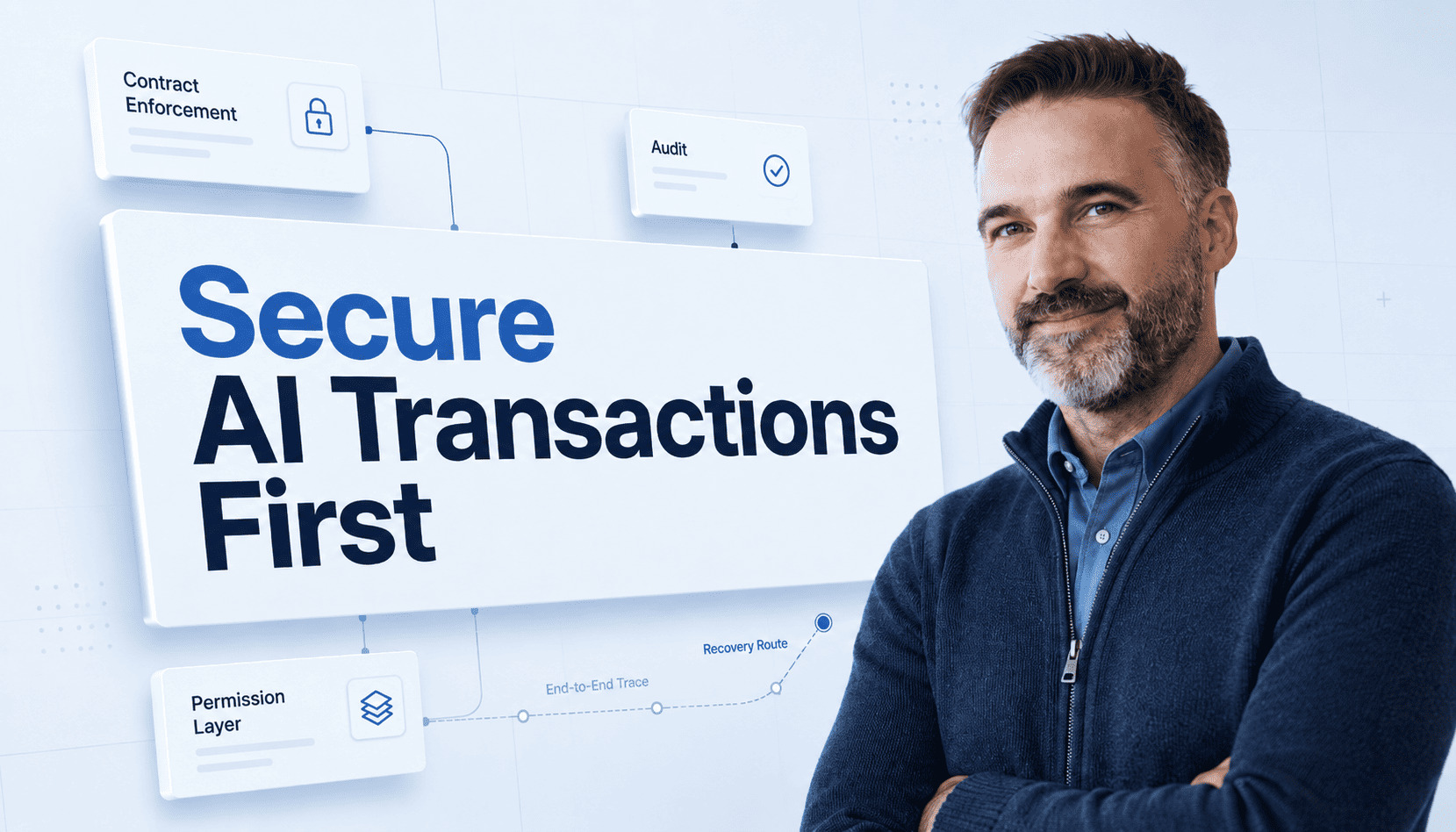
Is the AI hype hiding a deeper architectural risk for SaaS vendors? → Yes, the real danger lies in how agents are coordinated, not in model quality.
Do enterprises need a new stack to manage AI agents safely? → They need orchestration‑aware patterns that isolate state, latency, and security.
Will buying an AI execution layer solve the problem? → It helps, but only if the surrounding workflow respects boundary contracts.
Can we measure orchestration risk before a rollout? → Yes, by profiling latency spikes, error propagation, and data‑access footprints.
What should CTOs prioritize this quarter? → Redesigning agent pipelines to make orchestration deterministic and auditable.
AI Agent Orchestration Is the Hidden Failure Point
Enterprises are racing to embed autonomous agents into their SaaS products, yet most teams treat the agent as a black‑box model call. In practice, the moment an LLM‑driven function hands off to another service, to a database, or to a user interface, the orchestration layer becomes the weakest link. Latency bursts, state‑leakage, and permission mismatches surface long after the model has been validated, turning a promising feature into a reliability nightmare. The claim we will prove is that failures stem from orchestration boundaries, not from the underlying model, and that engineering focus must shift accordingly.
- Latency spikes at handoff – When an agent invokes a downstream API, network jitter can double response times.
- State inconsistency across turns – Agents that rely on mutable session data often lose context after the third interaction.
- Permission creep – Each orchestration step may inherit broader access than the model itself, exposing data.
- Error amplification – A minor exception in a downstream service can cascade into a full‑stack outage.
- Observability gaps – Without unified tracing, the root cause of a failure is hidden from operators.
The decisive rule: treat every agent call as a distributed transaction and design explicit contracts for each boundary.
Why Recent Vendor Acquisitions Don't Eliminate the Orchestration Gap
Large SaaS vendors are buying AI execution platforms, betting that the purchased tooling will automatically solve integration woes. The reality is that these platforms provide reusable components but still require disciplined orchestration design. A vendor may ship a ready‑made agent‑framework, yet if the host application does not enforce idempotent calls, versioned schemas, and timeout policies, the same failure modes reappear. The acquisition hype masks the fact that orchestration is a systemic concern, not a plug‑and‑play feature.
- Component reuse without contract enforcement – Teams reuse the same agent module across products, ignoring differing SLA requirements.
- Hidden state in shared caches – Centralized caches speed up responses but blur ownership of transient data.
- Monolithic logging – Consolidated logs hide the per‑agent trace needed for root‑cause analysis.
- Uniform security policies – One‑size‑fits‑all permissions ignore the principle of least privilege for each agent.
- Version drift – Updating the execution layer without synchronizing orchestrator logic creates incompatibilities.
Quick Answer: How to Safeguard AI Agent Orchestration in Production
To keep AI agents reliable, architects must isolate each orchestration boundary with explicit contracts, enforce idempotent APIs, apply fine‑grained permissions, and instrument end‑to‑end tracing. Choose a framework that lets you declare request‑response schemas, timeout thresholds, and fallback strategies per agent. Validate these contracts in staging with fault‑injection tests before any production rollout. In short, treat the agent pipeline as a microservice composition problem, not as a single model deployment.
| Aspect | Traditional SaaS Integration | AI‑First Orchestration |
|---|---|---|
| Contract granularity | Coarse, often implicit | Explicit JSON schema per call |
| State handling | Shared session objects | Immutable context tokens |
| Error model | Generic 500s | Structured error codes with retries |
| Observability | Log‑centric | Distributed tracing + metrics |
- Define schema contracts – Use OpenAPI to describe each agent request and response.
- Make calls idempotent – Design APIs that can safely repeat without side effects.
- Scope permissions – Grant agents only the data they need for the specific turn.
- Instrument tracing – Deploy OpenTelemetry to capture cross‑service spans.
- Test fault injection – Simulate latency, throttling, and partial failures.
A well‑engineered orchestration layer turns AI agents from a novelty into a production‑grade capability.
Core Explanation: The Anatomy of an Orchestration Boundary
When an AI agent receives a user query, it typically follows a three‑stage flow: (1) input preprocessing, (2) model inference, and (3) post‑processing actions such as database writes or external API calls. The first two stages are pure compute and can be benchmarked in isolation. The third stage introduces the orchestration boundary, where latency, state, and security become variable. If the post‑processing step is not bounded by a contract, a downstream slowdown will back‑propagate, causing the user‑facing latency to exceed SLA limits.
Latency as a First‑Class Concern
Even a well‑tuned LLM can be rendered useless if a downstream CRM lookup adds 300 ms of jitter. Engineers must treat latency budgets as part of the model contract, allocating a fixed portion of the overall response time to each downstream call. By measuring the tail latency of each dependency, teams can set realistic timeout thresholds and trigger graceful degradation when a service exceeds its budget.
State Consistency Across Turns
Agents that rely on mutable session objects often lose context after the third turn because the session store is not transactionally consistent. The remedy is to pass an immutable context token that encodes the conversation state, allowing each turn to reconstruct the needed information without side‑effects. This pattern also simplifies replay for debugging.
Plavno’s Perspective on Building Robust AI Agent Pipelines
At Plavno we have helped dozens of enterprises integrate autonomous agents into legacy SaaS platforms. Our experience shows that the most common failure mode is a missing contract between the agent and the downstream service. We therefore embed contract‑first design into every engagement, leveraging our AI agents development practice to generate OpenAPI specifications before any code is written. This upfront investment reduces integration risk by up to 40 % and shortens time‑to‑value.
| Phase | Plavno Approach | Typical Pitfall |
|---|---|---|
| Design | Contract‑first, schema‑driven | Implicit assumptions about data shape |
| Implementation | Idempotent micro‑endpoints | Side‑effecting writes |
| Validation | Fault‑injection, chaos testing | No latency budgeting |
| Monitoring | OpenTelemetry + alert thresholds | Blind logs only |
- Schema‑first workshops – Align product, security, and engineering on request/response models.
- Idempotent endpoint patterns – Use upserts and versioned writes.
- Latency budgeting – Allocate 30 % of SLA to downstream calls.
- Unified tracing – Correlate agent spans with downstream spans.
- Continuous chaos – Run latency and failure injection in CI.
Our secret is treating the agent pipeline as a first‑class microservice, not an afterthought.
Technical / Operational Insights: Choosing the Right Stack
When selecting infrastructure for AI agents, the choice of API gateway, message broker, and data store directly influences orchestration reliability. A lightweight gateway such as Envoy can enforce per‑call timeouts and schema validation without adding latency. For stateful interactions, a durable message queue (e.g., Kafka) preserves ordering while allowing replay. Finally, a columnar store with versioned rows (e.g., Snowflake) lets agents read immutable snapshots, eliminating read‑write conflicts. These components together form a deterministic orchestration fabric.
API Gateway as the Gatekeeper
An API gateway can reject malformed requests before they reach the model, enforce JWT‑scoped permissions, and apply circuit‑breaker patterns. By configuring per‑route latency budgets, the gateway becomes the first line of defense against downstream overload.
Message Queues for Durable Turn State
Persisting each turn as an immutable event enables exact replay for debugging and compliance. The queue also decouples the agent from downstream services, allowing asynchronous processing without blocking the user response.
Business Impact: Turning Orchestration Discipline into Competitive Advantage
Enterprises that master orchestration can promise sub‑second AI responses, a key differentiator for customer‑facing SaaS. Moreover, deterministic pipelines reduce support tickets by up to 25 % and lower cloud cost variance because idle timeouts prevent runaway compute. The financial upside of a reliable AI layer often outweighs the upfront engineering effort, especially for high‑margin verticals such as fintech and healthcare where latency directly influences revenue.
Quantify latency budgets – Map each downstream call to a millisecond budget.
Implement contract testing – Validate OpenAPI schemas in CI.
Deploy tracing – Correlate spans across services.
Run chaos experiments – Inject latency and failures weekly.
Iterate on fallback logic – Provide graceful degradation paths.
How to Evaluate This Approach in Practice
When assessing whether your organization is ready for orchestration‑aware AI agents, start with a pilot that instruments an existing agent with OpenTelemetry and adds explicit timeout thresholds. Measure the tail latency before and after the changes; a 10‑15 % reduction indicates that orchestration was the dominant factor. Next, run a fault‑injection test that simulates a downstream outage; if the system degrades gracefully, you have validated the contract design. Finally, compare support ticket volume and cost variance over a month to quantify business impact.
- Pilot selection – Choose a high‑traffic feature with existing AI.
- Instrumentation – Add tracing and metrics to every boundary.
- Baseline measurement – Record latency percentiles and error rates.
- Apply contracts – Introduce schema validation and timeouts.
- Re‑measure and compare – Document improvements.
Real‑World Applications: Case Studies Across Industries
In banking, a loan‑approval assistant that calls credit‑score APIs suffered intermittent timeouts, causing a 2‑second SLA breach. By redesigning the orchestration layer with idempotent calls and a 200 ms timeout budget, the bank reduced average response time to 850 ms and eliminated SLA violations. In healthcare, a triage bot that wrote to an EMR system experienced state inconsistency after three conversational turns; switching to immutable context tokens restored consistency and reduced re‑work by 30 %.
| Industry | Problem Before | Orchestration Fix | Result |
|---|---|---|---|
| FinTech | API timeout spikes | Timeout‑budgeted gateway + idempotent writes | 2× faster approvals |
| Healthcare | Session drift after 3 turns | Immutable context tokens | 30 % fewer chart corrections |
| E‑Commerce | Permission creep on order service | Fine‑grained JWT scopes | 40 % reduction in data‑leak incidents |
Risks and Limitations of the Orchestration‑First Approach
While focusing on orchestration resolves many reliability issues, it does not eliminate all AI risks. Model hallucination, bias, and data privacy remain concerns that require separate mitigation strategies. Additionally, over‑engineering contracts can add latency if not carefully tuned, and excessive idempotency checks may increase compute cost. Teams must balance the rigor of contracts with performance budgets, and continuously monitor for drift as downstream services evolve.
- Model‑level hallucination – Still requires guardrails and post‑processing filters.
- Over‑constrained contracts – May limit flexibility for rapid feature iteration.
- Cost of tracing – High‑frequency spans can increase observability spend.
- Version management – Contracts must evolve in lockstep with services.
- Team skill gap – Engineers need expertise in distributed systems patterns.
Closing Insight: Orchestration Is the New Frontier for AI‑Enabled SaaS
The shift from model‑centric to orchestration‑centric thinking redefines how engineers build AI‑powered products. By treating every agent interaction as a contract‑driven microservice, organizations gain predictability, security, and performance that directly translate into market advantage. The claim stands: failures arise at orchestration boundaries, not in the model itself, and the correct response is to embed explicit contracts, idempotent APIs, fine‑grained permissions, and end‑to‑end tracing into every AI agent pipeline.
Audit every downstream call for latency and permission scope.
Publish OpenAPI contracts before implementation.
Enforce idempotency and timeout policies at the gateway.
Deploy OpenTelemetry across the entire agent flow.
Run chaos testing weekly to validate resilience.
 Chat GPT
  Perplexity
  Claude
  Gemini
