What makes AI agents stumble in real‑world deployments?
Most failures arise from how agents are wired together, not from the underlying large language model.
Is choosing a bigger LLM enough to guarantee success? No; a more powerful model can’t fix broken request routing or state‑management bugs.
Can we detect orchestration flaws before they hit customers? Yes, by treating the orchestration layer as a first‑class component and applying eval‑engineering practices.
Do agile teams have an edge in scaling AI agents? Teams that iterate on orchestration patterns rather than model hype tend to ship reliable agents faster.
What should CTOs prioritize when budgeting for an AI‑agent project? Invest in orchestration infrastructure, observability, and automated testing before buying the biggest model.
Quick Answer
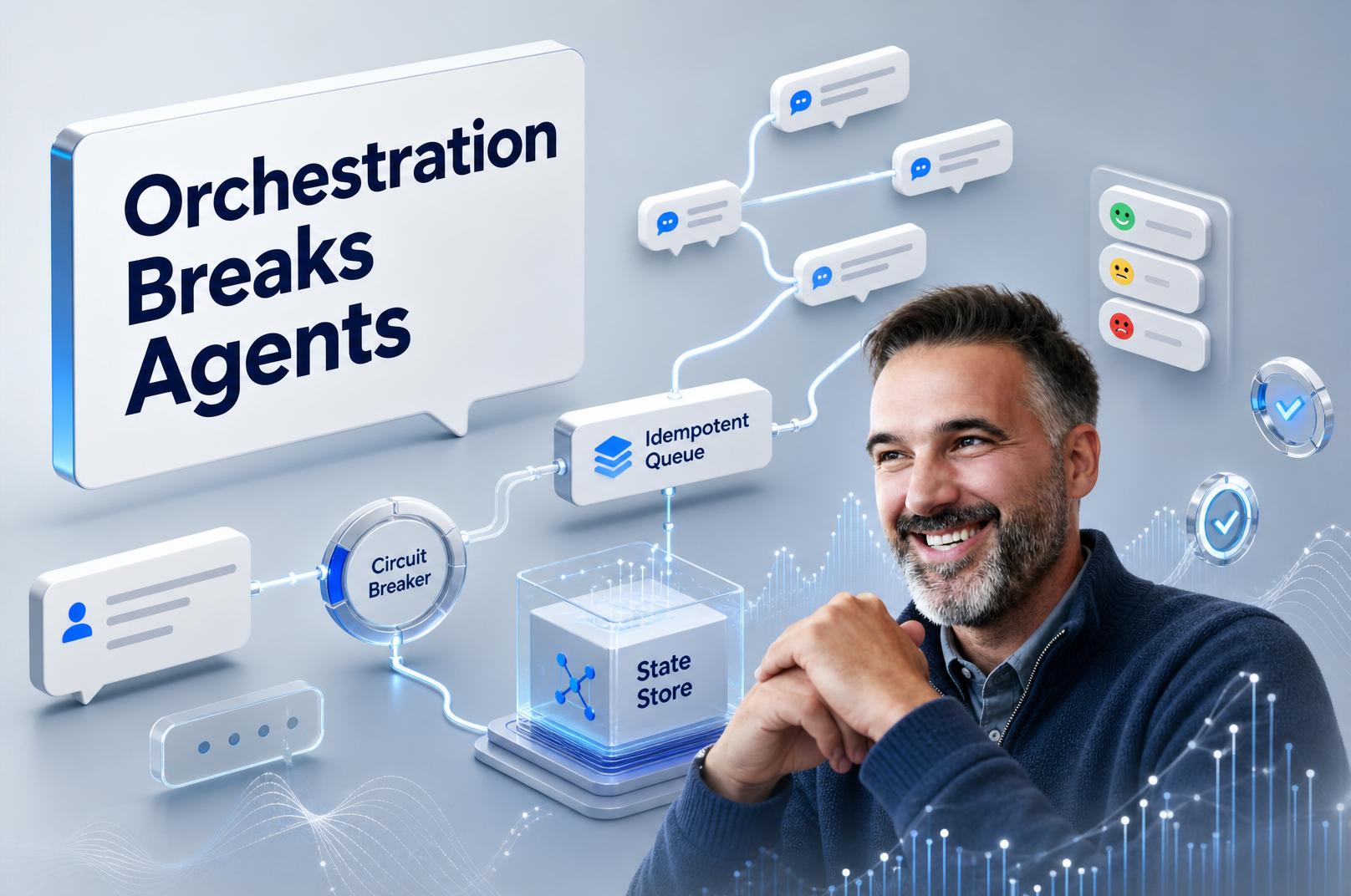
AI agents often fail in production because the surrounding orchestration—state handling, task routing, and external API integration—breaks down under real‑world load. The model itself remains reliable, but the glue code that connects the model to databases, microservices, and user interfaces introduces latency spikes, race conditions, and data inconsistency. Engineers should therefore treat orchestration as the primary risk surface, adopt rigorous eval‑engineering pipelines, and design resilient patterns such as idempotent task queues, explicit state stores, and circuit‑breaker proxies. By focusing on these architectural safeguards, organizations can move from pilot to production with confidence.
Where AI Agents Actually Break in Production
When a generative AI model is wrapped in a thin API call, the interaction appears seamless. In practice, however, agents must juggle multiple responsibilities: maintaining conversational context, invoking external services, handling retries, and respecting compliance constraints. The moment an agent reaches out to a CRM, a payment gateway, or a legacy ERP, the orchestration layer becomes the bottleneck. Engineers observe three recurring failure modes:
- State‑drift errors – Contextual data stored in in‑memory caches evaporates when the service scales horizontally, leading to contradictory replies.
- Latency cascades – A slow third‑party API block the agent’s response thread, causing timeouts that the LLM cannot recover from.
- Race‑condition explosions – Concurrent requests update the same user record without proper locking, resulting duplicate actions or lost updates.
These issues surface only after a few hundred real users interact with the system, which explains why 95 % of generative‑AI pilots never scale, as reported by MIT.
Why Orchestration, Not Model, Drives Failure
The intuition that a larger model equals better performance is reinforced by headlines touting GPT‑4‑Turbo or Claude‑3. Yet the model’s inference latency is typically bounded between 60 ms and 200 ms for a 4 k token prompt, a range that modern cloud providers can comfortably meet. The real variability comes from the surrounding micro‑service calls, which can swing from sub‑millisecond cache hits to multi‑second third‑party timeouts. In a typical AI‑agent stack, the orchestration layer consumes 60 %–80 % of total response time.
Moreover, orchestration bugs are opaque to the model’s internal diagnostics. A language model will happily generate a correct answer, but if the surrounding code drops the response, the failure is logged as a generic “timeout” rather than a “state‑drift” problem. This misattribution leads teams to chase larger models instead of fixing the glue code.
Architectural Patterns That Mitigate Orchestration Risks
Designing a robust orchestration layer requires explicit separation of concerns. Below are three patterns that have proven effective in production deployments:
- Idempotent Task Queues – By publishing every external call to a durable queue (e.g., Amazon SQS or Apache Kafka) and making the downstream workers idempotent, you eliminate duplicate executions caused by retries. The queue also absorbs spikes, smoothing latency for the front‑end agent.
- Explicit State Stores – Instead of relying on in‑process memory, store conversational context in a fast key‑value store such as Redis with a TTL aligned to the session length. Version the state with a monotonic sequence number, allowing the agent to detect and reconcile out‑of‑order updates.
- Circuit‑Breaker Proxies – Wrap each third‑party API in a proxy that monitors latency and error rates. When thresholds are crossed, the proxy returns a cached fallback or a graceful degradation response, preventing the entire agent pipeline from stalling.
These patterns introduce modest overhead—typically an additional 10 ms to 30 ms per request—but they dramatically reduce failure rates, as observed in a recent fintech voice‑assistant rollout where error‑rate dropped from 12 % to under 2 % after implementing idempotent queues.
Trade‑offs Between Centralized and Decentralized Orchestration
A common dilemma is whether to centralize orchestration in a single “agent hub” service or to distribute it across domain‑specific micro‑services. Centralization simplifies monitoring and policy enforcement, but it creates a single point of failure and can become a performance choke point. Decentralization spreads risk and allows teams to tailor orchestration to domain latency requirements, yet it complicates cross‑domain state consistency.
When latency is critical—such as in voice‑assistant applications where users expect sub‑second responses—decentralized orchestration with edge‑proxied circuit‑breakers often wins. Conversely, for compliance‑heavy domains like banking, a centralized hub that enforces audit logging and encryption policies may be preferable, even if it adds 20 ms of extra hop time.
Plavno’s Approach to Building Resilient AI Agent Systems
At Plavno we treat orchestration as a product in its own right. Our AI agents development practice starts with an eval‑engineering pipeline that automatically injects synthetic failures—latency spikes, state corruption, and API throttling—into the orchestration layer during CI runs. We then surface metrics in a unified dashboard powered by cloud software development tooling, enabling engineers to spot regressions before they reach production.
Our teams also embed a “state‑audit” middleware that writes every context transition to an immutable log in Amazon S3, providing a forensic trail for post‑mortem analysis. This approach has allowed our clients in the legal‑tech space to achieve a 4‑fold reduction in compliance‑related incidents while keeping the conversational latency under 500 ms.
Business Impact of Robust Orchestration
When orchestration reliability improves, the downstream business metrics follow. A 0.5 % reduction in error rate can translate into a 5 % lift in user satisfaction scores, because users perceive the system as more trustworthy. For revenue‑generating agents—such as sales‑assistant bots—each avoided failure can preserve a $30 average order value, resulting in multi‑million‑dollar gains at scale.
Furthermore, robust orchestration shortens the feedback loop. Teams can iterate on new features without fearing that a latent bug will cascade into a customer‑facing outage. This agility is exactly what Freshworks highlighted as the hallmark of “agile enterprises” that win the AI race.
How to Evaluate Orchestration Robustness in Practice
Evaluating the health of your orchestration layer should be a continuous activity, not a one‑off checklist. Start by defining three key indicators: latency variance, state‑reconciliation rate, and failure‑injection coverage. Instrument each external call with OpenTelemetry traces, and aggregate the data in a Grafana dashboard. Run a nightly eval suite that simulates 10 k concurrent sessions, injecting random latency and error patterns. If the observed failure‑injection coverage falls below 80 %, prioritize adding more fault‑injection scenarios.
Decision logic follows a simple rule: if the 95th‑percentile latency exceeds the SLA by more than 100 ms, or if state‑reconciliation errors exceed 0.1 % of sessions, the orchestration must be refactored before any new model upgrades are considered.
Real‑World Applications Where Orchestration Made the Difference
In a large‑scale AI voice‑assistant for a retail bank, the initial prototype used a monolithic orchestration service that directly called the core banking API. Under load, the banking API’s occasional 2‑second hiccup caused the entire assistant to time out, leading to a 15 % abandonment rate. By refactoring to an idempotent task queue and adding a circuit‑breaker proxy, the team reduced the abandonment rate to 3 % and lifted the Net Promoter Score by 12 points.
Similarly, a legal‑tech firm deployed an AI‑driven document‑review assistant that relied on a shared state store. When multiple reviewers edited the same case simultaneously, state‑drift errors caused contradictory annotations. Introducing an explicit versioned state store eliminated the drift, and the firm reported a 30 % acceleration in contract turnaround time.
Risks and Limitations of Over‑Engineering Orchestration
While robust orchestration is essential, over‑engineering can introduce unnecessary complexity. Adding too many layers of proxies and queues can inflate operational costs by 15 %–25 % and increase the mental load on developers. Moreover, excessive indirection may obscure the root cause of failures, making debugging harder.
The key is to balance resilience with simplicity. Adopt the minimal set of patterns that address the most common failure modes for your domain, and iterate based on observed metrics. Remember that the goal is to keep the orchestration transparent enough for engineers to reason about, while still providing the safety nets needed for production.
Closing Insight
The narrative that bigger models solve AI‑agent problems is a distraction. The real engineering challenge lies in stitching together reliable, observable, and fault‑tolerant orchestration. By treating orchestration as a first‑class component, applying rigorous eval‑engineering, and choosing patterns that match your latency and compliance constraints, you can turn a fragile prototype into a production‑grade AI service that delivers measurable business value.
Our broader AI consulting services AI consulting and AI automation offerings AI automation complement this approach.
 Chat GPT
  Perplexity
  Claude
  Gemini
