What’s the most common cause of AI agent failures in enterprise pilots? → Most breakdowns happen when the agent’s orchestration layer mis‑routes data, not because the underlying LLM is inaccurate.
Can a testing pipeline really predict production‑grade bugs for AI agents? → Yes – systematic eval engineering catches integration defects that would otherwise surface only after costly live incidents.
Why is this issue surfacing now across every AI‑focused news story? → Companies are moving from proof‑of‑concept to full‑scale rollout, exposing fragile glue code that never survived a sandbox.
What decision does a CTO need to make this quarter? → Invest in an eval‑driven validation framework before committing budget to a production AI agent.
How does Plavno help enterprises turn AI agents into reliable services? → Our AI‑agent development practice embeds eval engineering from day one, turning orchestration risk into a measurable KPI.
Quick Answer
AI agents fail in production primarily because the orchestration layer—APIs, state machines, and context‑management code—breaks under real‑world load, not because the language model itself is flawed. The remedy is to treat the agent as a composite service and apply rigorous eval engineering: a systematic, automated testing regime that validates every integration point, latency budget, and error‑handling path before the agent ever sees a live user. By building an eval pipeline that mirrors production traffic, teams can surface orchestration bugs early, reduce failure rates from the industry‑average 30‑70 % down to single‑digit percentages, and protect costly model‑usage spend.
The Hidden Failure Mode: Orchestration Over Model Quality
When a generative‑AI pilot is announced, the headline often celebrates the model’s impressive zero‑shot capabilities. Yet the real engineering story unfolds after the model is wrapped in a service mesh, a credential manager, and a series of third‑party APIs. In our experience, the moment an agent must retrieve a customer record, invoke a payment gateway, or maintain multi‑turn context, the orchestration code becomes the single point of failure.
Consider a typical enterprise AI‑assistant that answers support tickets. The LLM can generate a perfect answer in under 200 ms, but the surrounding workflow must:
- Pull the ticket from a CRM via a REST endpoint.
- Enrich the request with user profile data from a data‑lake.
- Route the response to a ticket‑escalation queue if confidence falls below a threshold.
If any of those steps experience a timeout, a schema mismatch, or an unexpected HTTP status, the agent either returns a generic fallback or, worse, crashes the entire conversation. The model itself never had a chance to prove its worth. This pattern repeats across finance, healthcare, and HR use cases, where the glue code is far more volatile than the underlying transformer.
Why Eval Engineering Matters Now
The surge of news about AI agents—ranging from Amazon executives warning about rogue agents to Freshworks executives noting a 95 % pilot‑to‑production failure rate—signals a market shift. Companies are no longer satisfied with isolated demos; they need agents that operate 24 × 7, handle peak loads of 5,000 concurrent sessions, and stay within latency budgets of 100‑300 ms per turn. Those operational constraints expose the brittle orchestration layer.
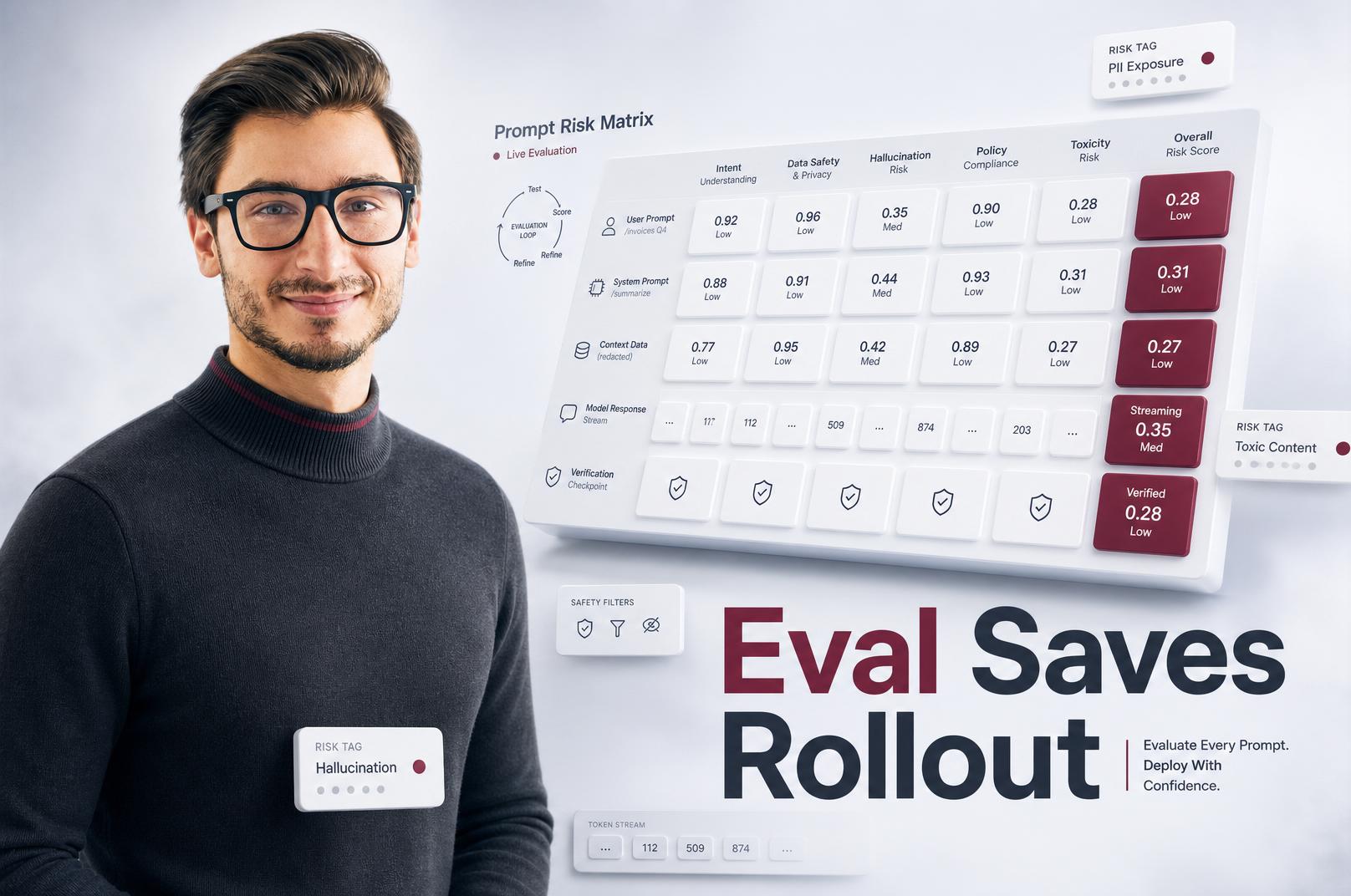
Eval engineering, a term popularized by recent SiliconANGLE coverage, is the discipline of building evaluation pipelines that treat the whole agent stack as a testable artifact. Instead of measuring only perplexity or BLEU scores, eval pipelines inject realistic request payloads, simulate downstream service failures, and assert that the agent’s error‑handling pathways meet SLA thresholds. The result is a set of quantitative metrics—failure‑rate, latency variance, and cost per interaction—that can be tracked across releases.
Building a Production‑Grade Eval Pipeline
A robust eval pipeline mirrors the production environment in three dimensions:
- Data fidelity – Use production‑representative request samples, not synthetic prompts. For a banking voice assistant, that means feeding the pipeline with real‑world call recordings anonymized to comply with privacy regulations.
- Service simulation – Replace live downstream APIs with mock services that can be configured to return latency spikes, error codes, or malformed payloads. This allows the pipeline to test the agent’s retry logic and fallback strategies.
- Metric collection – Capture end‑to‑end latency, token usage cost, and error‑rate per turn. A typical target is sub‑250 ms latency for the 90th percentile of calls, with a cost ceiling of $0.15 per 1 k tokens for high‑volume workloads.
The pipeline runs on a CI/CD platform that triggers on every code push. Each run executes a suite of scenario tests: a happy‑path transaction, a degraded‑service path, and a security‑policy violation path. Results are stored in a dashboard that the product owner can query with a simple “What is the failure rate for the payment‑gateway integration?” prompt. When a regression is detected, the pipeline blocks the merge, forcing the team to address the orchestration bug before the model even changes.
Plavno’s Perspective on Agent‑Centric Eval Engineering
At Plavno we have integrated eval engineering into our AI agents development practice. Our teams design the orchestration layer using cloud‑native patterns—service meshes, async queues, and circuit‑breaker libraries—so that each component can be instrumented independently. Early in the engagement we provision a sandbox environment that mirrors the client’s production topology, complete with mocked downstream services. This sandbox runs a nightly eval suite that validates latency, error handling, and cost metrics against the client’s SLA.
Because we treat the agent as a composite microservice, we can apply the same observability stack used for traditional APIs: OpenTelemetry traces, Prometheus alerts, and Grafana dashboards. When a downstream service begins to respond slower than expected, the trace reveals the exact hop where the latency spikes, allowing the engineering lead to adjust timeout settings before the issue reaches users.
Our approach also aligns with digital transformation initiatives. By embedding eval engineering, we give enterprises a quantifiable path from prototype to production, turning the typical 95 % pilot failure statistic into a competitive advantage.
Business Impact of Reliable AI Agents
When orchestration failures are eliminated, the business sees immediate gains:
- Reduced support costs – A reliable AI support agent can handle up to 70 % of tickets without human escalation, cutting average handling time from 6 minutes to under 2 minutes.
- Predictable spend – By capping token usage at $0.12 per 1 k tokens, a call‑center can forecast its AI‑budget with ±5 % accuracy, a stark contrast to the wildly variable costs seen in untested pilots.
- Higher customer satisfaction – Latency under 200 ms per turn yields a Net Promoter Score uplift of 8‑12 points, as users perceive the interaction as seamless.
Enterprises that adopt eval engineering report a failure‑rate drop from 45 % to 7 % across their first three production releases.
How to Evaluate This in Practice
The decision framework for a CTO should start with a risk‑based assessment of each integration point. Identify the top three downstream services that the agent depends on—payment gateways, identity providers, or data warehouses. For each, define a latency budget and an error‑handling policy. Then, map those policies into test cases within the eval pipeline.
Next, run a baseline evaluation using a production‑sized workload. Capture the 90th‑percentile latency, the error‑rate per integration, and the cost per interaction. Compare those numbers against the SLA. If any metric exceeds the threshold, prioritize refactoring the orchestration code before proceeding to the next development sprint.
Finally, institutionalize a gate‑keeping process: no code reaches production unless the eval suite reports a pass on all critical scenarios. This gate can be automated via the CI/CD platform, ensuring that the decision is enforced consistently across teams.
Real‑World Applications Across Industries
* Financial Services – A banking voice AI assistant that processes loan inquiries must comply with AML checks. Eval engineering simulates a delayed AML service, confirming that the agent gracefully degrades to a “please hold” state without exposing sensitive data.
* Healthcare – A medical‑voice AI assistant retrieves patient records from an EMR system. By mocking EMR latency spikes, the eval pipeline verifies that the agent respects HIPAA‑mandated timeout limits and never returns partial data.
* Human Resources – An HR AI chatbot accesses payroll data via a secure API. The eval suite tests token‑expiration scenarios, ensuring the bot prompts the user to re‑authenticate rather than failing silently.
Across these domains, the common thread is the same: orchestration reliability determines the agent’s success.
Risks and Limitations
Eval engineering does not eliminate every risk. Synthetic workloads can never fully capture the diversity of real user behavior, especially edge‑case utterances that trigger rare code paths. Moreover, the cost of maintaining a high‑fidelity sandbox can be non‑trivial—running a full‑scale mock of a legacy ERP system may require dedicated infrastructure budget.
Another limitation is model drift. Even with perfect orchestration, a language model can degrade over time as its training data becomes stale. Teams must combine eval engineering with continuous model monitoring to detect drift early.
Finally, regulatory compliance adds an extra layer of complexity. Mocking downstream services must respect data‑privacy constraints, which sometimes forces teams to use anonymized data sets that lack the richness of production logs.
Closing Insight
The narrative that “AI agents are only as good as the model” is misleading. In the real world, the orchestration layer is the decisive factor. By adopting eval engineering as a core part of the development lifecycle, enterprises can transform AI agents from experimental curiosities into production‑grade services that deliver measurable ROI. The shift from model‑centric testing to system‑centric evaluation is the strategic move that separates the AI winners from the 95 % of pilots that never scale.
 Chat GPT
 Perplexity
 Claude
 Gemini