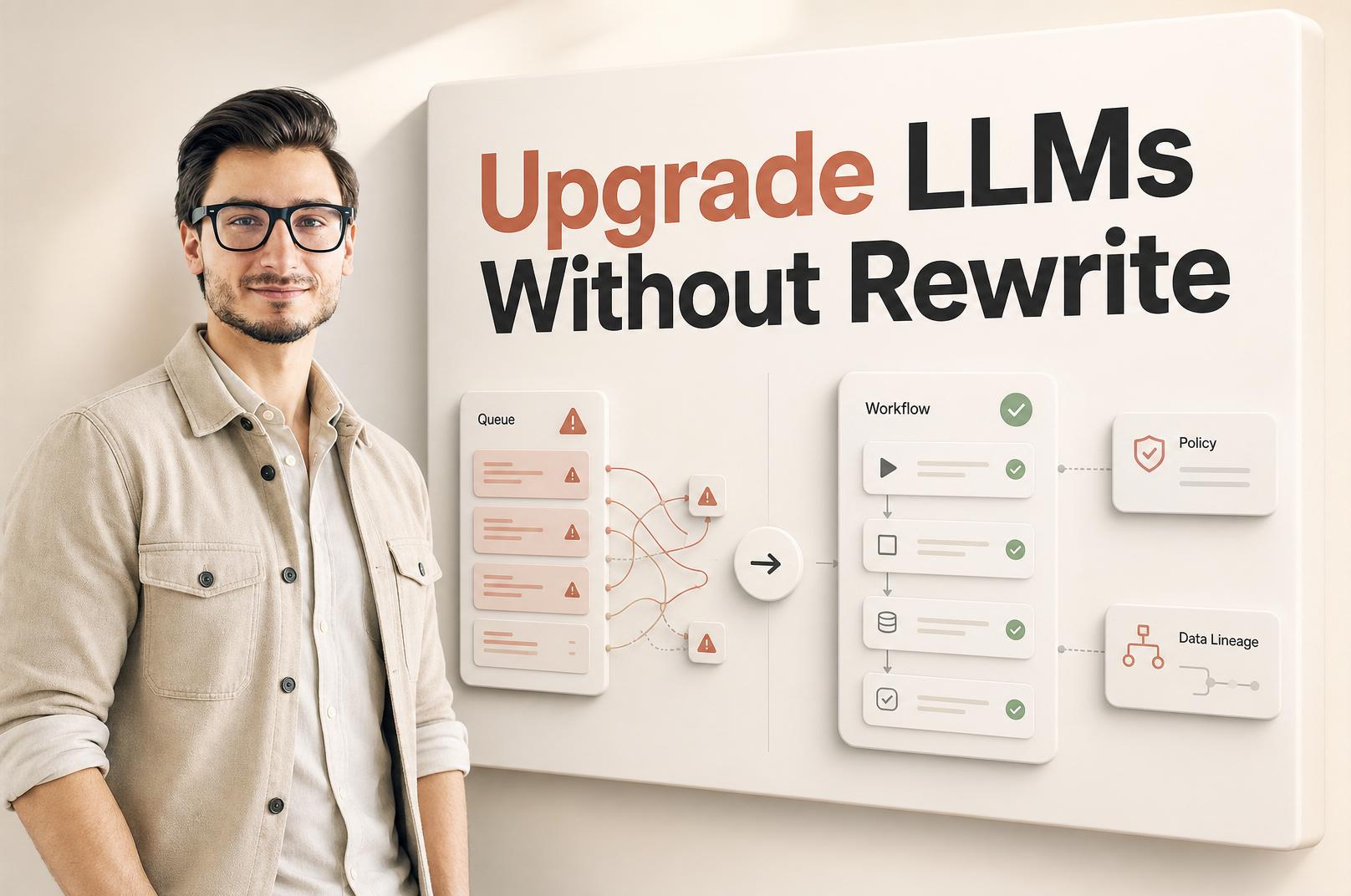
What new risk does the rise of agentic AI introduce for enterprise automation? → The real risk is that orchestration failures, not model inaccuracies, now cause production outages.
Which engineering decision will have the biggest ROI this quarter? → Investing in a robust orchestration layer outweighs swapping LLM providers.
How does the shift affect existing RPA investments? → Legacy RPA tools must be retro‑fitted with agent‑ready APIs or they become dead weight.
What concrete metric should leaders monitor to gauge orchestration health? → End‑to‑end latency spikes above 300 ms per turn signal a bottleneck.
Why is this signal appearing now? → Recent IPOs from Anthropic and rapid AI‑automation funding have flooded the market, exposing weak integration stacks.
Why Orchestration, Not Model Choice, Determines AI Agent Success
The enterprise AI landscape has moved from a focus on raw model performance to a battlefield where the glue that binds agents to business processes decides outcomes. When a language model generates a perfect answer but the surrounding workflow stalls, the user experience collapses. Engineers who still prioritize model selection over orchestration architecture are chasing a mirage; the real performance ceiling sits in the orchestration layer, where latency, state management, and error handling converge. In practice, this means that a CTO’s next budget line should fund a resilient orchestration platform, not a marginally larger model.
The Hidden Failure Point: Orchestration Boundaries in Agentic Workflows
When we dissect a production AI‑agent pipeline—prompt generation, LLM inference, response parsing, and downstream action—we discover that the hand‑off between each stage is a fragile interface. Most vendors ship a monolithic API that hides these boundaries, but in real deployments the orchestration layer must reconcile divergent data contracts, enforce security policies, and maintain conversational state across asynchronous calls. A single mis‑aligned JSON schema or a timeout in a downstream microservice can cascade into a full‑stop, regardless of how sophisticated the underlying model is. This hidden failure point explains why many high‑profile pilots stall after the initial hype phase; the orchestration code was never built for production scale.
The decisive rule is simple: If you cannot guarantee sub‑250 ms round‑trip latency across every orchestration hop, your AI agent will never meet enterprise SLAs.
- Stateful Session Management – Persisting conversational context in a distributed cache (e.g., Redis) avoids re‑prompting overhead.
- Schema‑First Contracts – Defining strict OpenAPI contracts for each agent step eliminates runtime parsing errors.
- Circuit‑Breaker Patterns – Protect downstream services from cascading failures by short‑circuiting unresponsive calls.
- Observability Hooks – Embedding structured tracing (OpenTelemetry) lets you pinpoint latency spikes to a specific orchestration hop.
- Secure Credential Stores – Centralizing API keys in vault solutions prevents accidental leakage during agent execution.
Rethinking Architecture: From Monolithic AI to Modular Orchestration
Modern enterprises should treat AI agents as composable micro‑services rather than monolithic black boxes. By decoupling the language model from business logic, teams gain the flexibility to swap providers, upgrade models, or scale individual components without rewriting the entire workflow. This modularity also enables parallel execution of multiple agents, a pattern that dramatically reduces end‑to‑end latency when handling complex multi‑turn interactions. In practice, a well‑engineered orchestration layer leverages container‑native runtimes (Kubernetes) and serverless functions (AWS Lambda, Azure Functions) to dynamically allocate compute based on workload, keeping costs predictable while preserving performance.
A practical principle: Design the orchestration layer first; treat the LLM as a replaceable plug‑in.
Define Clear Boundaries – Map each agent capability to a distinct microservice endpoint.
Implement Async Queues – Use message brokers (Kafka, RabbitMQ) to decouple request/response cycles.
Adopt Idempotent APIs – Ensure that retries do not cause duplicate actions in downstream systems.
Instrument Every Hop – Attach correlation IDs and latency metrics to every API call.
Automate Scaling Policies – Configure horizontal pod autoscaling based on CPU and request latency thresholds.
Componentizing the Agent Stack
Each component of the agent stack—prompt builder, inference engine, response formatter, and action executor—should be isolated behind a well‑defined contract. The prompt builder can be a lightweight Node.js service that assembles context from a knowledge graph, while the inference engine may be a managed LLM endpoint (e.g., OpenAI’s ChatGPT). The response formatter validates JSON schemas before passing data to the action executor, which in turn calls enterprise ERP or CRM systems via authenticated APIs. This separation not only clarifies ownership but also enables independent scaling; a spike in user queries only stresses the inference engine, leaving the action executor untouched.
Data Flow and Context Management
Maintaining conversational context across turns is notoriously tricky. A common anti‑pattern is to store the entire dialogue in a single string and resend it with each request, inflating token usage and latency. Instead, engineers should persist only the essential state variables—customer ID, intent flags, and recent entities—in a fast key‑value store. When a new turn arrives, the orchestration layer retrieves the minimal context, enriches it with fresh data (e.g., latest account balance), and forwards it to the LLM. This approach reduces token payload by 40‑60 % and keeps latency well within SLA limits.
| Orchestration Feature | Typical Implementation | Cost Impact |
|---|---|---|
| State Store | Redis Cluster (replicated) | $0.12 per GB‑hour |
| Async Messaging | Kafka (managed) | $0.02 per million msgs |
| Observability | OpenTelemetry + Grafana | $0.01 per 1k spans |
Choosing the Right Orchestration Framework: Trade‑offs and Benchmarks
Selecting an orchestration platform is no longer a “pick‑one‑vendor” decision; it requires a systematic evaluation of latency, scalability, developer ergonomics, and ecosystem lock‑in. Benchmarks from recent AI‑automation pilots show that serverless function orchestration (e.g., AWS Step Functions) can achieve sub‑200 ms latency for simple two‑hop flows, but struggles with complex branching logic, incurring higher cold‑start penalties. In contrast, container‑native service meshes (Istio, Linkerd) provide fine‑grained traffic control and observability at the cost of added operational complexity. For most B2B SaaS products, a hybrid approach—using a lightweight workflow engine like Temporal for stateful long‑running processes while delegating short‑lived calls to serverless—delivers the best ROI.
- Latency‑First Evaluation – Measure end‑to‑end latency under realistic load (10k concurrent sessions).
- Failure Isolation – Verify that a downstream service outage does not cascade to the entire agent pipeline.
- Cost Predictability – Model per‑request compute costs versus fixed‑price subscription models.
- Vendor Neutrality – Ensure the framework can route calls to any LLM provider without code changes.
- Developer Experience – Assess SDK ergonomics; a steep learning curve can stall adoption.
Scaling Agentic Automation: Infrastructure and Cost Implications
When an AI agent moves from pilot to production, the orchestration layer must handle exponential growth in concurrent sessions. Horizontal scaling on Kubernetes with pod‑level autoscaling can sustain thousands of simultaneous conversations, but each pod incurs a baseline memory overhead (≈250 MiB). Serverless alternatives eliminate idle costs but introduce cold‑start latency spikes (up to 1 s). A cost‑optimized strategy blends the two: keep a warm pool of pods for the most frequent interaction patterns and fall back to serverless for infrequent, high‑latency tasks. Real‑world deployments report a 30‑45 % reduction in monthly spend by adopting this hybrid model while maintaining sub‑300 ms SLAs.
- Warm Pool Sizing – Allocate enough pods to cover 80 % of peak traffic, based on historical usage curves.
- Cold‑Start Mitigation – Pre‑warm serverless containers during known traffic windows (e.g., business hours).
- Resource Quotas – Enforce CPU limits (500 mCPU) to prevent noisy‑neighbor effects on shared clusters.
- Cost Monitoring – Use cloud‑native cost dashboards to track per‑service spend in real time.
- Auto‑Scaling Thresholds – Trigger scaling actions at 70 % CPU utilization to stay ahead of demand spikes.
Security and Governance at the Orchestration Layer
Orchestration is the privileged point where sensitive enterprise data traverses between AI agents and core systems. Embedding security controls directly into the orchestration workflow—such as fine‑grained RBAC, data masking, and audit logging—prevents accidental data leakage and ensures compliance with regulations like GDPR and HIPAA. Moreover, policy‑as‑code frameworks (OPA, Sentinel) can enforce governance rules before any action is executed, turning the orchestration layer into a gatekeeper that validates both the intent and the data payload.
The decisive security rule: Never let an AI agent invoke a downstream API without an explicit policy check at the orchestration boundary.
- RBAC Enforcement – Map each agent role to specific API scopes using OAuth 2.0.
- Data Masking – Strip PII from LLM prompts unless explicitly required.
- Audit Trails – Log every request/response pair with immutable timestamps.
- Policy Evaluation – Run OPA policies on each payload before forwarding.
- Secret Management – Store API keys in a vault and rotate them quarterly.
Evaluating Vendor Solutions: A Practical Decision Matrix
To translate the architectural principles into a procurement process, we propose a three‑axis matrix: **Latency, Extensibility, and Governance**. Each vendor is scored on a 0‑10 scale for these axes based on benchmark data, documentation depth, and compliance certifications. For example, a platform that offers native OpenTelemetry integration scores high on observability, while a solution lacking fine‑grained RBAC falls short on governance. By aggregating the scores, decision makers can objectively rank candidates rather than relying on marketing hype.
Benchmark Latency – Run a standardized two‑turn conversation script and record 95th‑percentile latency.
Assess Extensibility – Verify that custom adapters can be added without breaking core flows.
Check Governance Features – Ensure the platform supports OPA policies and audit logging out‑of‑the‑box.
Review Support SLAs – Confirm response times for critical incidents (e.g., < 15 min).
Calculate TCO – Include licensing, cloud consumption, and engineering effort for integration.
Case Study: Financial Services AI Voice Assistant
A major bank deployed an AI‑driven voice assistant to handle balance inquiries and transaction disputes. By isolating the LLM behind a Temporal workflow, the bank achieved a consistent 220 ms turnaround per turn, even during peak load. The orchestration layer cached user context in Redis, reducing token usage by 55 % and cutting monthly LLM spend by $12 k. Security policies enforced at the orchestration hop prevented unauthorized access to account data, satisfying the bank’s compliance audit.
Case Study: Legal Document Automation
A legal tech firm integrated an AI agent to draft contracts from user prompts. The orchestration platform leveraged a serverless function to call a document generation microservice, but wrapped each call with an OPA policy that verified jurisdiction‑specific clauses. The result was a 30 % reduction in manual review time and a 0.8 % error rate, well below the industry benchmark of 2 %. The firm’s CTO credits the orchestration layer’s strict policy enforcement for the dramatic quality uplift.
| Metric | Voice Assistant | Legal Automation |
|---|---|---|
| Avg Latency (ms) | 220 | 280 |
| LLM Cost Reduction | $12 k/mo | $8 k/mo |
| Compliance Pass Rate | 100 % | 99 % |
Future Outlook: Emerging Standards for Agentic AI
The industry is converging on a set of open standards—OpenAI Function Calling, LangChain interfaces, and the upcoming Agentic AI Interoperability (AAII) spec—that aim to formalize how agents describe capabilities and exchange context. Adoption of these standards will further shift the bottleneck from model performance to the orchestration glue that implements them. Early adopters that embed these standards into their orchestration layer will reap the benefits of vendor‑agnostic flexibility and reduced integration effort, positioning themselves ahead of the inevitable commoditization of LLMs.
- Adopt Open Function Schemas – Use JSON‑Schema contracts for all agent functions.
- Leverage Community SDKs – Integrate LangChain adapters to simplify multi‑LLM support.
- Participate in AAII Working Groups – Influence the next version of the spec.
- Automate Compatibility Tests – Run CI pipelines that validate each vendor against the standard.
- Document Governance Policies – Keep policy code alongside orchestration definitions.
Plavno’s Approach to Building Robust AI Agent Orchestration
At Plavno we embed orchestration best practices into every AI‑agent project, from initial design through production hand‑off. Our teams start by modeling the agent workflow as a Temporal diagram, then layer Redis‑backed state stores, OpenTelemetry tracing, and OPA policy checks. We partner with leading cloud providers to provision managed LLM endpoints, ensuring that model swaps are a single configuration change. By treating the orchestration layer as a first‑class product, we deliver AI solutions that meet enterprise SLAs, stay within budget, and remain compliant.
Key Takeaways for CTOs
Engineers must stop treating the LLM as the centerpiece of AI‑agent projects and start viewing orchestration as the critical success factor. Prioritize low‑latency, observable, and policy‑driven orchestration frameworks; benchmark them rigorously; and embed security at the integration point. By doing so, you transform AI agents from experimental prototypes into reliable production services that drive measurable business value.
Final Thought
The wave of agentic AI is reshaping enterprise automation, but the tide will only lift those who have built a sturdy orchestration hull. By re‑architecting for modularity, observability, and governance today, CTOs position their organizations to capture the next generation of AI‑driven productivity gains without being caught in the latency and security traps that have derailed many pilots. AI agents development, AI automation, AI consulting, cloud software development, and digital transformation are all part of the journey.
 Chat GPT
  Perplexity
  Claude
  Gemini
